Spine Care
[Scoliosis Basics & Fundamentals 03] What Is Scoliosis? Definition, Types, Causes, and Spinal Alignment Explained
Learn what scoliosis is, how the Cobb angle measures spinal curvature, the major types of scoliosis, and the primary causes of abnormal spinal alignment in children and adults.
What Is Scoliosis?
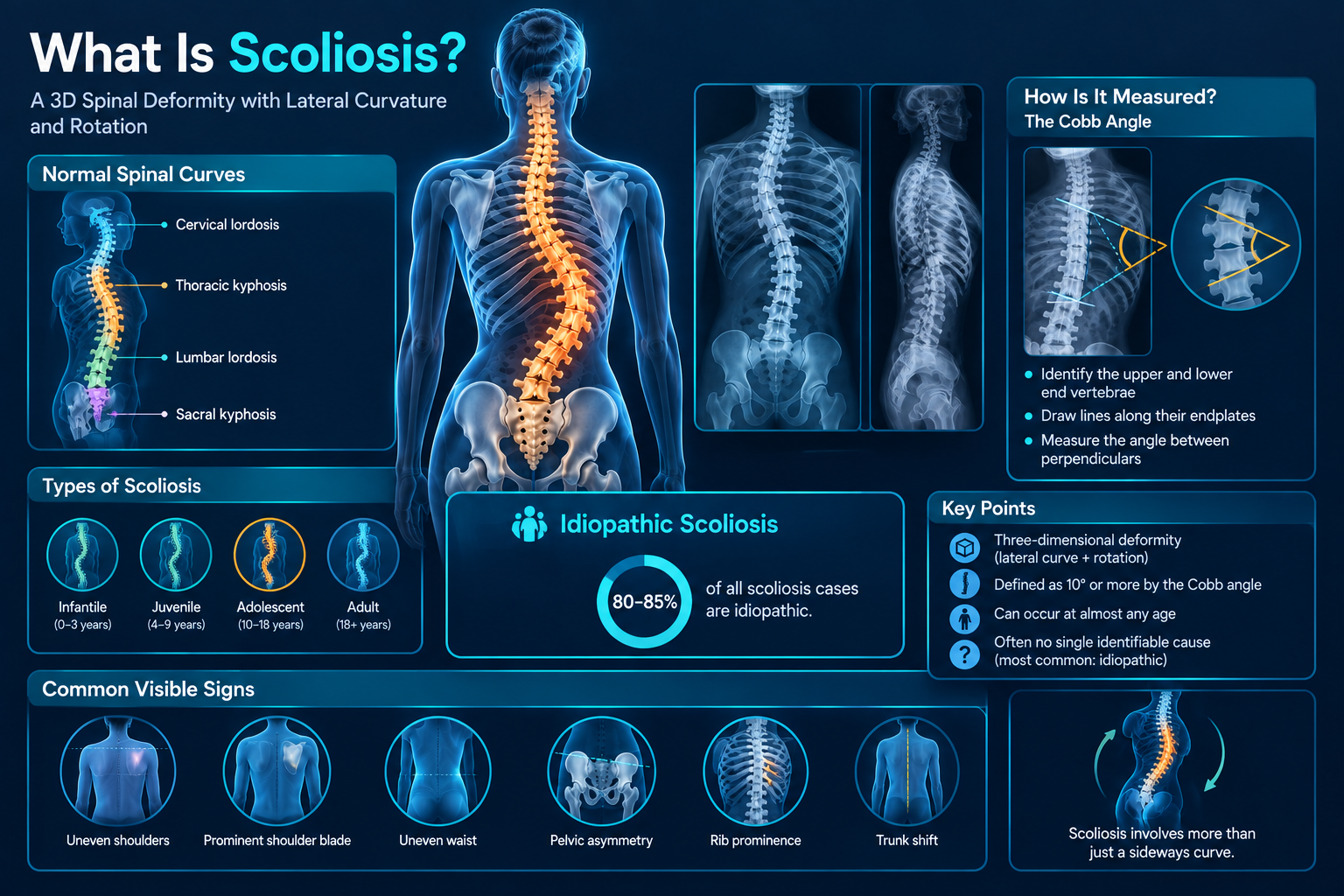
Scoliosis is a three-dimensional spinal deformity in which the spine develops an abnormal lateral curvature, usually accompanied by some degree of vertebral rotation. On a standing X-ray, the spine may appear to form a C-shaped or S-shaped curve rather than following a relatively straight vertical alignment. [1][2]
Clinically, scoliosis is generally defined as a spinal curvature measuring 10 degrees or more by the Cobb method, together with the characteristic structural changes associated with scoliosis. [1][3]
However, scoliosis is more than simply a spine that appears to bend sideways.
The spine normally has curves when viewed from the side. These include cervical lordosis, thoracic kyphosis, and lumbar lordosis, which help the body maintain balance and absorb mechanical forces. In scoliosis, the abnormality primarily involves the coronal plane but can also involve the sagittal and transverse planes. [2][4]
This is why scoliosis is best understood as a three-dimensional spinal alignment disorder, rather than simply a “sideways curve.” [2][4]
For patients and families, this distinction is important. A person may have an apparently mild curve but noticeable asymmetry of the shoulders, waist, pelvis, or rib cage. Conversely, a radiographic curve may be present without obvious symptoms. [1][5]
Scoliosis can occur at almost any age. Some cases develop during early childhood, some appear during adolescence, and others become clinically significant during adulthood. [1][6]
The most common form is idiopathic scoliosis, meaning that a specific underlying cause cannot be identified. More than 80% of scoliosis cases are generally classified as idiopathic. [1][7]
---
Understanding the Normal Spine
Before understanding scoliosis, it helps to understand normal spinal alignment.
The human spine consists of approximately 33 vertebral segments, although some vertebrae fuse in the sacrum and coccyx. The vertebral column supports the head and trunk while protecting the spinal cord and allowing controlled movement. [8]
When viewed from the front or back, a healthy spine generally maintains relatively symmetrical alignment.
When viewed from the side, however, the spine is naturally curved.
The normal spinal curves include:
- Cervical lordosis – an inward curve of the neck
- Thoracic kyphosis – an outward curve of the upper and middle back
- Lumbar lordosis – an inward curve of the lower back
- Sacral kyphosis – the natural curvature of the sacrum
These curves contribute to balance and efficient distribution of mechanical loads. [8]
In scoliosis, the spine may deviate from the expected coronal alignment and may also undergo axial rotation and changes in sagittal alignment. [2][4]
This three-dimensional component helps explain why scoliosis can produce visible changes such as:
- Uneven shoulders
- One shoulder blade appearing more prominent
- Uneven waist contours
- Pelvic asymmetry
- Trunk shift
- Rib prominence
- Differences in the apparent height of the hips
- Changes in overall posture symmetry
The Scoliosis Research Society describes these clinical findings as important features that may be observed during physical examination. [1]
---
How Is Scoliosis Measured? Understanding the Cobb Angle
One of the most important concepts in scoliosis evaluation is the Cobb angle.
The Cobb angle is a radiographic measurement used to quantify the magnitude of a spinal curve. It is measured on an appropriate spinal X-ray by identifying the upper and lower end vertebrae of the curve and drawing lines along their endplates. The angle between the relevant perpendiculars is then used to determine the curve magnitude. [3][9]
Why does the Cobb angle matter?
The Cobb angle helps clinicians:
- Confirm the presence of scoliosis
- Quantify curve magnitude
- Monitor changes over time
- Evaluate progression
- Assist treatment planning
- Compare radiographs obtained at different times
A curve of less than 10 degrees is generally not classified as scoliosis under the conventional radiographic definition. [1][3]
However, the Cobb angle should not be interpreted in isolation.
Two people with the same Cobb angle can have very different clinical presentations because spinal deformity also involves factors such as:
- Curve location
- Curve pattern
- Vertebral rotation
- Sagittal alignment
- Skeletal maturity
- Pelvic alignment
- Trunk balance
- Remaining growth
- Underlying cause
Therefore, scoliosis assessment should consider the whole spinal alignment and the individual patient, not simply one numerical measurement. [2][4][10]
---
What Are the Main Types of Scoliosis?
Scoliosis can be classified in several ways. The most clinically useful classification considers cause, age at onset, and spinal characteristics. [1][6]
1. Idiopathic Scoliosis
Idiopathic scoliosis is scoliosis for which a specific underlying cause has not been established.
It is by far the most common category of scoliosis. [1][7]
The word idiopathic essentially means “of unknown cause.”
Importantly, “unknown cause” does not mean that there are no biological factors involved.
Research suggests that idiopathic scoliosis is influenced by multiple factors, potentially including genetic, developmental, biomechanical, and neuromuscular mechanisms. However, no single cause has been established as the explanation for most cases. [7][11]
Idiopathic scoliosis can be classified by age of onset:
- Infantile idiopathic scoliosis: approximately birth through 2 years
- Juvenile idiopathic scoliosis: approximately 3–9 years
- Adolescent idiopathic scoliosis: approximately 10–17 years
- Adult idiopathic scoliosis: 18 years and older
Age classifications can vary slightly between clinical systems and organizations. [1][6]
Adolescent Idiopathic Scoliosis
Adolescent idiopathic scoliosis (AIS) is particularly important because it commonly develops during the period of rapid growth.
Many adolescents with scoliosis have no significant pain or neurological symptoms. The condition may first be noticed because of changes in posture symmetry rather than discomfort. [1][5]
For example, parents may notice:
- One shoulder higher than the other
- One shoulder blade becoming more prominent
- An uneven waistline
- A tilted appearance of the torso
- One hip appearing higher
- A rib prominence during forward bending
Because curve progression is closely associated with growth, adolescents with scoliosis may require periodic clinical and radiographic monitoring. [1][6]
---
2. Congenital Scoliosis
Congenital scoliosis develops because of abnormal formation or separation of vertebrae during fetal development. [12]
In other words, the structural abnormality originates before birth, although the resulting spinal curvature may not become obvious until later in childhood.
Examples of vertebral abnormalities include:
- Hemivertebrae
- Failure of vertebral segmentation
- Vertebral fusion
- Other congenital vertebral malformations
The progression of congenital scoliosis depends heavily on the type and location of the vertebral abnormality. [12]
Some children have relatively stable deformities, while others may develop progressive curvature as the spine grows.
Congenital scoliosis can also occur alongside abnormalities involving other organ systems, including the heart and kidneys, so appropriate medical evaluation may be necessary. [12]
---
3. Neuromuscular Scoliosis
Neuromuscular scoliosis occurs as a consequence of disorders affecting the nervous system, muscles, or the interaction between them. [13]
Examples include:
- Cerebral palsy
- Muscular dystrophy
- Spinal muscular atrophy
- Spinal cord injury
- Certain neurological disorders
In these conditions, the muscles and nervous system may be unable to maintain normal trunk stability and spinal alignment.
Neuromuscular scoliosis can differ substantially from idiopathic scoliosis.
Curves may progress more rapidly and may continue progressing after skeletal maturity. Pelvic obliquity and other forms of trunk imbalance may also occur. [13]
Severe neuromuscular scoliosis can affect sitting balance and, in some patients, respiratory function.
Therefore, evaluation often requires a broader approach than simply measuring the Cobb angle. [13]
---
4. Syndromic Scoliosis
Scoliosis may also occur as part of an underlying genetic or systemic syndrome. [14]
Examples include conditions such as:
- Marfan syndrome
- Ehlers-Danlos syndromes
- Neurofibromatosis
- Certain skeletal dysplasias
- Other connective-tissue or genetic disorders
The characteristics and progression of scoliosis vary according to the underlying condition.
For example, a patient with a connective-tissue disorder may have different spinal stability and musculoskeletal characteristics from a patient with adolescent idiopathic scoliosis.
Syndromic scoliosis therefore requires evaluation in the context of the patient’s overall health rather than being treated as an isolated spinal curve. [14]
---
5. Degenerative or Adult-Onset Scoliosis
Scoliosis in adulthood can have several different origins.
Some adults have a curve that developed during adolescence and persisted into adulthood. Others develop or experience progression of spinal curvature later in life as degenerative changes occur in the intervertebral discs, facet joints, and vertebral structures. [6][15]
This is often referred to as adult degenerative scoliosis or degenerative lumbar scoliosis.
Age-related spinal changes may include:
- Intervertebral disc degeneration
- Asymmetric disc-space narrowing
- Facet joint degeneration
- Vertebral translation
- Loss of normal spinal alignment
- Changes in lumbar lordosis
- Sagittal imbalance
Adult scoliosis may therefore involve not only coronal curvature but also significant changes in sagittal alignment. [15]
Patients may experience:
- Back pain
- Leg pain
- Neurogenic claudication
- Numbness or weakness
- Difficulty standing upright
- Reduced walking tolerance
- Progressive imbalance
These symptoms should be evaluated medically because they may also result from spinal stenosis, disc disease, nerve compression, or other conditions. [15]
---
What Causes Scoliosis?
The answer depends on the type.
The Cause of Idiopathic Scoliosis
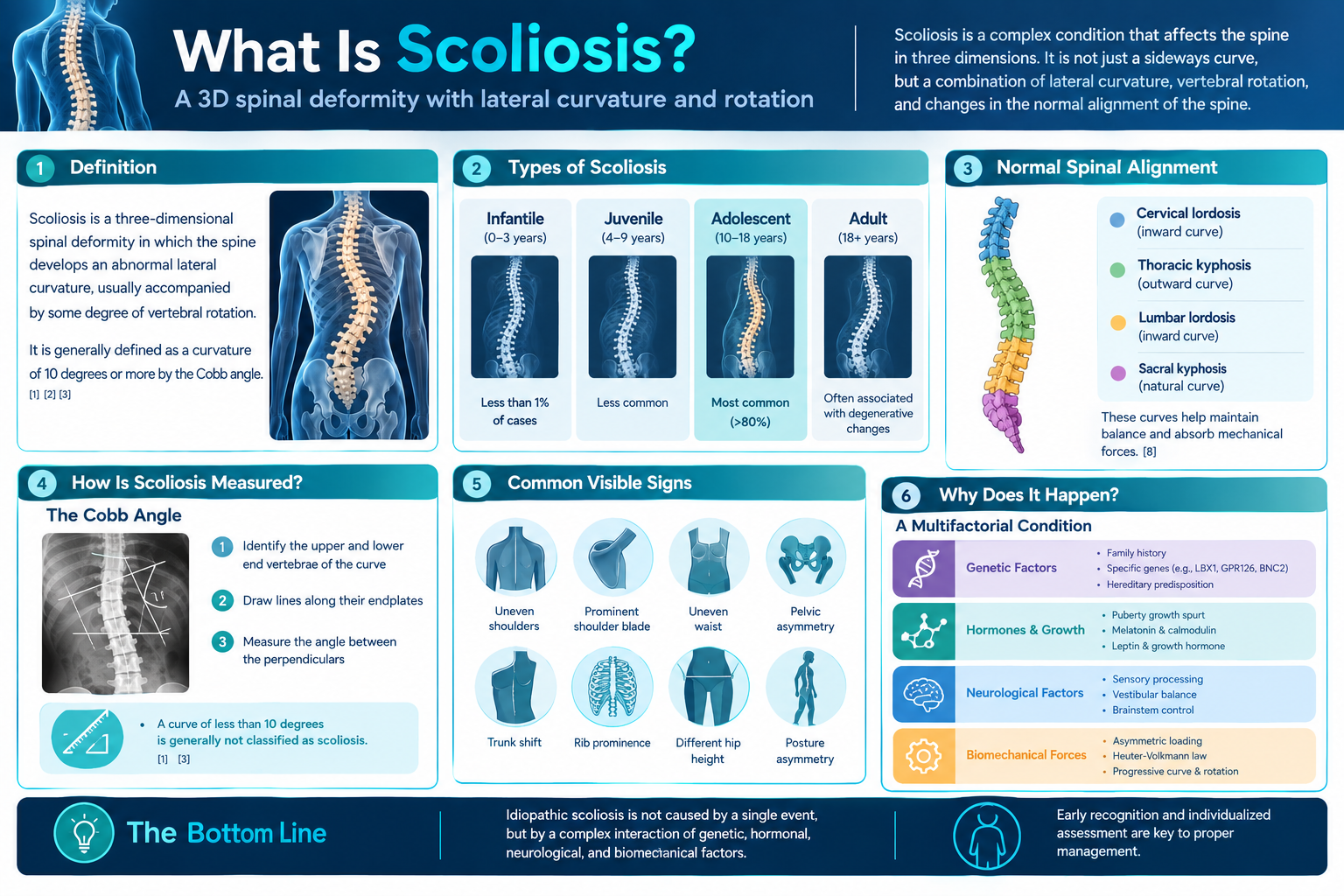
For most idiopathic scoliosis, there is no single identified cause. [1][7]
This is one of the most important facts for patients and parents to understand.
Scoliosis is not simply the result of bad posture, carrying a heavy backpack, sleeping in an unusual position, or participating in sports. [1]
The Scoliosis Research Society specifically notes that scoliosis does not result from heavy backpacks, athletic participation, poor sleeping or standing posture, lack of calcium, or minor differences in leg length. [1]
However, “idiopathic” should not be interpreted as “random.”
Current research continues to investigate possible contributions from:
- Genetic predisposition
- Growth and skeletal development
- Neuromuscular control
- Connective-tissue characteristics
- Hormonal and developmental factors
- Biomechanical factors
- Vertebral growth asymmetry
The exact interaction between these factors remains an area of ongoing research. [7][11]
---
Does Poor Posture Cause Scoliosis?
This is one of the most common questions about scoliosis.
The short answer is: ordinary poor posture does not cause structural scoliosis.
A person can habitually sit with rounded shoulders, lean to one side, or stand asymmetrically without developing idiopathic scoliosis as a direct consequence. [1]
However, posture and spinal alignment are still clinically important.
A person with scoliosis may develop postural asymmetry as a consequence of the spinal curve. In addition, functional or non-structural spinal deviations can sometimes occur because of factors such as pelvic imbalance, pain, or other musculoskeletal conditions. [1][16]
This distinction is critical:
Postural asymmetry is not automatically the same thing as structural scoliosis.
A structural scoliosis diagnosis requires appropriate clinical assessment and, when indicated, radiographic evaluation. [1][3]
---
Structural vs. Functional Spinal Curvature
Not every visible spinal deviation represents structural scoliosis.
Structural scoliosis
A structural curve involves persistent anatomical changes in the spine and may include:
- Vertebral rotation
- Fixed curvature
- Vertebral wedging or remodeling
- Persistent coronal deviation
Functional or non-structural curvature
A functional curve may result from an external or temporary factor and can change when that factor is corrected or when the patient changes position.
Potential contributors can include:
- Pelvic asymmetry
- Leg-length discrepancy
- Muscle spasm
- Pain
- Certain compensatory postures
The Scoliosis Research Society distinguishes non-structural curves from structural scoliosis using radiographic assessment, including side-bending studies in appropriate circumstances. [1]
This is another reason why visual inspection alone cannot establish a definitive diagnosis.
---
Scoliosis and Spinal Alignment
Modern scoliosis assessment increasingly recognizes that the spine should be evaluated in three dimensions. [2][4]
A conventional frontal X-ray primarily demonstrates the coronal component of the curve.
But scoliosis may also involve:
Coronal alignment
This refers broadly to the side-to-side alignment of the spine when viewed from the front.
Clinicians may assess:
- Cobb angle
- Trunk shift
- C7 or other vertical alignment references
- Pelvic obliquity
- Curve location and pattern
Sagittal alignment
This describes spinal alignment when viewed from the side.
Important parameters may include:
- Thoracic kyphosis
- Lumbar lordosis
- Pelvic parameters
- Global sagittal balance
Axial or transverse alignment
This involves rotational changes of the vertebrae.
Vertebral rotation contributes to some of the characteristic physical findings of scoliosis, including rib prominence and asymmetry of the trunk. [2][4]
Consequently, a complete scoliosis evaluation should consider curve magnitude, rotation, spinal balance, posture symmetry, and the patient’s functional status. [2][4][10]
---
When Should Scoliosis Be Evaluated?
Consider professional evaluation when you notice persistent:
- Uneven shoulders
- Uneven shoulder blades
- Uneven waistline
- Pelvic asymmetry
- Trunk leaning to one side
- Rib prominence
- A visible spinal curve
- Significant changes in posture symmetry
- Back pain associated with neurological symptoms
- Progressive changes during childhood or adolescence
A simple screening examination, such as the Adam’s forward bend test, can help identify asymmetry, but screening does not replace diagnostic assessment. [1][17]
A healthcare professional may determine whether imaging is appropriate.
For patients with confirmed scoliosis, follow-up may involve monitoring the Cobb angle, skeletal maturity, curve pattern, symptoms, and overall spinal alignment. [1][6]
---
Important Precautions and Medical Disclaimer
The information provided by 4scoliosis.com is intended for general educational purposes only. It is not a substitute for an examination, diagnosis, or individualized treatment plan provided by a qualified healthcare professional.
A visible difference in shoulder height, waist symmetry, or posture does not by itself establish a diagnosis of scoliosis.
Likewise, the Cobb angle should not be interpreted independently of age, skeletal maturity, curve pattern, symptoms, neurological findings, and overall spinal alignment. [2][4][10]
Patients should seek professional medical evaluation when they have:
- Significant or persistent back pain
- Progressive spinal deformity
- Numbness or weakness
- Changes in walking or coordination
- Bowel or bladder dysfunction
- Breathing difficulties
- Rapidly changing spinal asymmetry
- Scoliosis developing at an unusually young age
Children and adolescents with suspected scoliosis should be evaluated appropriately because remaining growth can influence curve progression. [1][6]
This article does not recommend a specific treatment, brace, exercise program, manual therapy, medication, or surgical procedure for an individual patient.
---
Conclusion: Understanding Scoliosis Is the First Step
Scoliosis is more than a simple sideways curve of the spine. It is a complex spinal alignment condition that may involve coronal curvature, vertebral rotation, sagittal alignment, and changes in overall posture symmetry. [2][4]
The conventional radiographic definition uses a Cobb angle of 10 degrees or more, but the number alone does not describe the entire condition. [1][3]
The major categories include:
- Idiopathic scoliosis – the most common type, with no single established cause
- Congenital scoliosis – associated with vertebral development abnormalities present from birth
- Neuromuscular scoliosis – associated with neurological or muscular disorders
- Syndromic scoliosis – associated with certain genetic or systemic conditions
- Adult degenerative scoliosis – associated with degenerative changes and altered spinal alignment in adulthood
Perhaps most importantly, scoliosis is not simply caused by poor posture, carrying a heavy backpack, or participating in sports. [1]
If you or your child has noticeable spinal asymmetry, the appropriate next step is not to assume the cause. Instead, seek a professional assessment that can determine whether a structural curve is present and, when appropriate, evaluate the Cobb angle and broader spinal alignment.
Early recognition, accurate classification, and appropriate monitoring can provide a clearer understanding of how a spinal curve behaves over time and help patients make informed decisions about their spinal health. [1][6]
At 4scoliosis.com, our goal is to make scoliosis information easier to understand so that patients, parents, caregivers, and health professionals can approach spinal health with better knowledge and greater confidence.
---
References
[1] Scoliosis Research Society. Adolescent Idiopathic Scoliosis. https://www.srs.org/Patients/Conditions/Scoliosis/Adolescent-Idiopathic-Scoliosis
[2] Scoliosis Research Society. Scoliosis: What You Need to Know. https://www.srs.org/Patients/Conditions/Scoliosis
[3] Cobb JR. Outline for the Study of Scoliosis. Instructional Course Lectures. 1948;5:261–275. https://pubmed.ncbi.nlm.nih.gov/18910852/
[4] Scoliosis Research Society. Adult Degenerative Scoliosis. https://www.srs.org/Patients/Conditions/Scoliosis/Adult-Degenerative-Scoliosis
[5] American Academy of Orthopaedic Surgeons. Scoliosis in Children and Teens. https://orthoinfo.aaos.org/en/diseases--conditions/scoliosis-in-children-and-teens/
[6] National Institute of Arthritis and Musculoskeletal and Skin Diseases. Scoliosis. https://www.niams.nih.gov/health-topics/scoliosis
[7] Cheng JC, Castelein RM, Chu WCW, et al. Adolescent idiopathic scoliosis. Nature Reviews Disease Primers. 2015;1:15030. https://www.nature.com/articles/nrdp201530
[8] National Cancer Institute. Spinal Anatomy. https://www.cancer.gov/publications/dictionaries/cancer-terms/def/spine
[9] Langensiepen S, Semler O, Sobottke R, et al. Measuring procedures to determine the Cobb angle in idiopathic scoliosis: a systematic review. European Spine Journal. 2013;22:2360–2371. https://pubmed.ncbi.nlm.nih.gov/23812542/
[10] Schwab F, Ungar B, Blondel B, et al. Scoliosis Research Society-Schwab adult spinal deformity classification. Spine. 2012;37(12):1077–1082. https://pubmed.ncbi.nlm.nih.gov/22045006/
[11] Giampietro PF, Raggio CL, Reynolds C, et al. Genetic basis of idiopathic scoliosis. Spine. 2006;31(21)–E683. https://pubmed.ncbi.nlm.nih.gov/17023848/
[12] American Academy of Orthopaedic Surgeons. Congenital Scoliosis. https://orthoinfo.aaos.org/en/diseases--conditions/congenital-scoliosis/
[13] Scoliosis Research Society. Neuromuscular Scoliosis. https://www.srs.org/Patients/Conditions/Scoliosis/Neuromuscular-Scoliosis
[14] Scoliosis Research Society. Syndromic Scoliosis. https://www.srs.org/Patients/Conditions/Scoliosis/Syndromic-Scoliosis
[15] Aebi M. The adult scoliosis. European Spine Journal. 2005;14(10):925–948. https://pubmed.ncbi.nlm.nih.gov/16328223/
[16] Scoliosis Research Society. Functional Scoliosis. https://www.srs.org/Patients/Conditions/Scoliosis
[17] U.S. Preventive Services Task Force. Screening for Adolescent Idiopathic Scoliosis. https://www.uspreventiveservicestaskforce.org/uspstf/recommendation/adolescent-idiopathic-scoliosis-screening