Idiopathic Scoliosis
[Scoliosis Basics & Fundamentals 02] Understanding Idiopathic Scoliosis: Why Does It Happen?
Explore the root causes, genetic factors, and biomechanical triggers of idiopathic scoliosis. A scientifically referenced guide to spine curvature.
Introduction
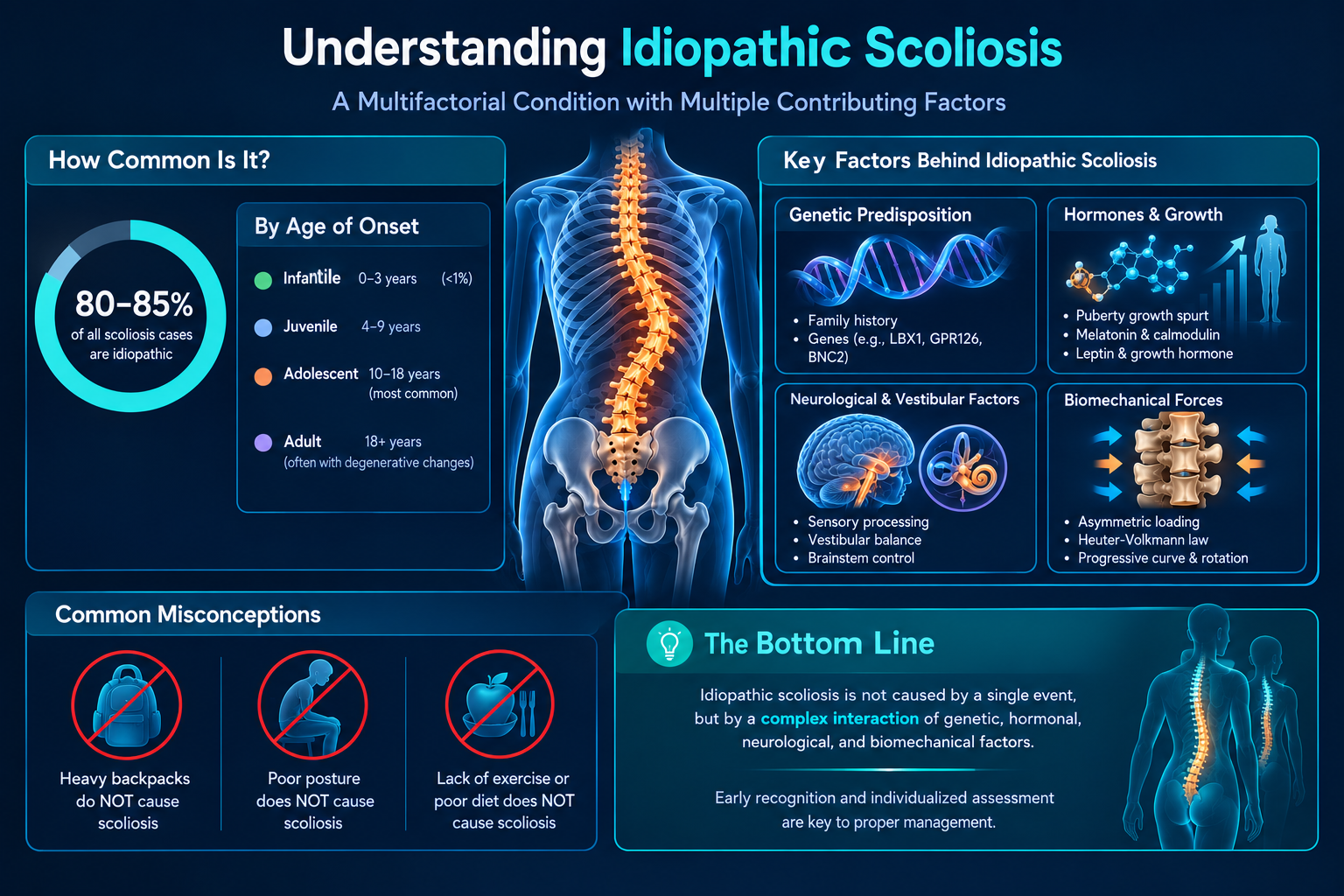
Scoliosis is defined as a three-dimensional deviation of the human spine, characterized by a lateral curvature in the frontal plane of 10 degrees or more, accompanied by vertebral rotation [1]. Among all clinical presentations of spinal deformities, idiopathic scoliosis is by far the most common, accounting for approximately 80% to 85% of all diagnosed cases [1, 2].
The term "idiopathic" originates from Ancient Greek, combining idio- (one's own / distinct) and pathos (suffering or disease)—literally translating to "a condition of unknown origin." For decades, medical practitioners and patients alike have asked a fundamental question: Why does idiopathic scoliosis happen?
While its precise initial trigger remains an active area of orthopedic research, modern biomechanics, genetics, and neurodevelopmental studies show that idiopathic scoliosis is not caused by a single event, but rather by a complex multifactorial interaction [1, 2]. This guide breaks down the science behind adolescent and adult idiopathic scoliosis and explores the primary mechanisms driving its onset and progression.
---
Classifications by Age of Onset
Idiopathic scoliosis is categorized based on the age at which the spinal curvature is first clinically identified [1, 5]:
- Infantile Idiopathic Scoliosis: Diagnosed between birth and 3 years of age (represents less than 1% of cases) [5].
- Juvenile Idiopathic Scoliosis: Diagnosed between 4 and 9 years of age [5].
- Adolescent Idiopathic Scoliosis (AIS): Diagnosed between ages 10 and 18. AIS is the most prevalent form, typically coinciding with the rapid growth spurts of puberty [1, 5].
- Adult Idiopathic Scoliosis: A continuation of adolescent scoliosis into adulthood, often complicated by degenerative changes in intervertebral discs and facet joints [1].
---
Key Factors Underlying Idiopathic Scoliosis
Although "idiopathic" means no single clear cause has been pinpointed, landmark scientific studies highlight several contributing biological, genetic, and structural factors.
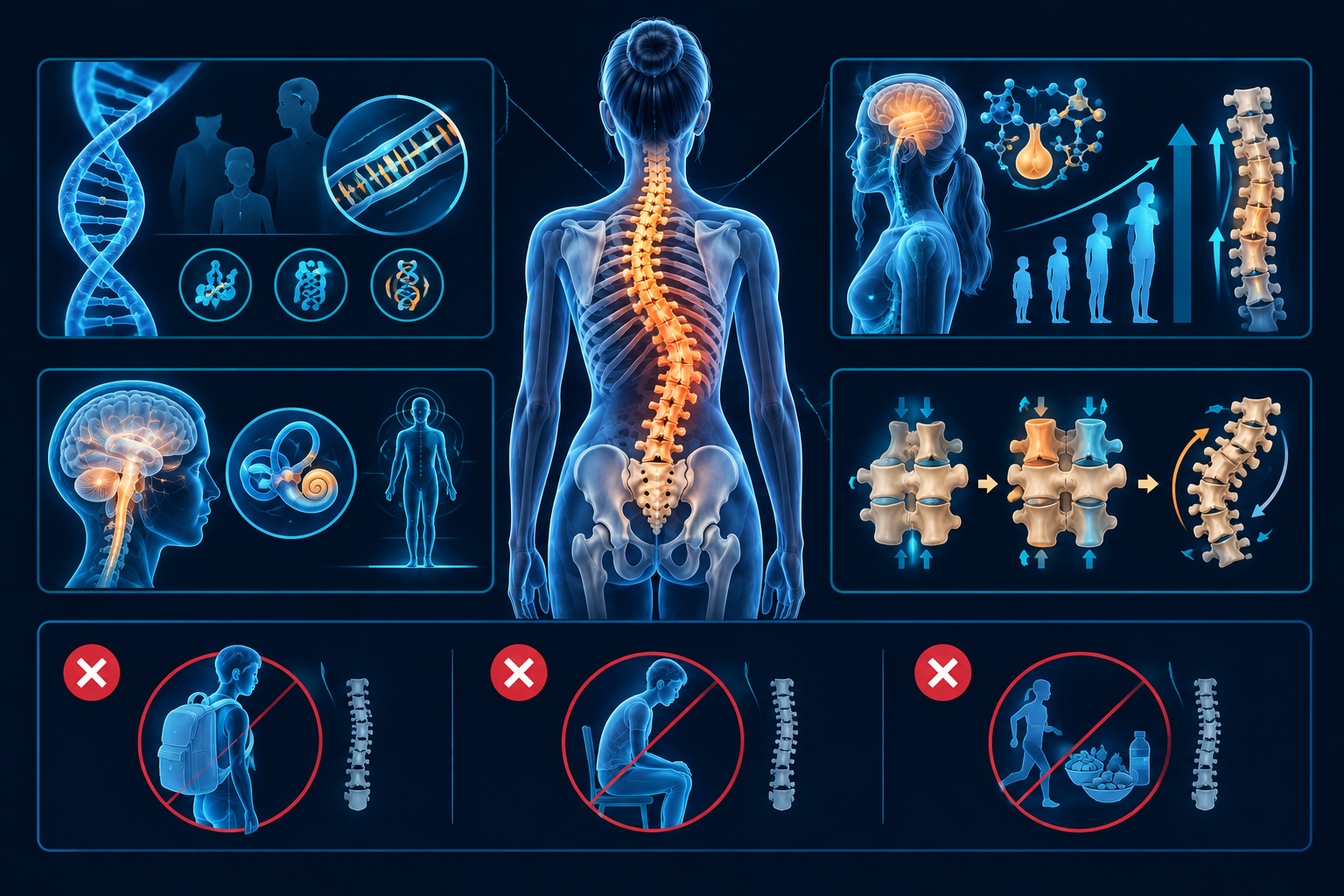
1. Genetic Predisposition and Hereditary Traits
Familial aggregation studies have long demonstrated that scoliosis runs in families [1, 3]. If a first-degree relative (such as a parent or sibling) has AIS, the likelihood of developing a spinal curve increases significantly.
- Genome-wide association studies (GWAS) have identified specific candidate genes—such as LBX1 (Ladybird Homeobox 1), GPR126, and BNC2—that are strongly associated with spinal development and susceptibility to curve progression [3].
2. The Role of Hormones and Asymmetric Growth
Rapid axial growth during puberty is one of the biggest risk factors for curve acceleration [1, 2].
- Research highlights a potential link involving melatonin signaling dysfunction and abnormal calmodulin activity, which affect bone density and bilateral muscle tone balance [2].
- Leptin levels and altered growth hormone pathways have also been observed in adolescents with progressive curves, suggesting systemic metabolic factors influence spinal bone development [2].
3. Neurological and Vestibular Imbalances
The brain controls spinal alignment through feedback loops involving the central nervous system, proprioceptors, and the vestibular (inner ear) system [2]. Minor subclinical dysfunctions in:
- Posterior column somatosensory processing [2],
- Vestibular processing of spatial orientation [2], and
- Brainstem postural control mechanisms [2]
can lead to asymmetrical firing of paraspinal muscles, causing uneven biomechanical forces along the vertebral column.
4. Biomechanical Forces: The Heuter-Volkmann Law
Once a minor initial curve forms (even as small as 5 to 10 degrees), mechanical forces take over through a phenomenon known as the vicious cycle of scoliosis [4]:
- An asymmetric tilt subjects one side of the vertebra (the concave side) to higher compressive load [4].
- According to the Heuter-Volkmann Law, increased mechanical compression slows down longitudinal bone growth, while reduced compression on the convex side accelerates growth [4].
- This differential growth rate wedges the vertebrae over time, leading to worsening lateral curvature and axial vertebral rotation [4].
---
Common Misconceptions: What Does NOT Cause Idiopathic Scoliosis?
Understanding what causes idiopathic scoliosis also requires dispelling pervasive myths [1]:
- Heavy Backpacks: Carrying a heavy school bag can cause temporary back fatigue or poor posture, but it does not cause structural idiopathic scoliosis [1].
- Poor Posture or Slouching: Slouching is a functional habit, whereas structural scoliosis involves anatomical rotation of the vertebrae. Slouching does not alter spinal bone structures [1].
- Lack of Exercise or Dietary Deficiencies: While general health is important for bone density, scoliosis develops independently of general physical fitness or normal nutritional intake [1].
---
Medical Disclaimer
This content is intended strictly for educational and informational purposes and does not constitute medical advice, diagnosis, or treatment. Always consult a qualified physician or orthopedic specialist for individual medical evaluation and management.
---
References & Scientific Literature
- Weinstein, S. L., Dolan, L. A., Cheng, J. C., Danielsson, A., & Morcuende, J. A. (2008). Adolescent idiopathic scoliosis. The Lancet, 371(9623), 1527-1537.
- Kuroki, H. (2018). Etiology and Pathogenesis of Adolescent Idiopathic Scoliosis. Journal of Orthopaedic Science, 23(1), 10-16.
- Takahashi, Y., et al. (2011). LBX1 on chromosome 10q24.31 is associated with adolescent idiopathic scoliosis in East Asian populations. Nature Genetics, 43(12), 1237-1240.
- Stokes, I. A. (1999). Analysis of symmetry of vertebral body growth and shape in scoliotic spines. Spine, 24(19), 2011-2016.
- Gorman, K. F., & Breden, F. (2007). Idiopathic scoliosis: The prevalence and natural history of curve progression. Spine State of the Art Reviews, 21(1), 1-14.
---