Spine Care
[Scoliosis Basics & Fundamentals 01] Structural vs. Functional Scoliosis: Key Differences Explained
Understand how structural and functional scoliosis differ in spinal flexibility, vertebral rotation, causes, diagnosis, and clinical management and what parents should know
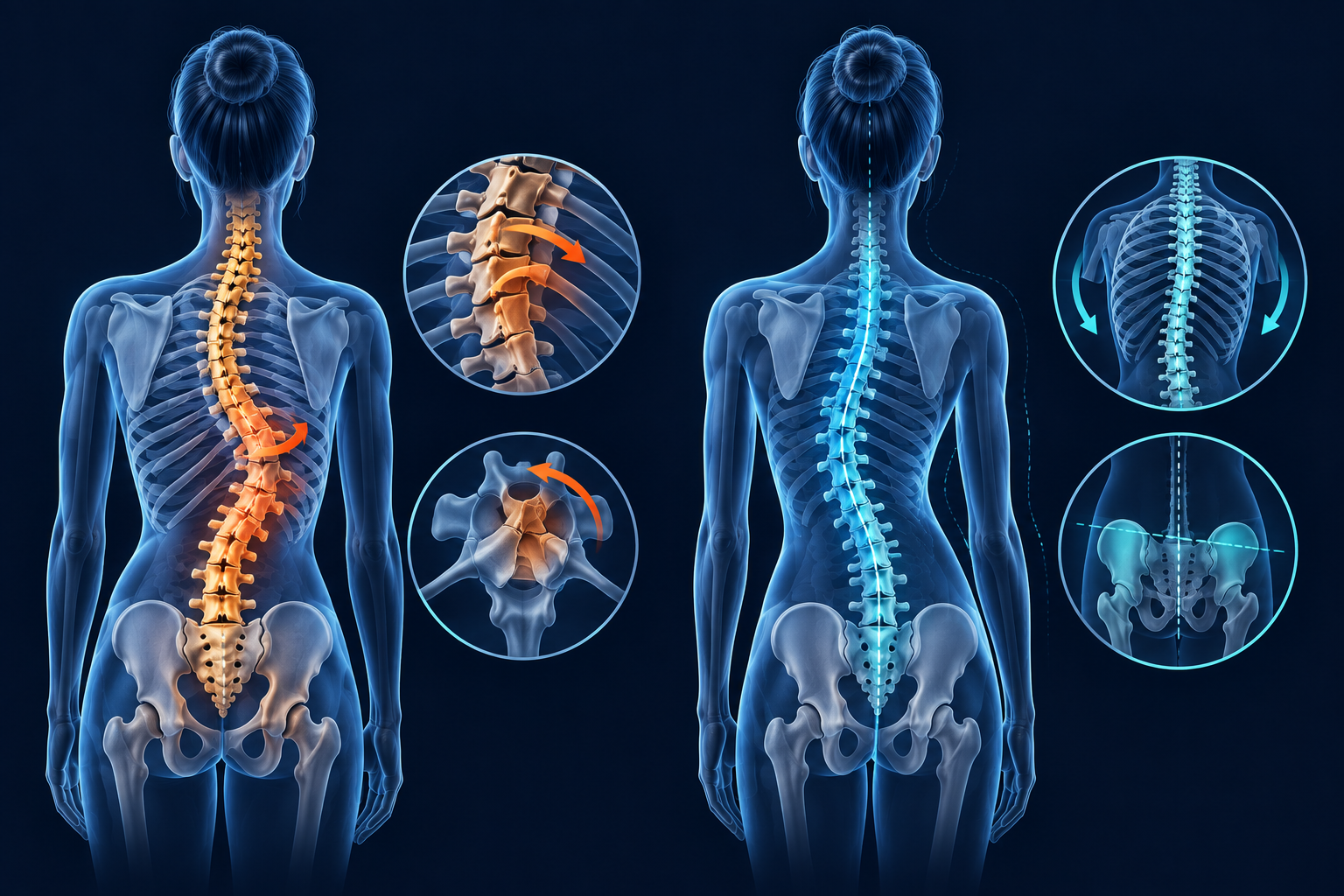
Structural vs. Functional Scoliosis: What Is the Difference?
When parents first notice that their child's shoulders are uneven, one side of the waist looks different, or the trunk appears to lean to one side, it is natural to worry about scoliosis. However, not every visible spinal curve represents the same condition. Some spinal curves are structural, meaning that the spine itself has developed a persistent deformity, while others are functional or non-structural, meaning that the curvature is associated with an underlying positional, mechanical, or other factor and may improve when that factor changes. [1][2]
Understanding this distinction is important because the words "structural" and "functional" describe how a spinal curve behaves, not simply how severe it looks from the outside. A curve can look significant while standing but become much smaller or disappear when the patient changes position. Conversely, a structural curve may remain present even when the patient lies down or bends to the side. [1][3]
For parents, this distinction can also prevent unnecessary fear. Seeing an asymmetrical posture does not automatically mean that a child has permanent spinal deformity. At the same time, a flexible or apparently mild curve should not automatically be dismissed, because the underlying reason for the curvature still needs to be understood. [1][2]
---
What Is Structural Scoliosis?
Structural scoliosis refers to a persistent spinal curvature associated with changes in the structure and alignment of the spine. The curve does not completely disappear when the patient changes position or when the spine is tested for flexibility. Structural scoliosis may also involve vertebral rotation, changes in vertebral shape, and alterations in the three-dimensional alignment of the spine. [1][3]
The Scoliosis Research Society describes a structural curve as a coronal-plane curve that does not correct completely on a maximal voluntary side-bending radiograph. In other words, the curve has a degree of rigidity or persistence that distinguishes it from a purely positional curvature. [3]
Structural scoliosis is therefore not simply a matter of standing incorrectly. It reflects a more persistent alteration in spinal alignment. In adolescent idiopathic scoliosis, for example, the spine can develop a lateral curvature together with axial rotation of the vertebrae, which can contribute to visible rib or trunk asymmetry. [1][4]
Structural scoliosis may involve:
- Persistent lateral spinal curvature
- Vertebral rotation
- Changes in vertebral alignment
- Reduced spinal flexibility
- Rib or trunk prominence
- Persistent asymmetry of the shoulders or waist
- Alterations in coronal and sometimes sagittal spinal balance [1][4]
It is important to understand that structural scoliosis does not necessarily mean that the spine is completely rigid. A structural curve can still be flexible to some degree. The key distinction is that it does not fully correct under the conditions used to assess flexibility. [3][5]
---
What Is Functional Scoliosis?
Functional scoliosis, sometimes called non-structural scoliosis, is a spinal curvature that develops secondary to another factor outside the intrinsic structure of the vertebrae. The curvature may decrease substantially or disappear when the underlying factor is corrected or when the patient's position changes. [1][2]
The Scoliosis Research Society provides a straightforward example: if a person stands asymmetrically with one knee bent, the pelvis may tilt, and the spine may curve to compensate. When the knee is straightened and the pelvis becomes level, the apparent spinal curve can disappear. [1]
Functional curvature may therefore be better understood as a spinal response to an imbalance or external influence rather than a primary fixed deformity of the spine. [2]
Potential contributors can include:
- Leg-length inequality
- Pelvic obliquity
- Asymmetric standing posture
- Muscle spasm
- Pain-related postural changes
- Certain mechanical or musculoskeletal imbalances
- Other conditions that cause the body to compensate for asymmetry [1][2][6]
However, parents should be careful with the word "functional." It does not mean that the curve is imaginary or that the child is simply "standing badly." A functional curve is a real change in spinal alignment; the important question is whether that change is reversible and secondary to another factor. [1][2]
---
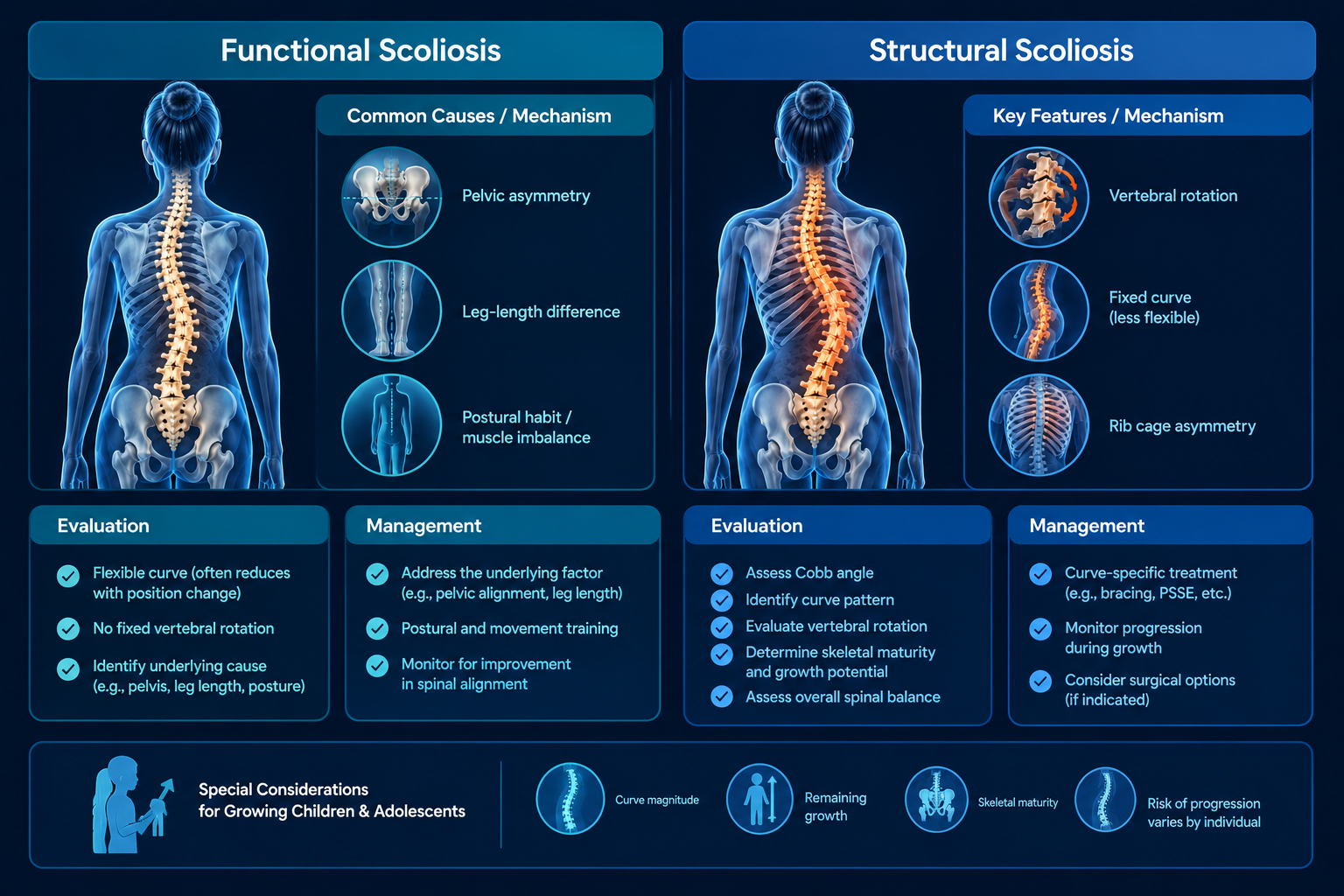
Structural vs. Functional Scoliosis: The Key Differences
The simplest way to understand the distinction is to think about flexibility and reversibility.
| Feature | Structural Scoliosis | Functional Scoliosis | | --------------------- | --------------------------------------------------------------------------- | ---------------------------------------------------------- | | Basic nature | Persistent spinal deformity | Usually secondary/reversible curvature | | Spinal flexibility | Reduced to varying degrees | Usually relatively flexible | | Changes with position | Curve persists | Curve may decrease or disappear | | Vertebral rotation | May be present and clinically important | Usually less prominent, but exceptions exist | | Underlying cause | May be idiopathic, congenital, neuromuscular, syndromic, degenerative, etc. | Often related to an external or mechanical factor | | Side-bending X-ray | Curve remains to a significant degree | Curve may substantially correct | | Posture symmetry | Often persistently altered | May improve when the underlying asymmetry is corrected | | Management | Depends on age, magnitude, cause, growth, symptoms, and progression risk | Focuses on identifying and addressing the underlying cause |
This table provides a useful general framework, but it should not be used as a substitute for clinical diagnosis. There are important exceptions, and the definition of a "structural" curve can depend on the specific clinical or classification context. [1][3][5]
---
Why Does the Difference Matter?
The distinction matters because the underlying mechanism affects what should be evaluated next.
If a child's spinal curve is functional, the clinician will generally want to determine why the body is creating the compensatory curve. For example, pelvic asymmetry or a leg-length difference may alter the child's standing alignment. If the underlying factor can be corrected, the spinal curvature may improve. [1][6]
If the curve is structural, however, simply changing standing posture may not eliminate it. The clinician may need to assess the Cobb angle, curve pattern, vertebral rotation, skeletal maturity, growth potential, and overall spinal balance. [1][4]
For growing children and adolescents, this distinction is particularly important because a structural curve may change as the spine grows. The risk of progression depends on several factors, including curve magnitude and remaining skeletal growth. [4][7]
---
How Is Structural Scoliosis Identified?
A scoliosis evaluation generally begins with a physical examination.
The clinician may look for:
- Uneven shoulder height
- Scapular asymmetry
- Uneven waist contours
- Pelvic asymmetry
- Trunk shift
- Apparent spinal curvature
- Rib prominence during forward bending
- Differences in overall posture symmetry [1][8]
The Adam's forward bend test is commonly used as part of the clinical examination. The patient bends forward while the examiner observes the back for asymmetry, particularly a rib prominence that may reflect vertebral rotation. [1][8]
This test is useful, but it cannot by itself determine whether a curve is definitively structural.
A child can have an asymmetric posture without having structural scoliosis, and the absence of obvious asymmetry does not completely exclude a spinal curve. When scoliosis is suspected, the clinician determines whether imaging is appropriate. [1][8]
---
The Cobb Angle: Important but Not the Whole Story
The Cobb angle is one of the most widely used measurements for quantifying scoliosis on a spinal radiograph. It is calculated using the upper and lower end vertebrae of a curve. [4][9]
In conventional scoliosis definitions, a coronal curvature of approximately 10 degrees or greater on an appropriate standing radiograph is commonly used as the threshold for diagnosing scoliosis. [2][4]
However, the Cobb angle alone cannot tell a parent whether a curve is structural or functional.
For example, two patients might have similar standing Cobb angles but very different spinal flexibility. One curve might substantially correct during side bending, while the other remains relatively fixed. Therefore, curve flexibility and the behavior of the curve under different conditions are important components of assessment. [3][5]
The Cobb angle also has measurement variability. A small change between two radiographs does not necessarily mean that the spine has truly progressed; clinicians interpret changes in the context of measurement error, positioning, growth, and the overall clinical picture. [4][9]
---
What Is a Side-Bending X-Ray?
A side-bending radiograph is an X-ray taken while the patient actively bends the spine to one side. It is used in selected scoliosis evaluations to assess the flexibility of different curves. [3][5]
Imagine a child with an S-shaped curve. The standing X-ray may show two visible curves. When the child bends to one side, one curve may become much smaller or nearly disappear, while another remains clearly present.
The curve that remains relatively persistent may represent the structural curve, while a smaller curve that corrects substantially may be considered non-structural or compensatory in the relevant classification system. [3][5]
This is particularly important when clinicians are analyzing multiple curves in patients with adolescent idiopathic scoliosis. The purpose is not simply to label a curve but to understand the relationship between the primary curve and the body's compensatory response. [5]
---
Structural Scoliosis and Vertebral Rotation
One of the major differences between structural and purely positional curvature is the potential presence of vertebral rotation.
In structural scoliosis, vertebrae may rotate around the spinal axis as the curve develops. In a thoracic curve, this rotation can affect the ribs and contribute to the familiar "rib hump" that may become visible during the Adam's forward bend test. [4][8]
This is one reason why scoliosis should not be thought of as a simple two-dimensional sideways bend.
A more complete description considers three-dimensional spinal alignment:
Coronal plane
The spine is viewed from the front or back, and clinicians assess lateral curvature and coronal balance.
Sagittal plane
The spine is viewed from the side, allowing assessment of thoracic kyphosis, lumbar lordosis, and overall sagittal alignment.
Axial plane
The spine is considered from above, allowing assessment of vertebral rotation and rotational deformity. [4][10]
For patients and parents, this means that a "20-degree curve," for example, does not completely describe the person's spinal condition. The location of the curve, flexibility, rotation, balance, growth stage, and symptoms can all matter. [4][10]
---
Common Causes of Functional Scoliosis
Functional scoliosis is usually associated with a factor that changes the body's alignment or causes the spine to compensate.
1. Leg-Length Inequality
A difference in lower-limb length can alter pelvic position. The pelvis may become oblique when standing, and the spine can respond by developing a compensatory curvature. [6][11]
However, this relationship is more complicated than simply saying that "unequal legs cause scoliosis." Research has produced mixed findings regarding the amount of leg-length difference required to produce a meaningful spinal curve, and not every person with a leg-length difference develops functional scoliosis. [6][11]
Therefore, leg length should be assessed appropriately rather than assumed to be the explanation for every asymmetric posture.
---
2. Pelvic Obliquity
Pelvic obliquity means that the pelvis is not level in the frontal plane.
Because the spine connects the trunk to the pelvis, pelvic asymmetry can influence the alignment of the lumbar spine. The spine may curve as part of a compensatory strategy to maintain balance and keep the head and trunk appropriately positioned. [6][10]
A clinician may therefore assess pelvic level, leg length, gait, and standing alignment when evaluating a suspected functional curve. [1][6]
---
3. Pain and Muscle Spasm
Pain can change the way a person stands or moves.
For example, a child or adult experiencing significant pain on one side of the back, hip, or lower limb may unconsciously shift the trunk away from the painful area. Muscle spasm can also create an asymmetric posture. [2][12]
This type of curvature can be considered a pain-related or antalgic spinal response, rather than primary idiopathic scoliosis.
However, an unusual or painful spinal curve deserves careful evaluation. A new curve accompanied by significant pain should not simply be assumed to be "functional." The underlying cause of the pain needs to be considered. [8][12]
---
Can Functional Scoliosis Become Structural?
This is an important question for parents.
The relationship between functional and structural curvature is complex. Traditional descriptions distinguish functional curves as reversible and structural curves as persistent, but spinal alignment can change over time, particularly during growth. [2][12]
Some historical and experimental literature has proposed that prolonged asymmetric loading or an untreated underlying problem could contribute to more persistent deformity in certain circumstances. However, this does not mean that every functional curve will become structural scoliosis. [2][12]
Parents should therefore avoid two opposite assumptions:
"It's functional, so it doesn't matter."
and
"It's functional, so it will definitely become structural."
Neither statement is medically justified.
The appropriate approach is to identify the underlying cause, correct reversible factors when appropriate, and monitor the child when clinical circumstances warrant follow-up. [1][2]
---
Can Poor Posture Cause Structural Scoliosis?
This question causes considerable anxiety among parents.
Ordinary poor posture should not be presented as the simple cause of adolescent idiopathic scoliosis. Idiopathic scoliosis is a multifactorial condition, and its exact cause remains incompletely understood. [2][4]
At the same time, posture matters clinically.
A child's habitual standing or sitting position can influence apparent trunk symmetry and can create temporary or functional deviations. Therefore, a parent may correctly observe that a child's posture looks asymmetric without that observation proving the presence of structural scoliosis. [1][2]
This is why the distinction between postural asymmetry and structural spinal deformity is so important.
---
What Should Parents Do If They Notice an Asymmetry?
If you notice that your child consistently has uneven shoulders, a prominent shoulder blade, an uneven waist, pelvic asymmetry, or a visible trunk shift, try not to panic.
Instead, consider these steps:
Step 1: Observe the pattern
Look at the child standing naturally rather than deliberately correcting their posture.
Step 2: Look for persistence
Does the asymmetry remain when the child changes position?
Step 3: Consider growth
Rapid growth during adolescence is an important period in which scoliosis may become apparent or progress. [4][7]
Step 4: Arrange an appropriate evaluation
A healthcare professional can perform a physical examination and determine whether imaging is indicated. [1][8]
Step 5: Do not diagnose from photographs alone
A photograph can show posture asymmetry, but it cannot reliably determine whether a curve is structural, functional, or another type of spinal condition.
Step 6: Do not begin corrective treatment based only on appearance
Exercises, shoe lifts, braces, manual techniques, or other interventions should be selected based on an appropriate assessment of the underlying condition. [1][7]
---
When Should Parents Seek Medical Evaluation Promptly?
Some findings deserve more attention than an ordinary postural asymmetry.
Seek professional evaluation when a child has:
- A rapidly developing spinal deformity
- Significant or persistent back pain
- Neurological symptoms
- Weakness or numbness
- Changes in gait or coordination
- Bowel or bladder symptoms
- A curve appearing at an unusually young age
- Significant asymmetry that is worsening
- Other systemic symptoms accompanying the spinal curvature [4][8]
In particular, significant pain or neurological findings are not typical features of uncomplicated adolescent idiopathic scoliosis and may warrant investigation for another underlying condition. [4][8]
---
Structural vs. Functional Scoliosis: What Parents Should Remember
The most important message is simple:
Structural and functional scoliosis are not interchangeable terms.
A structural curve represents a persistent spinal deformity with reduced flexibility to varying degrees. A functional curve is generally a reversible or substantially correctable curvature associated with another factor, such as positional asymmetry or a mechanical imbalance. [1][2]
The distinction cannot always be made reliably by looking at a child's back.
A proper evaluation may combine:
- Physical examination
- Posture and gait assessment
- Adam's forward bend test
- Assessment of shoulder and pelvic symmetry
- Cobb angle measurement when imaging is indicated
- Evaluation of vertebral rotation
- Standing spinal radiographs
- Side-bending radiographs when clinically appropriate
- Assessment of skeletal maturity and growth [1][3][4]
This comprehensive approach helps clinicians understand not just how much the spine curves, but why it curves and how flexible the curve is.
---
Important Precautions and Medical Disclaimer
The information in this article is provided for general educational purposes only. It is not intended to diagnose scoliosis or replace an examination by a qualified healthcare professional.
The terms "structural scoliosis" and "functional scoliosis" are used in different clinical contexts, and specific radiographic thresholds can vary according to the classification system being applied. In particular, the frequently cited 25-degree side-bending threshold is associated with specific scoliosis classification systems and should not be interpreted as a universal definition for every patient. [3][5]
A Cobb angle should also not be interpreted by itself. Age, skeletal maturity, curve pattern, vertebral rotation, sagittal and coronal balance, symptoms, and the clinical context all contribute to appropriate assessment. [4][10]
Parents should not attempt to determine from an online article whether their child's curve is structural or functional. If persistent asymmetry is present, professional assessment is the safest way to determine whether further evaluation is necessary.
This article does not recommend a specific brace, exercise program, shoe lift, manual therapy, medication, or surgical procedure for any individual patient.
---
Conclusion: Structural or Functional—The Right Question Is Why?
When a child's spine appears curved, the first question should not simply be "How many degrees is the curve?"
A more complete evaluation asks:
Is the curve structural or functional?
Does it persist when the body changes position?
Is there vertebral rotation?
Is the pelvis level?
Is there a leg-length inequality or another mechanical factor?
What does the Cobb angle show?
How does the curve behave on flexibility testing?
Is the child still growing?
These questions help clinicians distinguish a persistent spinal deformity from a potentially reversible compensatory curvature. [1][3][4]
For parents, the key message is reassuring but practical: an uneven posture does not automatically mean permanent scoliosis, but persistent asymmetry deserves appropriate evaluation rather than assumptions.
Early recognition can help identify structural scoliosis when it is present and can also reveal potentially correctable contributors when the curvature is functional. The goal is not simply to make the spine look straighter—it is to understand the child's spinal alignment, posture symmetry, flexibility, growth, and overall health so that appropriate decisions can be made. [1][4]
At 4scoliosis.com, our goal is to help patients and families understand scoliosis in clear, evidence-informed language. Understanding the difference between structural and functional curvature is an important first step toward asking better questions and making informed decisions about spinal health.
---
References
[1] Scoliosis Research Society (SRS). Diagnosing Scoliosis. https://www.srs.org/Patients/Diagnosis-And-Treatment/Diagnosing-Scoliosis
[2] SOSORT. 2016 SOSORT Guidelines: Orthopaedic and Rehabilitation Treatment of Idiopathic Scoliosis During Growth. https://pmc.ncbi.nlm.nih.gov/articles/PMC5795289/
[3] Scoliosis Research Society. SRS Glossary – Structural Curve and Vertebral Axial Rotation. https://www.srs.org/Education/Glossary
[4] Tsiligiannis T, Grivas T. Current concepts in the diagnosis and management of adolescent idiopathic scoliosis. https://pmc.ncbi.nlm.nih.gov/articles/PMC7250959/
[5] Scoliosis Research Society. Spinal Deformity Study Group Radiographic Measurement Manual. https://www.srs.org/Files/Research/Manuals-and-Publications/sdsg-radiographic-measuremnt-manual.pdf
[6] Scoliosis and Lower Limb Inequality: To Lift or Not to Lift, That Is the Question. https://pmc.ncbi.nlm.nih.gov/articles/PMC11022167/
[7] Scoliosis Research Society. Diagnosis and Treatment of Scoliosis. https://www.srs.org/Patients/Diagnosis-And-Treatment
[8] Scoliosis Research Society. Diagnosis and Screening of Scoliosis. https://etext.srs.org/patients-and-families/common-questions-and-glossary/frequently-asked-questions/diagnosis--screening-of-scoliosis
[9] Clinical Investigation and Imaging of Adolescent Idiopathic Scoliosis. https://pmc.ncbi.nlm.nih.gov/articles/PMC3566259/
[10] Coşkun E, Bucak ÖF, et al. A Comprehensive Review of Adult Scoliosis: Advances in Pathogenesis, Diagnosis, and Management Strategies. Turkish Journal of Physical Medicine and Rehabilitation, 2025. https://pmc.ncbi.nlm.nih.gov/articles/PMC12914251/
[11] Vertebral Rotation in Functional Scoliosis Caused by Limb-Length Inequality. https://pmc.ncbi.nlm.nih.gov/articles/PMC10488457/
[12] Hawes MC, O'Brien JP. The transformation of spinal curvature into spinal deformity: pathological processes and implications for treatment. https://pmc.ncbi.nlm.nih.gov/articles/PMC1459276/
---
Editorial note for 4scoliosis.com
For patient education, one particularly important point is that "functional scoliosis" should not be presented as simply "bad posture." The current literature supports a broader concept involving reversible or compensatory curvature secondary to factors such as pelvic position, limb-length inequality, pain, or muscle imbalance. The relationship between functional curvature and later structural deformity is more complex and should not be presented as inevitable. [1][2][6][12]
Similarly, the 25° criterion should be presented as a classification-specific radiographic criterion rather than a universal definition of structural scoliosis. This distinction makes the article more medically defensible and reduces the risk of misleading parents who may interpret the number as a universal diagnostic cutoff. [3][5]