Spine Care
[Scoliosis Basics & Fundamentals 15] Key Differences Between Cervical, Thoracic, and Lumbar Scoliosis
Learn the key differences between cervical, thoracic, and lumbar scoliosis, including curve location, symptoms, spinal alignment, neurological risks, diagnosis, and treatment considerations.
Introduction
Scoliosis is commonly described as an abnormal sideways curvature of the spine, but the condition is more complex than a simple side-to-side bend. Structural scoliosis is a three-dimensional spinal deformity involving changes in the coronal plane, vertebral rotation, and often alterations in normal sagittal alignment. [1]
One of the most useful ways to understand scoliosis is to identify where the main curve is located.
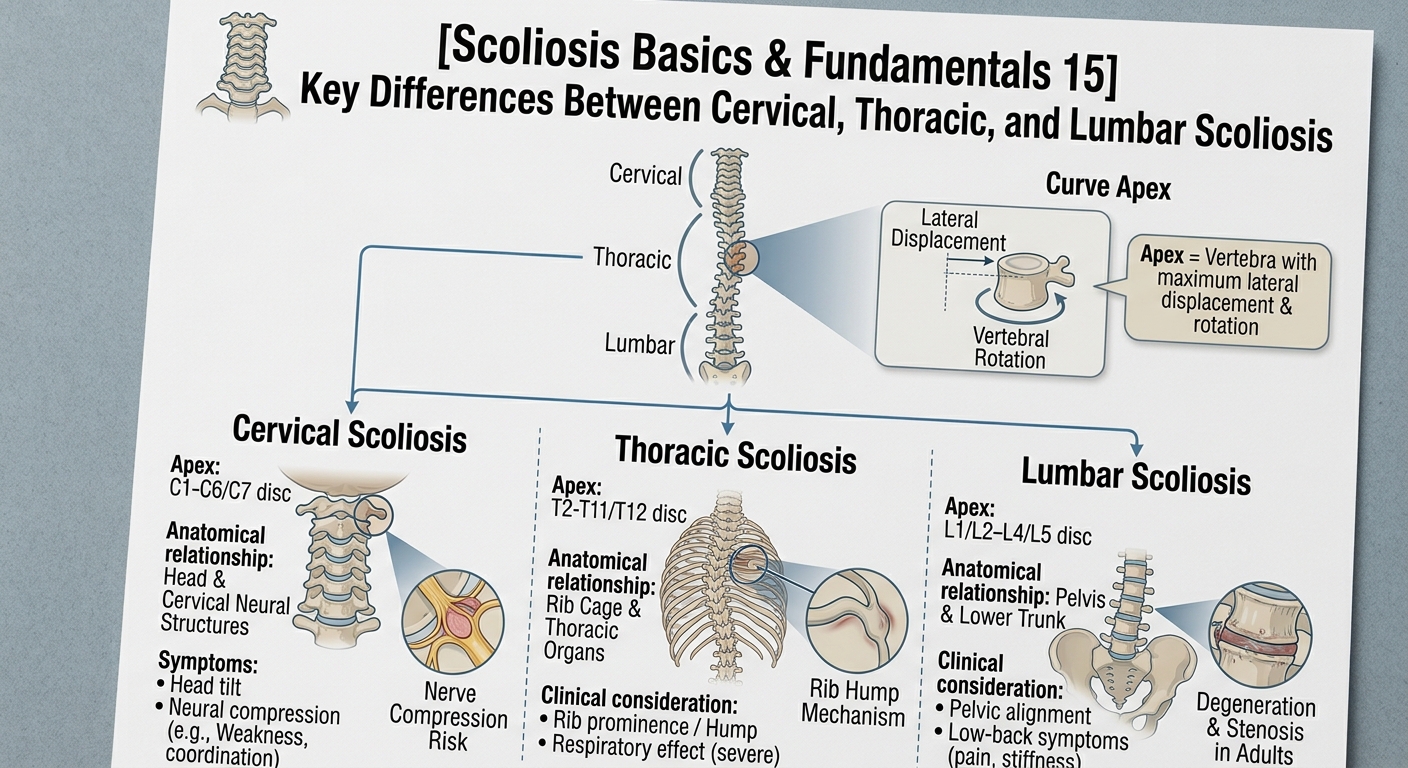
Depending on the location of the curve's apex, scoliosis may be described as cervical, cervicothoracic, thoracic, thoracolumbar, lumbar, or lumbosacral scoliosis. The Scoliosis Research Society (SRS) defines cervical scoliosis as a curve with its apex between C1 and the C6–C7 disc, thoracic scoliosis as a curve with its apex between T2 and the T11–T12 disc, and lumbar scoliosis as a curve with its apex between the L1–L2 disc and L4–L5 disc. [1]
The location of the curve matters because different spinal regions have different anatomical functions.
A cervical curve affects the portion of the spine that supports the head and contains the cervical spinal cord and nerve roots. A thoracic curve interacts closely with the rib cage and therefore may have implications for chest-wall symmetry and, in severe cases, respiratory mechanics. A lumbar curve affects the lower back and has a particularly important relationship with pelvic alignment, lumbar lordosis, and load transmission between the trunk and pelvis. [1, 2]
Understanding these differences can help patients and parents interpret an X-ray report, understand why symptoms may vary between individuals, and appreciate why scoliosis treatment cannot be based on the Cobb angle alone.
---
What Is the Difference Between Cervical, Thoracic, and Lumbar Scoliosis?
The simplest distinction is the location of the curve apex.
| Type | General curve location | Main anatomical structures involved | Potential clinical considerations | | --------------------------- | ------------------------------------------ | ------------------------------------------------------------------- | ------------------------------------------------------------------------------------------- | | Cervical scoliosis | Neck | Cervical vertebrae, head-neck alignment, cervical neural structures | Neck alignment, neurological symptoms, head balance | | Thoracic scoliosis | Upper/mid back | Thoracic vertebrae, ribs, thoracic cage | Shoulder/trunk asymmetry, rib prominence, possible respiratory effects in severe cases | | Lumbar scoliosis | Lower back | Lumbar vertebrae, pelvis, lumbar musculature | Low-back symptoms, pelvic alignment, sagittal balance, leg symptoms in degenerative disease | | Thoracolumbar scoliosis | Junction between thoracic and lumbar spine | Lower thoracic and upper lumbar regions | Trunk balance and transition-zone mechanics |
The SRS terminology is based on the location of the apical vertebra or disc, rather than simply the region where the patient notices pain or visible asymmetry. [1]
This distinction is important because a patient may have pain in the lumbar region even when the primary structural curve is thoracic.
---
Understanding the Curve Apex
The apical vertebra is generally the vertebra located near the center of the structural curve and is the vertebra that is most laterally displaced from the patient's vertical spinal axis. [1]
The location of this apex helps classify the scoliosis.
For example:
- A curve centered in the cervical region may be classified as cervical scoliosis.
- A curve centered around the upper or middle thoracic spine may be thoracic scoliosis.
- A curve centered around the thoracolumbar junction may be thoracolumbar scoliosis.
- A curve centered in the lumbar spine may be lumbar scoliosis.
This classification is more precise than simply saying that someone has "upper-back scoliosis" or "lower-back scoliosis."
---
Cervical Scoliosis
What Is Cervical Scoliosis?
Cervical scoliosis is a relatively uncommon pattern in which the structural curve is centered in the cervical spine.
The SRS defines cervical scoliosis as scoliosis with an apex between C1 and the C6–C7 disc. A curve centered at C7, T1, or the intervening disc space is classified as cervicothoracic scoliosis. [1]
The cervical spine consists of seven vertebrae, C1 through C7, and normally has a lordotic alignment when viewed from the side. [2]
Because the cervical spine supports the head and contains important neural structures, cervical deformity can have clinical implications that differ substantially from those of a typical thoracic or lumbar scoliosis.
---
Why Cervical Scoliosis Can Be Clinically Different
The cervical spine is responsible for supporting and positioning the head while allowing substantial movement.
A structural deformity in this region can therefore influence:
- head position
- neck alignment
- shoulder and upper-trunk balance
- cervical range of motion
- neck muscle loading
- cervical sagittal alignment
- neurological function in certain disorders
Cervical scoliosis may also occur as part of a more extensive spinal deformity rather than as an isolated curve.
In adults, cervical deformity is often evaluated not only in terms of coronal curvature but also through sagittal alignment and global spinal balance. Contemporary cervical deformity classifications use the location of the deformity and additional alignment modifiers to describe these complex patterns. [3]
---
Symptoms of Cervical Scoliosis
Symptoms vary considerably depending on the underlying cause and severity.
Possible symptoms include:
- visible neck asymmetry
- tilted or shifted head position
- neck discomfort
- muscle fatigue
- restricted cervical motion
- shoulder asymmetry
- headaches in some patients
- arm pain or numbness when nerve structures are involved
However, pain or neurological symptoms should not automatically be attributed to the scoliosis itself.
A patient with cervical curvature may also have cervical disc disease, foraminal narrowing, spinal stenosis, inflammatory disease, trauma, or another neurological or musculoskeletal condition.
---
Cervical Scoliosis and Neurological Symptoms
The cervical spine surrounds the upper portion of the spinal cord and contains nerve roots that contribute to the function of the upper extremities.
Consequently, neurological symptoms deserve particular attention when a cervical deformity is present.
Potential warning signs include:
- arm weakness
- persistent numbness
- tingling
- loss of hand coordination
- difficulty with fine motor tasks
- changes in walking or balance
- symptoms suggesting spinal cord compression
These findings require appropriate medical assessment because they may indicate cervical spinal cord or nerve-root involvement rather than a simple cosmetic spinal curvature.
---
Thoracic Scoliosis
What Is Thoracic Scoliosis?
Thoracic scoliosis is a structural curve centered in the thoracic spine.
According to the SRS classification, thoracic scoliosis has an apex between the T2 vertebral body and the T11–T12 disc. [1]
Thoracic scoliosis is particularly important because the thoracic vertebrae are connected to the ribs.
This anatomical relationship means that a thoracic spinal deformity can influence not only spinal alignment but also the shape and symmetry of the chest.
---
Thoracic Scoliosis and Rib-Cage Asymmetry
One of the characteristic physical findings associated with thoracic scoliosis is a rib prominence or rib hump.
As the vertebrae rotate, the attached ribs can rotate with them. This can create asymmetry between the two sides of the posterior chest wall.
During a forward-bending examination, this rotational deformity may become more visible.
Therefore, scoliosis assessment should not focus exclusively on the amount of lateral curvature.
A comprehensive evaluation may consider:
- Cobb angle
- vertebral rotation
- rib prominence
- trunk rotation
- shoulder balance
- pelvic balance
- sagittal alignment
- overall spinal balance
The three-dimensional nature of scoliosis is particularly important in thoracic curves.
---
Thoracic Scoliosis and Breathing
The thoracic spine and rib cage form an important part of the mechanical system involved in respiration.
For this reason, severe thoracic scoliosis can affect chest-wall mechanics and pulmonary function.
Research has demonstrated an association between larger thoracic curves and reduced pulmonary-function measurements such as FVC and TLC, although the clinical significance varies considerably between patients. [4]
This does not mean that everyone with thoracic scoliosis will have breathing problems.
Many people with mild or moderate thoracic scoliosis have sufficient pulmonary function for normal daily activities.
Respiratory concerns become more important when there is substantial thoracic deformity, particularly in severe or early-onset scoliosis.
---
Thoracic Scoliosis and Shoulder Asymmetry
Thoracic curves frequently produce visible changes in shoulder and trunk symmetry.
Patients or parents may notice:
- one shoulder appearing higher
- one shoulder blade becoming more prominent
- uneven waist contours
- rib prominence
- asymmetric posture
- clothing appearing uneven
These findings can be useful clinical clues, but visual appearance alone cannot determine the severity of a structural curve.
Radiographic evaluation is required to quantify the curve using the Cobb method.
---
Lumbar Scoliosis
What Is Lumbar Scoliosis?
Lumbar scoliosis is a structural curve centered in the lower back.
The SRS defines lumbar scoliosis as a curve with its apex between the L1–L2 disc space and the L4–L5 disc space. [1]
The lumbar spine consists of five vertebrae, L1 through L5, and normally has a lordotic curvature when viewed from the side.
Because the lumbar spine is closely connected to the pelvis, lumbar scoliosis is particularly important when evaluating spinopelvic alignment and global sagittal balance.
---
Lumbar Scoliosis and Pelvic Alignment
The lumbar spine does not function independently from the pelvis.
The pelvis provides the foundation through which forces are transferred between the spine and lower extremities. Changes in lumbar curvature can therefore influence overall trunk balance.
A lumbar curve may be associated with changes in:
- lumbar lordosis
- pelvic tilt
- sacral slope
- trunk shift
- coronal balance
- sagittal balance
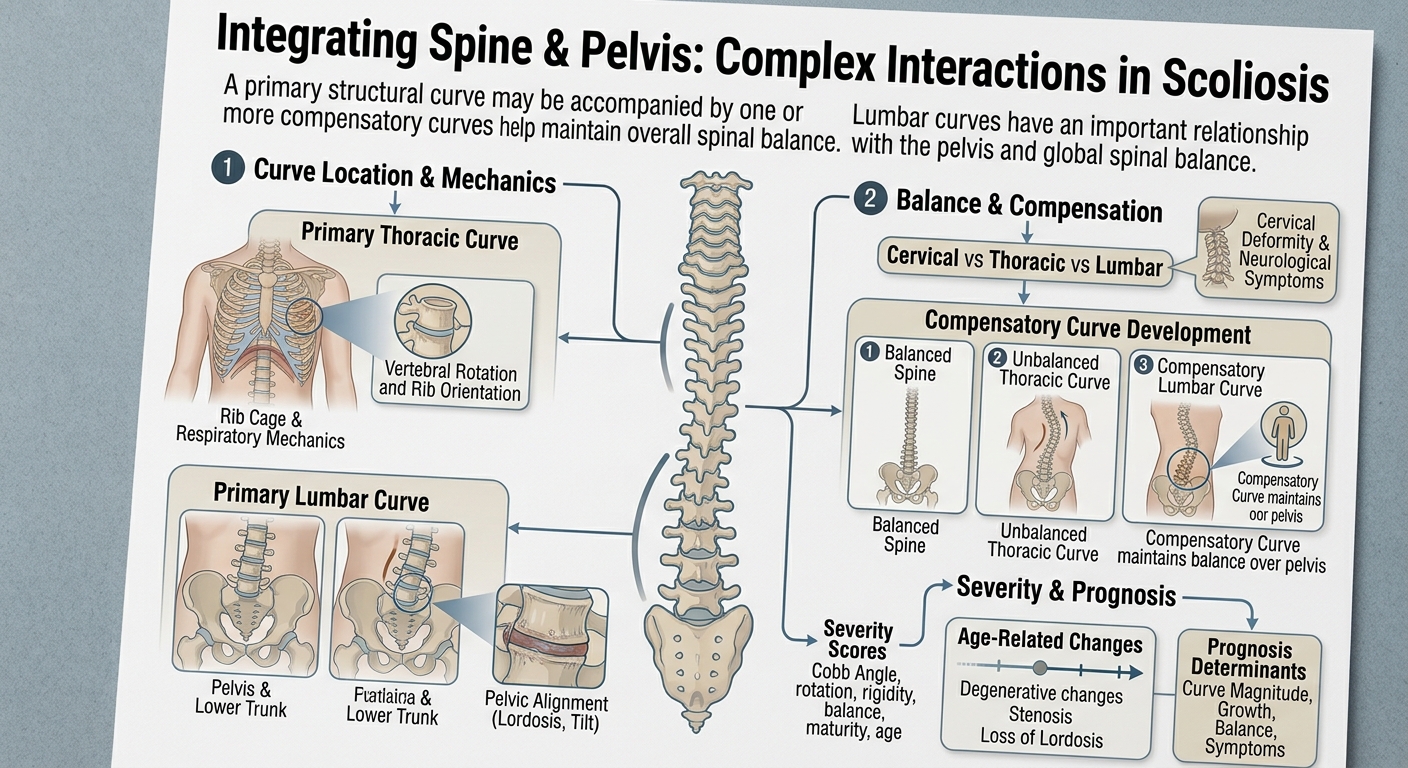
The body may develop compensatory curves above or below the primary structural curve in an attempt to maintain an upright posture and keep the head positioned over the pelvis. [2]
This is one reason why evaluating the entire spine and pelvis is often more informative than examining a single spinal segment.
---
Lumbar Scoliosis and Low-Back Pain
Lumbar scoliosis is often associated with lower-back symptoms, particularly in adults.
However, the relationship between scoliosis and pain is complex.
In adult scoliosis, degenerative changes involving the intervertebral discs and facet joints can contribute to:
- low-back pain
- stiffness
- foraminal narrowing
- spinal stenosis
- leg pain
- numbness
- muscle fatigue
The SRS notes that adult scoliosis can become more symptomatic because degenerative changes may narrow spaces around the spinal canal and nerves. [5]
Therefore, adult lumbar scoliosis should be distinguished from adolescent idiopathic scoliosis, even when both involve a lateral spinal curve.
---
Lumbar Scoliosis and Leg Symptoms
A lumbar curve does not necessarily cause neurological symptoms.
However, degenerative changes associated with adult lumbar scoliosis may contribute to narrowing around nerve roots.
Patients may experience:
- radiating leg pain
- numbness
- tingling
- weakness
- cramping
- difficulty walking for prolonged periods
These symptoms may indicate nerve compression and require clinical assessment.
The presence of leg symptoms therefore changes the clinical context considerably compared with an otherwise asymptomatic structural curve.
---
Thoracolumbar Scoliosis
Between the thoracic and lumbar regions is the thoracolumbar junction.
The SRS defines thoracolumbar scoliosis as a curve with its apex at T12, L1, or the T12–L1 disc. [1]
This region is mechanically important because it represents a transition between the relatively rigid thoracic spine and the more mobile lumbar spine.
A thoracolumbar curve can therefore influence:
- trunk balance
- rib and waist symmetry
- lumbar alignment
- pelvic compensation
- sagittal posture
Thoracolumbar curves may also coexist with compensatory curves elsewhere in the spine.
---
Cervical vs. Thoracic vs. Lumbar Scoliosis: Key Differences
The major differences can be summarized as follows.
| Feature | Cervical Scoliosis | Thoracic Scoliosis | Lumbar Scoliosis | | ---------------------------- | --------------------------------------------- | ---------------------------------------- | ------------------------------------------------- | | Primary region | Neck | Upper/mid back | Lower back | | Main anatomical relationship | Head and cervical neural structures | Rib cage and thoracic organs | Pelvis and lower trunk | | Typical visible findings | Head/neck tilt or asymmetry | Shoulder/rib asymmetry | Waist/trunk asymmetry | | Rib prominence | Usually less prominent | Often more apparent | Usually less prominent | | Respiratory relevance | Usually indirect | Most direct | Usually limited | | Neurological concern | Particularly important if cord/roots affected | Depends on cause and severity | Radiculopathy/stenosis can be important in adults | | Sagittal alignment | Cervical lordosis and head balance | Thoracic kyphosis | Lumbar lordosis and pelvic alignment | | Common adult concern | Cervical deformity and neurological symptoms | Global deformity | Degeneration, stenosis, pain | | Main structural measurement | Cobb angle plus regional alignment | Cobb angle, rotation, thoracic alignment | Cobb angle plus lumbar/pelvic alignment |
This table is a simplification. Many patients have multiple structural curves, and the clinical significance of each curve depends on the overall three-dimensional spinal configuration.
---
Why Location Alone Does Not Determine Severity
It is tempting to assume that one type of scoliosis is inherently more serious than another.
That is not medically accurate.
A small cervical curve may be clinically less significant than a large lumbar curve, while a moderate thoracic curve may be more relevant to chest-wall mechanics than a similarly sized lumbar curve.
Severity depends on multiple variables, including:
- Cobb angle
- curve location
- curve length
- vertebral rotation
- structural rigidity
- sagittal alignment
- coronal balance
- pelvic alignment
- skeletal maturity
- age
- underlying etiology
- neurological findings
- symptoms
- progression over time
Therefore, location is a classification feature, not a complete severity score.
---
How the Cobb Angle Is Used Across Different Regions
The Cobb angle is commonly used to quantify the magnitude of a scoliosis curve.
The measurement is obtained from standing spinal radiographs by identifying the end vertebrae of the curve and measuring the angle between their endplates or corresponding perpendicular lines.
The same basic principle applies to cervical, thoracic, thoracolumbar, and lumbar curves.
However, the clinical interpretation of the same Cobb angle can differ depending on the curve's location.
For example, a 40-degree thoracic curve and a 40-degree lumbar curve are numerically similar in magnitude, but they may produce very different effects on:
- chest-wall shape
- rib prominence
- shoulder balance
- lumbar lordosis
- pelvic compensation
- overall sagittal and coronal alignment
This is why the Cobb angle should always be interpreted within the context of the complete spinal deformity.
---
Coronal Alignment vs. Sagittal Alignment
Scoliosis is usually recognized because of abnormal curvature when viewing the spine from the front or back.
This represents the coronal plane.
However, the spine also has important curves when viewed from the side.
These include:
- cervical lordosis
- thoracic kyphosis
- lumbar lordosis
These normal sagittal curves work together to position the head and trunk over the pelvis. [2]
A patient can therefore have a significant scoliosis curve while also having abnormalities in sagittal alignment.
This is particularly important in adult spinal deformity, where loss of lumbar lordosis and global sagittal imbalance can become major determinants of disability and treatment planning. [5]
---
Compensatory Curves
The spine does not always develop only one curve.
A structural curve may be accompanied by one or more compensatory curves above or below it.
A compensatory curve may develop as the body attempts to maintain overall spinal balance.
For example, a primary thoracic curve may be accompanied by a lumbar curve that helps keep the trunk and head aligned over the pelvis.
The SRS describes a compensatory curve as a secondary curve located above or below a structural curvature that develops to help maintain normal body alignment. [2]
This concept is essential when interpreting scoliosis X-rays.
Treating or correcting one curve without considering the balance of the entire spine can have consequences for global alignment.
---
How the Location of Scoliosis Influences Symptoms
Symptoms vary significantly according to curve location.
Cervical curves may be associated with:
- neck discomfort
- head or neck imbalance
- restricted movement
- neurological symptoms when neural structures are involved
Thoracic curves may be associated with:
- shoulder asymmetry
- rib prominence
- trunk rotation
- chest-wall asymmetry
- respiratory effects in severe cases
Lumbar curves may be associated with:
- lower-back pain
- stiffness
- waist asymmetry
- pelvic imbalance
- leg symptoms when degenerative nerve compression develops
However, these are potential associations, not diagnostic rules.
A patient may have substantial scoliosis without pain, while another patient with a smaller curve may experience significant symptoms because of another spinal or musculoskeletal condition.
---
Why Age Matters
The same curve location can have very different clinical implications depending on the patient's age.
In adolescents, idiopathic scoliosis is often evaluated primarily in relation to:
- curve magnitude
- growth remaining
- skeletal maturity
- progression risk
- balance and deformity
In adults, additional factors become increasingly important:
- disc degeneration
- facet-joint degeneration
- spinal stenosis
- loss of lumbar lordosis
- sagittal imbalance
- neurological symptoms
The SRS notes that adolescent idiopathic curves can continue to progress in adulthood, particularly when curves are already substantial, while degenerative changes can also contribute to worsening adult deformity. [5]
---
How Doctors Diagnose the Different Types
A comprehensive scoliosis assessment may include several components.
1. Clinical Examination
The clinician may assess:
- posture
- shoulder level
- pelvic level
- trunk shift
- spinal range of motion
- rib prominence
- neurological function
- gait
2. Standing Radiographs
Standing full-spine radiographs allow assessment of:
- Cobb angle
- curve location
- curve pattern
- vertebral alignment
- coronal balance
- sagittal alignment
3. Bending Radiographs
Side-bending radiographs may be used to evaluate curve flexibility and help distinguish structural curves from more flexible compensatory curves.
4. Advanced Imaging
MRI or CT may be appropriate in selected patients, particularly when there are neurological findings, atypical curve patterns, congenital abnormalities, suspected tumors, infection, or other concerning features.
The need for additional imaging depends on the clinical situation rather than the scoliosis label alone.
---
Does Cervical, Thoracic, or Lumbar Scoliosis Require Different Treatment?
Potentially, yes.
Treatment is individualized according to:
- age
- skeletal maturity
- Cobb angle
- progression
- symptoms
- curve pattern
- structural rigidity
- sagittal and coronal alignment
- neurological findings
- underlying cause
For children and adolescents, observation, scoliosis-specific exercise, and bracing may be considered in appropriate situations, particularly when substantial growth remains.
For adults, treatment may focus more heavily on pain, neurological compression, degeneration, functional limitation, and global spinal balance.
Surgery is generally considered when the expected benefits outweigh the risks and when deformity, progression, neurological compromise, or symptoms justify operative treatment.
Therefore, there is no single treatment algorithm based solely on whether a curve is cervical, thoracic, or lumbar.
---
When Should Patients Be More Concerned?
Patients should seek professional evaluation when scoliosis is associated with:
- rapidly increasing curvature
- persistent or worsening pain
- neurological symptoms
- weakness
- numbness or tingling
- changes in walking or balance
- significant exercise intolerance
- unexplained breathing problems
- bowel or bladder changes
- major changes in posture or spinal balance
Some symptoms may indicate conditions other than scoliosis and should not be ignored.
In particular, new neurological symptoms involving the arms or legs require appropriate medical evaluation.
---
Frequently Asked Questions
Is thoracic scoliosis worse than lumbar scoliosis?
Not necessarily.
Thoracic and lumbar scoliosis have different anatomical consequences. Thoracic curves can have greater implications for rib-cage shape and, in severe cases, respiratory mechanics, while lumbar curves may be more closely associated with pelvic alignment, low-back symptoms, degeneration, and nerve compression in adults. [4, 5]
Which type of scoliosis is most common?
Adolescent idiopathic scoliosis most commonly involves thoracic, thoracolumbar, lumbar, or combined curve patterns. Cervical scoliosis is considerably less common as an isolated pattern.
Can cervical scoliosis cause headaches?
It can be associated with neck muscle tension or altered head-neck mechanics, but headache has many possible causes. A cervical curve should not automatically be considered the cause of a headache.
Can lumbar scoliosis cause leg pain?
It can, particularly in adults when degenerative changes produce foraminal or central spinal narrowing. However, leg pain can have many other causes.
Can thoracic scoliosis affect breathing?
Yes, particularly when a substantial thoracic deformity alters the shape and mechanics of the rib cage. Mild or moderate thoracic scoliosis does not necessarily cause clinically important respiratory impairment. [4]
Does a larger Cobb angle always mean more symptoms?
No.
Cobb angle is an important structural measurement, but symptoms are influenced by many other factors, including location, rotation, sagittal alignment, degeneration, neurological involvement, and individual sensitivity.
---
Key Takeaways
The distinction between cervical, thoracic, and lumbar scoliosis is primarily anatomical, but the anatomical location has important clinical consequences.
Cervical scoliosis involves the neck and may have particular relevance to head-neck alignment and neurological structures.
Thoracic scoliosis involves the rib-bearing portion of the spine and can produce characteristic rib and shoulder asymmetry. Severe thoracic deformity may also affect respiratory mechanics.
Lumbar scoliosis involves the lower back and has a close relationship with lumbar lordosis, pelvic alignment, degeneration, low-back pain, and possible nerve compression in adults.
The most important principles are:
- Scoliosis is a three-dimensional spinal deformity, not simply a sideways curve.
- Curve location is determined by the location of the curve apex. [1]
- Cervical, thoracic, and lumbar curves can have different clinical implications because their surrounding anatomy differs.
- Thoracic curves have a particularly important relationship with the rib cage and respiratory mechanics.
- Lumbar curves have an important relationship with the pelvis and global spinal balance.
- Cervical deformity deserves particular attention when neurological symptoms are present.
- Cobb angle is essential but does not completely describe scoliosis severity.
- Vertebral rotation, sagittal alignment, coronal balance, pelvic alignment, and skeletal maturity should also be considered.
- A patient's symptoms cannot be predicted from curve location or Cobb angle alone.
- Individual evaluation is essential for determining prognosis and treatment.
---
Important Precautions & Medical Disclaimer
This article is intended for general educational purposes and does not replace professional medical evaluation, diagnosis, or individualized treatment.
Scoliosis can have many causes, including idiopathic, congenital, neuromuscular, degenerative, and other less common conditions. The clinical significance of a cervical, thoracic, thoracolumbar, or lumbar curve depends on the patient's age, skeletal maturity, curve magnitude, structural characteristics, symptoms, neurological findings, and overall spinal alignment.
A Cobb angle should not be interpreted in isolation.
Patients experiencing progressive pain, weakness, numbness, gait disturbance, significant breathing difficulty, bowel or bladder changes, or other new neurological symptoms should seek appropriate medical evaluation.
---
Conclusion
Cervical, thoracic, and lumbar scoliosis are not simply different names for the same condition in different parts of the spine. Their anatomical location changes the structures affected by the deformity and can influence symptoms, biomechanics, evaluation, and treatment planning.
The cervical spine is closely related to head position, neck function, and neurological structures. The thoracic spine is connected to the rib cage and therefore has a unique relationship with chest-wall symmetry and respiratory mechanics. The lumbar spine interacts closely with the pelvis and plays a major role in load transmission, lumbar lordosis, and global spinal balance.
At the same time, scoliosis should always be evaluated as a whole-spine, three-dimensional deformity.
A complete assessment may therefore consider the Cobb angle together with vertebral rotation, posture symmetry, sagittal and coronal alignment, pelvic parameters, skeletal maturity, neurological findings, and the patient's symptoms.
Understanding the differences between cervical, thoracic, and lumbar scoliosis provides patients and families with a more accurate framework for interpreting imaging findings and discussing treatment options with their healthcare professionals.
---
References
[1] Scoliosis Research Society. Glossary of Terms. Scoliosis Research Society.
[2] Scoliosis Research Society. Glossary of Terms – Patients and Families. Scoliosis Research Society.
[3] Ames CP, et al. Classification of cervical deformity based on curve apex location and regional/global alignment. PubMed.
[4] Zhang J, et al. Is impaired lung function related to spinal deformities in patients with adolescent idiopathic scoliosis? A systematic review and meta-analysis—SOSORT 2019 award paper. European Spine Journal. 2022.
[5] Scoliosis Research Society. Scoliosis in Adults. Scoliosis Research Society.