Idiopathic Scoliosis
[Scoliosis Basics & Fundamentals 14] How Scoliosis Impacts Lung Capacity and Breathing
How Scoliosis Impacts Lung Capacity and Breathing: A Complete Guide
Learn how scoliosis can affect lung capacity and breathing, how thoracic curves and Cobb angle influence pulmonary function, and when respiratory evaluation may be needed.
---
Introduction
Scoliosis is more than a sideways curve of the spine. It is a three-dimensional spinal deformity that can involve lateral curvature, vertebral rotation, and changes in the normal alignment and shape of the thoracic spine. Because the thoracic spine and rib cage form an important part of the mechanical system that allows the lungs to expand, significant thoracic scoliosis can affect breathing and pulmonary function in some patients. [1, 2]
For many people with scoliosis, particularly those with mild or moderate adolescent idiopathic scoliosis, lung function remains adequate for normal daily activities. However, research shows that increasing thoracic curve severity can be associated with measurable reductions in pulmonary function. The relationship is not necessarily limited to extremely severe curves; rather, pulmonary function may decline gradually as thoracic deformity becomes more pronounced. [3]
This naturally raises an important question for patients and parents: Can scoliosis make it harder to breathe?
The answer is yes, in some patients—but scoliosis does not automatically mean that a person has impaired lung function. The respiratory impact depends on several factors, including the location and magnitude of the spinal curve, vertebral rotation, thoracic shape, age at onset, skeletal maturity, and whether the developing chest is significantly affected. [2, 3, 4]
Understanding this relationship can help patients and families recognize when respiratory evaluation may be appropriate without creating unnecessary fear.
---
How Does Scoliosis Affect Breathing?
The Spine and Rib Cage Are Mechanically Connected
Normal breathing depends on coordinated movement of the diaphragm, ribs, chest wall, and respiratory muscles. During inspiration, the diaphragm contracts and moves downward while the rib cage expands, increasing the volume available for the lungs. [2]
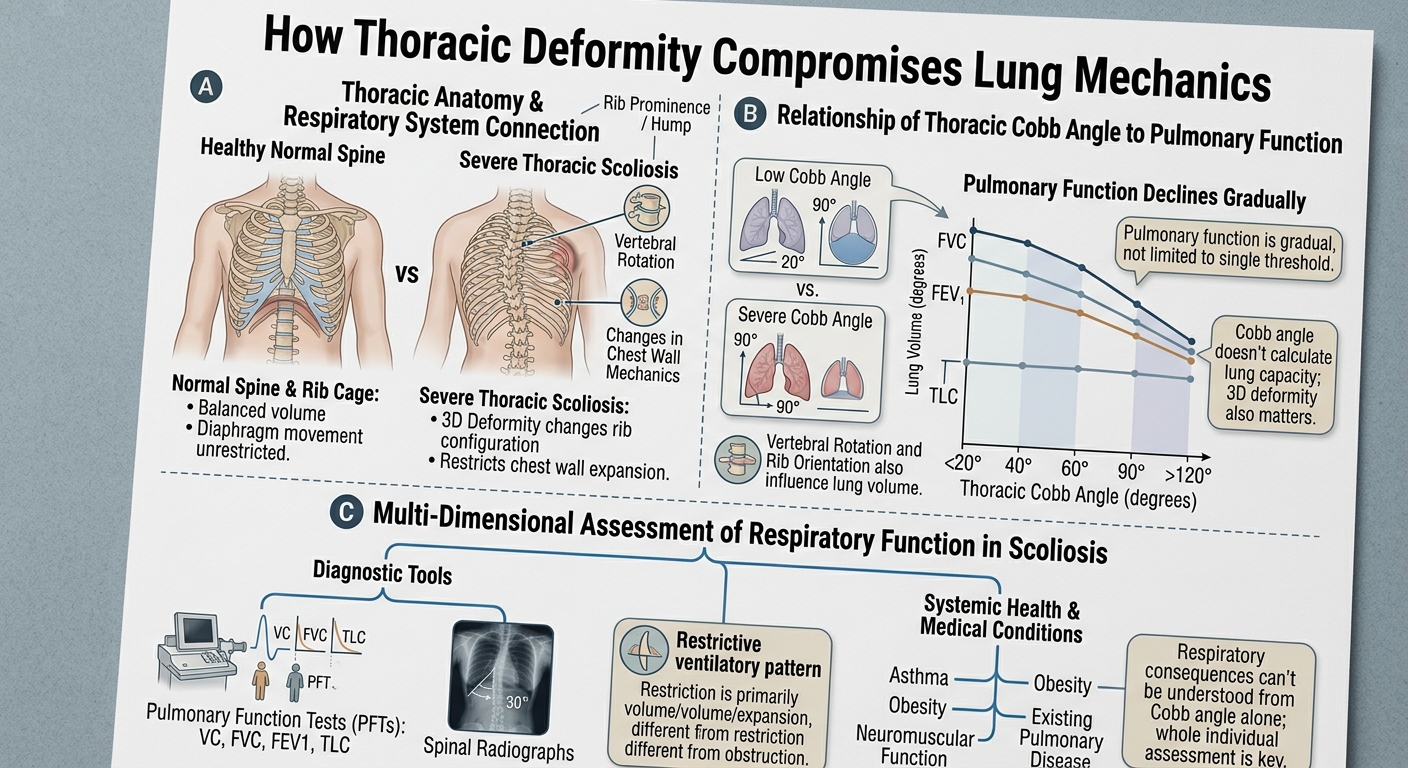
The thoracic spine is an integral part of this system because the ribs attach to the thoracic vertebrae. When scoliosis changes the three-dimensional geometry of the thoracic spine, it can also alter the shape and movement of the rib cage. [2, 4]
A significant thoracic curve may therefore produce:
- asymmetry of the chest wall
- vertebral rotation
- rib prominence
- altered rib orientation
- reduced thoracic volume
- changes in chest-wall mechanics
- reduced efficiency of lung expansion
The respiratory problem is therefore not simply that a curved spine "presses against the lungs." Instead, scoliosis can change the three-dimensional architecture of the thorax and make expansion of the chest mechanically less efficient. [2, 4]
---
Why Thoracic Scoliosis Is More Relevant to Lung Function
Not all scoliosis curves have the same potential effect on breathing.
A lumbar curve primarily affects the lower back and generally has less direct mechanical influence on the lungs. A substantial thoracic curve, by contrast, involves the portion of the spine connected to the ribs and therefore has a much more direct relationship with the mechanics of the chest. [3, 4]
This is one reason why two patients with similar overall Cobb angles can have different respiratory outcomes.
Important factors include:
- location of the curve
- thoracic Cobb angle
- number of vertebrae involved
- vertebral rotation
- thoracic kyphosis
- rib-cage configuration
- sagittal and coronal alignment
- age at onset
- skeletal maturity
- underlying cause of scoliosis
Consequently, the Cobb angle should be considered an important measurement rather than a complete description of respiratory risk.
---
What Is the Cobb Angle?
The Cobb angle is the standard radiographic measurement used to quantify the magnitude of a scoliosis curve. It is measured on a spinal X-ray between selected vertebrae that define the upper and lower boundaries of the curve. [1]
Cobb angle is important because larger curves generally represent greater structural deformity. However, it primarily describes the magnitude of curvature in the coronal plane. It does not fully describe vertebral rotation, rib-cage deformity, thoracic volume, or three-dimensional spinal alignment. [1, 4]
This distinction becomes particularly important when discussing breathing.
A patient with a relatively large Cobb angle may have acceptable pulmonary function, while another patient with a different three-dimensional thoracic configuration may experience greater mechanical restriction.
Therefore:
Cobb angle is important—but it is not a direct measurement of lung capacity.
---
What Does Research Show About Cobb Angle and Lung Function?
A major systematic review and meta-regression analysis examined 126 studies involving 8,723 children and adolescents with untreated idiopathic scoliosis. The researchers found a statistically significant inverse relationship between thoracic Cobb angle and several measures of pulmonary function, including forced vital capacity, vital capacity, and total lung capacity. [3]
Importantly, the researchers reported that pulmonary function appeared to decline gradually across the range of Cobb angles studied, from curves below 20 degrees to curves exceeding 120 degrees. This challenges the older assumption that clinically relevant respiratory effects occur only after a single very large curve threshold is reached. [3]
The study estimated that, for several pulmonary-function outcomes, predicted pulmonary function decreased by approximately 1% for every 2.6 to 4.5 degrees of scoliosis. However, these figures describe relationships observed across populations and should not be used to predict the lung function of an individual patient. [3]
This distinction is critical.
A statistical association between Cobb angle and pulmonary function does not mean that a particular patient's lung capacity can be calculated simply from an X-ray.
---
Understanding Pulmonary Function Tests
Doctors can use pulmonary function tests (PFTs) to objectively assess respiratory function.
Common measurements include:
Forced Vital Capacity (FVC)
FVC is the amount of air a person can forcefully exhale after taking a maximal breath.
Forced Expiratory Volume in One Second (FEV1)
FEV1 measures how much air can be exhaled during the first second of a forced expiration.
Total Lung Capacity (TLC)
TLC represents the total amount of air contained in the lungs after maximal inhalation.
Vital Capacity (VC)
VC represents the maximum volume of air that can be exhaled after taking a maximal breath.
These measurements can help clinicians determine whether a patient has a pattern suggestive of restrictive or obstructive respiratory impairment.
---
Scoliosis and Restrictive Lung Function
When scoliosis significantly alters the shape and mechanics of the thorax, pulmonary impairment may resemble a restrictive ventilatory pattern.
In a restrictive pattern, the total amount of air that can be accommodated by the respiratory system may be reduced. The problem is therefore primarily one of volume and expansion rather than obstruction of the airways.
This is different from conditions such as asthma, where airway narrowing is a major component of the problem.
However, clinicians should not automatically attribute abnormal pulmonary function to scoliosis. Other conditions—including obesity, asthma, chronic lung disease, neuromuscular disorders, and cardiovascular disease—can also affect pulmonary measurements.
Proper interpretation therefore requires consideration of the patient's entire clinical picture.
---
How Vertebral Rotation Can Affect Breathing
Scoliosis is a three-dimensional deformity. As the spine curves, individual vertebrae may also rotate.
This rotation can alter the position and orientation of the ribs, producing an asymmetric thoracic cage. One of the most visible manifestations is the rib hump, which may become apparent during a forward-bending examination. [4]
A systematic review and meta-analysis of adolescent idiopathic scoliosis found that larger thoracic Cobb angles and greater thoracic apical vertebral rotation were associated with poorer pulmonary function, although the authors emphasized that the available evidence was limited in quality. [4]
This finding is clinically relevant because it reinforces an important principle:
The respiratory consequences of scoliosis cannot be understood from a two-dimensional Cobb angle alone.
The three-dimensional relationship among spinal curvature, vertebral rotation, rib orientation, thoracic volume, and chest-wall mechanics also matters.
---
Does Every Person With Scoliosis Have Reduced Lung Capacity?
No.
This is perhaps the most important point for patients and parents.
Many individuals with scoliosis have normal or near-normal respiratory function, especially when the spinal deformity is relatively modest and does not substantially distort the thoracic cage. [3, 4]
The risk of clinically important respiratory impairment is generally greater when there is substantial thoracic deformity, particularly in severe curves and certain forms of early-onset scoliosis.
Therefore, receiving a diagnosis of scoliosis does not automatically mean that a patient has reduced lung capacity.
The appropriate approach is to assess the individual's curve pattern, symptoms, age, growth status, and overall health rather than assuming respiratory impairment from the diagnosis alone.
---
Severe Scoliosis and Breathing Problems
The respiratory implications become more important as thoracic deformity becomes severe.
Historically, patients with very large curves—particularly curves approaching 90–100 degrees—have been considered at greater risk of significant cardiopulmonary complications. However, contemporary research suggests that pulmonary function may decline progressively rather than suddenly crossing a single universal threshold. [3]
This does not mean that every patient with a large curve will develop respiratory failure.
Rather, curve magnitude should be considered one component of a broader assessment that includes:
- thoracic deformity
- vertebral rotation
- sagittal alignment
- rib-cage shape
- age
- skeletal maturity
- underlying diagnosis
- neuromuscular function
- cardiovascular health
- existing pulmonary disease
---
Early-Onset Scoliosis and Lung Development
The relationship between scoliosis and respiratory function is particularly important in early-onset scoliosis (EOS).
When significant spinal deformity develops during early childhood, the problem is not limited to the immediate mechanics of breathing. The chest and lungs are still developing during childhood, and severe thoracic deformity can interfere with normal thoracic growth. [2]
One condition associated with severe thoracic deformity is thoracic insufficiency syndrome (TIS).
The Scoliosis Research Society defines TIS as the inability of the thorax to support normal breathing and lung growth. The thorax—including the spine, rib cage, and sternum—must have sufficient space and mobility to support respiration and normal lung development. [2]
In severe cases, abnormalities in thoracic volume, symmetry, and function can compromise the respiratory system.
This is one reason children with very early-onset or severe thoracic scoliosis may require specialized evaluation.
---
What Symptoms Can Indicate Breathing Problems?
Mild reductions in pulmonary function may cause no obvious symptoms.
When respiratory impairment becomes clinically significant, however, patients may experience:
- shortness of breath
- reduced exercise tolerance
- unusual fatigue
- rapid breathing
- difficulty keeping up with peers
- breathlessness during physical activity
- labored breathing
In severe thoracic insufficiency, extreme breathlessness and fatigue can occur. [2]
Importantly, these symptoms are not specific to scoliosis.
Shortness of breath can result from asthma, respiratory infections, anemia, cardiovascular disease, obesity, physical deconditioning, anxiety, and numerous other conditions.
A patient should therefore not assume that every episode of breathlessness is caused by scoliosis.
---
How Do Doctors Evaluate Respiratory Function in Scoliosis?
Medical History
A clinician may ask about:
- shortness of breath
- exercise tolerance
- fatigue
- sleep-related breathing problems
- previous lung disease
- progression of scoliosis
- age at onset
- neurological symptoms
- underlying medical conditions
Physical Examination
The examination may include assessment of:
- spinal alignment
- posture symmetry
- chest-wall movement
- respiratory effort
- neurological function
- overall physical development
Spinal Imaging
Standing spinal radiographs are commonly used to determine the Cobb angle and evaluate curve location, spinal alignment, and other structural characteristics. [1]
X-rays, however, do not directly measure lung capacity.
Pulmonary Function Testing
When clinically indicated, pulmonary function testing may provide objective information about respiratory mechanics.
Depending on the patient's age and clinical circumstances, testing may include:
- FVC
- FEV1
- FEV1/FVC
- TLC
- VC
- other lung-volume measurements
The Scoliosis Research Society lists pulmonary function studies among the diagnostic tools that may be used when evaluating thoracic insufficiency. [2]
---
Can Scoliosis Cause Low Oxygen Levels?
A diagnosis of scoliosis does not automatically mean that blood oxygen levels will be low.
Most patients with mild or moderate scoliosis do not develop clinically significant oxygen deficiency simply because their spine is curved.
However, severe thoracic deformity can interfere substantially with ventilation. In advanced thoracic insufficiency, impaired ventilation can contribute to problems with oxygenation and carbon-dioxide removal. [2]
This distinction is important:
Reduced pulmonary function is not the same thing as dangerous oxygen deprivation.
At the same time, severe or persistent breathing difficulties should never be dismissed simply because the patient has scoliosis.
---
Does Scoliosis Reduce Exercise Capacity?
In some patients, yes.
Exercise places increased demands on the respiratory and cardiovascular systems. If thoracic deformity limits ventilatory capacity, a patient may have less respiratory reserve during physical activity.
Possible symptoms include:
- becoming breathless sooner than peers
- reduced endurance
- unusual fatigue
- difficulty with prolonged vigorous exercise
However, reduced exercise capacity is not necessarily caused by pulmonary impairment.
Physical conditioning, cardiovascular fitness, body composition, muscle strength, pain, and other medical conditions can all affect exercise performance.
Therefore, persistent exercise intolerance should be evaluated rather than automatically attributed to scoliosis.
---
Can Scoliosis Treatment Improve Lung Function?
Treatment decisions for scoliosis are generally based on factors such as curve magnitude, progression, skeletal maturity, age, symptoms, underlying cause, and overall clinical circumstances.
In severe deformity, however, maintaining or improving thoracic function can be an important consideration.
The Scoliosis Research Society describes the goals of scoliosis surgery primarily in terms of preventing progression and achieving correction of the spinal curve. The respiratory implications of surgery vary according to the patient's diagnosis, age, deformity, and procedure. [5]
It is therefore inappropriate to promise that surgical correction will automatically restore normal lung capacity.
Similarly, treatment should not be selected solely on the basis of a single pulmonary measurement.
---
Can Exercise or Breathing Exercises Prevent Lung Problems?
Regular physical activity is generally important for cardiovascular fitness, muscle function, general health, and quality of life.
However, maintaining physical fitness is different from correcting the structural mechanics of severe thoracic scoliosis.
Breathing exercises may have a role in selected patients, particularly when incorporated into an individualized rehabilitation program, but they should not be presented as a guaranteed way to prevent pulmonary impairment caused by structural spinal deformity.
Likewise, exercise should not be represented as a universal method of straightening a structural scoliosis curve.
Any exercise or respiratory program should be appropriate for the individual's age, diagnosis, symptoms, curve characteristics, and medical status.
---
Common Myths About Scoliosis and Breathing
Myth 1: Everyone with scoliosis will eventually develop lung problems.
False.
Many people with scoliosis maintain normal respiratory function. The potential respiratory impact depends on the severity and location of the deformity and other individual factors. [3, 4]
Myth 2: Lung problems occur only when the curve reaches 90 degrees.
This is an oversimplification.
Research indicates that pulmonary function may decline gradually as thoracic Cobb angle increases rather than suddenly changing at one universal threshold. [3]
Myth 3: The Cobb angle tells you exactly how well a person can breathe.
It does not.
The Cobb angle measures spinal curvature but does not directly measure lung capacity or completely describe the three-dimensional shape of the thorax. [1, 4]
Myth 4: Any shortness of breath in a person with scoliosis is caused by the scoliosis.
Not necessarily.
Respiratory symptoms have many possible causes and should be evaluated appropriately.
---
When Should Parents Seek Medical Evaluation?
Parents should discuss respiratory symptoms with a healthcare professional if a child with scoliosis develops:
- persistent shortness of breath
- unexplained exercise intolerance
- unusual fatigue
- labored breathing
- rapidly progressive spinal deformity
- significant early-onset scoliosis
- sleep-related breathing concerns
- neurological symptoms
- signs suggesting a neuromuscular or congenital condition
Children with early-onset scoliosis deserve particular attention because severe thoracic deformity during a period of rapid chest and lung development may affect both respiratory mechanics and lung growth. [2]
---
Key Takeaways for Patients and Parents
The relationship between scoliosis and breathing is real, but its clinical significance varies considerably between individuals.
The most important points are:
- Scoliosis can affect pulmonary function, particularly when a significant thoracic deformity alters the mechanics of the chest. [2–4]
- Thoracic curves are more directly relevant to respiratory mechanics than isolated lumbar curves. [3, 4]
- Larger thoracic Cobb angles are associated with poorer pulmonary function at the population level, although individual patients can differ substantially. [3]
- Vertebral rotation and three-dimensional thoracic deformity also matter. [4]
- Severe early-onset scoliosis can affect thoracic development and lung growth. [2]
- Not every person with scoliosis has impaired breathing. [3, 4]
- Pulmonary function testing can provide objective information when respiratory symptoms or the severity and type of spinal deformity warrant further assessment. [2]
- Breathing symptoms should not automatically be attributed to scoliosis, because many other conditions can cause similar symptoms.
---
Important Precautions & Medical Disclaimer
This article is intended for general educational and informational purposes. It does not replace an examination, diagnosis, or individualized treatment plan from a qualified healthcare professional.
A Cobb angle, spinal X-ray, pulmonary function test, or symptom description cannot by itself determine an individual's respiratory risk. Proper assessment should consider age, skeletal maturity, curve pattern, thoracic anatomy, underlying cause of scoliosis, respiratory symptoms, general health, and other relevant findings.
Patients or children with persistent shortness of breath, significant exercise intolerance, rapidly worsening symptoms, neurological changes, or other concerning symptoms should seek appropriate medical evaluation.
Children with early-onset scoliosis, severe thoracic deformity, neuromuscular scoliosis, congenital abnormalities, or suspected thoracic insufficiency may require assessment by specialists with expertise in pediatric spine and respiratory care.
Sudden or severe breathing difficulty—particularly when associated with chest pain, fainting, confusion, blue or gray discoloration, or severe respiratory distress—requires urgent medical attention.
---
Conclusion & Actionable Advice
Scoliosis can affect lung capacity and breathing because the spine and rib cage are mechanically connected to the respiratory system. When a significant thoracic deformity changes the three-dimensional shape and movement of the chest, lung expansion may become less efficient and pulmonary function may decline. [2–4]
Research indicates that larger thoracic Cobb angles are associated with lower measures of pulmonary function, including FVC and TLC. Importantly, this relationship appears to be gradual rather than dependent on one universal Cobb-angle threshold. [3]
The respiratory consequences of scoliosis also depend on factors beyond Cobb angle. Vertebral rotation, thoracic kyphosis, rib-cage configuration, age at onset, skeletal maturity, and the underlying cause of scoliosis can all influence respiratory mechanics. [2, 4]
For patients and parents, the most appropriate response is neither unnecessary fear nor false reassurance. Instead, it is appropriate monitoring, recognition of curve progression, attention to respiratory symptoms, and timely professional evaluation when concerns arise.
If a child has a significant or progressive thoracic curve—particularly when scoliosis begins at a young age—it may be appropriate for the treating team to consider both spinal alignment and respiratory development.
Scoliosis is a structural condition, but its impact is highly individual. Understanding the connection between spinal alignment, thoracic geometry, Cobb angle, vertebral rotation, and pulmonary function can help patients and families make better-informed decisions about long-term spine and respiratory health.
---
References
[1] Scoliosis Research Society. Scoliosis. Scoliosis Research Society.
[2] Scoliosis Research Society. Thoracic Insufficiency Syndrome (TIS). Scoliosis Research Society.
[3] Kempen DHR, Heemskerk JL, Kaçmaz G, Altena MC, Reesink HJ, Vanhommerig JW, Willigenburg NW. Pulmonary function in children and adolescents with untreated idiopathic scoliosis: a systematic review with meta-regression analysis. Spine Journal. 2022;22(7):1178–1190. doi:10.1016/j.spinee.2021.12.011.
[4] Is impaired lung function related to spinal deformities in patients with adolescent idiopathic scoliosis? A systematic review and meta-analysis—SOSORT 2019 award paper. European Spine Journal. 2022.
[5] Scoliosis Research Society. Surgery. Scoliosis Research Society.