Idiopathic Scoliosis
[Scoliosis Basics & Fundamentals 13] Is Scoliosis Hereditary? The Role of Genetics in Spinal Health
Learn how genetics and family history influence scoliosis risk, why scoliosis is not simply inherited from one parent, and what families should know about genetic risk and spinal health.
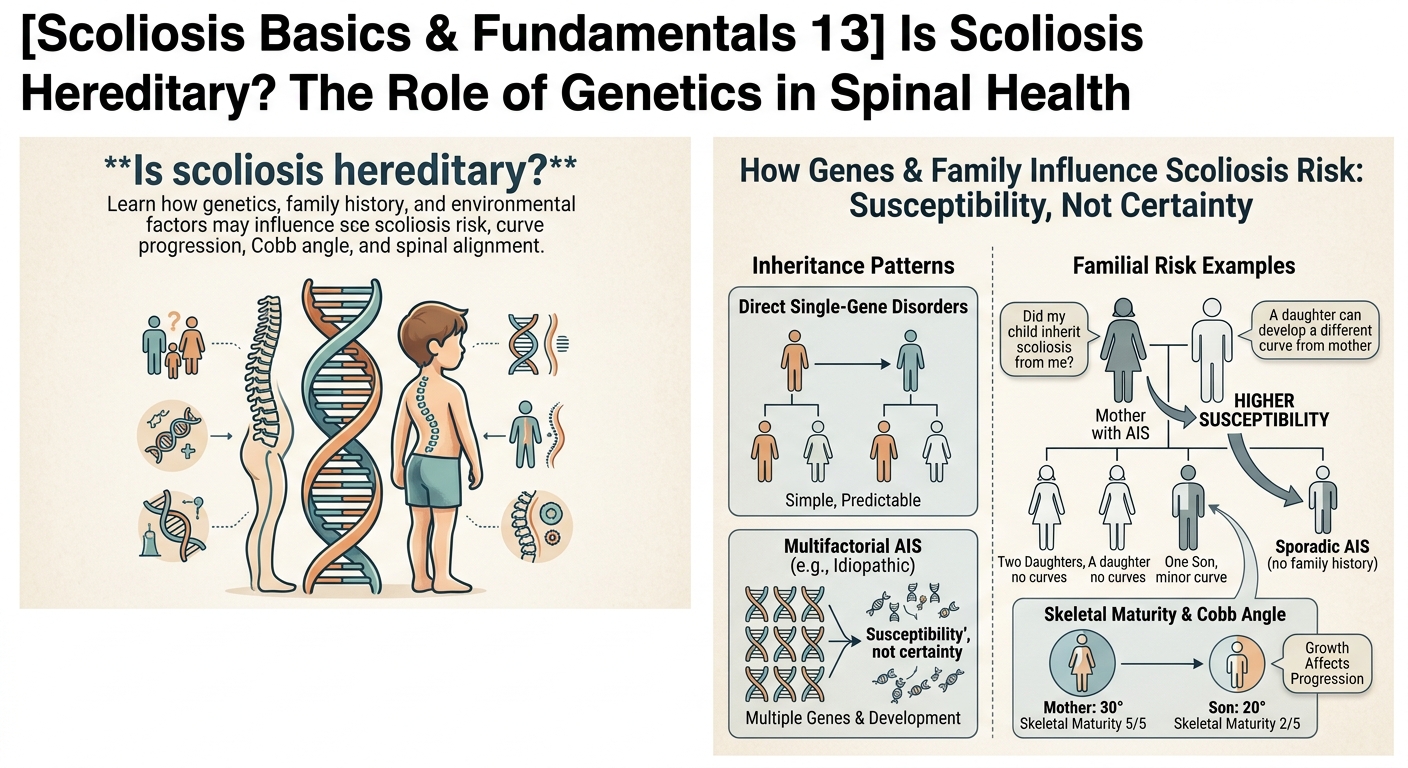
Is scoliosis hereditary? Learn how genetics, family history, and environmental factors may influence scoliosis risk, curve progression, Cobb angle, and spinal alignment.
---
Is Scoliosis Hereditary?
If a child is diagnosed with scoliosis, one of the first questions parents often ask is:
“Did my child inherit scoliosis from me?”
It is an understandable question. Parents naturally want to know whether their child's spinal curvature was something they could have prevented and whether other children in the family may also be at risk.
The short answer is that genetics appear to play an important role in scoliosis, but most scoliosis—especially adolescent idiopathic scoliosis—is not inherited in a simple, predictable way like some single-gene disorders. Instead, current evidence suggests that scoliosis can result from interactions among multiple genetic factors, growth and developmental processes, and possibly environmental or biomechanical influences. [1][2][3]
A family history of scoliosis can increase a person's likelihood of developing the condition, but having a parent or sibling with scoliosis does not mean that a child will definitely develop it. Likewise, many children and adults diagnosed with scoliosis have no known family history. [1][2]
For patients and parents, this distinction is important. Genetics may influence susceptibility, but susceptibility is not the same as certainty.
Understanding this difference can help families approach scoliosis with less fear and with a more realistic understanding of what family history means for spinal health.
---
What Does “Hereditary” Mean?
The words hereditary, genetic, and familial are sometimes used interchangeably, but they do not mean exactly the same thing.
A hereditary condition is generally one in which genetic information contributing to the condition can be passed from parents to children. A genetic condition may result from an inherited genetic variant, but genetic changes can also occur during a person's lifetime and may not be inherited. [4]
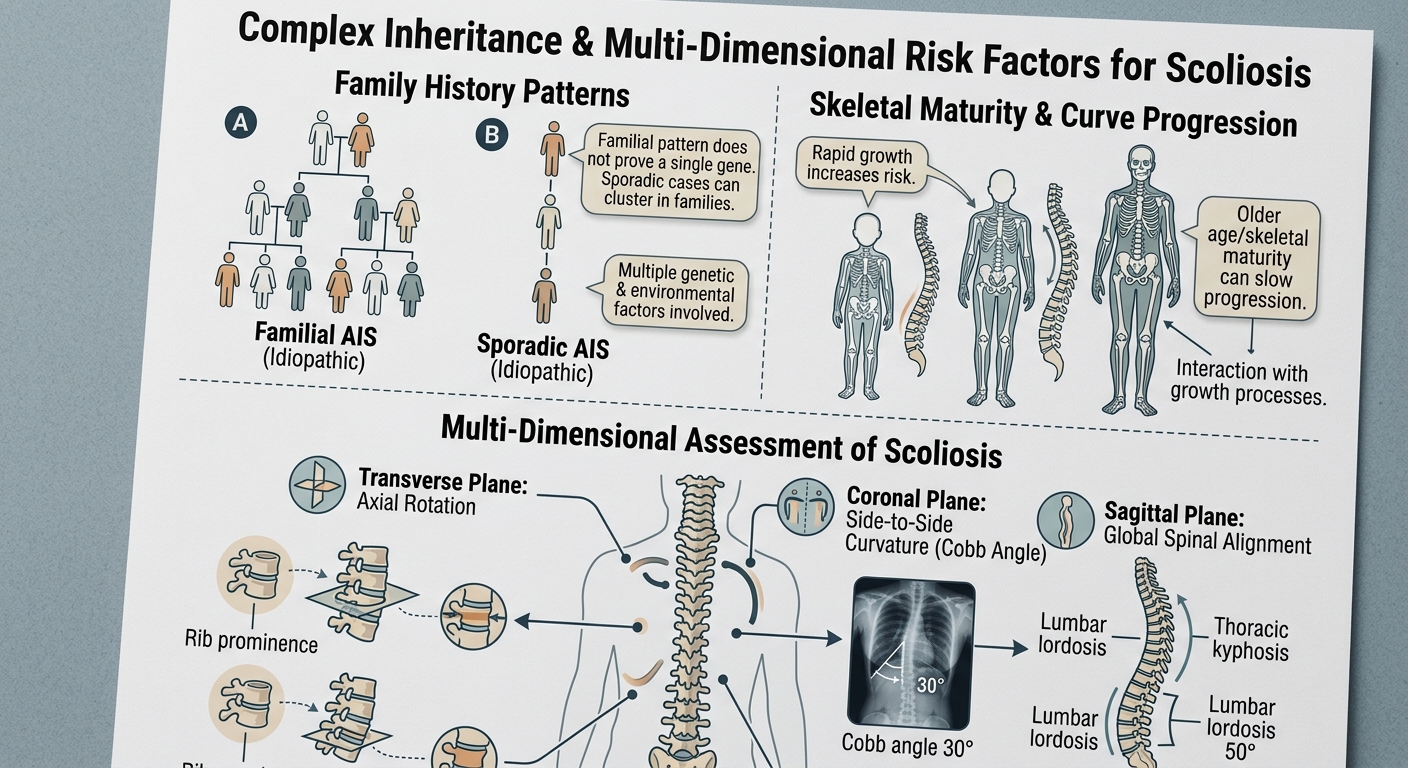
A condition is described as familial when it appears more frequently within a family than might be expected by chance. However, a familial pattern does not necessarily prove that a single gene is responsible. Family members share both genetic backgrounds and, to some extent, environmental and developmental circumstances. [5]
This distinction is particularly relevant to scoliosis.
In simple terms:
- Genetic means genes have a role.
- Hereditary means a genetic factor can be passed from parent to child.
- Familial means a condition appears to cluster within a family.
- Heritability is a population-level estimate of how much variation in a trait may be associated with genetic differences.
Therefore, saying that scoliosis has a genetic component does not mean that there is one “scoliosis gene” that determines whether a child will develop a spinal curve. [3][4][5]
---
Does Scoliosis Run in Families?
Yes. Idiopathic scoliosis can run in families.
The U.S. National Library of Medicine's MedlinePlus Genetics resource states that adolescent idiopathic scoliosis can occur sporadically, without a family history, or cluster in families. Having a close relative—such as a parent or sibling—with adolescent idiopathic scoliosis increases a child's risk. However, the exact inheritance pattern remains unclear because multiple genetic and environmental factors appear to be involved. [2]
This is an important distinction for parents.
If a mother has adolescent idiopathic scoliosis, for example, it does not mean that her daughter will automatically develop the same curve.
Instead, the child may have a higher susceptibility than someone without a family history.
The actual outcome can still depend on many factors, including skeletal growth, biological development, sex, age, curve characteristics, and potentially other genetic or environmental influences. [2][3]
---
What Does Research Tell Us About Heritability?
Researchers have investigated the genetic contribution to scoliosis using several approaches, including family studies and twin studies.
A systematic review and meta-analysis published in 2022 examined available family and twin studies of idiopathic scoliosis. The review found evidence for a hereditary component, but the results varied considerably among studies. A meta-analysis of three studies estimated narrow-sense heritability at approximately 0.57, with a wide 95% confidence interval of 0.29–0.86. [3]
This number requires careful interpretation.
A heritability estimate of 0.57 does not mean that “57% of an individual's scoliosis is genetic.”
Heritability is a statistical concept describing variation within a particular population under particular conditions. It does not predict the probability that one individual child will inherit scoliosis from a parent. [3][4]
For patients and families, the practical message is simpler:
Genetic factors clearly appear to contribute to idiopathic scoliosis, but they do not completely determine who will develop it or how severe the spinal curve will become.
---
Why Isn't Scoliosis a Simple Genetic Disorder?
Some genetic diseases are caused primarily by a pathogenic variant in a single gene.
In such conditions, inheritance patterns can sometimes be described relatively clearly—for example, autosomal dominant or autosomal recessive inheritance. [4]
Adolescent idiopathic scoliosis is different.
Researchers believe that many genes may contribute to susceptibility, with individual genetic variants potentially having relatively small effects. In addition, genetic susceptibility may interact with biological development and other factors. [2][6]
This makes idiopathic scoliosis a complex or multifactorial condition rather than a straightforward single-gene disorder.
In other words, there may not be a single genetic switch that says:
“This child will develop scoliosis.”
Instead, multiple biological influences may collectively affect spinal development and the likelihood that a curve will appear or progress. [2][3][6]
---
What Genes Have Been Associated With Scoliosis?
Researchers have identified numerous genetic variants and genomic regions associated with adolescent idiopathic scoliosis.
One example is GPR126, a gene that has been investigated in relation to susceptibility to adolescent idiopathic scoliosis. A genome-wide association study identified an association between variants near GPR126 and scoliosis susceptibility, with replication in several populations. [7]
Other genome-wide association studies have identified additional susceptibility loci.
For example, a large Japanese genome-wide association study involving more than 79,000 individuals identified 20 significant loci associated with adolescent idiopathic scoliosis, including 14 previously unreported loci. However, these loci explained only a small proportion of the overall phenotypic variation, illustrating the complexity of the genetic architecture of scoliosis. [6]
This is an important point.
Researchers have found genetic associations, but genetic research has not yet produced a simple genetic test that can reliably tell every child whether they will develop scoliosis or whether a particular spinal curve will progress.
---
Can Genetic Testing Diagnose Scoliosis?
For most patients with typical adolescent idiopathic scoliosis, genetic testing is not the standard method used to diagnose the condition.
Diagnosis generally relies on:
- Medical and family history
- Physical examination
- Assessment of spinal and posture symmetry
- Neurological examination when appropriate
- Standing spinal radiographs when clinically indicated
- Measurement of the Cobb angle
- Evaluation of skeletal maturity and curve characteristics
The diagnosis of scoliosis is therefore primarily clinical and radiographic rather than based on identifying a single genetic variant. [1][2]
Genetic evaluation may become more relevant when scoliosis occurs together with other features suggesting an underlying genetic or syndromic condition.
For example, a healthcare professional may consider a broader genetic evaluation when spinal deformity occurs alongside unusual skeletal features, developmental abnormalities, connective-tissue findings, neurological abnormalities, or a strong pattern of related conditions within a family. [4][8]
---
Does a Parent With Scoliosis Mean Their Child Will Develop It?
No.
This is perhaps the most important message for parents.
A family history of scoliosis means that the child's risk may be higher than average, but it does not establish that the child will develop scoliosis. [2][5]
MedlinePlus Genetics emphasizes that having relatives with a condition does not mean that an individual will definitely develop it. Conversely, someone without a family history can still develop a condition. [5]
This applies particularly well to idiopathic scoliosis.
A child may develop adolescent idiopathic scoliosis even when neither parent has ever been diagnosed with scoliosis.
At the same time, a child may have one or more close relatives with scoliosis and never develop a clinically significant spinal curve.
Therefore, parents should avoid both extremes:
“My child will definitely get scoliosis because I have it.”
and
“My child cannot get scoliosis because nobody else in our family has it.”
Neither assumption is medically justified.
---
What Should Parents Do If Scoliosis Runs in the Family?
A family history can be useful information for healthcare professionals.
If a parent, sibling, or close relative has scoliosis, parents should tell the child's healthcare provider, particularly when the child is approaching or entering the adolescent growth period. [2][5]
Parents can also become familiar with common signs of spinal asymmetry.
Signs worth paying attention to include:
- One shoulder appearing higher than the other
- One shoulder blade appearing more prominent
- Uneven waist contours
- Uneven hip or pelvic appearance
- The trunk appearing shifted to one side
- Rib prominence during forward bending
- A visible spinal curve
- Changes in posture symmetry
- Clothing appearing to hang unevenly
These signs do not prove that a child has scoliosis.
They simply indicate that professional assessment may be appropriate.
Because adolescent idiopathic scoliosis often becomes apparent during periods of rapid growth, changes in spinal alignment can sometimes become more noticeable over a relatively short period. [2][9]
---
Can Genetics Influence Curve Progression?
One of the most challenging questions in scoliosis research is not simply:
“Will someone develop scoliosis?”
but also:
“If scoliosis develops, how will the curve behave over time?”
Current research suggests that genetic factors may influence not only susceptibility to scoliosis but potentially characteristics such as curve progression and severity. However, the genetic predictors of progression are not yet sufficiently reliable to determine an individual patient's future with certainty. [2][6]
This distinction is clinically important.
Two adolescents may have similar Cobb angles at one point in time, yet their curves may behave differently during growth.
Factors relevant to progression assessment can include:
- Cobb angle
- Age
- Skeletal maturity
- Remaining growth
- Sex
- Curve pattern
- Curve location
- Vertebral rotation
- Overall spinal alignment
- Family history
- Clinical progression over time
Therefore, a single genetic factor—or even a family history—should not replace clinical monitoring. [1][2][9]
---
Genetics, Growth, and the Cobb Angle
The relationship between genetics and scoliosis becomes particularly interesting during periods of rapid skeletal growth.
Adolescent idiopathic scoliosis commonly becomes apparent during late childhood or adolescence, when the spine and the rest of the skeleton are undergoing substantial developmental changes. [2]
A curve may initially be relatively small but become more pronounced as growth continues.
The Cobb angle provides a standardized radiographic method for quantifying the magnitude of a spinal curve. However, the Cobb angle represents only one aspect of spinal deformity. [1][10]
A comprehensive evaluation may also consider:
- Coronal spinal alignment
- Sagittal alignment
- Vertebral rotation
- Trunk balance
- Pelvic alignment
- Skeletal maturity
- Posture symmetry
For this reason, families should not interpret a genetic risk factor as an independent predictor of a specific Cobb angle.
Genetics may influence susceptibility and biological behavior, but the observed spinal deformity develops through a complex interaction of multiple factors. [2][3][6]
---
Is Scoliosis Caused by Poor Posture?
No.
This is another important misconception.
Ordinary poor posture does not appear to be the cause of adolescent idiopathic scoliosis. Scoliosis should not be viewed simply as the result of sitting incorrectly, standing incorrectly, carrying a backpack, or participating in sports. [1]
However, scoliosis can produce visible postural asymmetry.
For example, a structural spinal curve and vertebral rotation may contribute to:
- Uneven shoulders
- Rib prominence
- Trunk shift
- Uneven waist contours
- Pelvic asymmetry
Therefore, posture can be an important clinical sign of scoliosis without being the underlying cause of the condition. [1][2]
This distinction is especially important for parents who may otherwise blame themselves or their child's habits.
---
What About Environmental and Biomechanical Factors?
The presence of genetic susceptibility does not necessarily mean that genetics are the only influence.
Idiopathic scoliosis is widely considered a complex condition in which genetic factors interact with other biological and potentially environmental influences. Researchers have investigated factors involving skeletal growth, neuromuscular control, hormonal mechanisms, connective tissues, and biomechanics. [2][6]
However, the exact contribution of these factors remains an active area of scientific research.
This means that families should be cautious about claims that a particular exercise, diet, sleeping position, backpack, or lifestyle factor is the primary cause of adolescent idiopathic scoliosis.
Current evidence does not support reducing idiopathic scoliosis to one simple behavioral cause. [1][2]
---
What If Several Family Members Have Scoliosis?
When scoliosis appears in several relatives across generations, the family history becomes particularly relevant.
A healthcare professional may want to know:
- Which relatives have scoliosis?
- At what age was each person diagnosed?
- Was the scoliosis idiopathic, congenital, neuromuscular, or syndromic?
- How severe was the curve?
- Was surgery required?
- Did the curve progress during adolescence?
- Were there other medical or skeletal abnormalities?
A detailed family history can help clinicians determine whether the pattern appears consistent with a familial component or whether another inherited condition may need consideration. [5]
However, even a strong family history does not automatically establish a single-gene inheritance pattern.
---
When Should a Family Consider Genetic Counseling?
Genetic counseling is not necessary for every child with scoliosis.
However, it may be appropriate in selected situations, particularly when scoliosis occurs with other features suggesting a genetic syndrome or when there is a particularly strong or unusual family history. [4][5]
Examples that may warrant additional evaluation include:
- Scoliosis occurring together with multiple unusual skeletal features
- Scoliosis associated with significant connective-tissue findings
- Neurological abnormalities
- Developmental abnormalities
- Multiple relatives with related genetic conditions
- Very early-onset scoliosis with unusual clinical findings
- A known genetic disorder within the family
A genetic counselor or medical geneticist can review the family history and determine whether genetic testing is appropriate.
Genetic counseling can also help families understand the difference between risk, inheritance, and certainty.
---
What Parents Should Remember About Genetic Risk
If your child has been diagnosed with scoliosis, it is natural to wonder whether you caused it or passed it on.
In most cases of adolescent idiopathic scoliosis, there is no evidence that a parent's behavior caused the condition.
Genetics appear to contribute to susceptibility, but the inheritance pattern is complex and incompletely understood. [2][3]
The most useful approach is therefore not to focus on blame.
Instead, focus on awareness and appropriate monitoring.
Parents can:
- Learn the family's spinal health history
- Inform the child's healthcare provider about relatives with scoliosis
- Pay attention to changes in posture symmetry
- Seek evaluation when persistent asymmetry is noticed
- Follow recommended monitoring during growth
- Avoid assuming that family history guarantees scoliosis
- Avoid blaming posture or everyday activities
- Ask questions about the child's Cobb angle and skeletal maturity when imaging is performed
Knowledge of family history can be useful—but it should support clinical care rather than create unnecessary anxiety.
---
Important Precautions and Medical Disclaimer
The information provided by 4scoliosis.com is intended for general educational purposes only. It is not a substitute for professional medical diagnosis, examination, genetic counseling, or individualized treatment.
A family history of scoliosis does not establish that a child has scoliosis, nor does it predict with certainty that a child will develop the condition. [2][5]
Likewise, the presence of a particular genetic variant does not necessarily mean that an individual will develop scoliosis. Genetic associations identified in research populations should not be interpreted as individual diagnostic tests unless they have been clinically validated for that specific purpose. [4][6]
Parents should seek professional assessment if a child develops persistent spinal asymmetry, uneven shoulders or hips, rib prominence, a visible spinal curve, or other concerning changes during growth.
Urgent medical evaluation may be appropriate when spinal deformity is accompanied by significant neurological symptoms, progressive weakness, changes in walking, bowel or bladder dysfunction, severe pain, or other unusual findings.
This article does not recommend a specific brace, exercise program, manual therapy, medication, genetic test, or surgical procedure for an individual patient.
---
Conclusion: Genetics Matter, but Genetics Do Not Determine Everything
So, is scoliosis hereditary?
The most accurate answer is:
Scoliosis—particularly adolescent idiopathic scoliosis—has an important genetic component and can run in families, but it is usually not inherited through a simple single-gene pattern.
Research from family and twin studies supports a hereditary contribution, while genetic studies have identified multiple susceptibility regions associated with scoliosis. Yet the known genetic variants explain only part of the observed genetic contribution, and the exact mechanisms remain under investigation. [3][6][7]
For parents, this means that having scoliosis in the family should be viewed as a reason for greater awareness—not as a prediction of certainty.
A child with a parent or sibling who has scoliosis may have an increased risk, but many children with a family history never develop clinically significant scoliosis. Conversely, scoliosis can occur in children with no known family history. [2][5]
The most practical approach is to understand the family's history, recognize possible changes in posture symmetry, and seek appropriate professional assessment when concerns arise.
Scoliosis should also be evaluated as a three-dimensional spinal alignment disorder. The Cobb angle is important for measuring curve magnitude, but a complete assessment may also consider vertebral rotation, coronal and sagittal alignment, skeletal maturity, pelvic balance, and the patient's overall clinical presentation. [1][9][10]
For families, the message is reassuring:
You did not necessarily cause your child's scoliosis, and your child's genetic susceptibility does not determine their future by itself.
Early recognition, appropriate monitoring, and evidence-based medical care remain more important than trying to identify a single cause.
At 4scoliosis.com, our goal is to help patients and parents understand scoliosis through reliable medical information—without unnecessary fear, blame, or oversimplification.
---
References
[1] Scoliosis Research Society (SRS). Scoliosis. Original source — Scoliosis Research Society
[2] MedlinePlus Genetics. Adolescent Idiopathic Scoliosis. National Library of Medicine, NIH. Original source — MedlinePlus Genetics
[3] Cheng T, Einarsdottir E, Kere J, Gerdhem P. “Idiopathic scoliosis: a systematic review and meta-analysis of heritability.” European Spine Journal. 2022;7:414–421. Original article — PubMed Full-text article — PubMed Central
[4] MedlinePlus Genetics. Inheriting Genetic Conditions. National Library of Medicine, NIH. Original source — MedlinePlus Genetics
[5] MedlinePlus Genetics. What Does It Mean If a Disorder Seems to Run in My Family? National Library of Medicine, NIH. Original source — MedlinePlus Genetics
[6] Kuroda T, et al. Genome-wide association study identifying susceptibility loci for adolescent idiopathic scoliosis. Nature Communications. Original article — Nature Communications
[7] Kou I, et al. Genetic variants in GPR126 are associated with adolescent idiopathic scoliosis. Nature Genetics. Original article — Nature Genetics
[8] De Salvatore S, Ruzzini L, Longo UG, et al. “Exploring the association between specific genes and the onset of idiopathic scoliosis: a systematic review.” BMC Medical Genomics. 2022;15:115. Original article — PubMed
[9] American Academy of Orthopaedic Surgeons. Scoliosis in Children and Teens. Original source — AAOS OrthoInfo
[10] Schwab F, Ungar B, Blondel B, et al. Scoliosis Research Society-Schwab adult spinal deformity classification. Spine. 2012;37(12):1077–1082. Original article — PubMed