Spine Care
[Scoliosis Basics & Fundamentals 12] How Vertebral Rotation Complicates Scoliosis Curves
How Vertebral Rotation Complicates Scoliosis Curves: A 3D Guide for Patients and Parents
Learn how vertebral rotation changes scoliosis from a simple spinal curve into a three-dimensional deformity, affecting rib prominence, posture symmetry, spinal alignment, and treatment assessment.
---
How Vertebral Rotation Complicates Scoliosis Curves
Introduction
When people first hear that they or their child has scoliosis, they are often told that the spine has a “sideways curve.” This description is useful as a starting point, but it does not tell the whole story. Scoliosis is better understood as a three-dimensional spinal deformity involving changes in the coronal, sagittal, and transverse planes. One of the most important components of this three-dimensional deformity is vertebral rotation, also called vertebral axial rotation. [1][2]
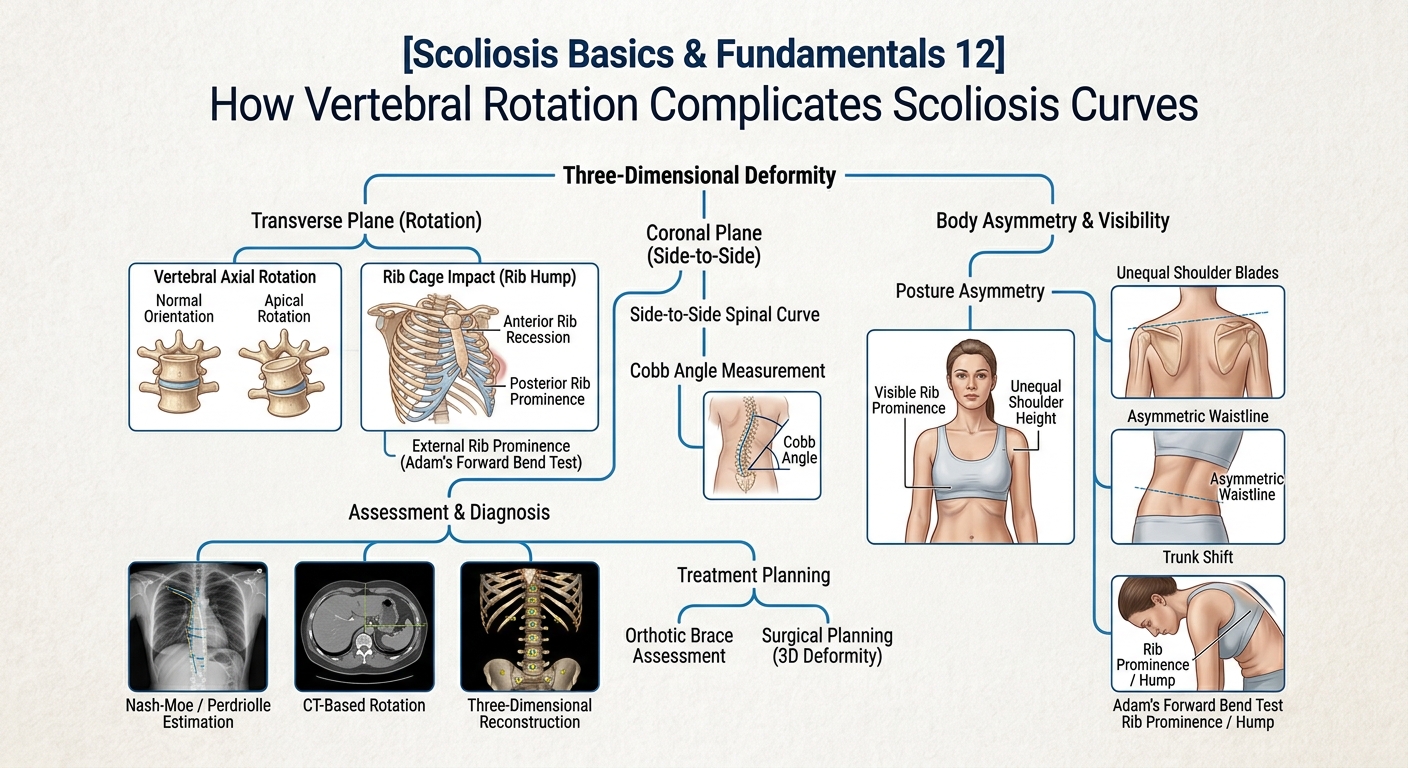
Vertebral rotation means that individual vertebrae rotate around the long axis of the spine. In a scoliotic curve, this rotation is particularly important around the apical vertebra, the vertebra located near the center of the curve. The Scoliosis Research Society defines vertebral axial rotation as the transverse-plane angulation of a vertebra. [1]
This rotational component helps explain why scoliosis can be visible from behind even when the Cobb angle on an X-ray does not appear extremely large. Rotation can alter the shape and position of the ribs, shoulder blades, waist, and trunk. As a result, two people with similar Cobb angles may have noticeably different body asymmetries. [1][3]
For parents, this can be confusing. A child may have a moderate-looking curve on an X-ray but a very obvious rib prominence when bending forward. Another child may have a larger Cobb angle but relatively subtle external asymmetry. Understanding vertebral rotation helps explain why the number of degrees alone cannot fully describe scoliosis. [2][3]
---
What Is Vertebral Rotation?
A Simple Definition
A vertebra normally has a particular orientation within the spinal column. In scoliosis, the vertebrae within the curved region may rotate around their vertical axis. This is known as axial or transverse-plane vertebral rotation. [1][2]
Imagine looking down from above at a normal stack of vertebrae. The vertebrae have a relatively consistent orientation. In a scoliotic spine, some vertebrae may gradually rotate as they move toward the apex of the curve and then rotate back toward a more normal orientation as the curve ends. This creates a rotational component in addition to the visible side-to-side curvature. [2]
The amount and pattern of rotation can vary between patients. Rotation may also differ between different sections of the same spinal curve. For this reason, clinicians and researchers may evaluate the rotation of individual vertebrae, particularly the apical vertebra. [1][2]
Key terms to understand
- Axial rotation: Rotation around the longitudinal axis of a vertebra.
- Apical vertebra: The vertebra located approximately at the center of a spinal curve.
- Coronal plane: The plane used to describe side-to-side spinal curvature.
- Sagittal plane: The plane used to describe front-to-back alignment.
- Transverse plane: The horizontal plane in which axial vertebral rotation occurs.
- Cobb angle: The conventional radiographic measurement used to quantify scoliosis curve magnitude. [1][2]
---
Why the Cobb Angle Does Not Tell the Whole Story
The Cobb angle remains one of the most important measurements in scoliosis. It quantifies the angular magnitude of a spinal curve on a radiograph and is widely used to classify and monitor scoliosis. A curve measuring more than 10 degrees is generally considered scoliosis. [3][4]
However, the Cobb angle primarily describes the angular component of a curve as seen on a two-dimensional radiograph. It does not independently describe the complete three-dimensional shape of the spine. Vertebral rotation is one reason why two curves with similar Cobb measurements can look and behave differently. [2][5]
For example, imagine two adolescents who both have a 35-degree thoracic curve. One may have relatively modest vertebral rotation and little visible rib prominence. The other may have greater axial rotation, producing a much more noticeable rib prominence during the forward-bending examination. The Cobb angle is the same, but the three-dimensional spinal deformity is not identical. [2][3]
This does not mean that vertebral rotation is more important than the Cobb angle. Rather, it means that the two measurements describe different aspects of scoliosis. A comprehensive assessment considers curve magnitude together with rotation, curve pattern, spinal balance, skeletal maturity, symptoms, and other clinical findings. [2][5]
---
How Does Vertebral Rotation Develop?
The exact biological mechanisms responsible for the development and progression of idiopathic scoliosis remain incompletely understood. Scoliosis is considered a complex three-dimensional deformity, and research continues to investigate genetic, developmental, biomechanical, and other contributing factors. [2][6]
As a spinal curve develops, the vertebrae within the curve can become progressively rotated. The relationship between lateral curvature and vertebral rotation is complex, and rotation should not simply be thought of as a secondary movement that occurs after the spine bends sideways. Instead, the coronal, sagittal, and transverse components interact with one another as the deformity develops. [2][5]
The precise sequence of events may differ among patients. Research into three-dimensional scoliosis has demonstrated that curve morphology cannot always be adequately represented by a single two-dimensional angle. Parameters such as apical vertebral rotation and the orientation of the plane of maximum curvature can provide additional information about the geometry of the deformity. [2]
---
Why Does Rotation Make Scoliosis More Visible?
One of the most noticeable effects of vertebral rotation is its influence on the rib cage and trunk shape.
The thoracic vertebrae are connected to the ribs through the costovertebral and costotransverse joints. When thoracic vertebrae rotate as part of a scoliotic deformity, the attached ribs can also change their orientation. This can produce a prominence of the ribs on one side of the upper back. [3][7]
This is commonly called a rib hump or rib prominence.
During the Adam's forward bend test, the patient bends forward while the examiner observes the back from behind. Rotational asymmetry can become particularly apparent in this position. The Scoliosis Research Society notes that the forward-bending examination is used to observe the rotational component of scoliosis, including rib prominence in the thoracic region and flank or waist prominence in the lower spine. [3]
Parents may notice:
- One side of the upper back appears higher
- One shoulder blade seems more prominent
- The ribs appear more prominent on one side
- The waist appears deeper on one side
- The trunk seems rotated
- Clothing may appear to fit asymmetrically
These observations can be important clues, but they do not establish a diagnosis by themselves. A healthcare professional must determine whether the asymmetry represents structural scoliosis or another condition. [3][8]
---
Vertebral Rotation and Posture Symmetry
Scoliosis can alter the visual symmetry of the entire trunk.
A person with scoliosis may have:
- Unequal shoulder height
- Unequal scapular prominence
- An asymmetric waistline
- Trunk shift
- Pelvic asymmetry
- Rib prominence
- Apparent differences in hip position
These changes do not necessarily result from the Cobb angle alone. Rotation and the interaction between the vertebrae, ribs, pelvis, and surrounding soft tissues can contribute to the external appearance of the deformity. [3][5]
This is why posture symmetry can sometimes look more dramatic than the numerical Cobb angle might suggest.
It is also important to remember that posture symmetry is not equivalent to spinal structure. A person can stand asymmetrically for functional reasons without having structural scoliosis, while a person with structural scoliosis may compensate for the curve through changes in posture and trunk position. [3][8]
---
The Relationship Between Rotation and the Apical Vertebra
The apical vertebra deserves particular attention when discussing vertebral rotation.
The apex is generally the vertebra that is farthest from the central axis of the curve. It often represents an important part of the deformity because the vertebra at or near the apex can demonstrate substantial lateral displacement, tilt, and axial rotation. [1][2]
The Scoliosis Research Society specifically defines apical vertebra axial rotation as the axial rotation of the apical vertebra of a curve. [1]
In clinical research, different methods have been developed to estimate vertebral rotation from radiographs or other imaging techniques. These include techniques such as the Nash-Moe and Perdriolle methods. More advanced imaging approaches can also provide three-dimensional information. [5]
However, vertebral rotation measurement is technically more complicated than simply measuring the Cobb angle. Different imaging methods and measurement techniques can produce different estimates, and the clinical significance of a particular rotation value depends on the overall deformity. [5]
---
How Vertebral Rotation Changes the Three-Dimensional Spine
To understand scoliosis properly, it helps to imagine the spine as a flexible three-dimensional structure rather than a line on an X-ray.
In the coronal plane
The spine curves from side to side.
This is the component most familiar to patients and is primarily represented by the Cobb angle. [3][4]
In the sagittal plane
The spine may demonstrate changes in:
- Thoracic kyphosis
- Lumbar lordosis
- Global sagittal balance
- Regional spinal alignment
These changes can influence overall posture and the body's ability to maintain an efficient upright position. [2][9]
In the transverse plane
The vertebrae can rotate around their longitudinal axes.
This is the axial rotation component of scoliosis. [1][2]
The three components interact.
Therefore, a scoliosis curve is not simply a bent line. It is a three-dimensional deformation in which curvature, rotation, translation, vertebral orientation, and spinal balance may all contribute to the final shape. [2][5]
---
Why Vertebral Rotation Can Complicate Clinical Assessment
1. A Two-Dimensional X-Ray Can Underrepresent a Three-Dimensional Problem
A standard standing X-ray provides highly valuable information, but conventional radiographs are two-dimensional representations of a three-dimensional structure. Vertebral rotation can therefore be difficult to fully appreciate from the Cobb angle alone. [5]
This is one reason researchers have developed various methods for measuring rotation and investigating three-dimensional scoliosis geometry. Advanced imaging and three-dimensional reconstruction techniques can provide additional information in selected clinical or research settings. [2][5]
However, more imaging is not automatically better for every patient. Imaging decisions should be based on clinical need, age, symptoms, radiation considerations, and the question the clinician is trying to answer.
---
2. Rotation Can Affect the Appearance of the Rib Cage
Thoracic vertebral rotation can influence rib orientation and contribute to a rib prominence. This means that the visible deformity may be partly related to the rotational component rather than simply the lateral displacement measured by the Cobb angle. [3][7]
For a parent, this is particularly important because the first sign of scoliosis may be something visible in the child's back rather than pain.
A child may say, “My back doesn't hurt,” while a parent notices that one side of the back appears higher when the child bends forward. This is one reason visual changes should not automatically be dismissed simply because there is no pain. [3]
---
3. Rotation Can Complicate the Interpretation of Progression
Monitoring scoliosis over time often focuses heavily on changes in Cobb angle. This is appropriate because Cobb measurement is a well-established tool for assessing curve magnitude. However, the overall deformity can also change in other dimensions. [4][5]
A patient may experience changes in vertebral rotation, trunk balance, sagittal alignment, or external asymmetry even when changes in Cobb angle appear relatively modest.
At the same time, rotation should not be assumed to mean that a curve will necessarily progress. A systematic review found stronger evidence for factors such as Cobb angle, curve type, and flexibility as predictors of progression, while evidence for apical vertebral rotation as an independent predictor was weaker. [10]
This distinction is important. Vertebral rotation is clinically meaningful, but it should not be presented to patients as a simple standalone predictor of future progression.
---
4. Rotation Can Influence the Patient's Appearance
Scoliosis is not only an X-ray diagnosis. Patients live with the physical appearance and functional consequences of their spinal deformity.
For some adolescents, visible asymmetry can become an important emotional and social concern. Uneven shoulders, a rib prominence, or an asymmetric waist can affect body image even when the patient has little or no pain. [3][11]
Parents should therefore avoid focusing exclusively on the Cobb angle.
A child's experience includes more than the radiographic measurement. Quality of life, body image, physical activity, emotional wellbeing, and the child's understanding of the condition should also be considered as part of comprehensive scoliosis care. [11]
---
Can Vertebral Rotation Be Seen Without an X-Ray?
Sometimes.
A trained clinician may identify signs associated with vertebral rotation during physical examination, particularly during forward bending. A rib prominence or asymmetric lumbar prominence may suggest rotational deformity. [3]
A scoliometer, or inclinometer, may also be used during a physical examination to estimate trunk asymmetry. However, screening tools do not directly replace radiographic assessment of the spinal curve. [3][8]
The physical examination can answer an important question:
Does the patient's trunk show asymmetry that warrants further evaluation?
Radiographic evaluation can then provide information about:
- Cobb angle
- Curve location
- Curve pattern
- Vertebral alignment
- Skeletal maturity
- Other structural features
The appropriate diagnostic approach depends on the individual patient and clinical circumstances. [3][8]
---
Does More Rotation Always Mean a More Severe Scoliosis Curve?
Not necessarily.
This is an important point for patients and parents.
A larger Cobb angle generally indicates a larger coronal curve, but the relationship between Cobb angle and vertebral rotation is not perfectly proportional. Scoliosis is a three-dimensional deformity, and different patients can have different combinations of coronal curvature, axial rotation, sagittal alignment, and trunk compensation. [2][5]
Therefore, it would be inappropriate to say:
“More rotation always means more severe scoliosis.”
A better statement is:
“Vertebral rotation is one component of scoliosis severity and morphology that should be interpreted together with the Cobb angle, curve pattern, spinal balance, skeletal maturity, and clinical findings.” [2][5]
This distinction helps prevent unnecessary fear when patients receive an imaging report mentioning vertebral rotation.
---
How Is Vertebral Rotation Evaluated?
Clinicians and researchers have developed several methods to evaluate vertebral rotation.
Common approaches include:
- Nash-Moe method
- Perdriolle method
- CT-based measurements
- MRI-based approaches in selected circumstances
- Three-dimensional reconstruction and imaging technologies
- Radiographic geometric measurements
Each method has advantages and limitations. Conventional radiographic methods are more accessible but provide indirect estimates of three-dimensional rotation. CT can provide detailed three-dimensional anatomical information but involves ionizing radiation and is therefore not routinely required simply to assess scoliosis rotation in every patient. [5]
The appropriate imaging technique depends on the clinical question.
For most patients with suspected scoliosis, the initial assessment relies on history, physical examination, and appropriate standing spinal radiographs when indicated. [3][8]
---
Why Vertebral Rotation Matters in Treatment Planning
Understanding the rotational component of scoliosis can be important when clinicians evaluate treatment options.
For example, scoliosis treatment may aim not only to reduce or stabilize the coronal curve but also to improve overall spinal balance and, in selected circumstances, address rotational deformity. Surgical planning in particular considers the three-dimensional nature of spinal deformity. [2][5]
However, treatment should never be selected based solely on a rotation measurement.
For children and adolescents, decisions may involve:
- Age
- Skeletal maturity
- Cobb angle
- Curve pattern
- Curve progression
- Growth remaining
- Overall spinal balance
- Symptoms
- Quality of life
Depending on the individual situation, treatment may include observation, scoliosis-specific exercise approaches, bracing, or surgery. [3][12]
The Scoliosis Research Society notes that observation is commonly used for smaller curves or stable curves, while bracing may be considered for selected growing patients with larger curves. Treatment decisions are individualized rather than based on one measurement alone. [12]
---
What Should Parents Look For at Home?
Parents do not need to diagnose vertebral rotation themselves.
Instead, they can be aware of persistent changes in posture symmetry.
Signs worth discussing with a healthcare professional include:
- One shoulder appearing higher
- One shoulder blade appearing more prominent
- Uneven waist contours
- One hip appearing more prominent
- A trunk shift
- Rib prominence during forward bending
- A persistent visible spinal curve
- Progressive asymmetry during periods of rapid growth
These observations do not prove scoliosis, but they can provide a useful reason to seek an appropriate clinical assessment. [3][8]
Parents should also remember that scoliosis usually does not cause significant pain in otherwise typical adolescent idiopathic scoliosis. Therefore, the absence of pain does not exclude scoliosis. Conversely, significant or persistent pain—especially when associated with neurological symptoms—deserves appropriate medical evaluation rather than being automatically attributed to scoliosis. [8]
---
Does Vertebral Rotation Cause Pain?
Vertebral rotation itself should not automatically be interpreted as the cause of pain.
Many adolescents with idiopathic scoliosis have no significant pain or neurological abnormalities. [3][8]
In adults, however, scoliosis may coexist with degenerative disc disease, facet joint degeneration, spinal stenosis, or other causes of back and leg symptoms. In these situations, the relationship between the spinal deformity and symptoms can be more complex. [9]
Therefore, patients with significant pain should receive an evaluation that considers the full clinical picture rather than assuming that the rotational deformity is the sole cause.
---
Vertebral Rotation and Adult Scoliosis
The importance of three-dimensional spinal alignment can become particularly apparent in adult scoliosis.
Adults may have scoliosis that originated during adolescence, or they may develop degenerative spinal deformity later in life. Degenerative changes can alter disc height, facet joint orientation, vertebral position, lumbar lordosis, and global spinal balance. [9]
As a result, adult spinal deformity may involve several interacting components:
- Coronal curvature
- Vertebral rotation
- Vertebral translation
- Loss of lumbar lordosis
- Sagittal imbalance
- Pelvic compensation
- Degenerative changes
Modern assessment of adult spinal deformity therefore increasingly considers global alignment rather than focusing only on the Cobb angle. [9]
---
A Practical Way to Understand Your Scoliosis X-Ray
If you or your child has recently received a scoliosis X-ray, consider asking the treating clinician the following questions:
1. What is the Cobb angle?
This provides information about the magnitude of the coronal curve. [3][4]
2. Where is the curve located?
For example, is it primarily thoracic, lumbar, or thoracolumbar? Curve location influences the overall morphology and clinical assessment. [1]
3. Is there significant vertebral rotation?
Ask whether rotation is particularly noticeable around the apical vertebra or elsewhere in the curve. [1][5]
4. Is the curve structural or functional?
A clinician can determine whether the curve behaves as a structural deformity or whether positional factors contribute substantially to the apparent curvature. [3][8]
5. How is overall spinal alignment?
This may include consideration of coronal balance, sagittal alignment, pelvic position, and trunk balance. [2][9]
6. Is the curve likely to change with growth?
For children and adolescents, remaining skeletal growth is an important factor in monitoring scoliosis. [3][12]
These questions can help families understand the complete picture rather than focusing on one number in an imaging report.
---
Important Precautions and Medical Disclaimer
The information provided by 4scoliosis.com is intended for general educational purposes only. It is not a substitute for an examination, diagnosis, or individualized medical advice from a qualified healthcare professional.
Vertebral rotation is an important component of scoliosis, but a statement such as “vertebral rotation” on an imaging report does not by itself determine the severity, prognosis, or appropriate treatment of an individual patient. The clinical meaning of rotation depends on the patient's age, curve pattern, Cobb angle, skeletal maturity, spinal balance, symptoms, and other findings. [2][5]
Parents should not attempt to measure vertebral rotation or diagnose scoliosis from photographs alone. A professional evaluation may include physical examination and, when clinically indicated, standing spinal radiographs. [3][8]
Patients should seek prompt medical evaluation if spinal asymmetry is accompanied by significant or persistent pain, neurological symptoms such as weakness or numbness, changes in walking, bowel or bladder dysfunction, breathing difficulties, or rapidly progressive deformity.
This article does not recommend a specific brace, exercise program, manual therapy, medication, or surgical procedure for any individual patient.
---
Conclusion: Scoliosis Is More Than a Sideways Curve
Vertebral rotation is one of the key reasons scoliosis should be understood as a three-dimensional spinal deformity rather than simply a sideways bend.
The Cobb angle remains essential for quantifying the magnitude of the coronal curve, but it cannot independently describe every aspect of spinal deformity. Vertebral axial rotation adds another dimension to the condition and can contribute to rib prominence, shoulder-blade asymmetry, waist asymmetry, and changes in overall posture symmetry. [1][2][3]
For patients and parents, the most important message is that a scoliosis measurement should always be interpreted in context.
A 30-degree curve is not simply “30 degrees.” Its clinical appearance may depend on where the curve is located, how the vertebrae are rotated, how the spine is balanced, how much growth remains, and whether the patient has symptoms or functional limitations. [2][5]
At the same time, vertebral rotation should not be a source of unnecessary fear. Rotation is a recognized component of scoliosis, and its presence does not automatically mean that a curve will rapidly progress or that surgery will be required. Evidence regarding rotation as an independent predictor of progression is less consistent than the evidence for factors such as Cobb angle, curve type, and flexibility. [10]
The practical approach is therefore straightforward:
Look at the whole spine, not just one number.
For families, that means understanding the Cobb angle, asking about vertebral rotation, considering posture symmetry and spinal balance, and following the curve appropriately during periods of growth.
For adults, it means considering both the deformity and age-related changes that may affect coronal and sagittal alignment.
And for every patient, it means working with an appropriately qualified healthcare professional who can interpret imaging findings in the context of the person's age, symptoms, growth status, and overall spinal health.
At 4scoliosis.com, our goal is to help patients and families understand scoliosis in clear, evidence-informed language—because understanding the three-dimensional nature of scoliosis is an important first step toward making informed decisions about spinal health.
---
References
[1] Scoliosis Research Society (SRS). Glossary: Vertebral Axial Rotation, Apical Vertebra Axial Rotation, Structural Curve, and related spinal deformity terminology. Scoliosis Research Society Glossary
[2] Daffner SD, et al. State of the art of current 3-D scoliosis classifications: a systematic review from a clinical perspective. This systematic review describes scoliosis as a complex three-dimensional deformity and reviews parameters including apical vertebral rotation and three-dimensional spinal geometry. PMC – 3-D Scoliosis Classifications Review
[3] Scoliosis Research Society (SRS). Scoliosis. Patient information covering physical examination, forward-bending assessment, rib prominence, trunk asymmetry, radiographs, and Cobb-angle measurement. Scoliosis Research Society – Scoliosis
[4] Scoliosis Research Society (SRS). Diagnosing Scoliosis. Information regarding clinical examination, radiographs, Cobb-angle measurement, and evaluation of rotational features. Scoliosis Research Society – Diagnosing Scoliosis
[5] Lam GC, Hill DL, Le LH, Raso JV, Lou EH. Vertebral rotation measurement: a summary and comparison of common radiographic and CT methods. Journal of Orthopaedic Surgery and Research. 2008;3:16. This review examines methods for measuring vertebral rotation and discusses its importance in understanding the three-dimensional nature of adolescent idiopathic scoliosis. PMC – Vertebral Rotation Measurement Review
[6] Cheng JC, Castelein RM, Chu WCW, et al. Adolescent idiopathic scoliosis. Nature Reviews Disease Primers. 2015;1:15030. This review discusses the multifactorial nature and three-dimensional characteristics of adolescent idiopathic scoliosis.
[7] Scoliosis Research Society (SRS). Scoliosis – Patient Information. The SRS describes rib prominence and rotational changes observed during forward bending in patients with scoliosis. Scoliosis Research Society – Patient Scoliosis Information
[8] Scoliosis Research Society (SRS). Diagnosing Scoliosis. Clinical signs include uneven shoulders, scapular prominence, trunk shift, hip asymmetry, and rib prominence. Scoliosis Research Society – Diagnosing Scoliosis
[9] Aebi M. The adult scoliosis. European Spine Journal. 2005;14(10):925–948. This review discusses adult scoliosis as a complex spinal deformity involving degenerative changes and alterations in spinal alignment.
*[10] Curve type, flexibility, correction, and rotation are predictors of curve progression in patients with adolescent idiopathic scoliosis undergoing conservative treatment: a systematic review. * The review found stronger evidence for Cobb angle, curve type, and flexibility as predictors of progression, while evidence for apical vertebral rotation as an independent predictor was weaker. PubMed – Systematic Review of Progression Predictors
[11] Scoliosis Research Society (SRS). Patient education resources emphasize that scoliosis affects patients beyond radiographic measurements and that quality of life and the patient's experience are important considerations. Scoliosis Research Society – Patient Resources
[12] Scoliosis Research Society (SRS). Observation and Treatment of Scoliosis. Treatment decisions consider curve magnitude, growth, progression, and the individual patient's circumstances rather than a single measurement. Scoliosis Research Society – Observation