Spine Care
[Scoliosis Basics & Fundamentals 10] Neuromuscular Scoliosis: Causes, Diagnosis, and Management
Neuromuscular Scoliosis: Causes, Symptoms, Diagnosis, and Treatment
Learn about neuromuscular scoliosis, including its causes, symptoms, Cobb angle, diagnosis, progression, non-surgical care, surgery, and what parents should know.
---
Introduction: What Is Neuromuscular Scoliosis?
Neuromuscular scoliosis is a form of spinal deformity that develops in people with an underlying disorder affecting the brain, spinal cord, nerves, or muscles. Unlike adolescent idiopathic scoliosis, where the cause is usually unknown, neuromuscular scoliosis develops in association with a known neurological or muscular condition. [1][2]
The nervous system and muscles normally work together to keep the head, trunk, pelvis, and spine balanced. When muscle weakness, abnormal muscle tone, paralysis, spasticity, or impaired motor control interferes with this system, the spine may gradually lose its normal alignment. Over time, this imbalance can produce a progressive spinal curve. [1][3]
For parents, the diagnosis can be particularly concerning because neuromuscular scoliosis is often part of a much larger medical picture. The spinal curve itself may not be the only issue that needs attention. A child's ability to sit, stand, walk, breathe comfortably, maintain head and trunk control, and receive daily care may all be relevant when evaluating the condition. [1][4]
Neuromuscular scoliosis is also different from many cases of adolescent idiopathic scoliosis because the curve may progress more aggressively and may continue to worsen after skeletal maturity, particularly in patients with severe neurological or muscular impairment. [1][3]
The good news is that families do not have to manage this condition alone. Modern care increasingly involves a multidisciplinary team, which may include pediatricians, neurologists, orthopedic or spine surgeons, pulmonologists, physiatrists, physical therapists, occupational therapists, nutrition specialists, seating and wheelchair specialists, nurses, and other healthcare professionals. [4][5]
---
What Causes Neuromuscular Scoliosis?
Neuromuscular scoliosis does not have one single cause. Rather, it develops because an underlying neuromuscular disorder interferes with the normal mechanisms that maintain spinal and trunk alignment. [1][3]
The nervous system controls muscle activation, coordination, balance, and posture. When these functions are impaired, the muscles supporting the spine may become too weak, excessively tight, poorly coordinated, or asymmetrical. The resulting imbalance can place abnormal mechanical forces on the developing spine. [3][4]
Over time, these forces can contribute to a structural spinal deformity involving the coronal, sagittal, and axial planes. In other words, neuromuscular scoliosis is not simply a spine bending from side to side; vertebral rotation, kyphosis or lordosis, trunk shift, and pelvic alignment may also become involved. [2][3]
Common conditions associated with neuromuscular scoliosis include:
- Cerebral palsy
- Spinal muscular atrophy (SMA)
- Duchenne muscular dystrophy (DMD)
- Other muscular dystrophies
- Spina bifida / myelomeningocele
- Spinal cord injury
- Friedreich ataxia
- Certain motor neuron disorders
- Other neuropathic or myopathic conditions [1][2][6]
The likelihood and severity of scoliosis vary considerably between these conditions. In general, greater neurological or muscular impairment is associated with a higher risk of developing significant spinal deformity. Non-ambulatory children may have particularly severe and progressive curves. [1][3]
---
Neuropathic vs. Myopathic Causes
Healthcare professionals sometimes divide neuromuscular disorders into broad categories based on whether the primary problem involves the nervous system or the muscles.
Neuropathic conditions
Neuropathic scoliosis occurs when disorders affecting the nervous system interfere with normal motor control.
Examples include:
- Cerebral palsy
- Spinal cord injury
- Spinal muscular atrophy
- Certain motor neuron disorders
The resulting scoliosis may be associated with abnormal muscle tone, weakness, spasticity, paralysis, or impaired coordination. [2][6]
Myopathic conditions
Myopathic scoliosis develops in association with diseases primarily affecting muscle tissue.
Examples include:
- Duchenne muscular dystrophy
- Becker muscular dystrophy
- Other muscular dystrophies
- Certain congenital myopathies
Progression can be influenced by the underlying disease, muscle strength, growth, ambulatory status, and the effectiveness of medical management of the primary disorder. [2][3]
This distinction is useful, but it is important for parents to understand that two children with different neuromuscular diagnoses can have very different spinal curves and treatment needs.
The diagnosis of the underlying disease is therefore an essential part of scoliosis management. [3][4]
---
Why Does Neuromuscular Scoliosis Progress?
One of the most important differences between neuromuscular scoliosis and many cases of idiopathic scoliosis is the potential for continued progression.
When the muscles and nervous system cannot adequately stabilize the spine, the curve may continue to develop as the child grows. In some neuromuscular conditions, progression can also continue after skeletal maturity. [1][3]
Several factors can influence progression:
- Severity of the underlying neuromuscular disorder
- Muscle weakness or abnormal muscle tone
- Ability to walk or stand independently
- Degree of trunk control
- Age at onset of scoliosis
- Growth remaining
- Cobb angle
- Curve flexibility
- Pelvic obliquity
- Sagittal spinal alignment
- Overall medical condition [1][3][4]
For this reason, a relatively small curve should not automatically be considered harmless simply because the Cobb angle is currently modest.
The trajectory of the curve over time is often just as important as the measurement at one particular visit. [3][4]
---
What Does Neuromuscular Scoliosis Look Like?
The appearance of neuromuscular scoliosis can vary substantially depending on the underlying condition.
A child may develop:
- Uneven shoulders
- Uneven shoulder blades
- Trunk leaning
- Asymmetric waist contours
- Rib prominence
- Pelvic obliquity
- Difficulty maintaining an upright sitting position
- Difficulty keeping the head centered over the trunk
- Increasing dependence on wheelchair positioning
- Changes in posture symmetry [1][3]
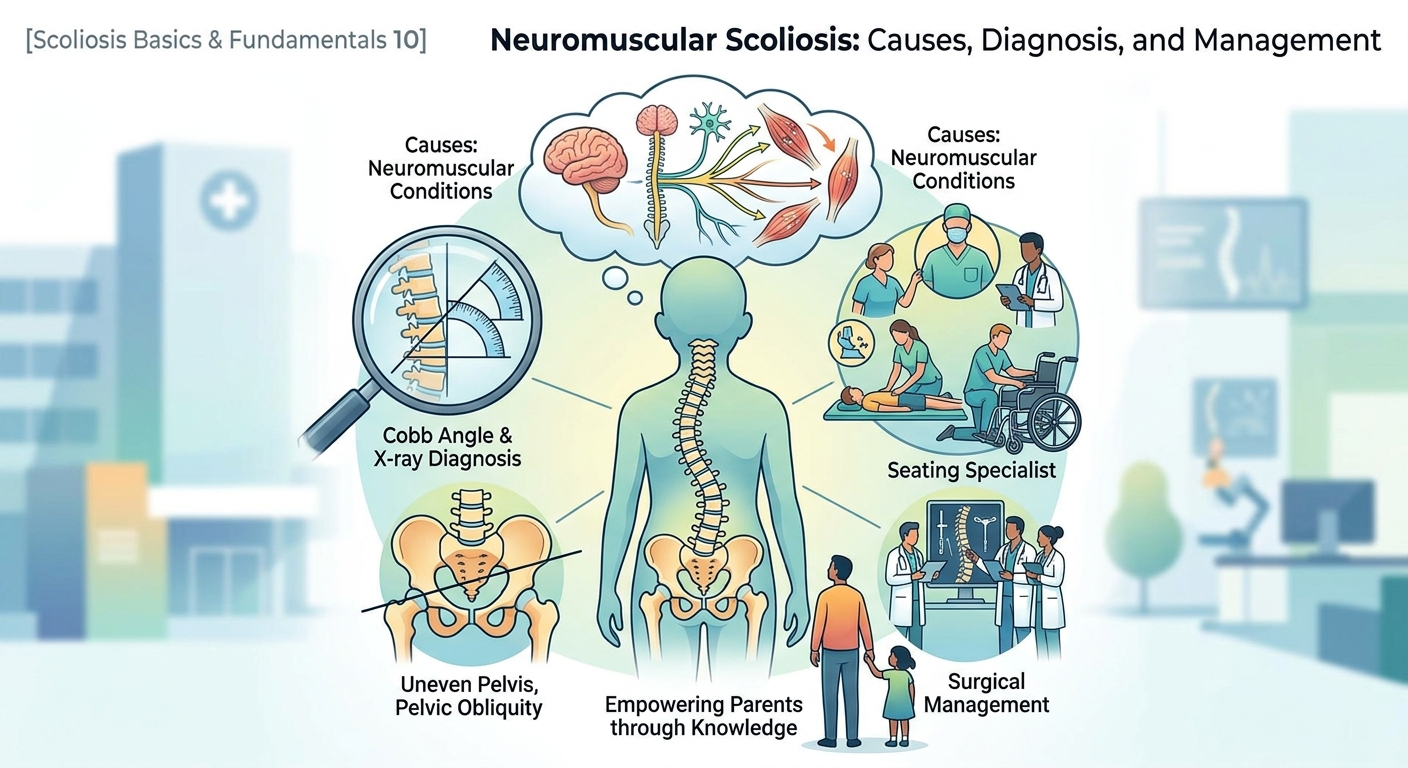
One characteristic pattern is a long C-shaped thoracolumbar curve, sometimes extending from the upper spine toward the pelvis. Pelvic obliquity may occur at the same time, meaning that one side of the pelvis is positioned higher than the other. [3][4]
For a child who uses a wheelchair, pelvic obliquity can have major practical consequences.
The child may gradually slide or lean to one side, have difficulty maintaining a comfortable sitting position, or require frequent repositioning. In severe cases, the rib cage may approach or contact the pelvis, creating discomfort and skin problems. [3][4]
Therefore, assessing neuromuscular scoliosis requires looking beyond the X-ray.
How the child functions in everyday life is an important part of the diagnosis and management plan. [4]
---
Understanding the Cobb Angle
The Cobb angle is the standard radiographic measurement used to quantify the magnitude of a scoliosis curve.
On a spinal X-ray, clinicians identify the upper and lower end vertebrae of the curve and measure the angle formed by their endplates. This measurement provides a numerical estimate of curve magnitude. [7]
For parents, the Cobb angle can be useful for understanding whether a curve is small, moderate, or severe and whether it is changing over time.
However, the Cobb angle should never be considered the entire diagnosis.
Two children with the same Cobb angle may have very different clinical needs.
For example, one child may walk independently and have good trunk control, while another may depend on a wheelchair and have severe pelvic obliquity, poor sitting balance, and respiratory impairment.
Therefore, physicians consider the Cobb angle together with:
- Curve pattern
- Curve progression
- Vertebral rotation
- Pelvic alignment
- Sagittal balance
- Curve flexibility
- Skeletal maturity
- Neuromuscular diagnosis
- Walking ability
- Sitting balance
- Respiratory status
- Pain
- Quality of life [3][4][7]
---
How Is Neuromuscular Scoliosis Diagnosed?
1. Medical and Neurological History
Diagnosis begins with understanding the child's underlying neuromuscular condition.
The healthcare team may ask about:
- Age when the neuromuscular disorder was diagnosed
- Muscle strength
- Ability to walk
- Ability to sit independently
- Head and trunk control
- Previous orthopedic problems
- Respiratory symptoms
- Feeding or swallowing difficulties
- Previous spinal imaging
- Previous scoliosis treatment
- Changes in functional ability [3][4]
The rate at which a spinal curve is developing is particularly important.
---
2. Physical Examination
The clinician examines the child's spine and overall posture.
Important findings may include:
- Shoulder asymmetry
- Trunk shift
- Rib prominence
- Waist asymmetry
- Pelvic obliquity
- Abnormal kyphosis or lordosis
- Muscle contractures
- Hip position
- Lower-limb alignment
- Range of motion
- Sitting balance
- Head and trunk control [1][3]
In ambulatory children, walking ability and gait may also be assessed.
In children who use wheelchairs, clinicians may examine the child's posture both in and out of the wheelchair, because seating systems can substantially influence spinal and pelvic alignment. [3][4]
---
Imaging and the Cobb Angle
When scoliosis is suspected or appears to be progressing, standing or seated spinal radiographs may be obtained depending on the child's functional abilities.
Standard imaging generally includes anteroposterior/posteroanterior and lateral views of the spine. These images allow clinicians to assess coronal curvature, sagittal alignment, vertebral rotation, and pelvic alignment. [8]
For children who cannot stand independently, seated imaging may be more appropriate.
The clinician may measure:
- Cobb angle
- Thoracic kyphosis
- Lumbar lordosis
- Pelvic obliquity
- Trunk shift
- Other measures of global spinal alignment [3][4]
The purpose is not merely to obtain a number.
Imaging helps the medical team understand the shape, balance, flexibility, and progression of the deformity.
---
Why Pelvic Obliquity Matters
Pelvic obliquity is particularly important in neuromuscular scoliosis.
It occurs when the pelvis is tilted so that one side is higher than the other. This may be associated with spinal curvature, muscle imbalance, hip contractures, or other factors affecting the relationship between the spine and pelvis. [3][4]
For an ambulatory child, pelvic imbalance may affect standing and walking.
For a non-ambulatory child, it can have an even greater impact because the pelvis forms the foundation of seated posture.
Pelvic obliquity may contribute to:
- Difficulty sitting upright
- Sliding or leaning in a wheelchair
- Need for frequent repositioning
- Increased pressure on certain areas of the body
- Difficulty with hygiene
- Pain or discomfort
- Reduced ability to interact with the environment [1][3][4]
This is why the goal of treatment is often not simply to make the spine "straight."
A major objective may be to achieve a balanced spine over a reasonably level pelvis, while improving the child's ability to sit, stand, move, and participate in daily life. [3][4]
---
Respiratory Function and Neuromuscular Scoliosis
Parents should also understand the relationship between spinal deformity and breathing.
Some children with neuromuscular disorders already have respiratory muscle weakness. A progressive spinal deformity can further affect the shape and mechanics of the thoracic cage, potentially reducing respiratory efficiency. [1][3][5]
This is particularly important when scoliosis develops at a young age or becomes severe.
Depending on the underlying condition, the medical team may therefore evaluate:
- Respiratory muscle strength
- Pulmonary function
- Oxygenation
- Sleep-related breathing
- Cough effectiveness
- History of respiratory infections
Children with significant neuromuscular disease may require coordinated care between spinal specialists and respiratory or pulmonary specialists. [5]
A parent should therefore tell the medical team about symptoms such as:
- Increasing shortness of breath
- Difficulty clearing secretions
- Frequent chest infections
- Abnormal breathing during sleep
- Unusual fatigue
- Reduced exercise tolerance
Respiratory symptoms should not automatically be attributed to scoliosis because the underlying neuromuscular condition itself may contribute substantially to respiratory impairment. [5]
---
Non-Surgical Management
Not every child with neuromuscular scoliosis requires surgery immediately.
Management depends on the underlying disease, age, curve magnitude, rate of progression, functional limitations, skeletal maturity, and overall health. [1][3][4]
For some children, the initial approach may involve observation and supportive care.
Observation
Regular monitoring may be appropriate when the curve is relatively small, stable, or when the child's overall medical condition makes immediate intervention inappropriate.
Follow-up may include:
- Physical examinations
- Periodic spinal X-rays
- Cobb angle measurements
- Assessment of sitting balance
- Assessment of walking ability
- Monitoring of respiratory function
- Review of wheelchair positioning
- Evaluation of pain and quality of life [3][4]
The interval between assessments is individualized.
---
Physical Therapy and Rehabilitation
Physical therapy is often an important component of comprehensive care, although it is important to understand what therapy can and cannot accomplish.
Rehabilitation may focus on:
- Maintaining mobility
- Preserving joint range of motion
- Managing contractures
- Improving functional strength where possible
- Supporting transfers
- Optimizing sitting and standing posture
- Maintaining independence
- Supporting respiratory function when appropriate [3][4]
Physical therapy should be tailored to the underlying neuromuscular condition.
The goal is generally not to "exercise the scoliosis away." Instead, rehabilitation aims to maximize function, comfort, mobility, positioning, and quality of life within the child's medical circumstances. [3][4]
---
Bracing: Can a Brace Help?
Bracing can be considered in selected children, particularly when curves are smaller or when external support improves positioning.
However, neuromuscular scoliosis behaves differently from adolescent idiopathic scoliosis.
The Scoliosis Research Society notes that most neuromuscular curves do not benefit substantially from bracing for preventing progression, although bracing may provide external support and may help some children with positioning or sitting balance. [1]
This distinction is important for parents.
A brace may sometimes be used because it helps a child sit more comfortably or maintain better trunk alignment, even if it does not stop the underlying structural curve from progressing.
The decision should therefore be individualized by the child's medical and rehabilitation team.
---
Wheelchair and Seating Management
For children who use wheelchairs, seating assessment can be an important part of scoliosis care.
A properly designed seating system may help optimize:
- Pelvic positioning
- Trunk support
- Pressure distribution
- Head positioning
- Functional reach
- Comfort
- Ability to interact with family and surroundings [3][4]
Wheelchair modifications do not necessarily correct a structural scoliosis.
Instead, their primary goal may be to support function and reduce the consequences of spinal and pelvic asymmetry.
A child whose wheelchair no longer provides adequate support may need reassessment by a specialized seating or rehabilitation team.
---
When Is Surgery Considered?
Surgery may be considered when the spinal deformity becomes progressive and begins to significantly affect function, sitting balance, comfort, respiratory status, self-care, or quality of life.
There is no single Cobb-angle threshold that determines surgery for every child with neuromuscular scoliosis.
The decision depends on the whole clinical picture, including the underlying neuromuscular diagnosis and the child's medical condition. [1][3][4]
Potential reasons for considering surgery include:
- Progressive scoliosis
- Severe trunk imbalance
- Significant pelvic obliquity
- Loss of sitting balance
- Difficulty with wheelchair positioning
- Pain
- Rib-pelvis contact
- Difficulty with hygiene or caregiving
- Respiratory compromise associated with severe deformity
- Significant impact on quality of life [1][3][4]
Surgery is therefore not simply performed because "the Cobb angle is high."
The healthcare team must ask a more important question:
Is the spinal deformity causing significant problems that are likely to be improved by surgery, and can the child safely undergo the procedure?
---
What Does Surgery Aim to Achieve?
The goals of spinal surgery are broader than simply making the X-ray look straighter.
Depending on the patient, surgical goals may include:
- Preventing further curve progression
- Improving coronal spinal alignment
- Improving sagittal alignment
- Correcting or reducing pelvic obliquity
- Improving sitting balance
- Improving wheelchair positioning
- Reducing pain
- Making hygiene and daily care easier
- Supporting quality of life [1][3][4]
Modern surgical techniques commonly use posterior spinal instrumentation and fusion, although the specific procedure depends on the child's age, anatomy, underlying diagnosis, bone quality, curve characteristics, and overall medical condition. [3][4]
---
Why Is Surgery More Complex in Neuromuscular Scoliosis?
Spinal surgery in a child with neuromuscular scoliosis can be substantially more complex than surgery for otherwise healthy children with adolescent idiopathic scoliosis.
Many patients have additional medical conditions involving:
- Respiratory function
- Nutrition
- Bone health
- Cardiac function
- Neurological status
- Muscle strength
- Gastrointestinal function
- Bladder function
- Infection risk [4][5]
For this reason, careful preoperative optimization is essential.
The team may need to evaluate respiratory function, nutrition, anemia, bone health, cardiac status, medications, infection risk, and the child's ability to recover after major surgery. [4][5]
A multidisciplinary approach is particularly important because the surgical result depends not only on correcting the spinal deformity but also on safely managing the child's underlying disease before, during, and after surgery. [4][5]
---
What Are the Risks of Surgery?
Families should receive a clear explanation of both potential benefits and risks before making a surgical decision.
Complications can include:
- Respiratory complications
- Infection
- Blood loss
- Wound problems
- Implant-related problems
- Neurological complications
- Failure of fusion or pseudarthrosis
- Need for revision surgery
- Medical complications related to the underlying neuromuscular condition [4][5][9]
Published studies have consistently found that complication rates are higher in neuromuscular scoliosis than in many cases of adolescent idiopathic scoliosis. A meta-analysis of 68 studies involving more than 15,000 patients reported substantial rates of pulmonary, implant-related, infectious, and neurological complications, although the studies were heterogeneous and many were based on older treatment eras. [9]
This does not mean that surgery is unsafe for every child.
Rather, it means that surgical decision-making should be individualized and performed in an experienced center with appropriate multidisciplinary support. More recent literature emphasizes careful patient selection, preoperative optimization, modern instrumentation, and coordinated perioperative care. [4][5]
---
What Parents Should Ask the Medical Team
A diagnosis of neuromuscular scoliosis can leave parents with many questions.
Before making treatment decisions, consider asking:
About the curve
- What is my child's Cobb angle?
- Where is the curve located?
- Is the curve progressing?
- How quickly has it changed?
- Is the curve flexible?
- Is there significant vertebral rotation?
About overall alignment
- Is there pelvic obliquity?
- Is there significant trunk shift?
- Is there kyphosis or abnormal sagittal alignment?
- How is my child's sitting or standing balance affected?
About the underlying condition
- Is the neuromuscular disease expected to progress?
- How does the underlying diagnosis affect the spine?
- Is my child's muscle strength changing?
- Does the condition affect breathing or heart function?
About treatment
- Could observation be appropriate?
- Would physical therapy help maintain function?
- Would a brace be useful for positioning?
- Does the wheelchair need modification?
- At what point would surgery be considered?
- What are the expected benefits and risks?
These questions can help parents move from simply asking "How many degrees is the curve?" to understanding the much more important question of "How is the spinal deformity affecting my child's life?"
---
Important Precautions and Medical Disclaimer
The information provided by 4scoliosis.com is intended for general educational purposes and should not be considered a substitute for professional medical diagnosis or treatment.
Neuromuscular scoliosis is a complex condition. The same Cobb angle can have very different implications in children with different neuromuscular diagnoses, functional abilities, ages, and medical conditions. Treatment decisions should therefore be individualized. [3][4]
Do not begin a brace, intensive exercise program, traction program, manual treatment, or other intervention for a child with neuromuscular scoliosis without discussing it with the child's healthcare team.
Parents should seek prompt medical evaluation if a child develops:
- Rapidly worsening spinal or pelvic asymmetry
- New or increasing pain
- Difficulty sitting or maintaining head control
- New weakness
- Changes in walking ability
- Increasing breathing difficulty
- Frequent respiratory infections
- Skin breakdown caused by positioning
- Increasing difficulty with feeding, hygiene, or daily care
These symptoms may reflect progression of scoliosis, the underlying neuromuscular disorder, or another medical problem and should not be assumed to be caused by the spine alone. [1][4][5]
---
Conclusion: Managing the Whole Child, Not Just the Curve
Neuromuscular scoliosis is a complex spinal deformity associated with disorders affecting the brain, spinal cord, nerves, or muscles.
Unlike many cases of adolescent idiopathic scoliosis, neuromuscular scoliosis may progress substantially during growth and, in some conditions, continue progressing into adulthood. [1][3]
Its effects extend beyond the spine.
A progressive curve can influence spinal alignment, pelvic position, posture symmetry, sitting balance, wheelchair positioning, mobility, comfort, respiratory function, hygiene, and quality of life. [1][3][4]
For this reason, successful management should not focus exclusively on the Cobb angle.
Instead, clinicians and families should consider the child's:
- Underlying neuromuscular diagnosis
- Age and growth potential
- Curve magnitude and progression
- Spinal flexibility
- Pelvic alignment
- Sitting or standing balance
- Walking ability
- Respiratory function
- Pain and comfort
- Nutritional and general medical status
- Quality of life
- Family and caregiver needs [3][4][5]
Treatment may range from observation and rehabilitation to specialized seating, selected bracing, and—when appropriate—complex spinal surgery.
The most important principle for parents is that there is no single treatment that is right for every child with neuromuscular scoliosis.
Early recognition and regular monitoring can help the medical team understand whether the deformity is stable or progressing. When intervention becomes necessary, careful multidisciplinary assessment can help balance the potential benefits of treatment against its risks. [4][5]
If your child has been diagnosed with neuromuscular scoliosis, ask the healthcare team to explain not only the Cobb angle, but also how the curve is affecting spinal balance, pelvic alignment, mobility, sitting, breathing, comfort, and daily life.
That broader perspective is essential to providing care that is centered on the child—not simply on the X-ray.
---
References
[1] Scoliosis Research Society (SRS). Neuromuscular Scoliosis. Scoliosis Research Society. SRS — Neuromuscular Scoliosis
[2] Allam AM, Schwabe AL. Neuromuscular scoliosis. PM&R. 2013;5(11):957–963. PMID: 24247014. PubMed — Neuromuscular Scoliosis
[3] Murphy RF, Mooney JF III. Current concepts in neuromuscular scoliosis. Current Reviews in Musculoskeletal Medicine. 2019;12:220–227. PMCID: PMC6542926. Full article — Current Concepts in Neuromuscular Scoliosis
[4] Loughenbury PR, Tsirikos AI. Current concepts in the treatment of neuromuscular scoliosis: clinical assessment, treatment options, and surgical outcomes. Bone & Joint Open. 2022;3(1):85–92. Full article — Bone & Joint Open
[5] Sharma S, et al. Perioperative Optimization of Patients With Neuromuscular Disorders Undergoing Scoliosis Corrective Surgery: A Multidisciplinary Team Approach. Global Spine Journal. 2021. PMCID: PMC7882827. Full article — Perioperative Optimization
[6] Scoliosis Research Society. Frequently Asked Questions: General Spinal Deformity. SRS — General Spinal Deformity FAQs
[7] Scoliosis Research Society. Scoliosis — Patient Information. SRS — Scoliosis
[8] Lonstein JE, et al. Neuromuscular scoliosis: causes of deformity and principles for evaluation and management. Seminars in Spine Surgery. PMID: 12524562. PubMed — Neuromuscular Scoliosis: Causes and Management
[9] Kose KC, et al. Prevalence of complications in neuromuscular scoliosis surgery: a literature meta-analysis from the past 15 years. European Spine Journal. 2013. PMCID: PMC3676557. Full article — Complications in Neuromuscular Scoliosis Surgery
[10] Scoliosis Research Society. Neuromuscular Scoliosis — Patient and Family Information. SRS — Neuromuscular Scoliosis Patient Guide