Spine Care
[Scoliosis Basics & Fundamentals 09] The Risser Sign: Tracking Bone Growth and Scoliosis Curve Progression
Learn how the Risser sign measures skeletal maturity, why remaining growth matters in scoliosis, and how Risser stage, Cobb angle, and other maturity indicators help assess curve progression.
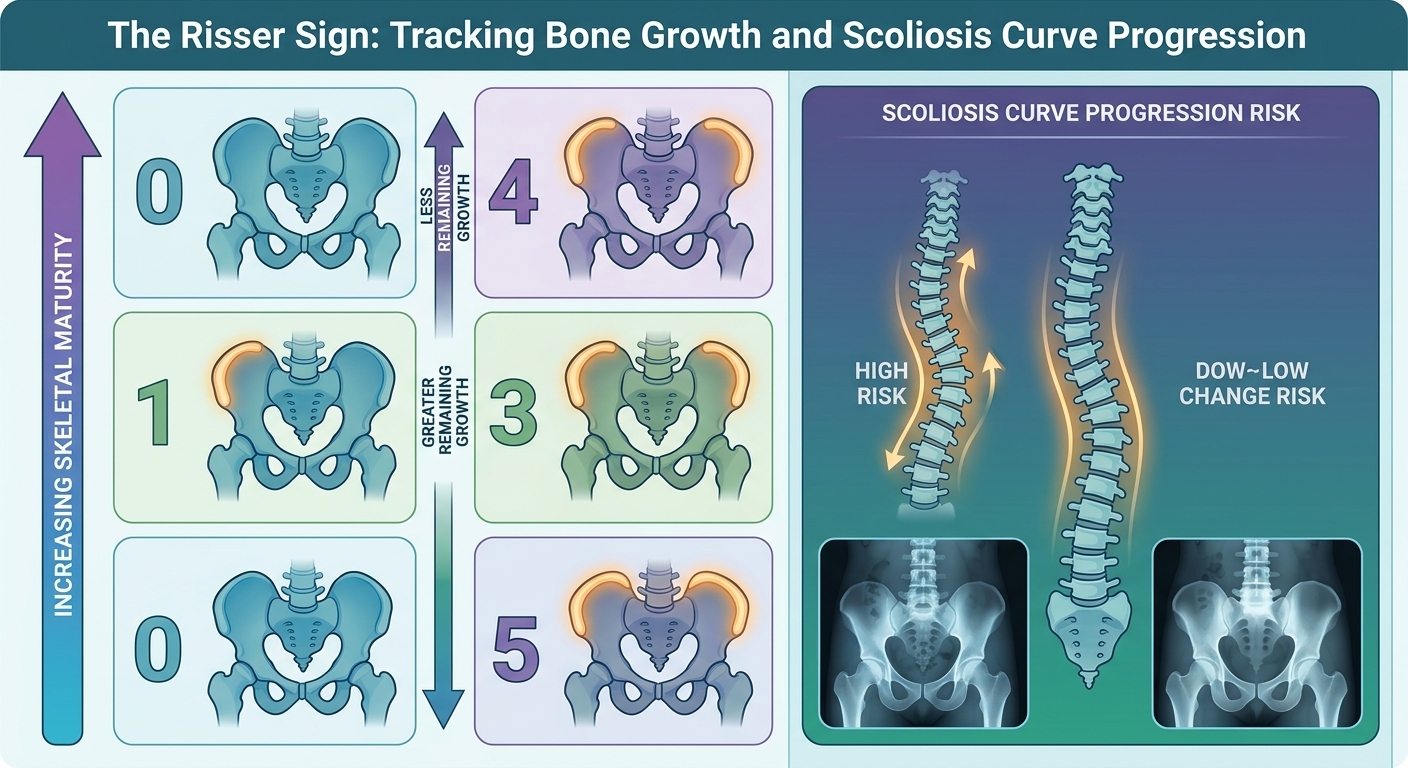
The Risser sign is an X-ray-based measure of skeletal maturity used in scoliosis care. Learn what Risser stages 0–5 mean, how growth affects curve progression, and why doctors may also use the Sanders maturity scale.
---
Introduction
If your child has recently been diagnosed with scoliosis, you may have heard terms such as Cobb angle, Risser sign, skeletal maturity, growth potential, curve progression, and bone age during a medical consultation. These terms can sound complicated, but they are important because scoliosis does not behave the same way in a growing child as it does in someone who has reached skeletal maturity. [1]
One of the traditional tools doctors use to estimate how much skeletal growth remains is the Risser sign, also called the Risser stage or Risser grading system. It is assessed on an X-ray by looking at the ossification and fusion of the iliac apophysis, a growth-related area along the upper part of the pelvis. [2]
Why does a pelvic bone matter when we are talking about the spine?
The answer is growth. During childhood and adolescence, the spine is still developing. A scoliosis curve can become larger during periods of rapid growth, and the amount of growth remaining is therefore an important factor when clinicians estimate the likelihood of curve progression. [1][3]
The Risser sign does not tell a parent exactly what will happen to a child's scoliosis. Instead, it provides one piece of information about skeletal maturity that can be considered alongside the Cobb angle, age, growth rate, menarchal status, curve pattern, clinical examination, and other skeletal maturity assessments. [1][4]
Understanding the Risser sign can therefore help parents understand why the same Cobb angle may be managed differently in two children of different ages or maturity levels. A 30-degree curve in a child with substantial growth remaining may present a different progression risk from a 30-degree curve in an adolescent who is nearly skeletally mature. [1][5]
---
What Is the Risser Sign?
The Risser sign is a radiographic indicator of skeletal maturity based on the appearance of the iliac apophysis, a secondary ossification center located along the iliac crest of the pelvis. On a frontal pelvic or full-spine X-ray, clinicians evaluate how much of this ossification center has developed and whether it has fused with the underlying iliac bone. [2]
The traditional Risser grading system ranges from 0 to 5. In general, lower Risser stages indicate less skeletal maturity and therefore more remaining growth, while higher stages indicate increasing skeletal maturity. Risser 5 represents fusion of the iliac apophysis to the iliac crest. [2]
The Scoliosis Research Society defines the stages as follows: [2]
- Risser 0: No visible ossification of the iliac apophysis
- Risser 1: Approximately 25% ossification
- Risser 2: Approximately 50% ossification
- Risser 3: Approximately 75% ossification
- Risser 4: Approximately 100% ossification, but not yet completely fused
- Risser 5: Complete fusion of the apophysis to the iliac crest
In simple terms, Risser 0 generally represents an immature skeleton, whereas Risser 5 indicates skeletal maturity. However, the relationship between a Risser stage and the amount of growth remaining is not perfectly predictable, which is one of the most important limitations parents should understand. [1][2][6]
---
Why Does Skeletal Growth Matter in Scoliosis?
Scoliosis progression is strongly associated with growth, particularly during the adolescent growth spurt. The Scoliosis Research Society notes that idiopathic scoliosis curves generally progress during periods of rapid growth, while progression usually slows substantially after skeletal maturity. [1]
This does not mean that every scoliosis curve will worsen during growth.
Many curves remain relatively stable, particularly when they are smaller and the child is approaching skeletal maturity. However, the combination of curve magnitude and remaining growth is clinically important when estimating progression risk and deciding whether observation, bracing, or another treatment strategy should be considered. [1][3]
For example, imagine two adolescents who both have a 25-degree Cobb angle.
One child may have substantial growth remaining and be entering a rapid growth phase. The other may be close to skeletal maturity. Although their Cobb angles are identical at that moment, their future risk of progression may not be the same. [1][5]
This is why a scoliosis evaluation should not focus only on the number of degrees in the curve.
---
Understanding the Relationship Between Cobb Angle and Risser Stage
The Cobb angle describes the magnitude of a spinal curve, while the Risser sign provides information about skeletal maturity. They answer two different questions. [1][2]
Cobb angle asks:
How large is the spinal curve now?
Risser stage asks:
How mature is the skeleton, and approximately how much growth may remain?
Together, these measurements provide more useful clinical information than either measurement alone. [1][3]
For example:
| Cobb Angle | Risser Stage | General Clinical Consideration | | ---------- | ------------ | ---------------------------------------------------------------------------- | | 15° | 0 | Small curve but substantial growth may remain | | 25° | 0–1 | Curve may require closer monitoring because growth remains | | 30° | 0–2 | Progression risk may be clinically important | | 30° | 4–5 | Less growth remains, potentially changing management | | 45° | 0–2 | Larger curve combined with substantial growth requires specialist assessment |
These examples are illustrative rather than treatment rules. Actual management depends on many additional factors, including age, curve pattern, skeletal maturity, rate of progression, symptoms, and the patient's overall health. [1][3]
---
What Do Risser Stages 0 Through 5 Mean?
Risser 0: Significant Growth Potential
Risser 0 means that no visible ossification of the iliac apophysis is present using the traditional grading system. In a child with scoliosis, this generally indicates an immature skeleton and potentially substantial remaining growth. [2]
This stage deserves particular attention because the period of rapid adolescent growth is one of the times when scoliosis curves can change relatively quickly. A child with a Risser 0 classification should therefore not be assumed to have a stable curve simply because the current Cobb angle is modest. [1][5]
However, Risser 0 does not automatically mean that the scoliosis will progress. It indicates skeletal immaturity, not a prediction that progression will definitely occur. Curve magnitude, age, sex, growth velocity, curve pattern, and other maturity indicators must also be considered. [1][4]
---
Risser 1: Early Skeletal Maturation
At Risser 1, approximately the first quarter of the iliac apophysis has ossified. The skeleton is still immature, and significant growth may remain. [2]
For parents, this means that the child's scoliosis should generally be considered in the context of ongoing development rather than as a fixed adult condition. The possibility of curve progression remains relevant, particularly when the Cobb angle is moderate or larger. [1]
Importantly, Risser 1 should not be interpreted as meaning that the child has only a small amount of growth remaining. Studies have shown that traditional Risser staging can sometimes underestimate or overestimate remaining growth when compared with more detailed skeletal maturity systems. [6][7]
---
Risser 2: Approximately Halfway Through Ossification
Risser 2 represents approximately 50% ossification of the iliac apophysis. This indicates increasing skeletal maturity, but it does not necessarily mean that spinal growth is nearly complete. [2][6]
This distinction is important because some adolescents classified at intermediate Risser stages may still be in clinically significant phases of growth. Research comparing Risser staging with other maturity systems has found meaningful disagreement between the systems, particularly around the adolescent growth period. [7][8]
Therefore, a doctor may consider additional information rather than assuming that Risser 2 automatically means that only a small amount of growth remains.
---
Risser 3: Approximately 75% Ossification
Risser 3 indicates approximately 75% ossification of the iliac apophysis. The adolescent is becoming more skeletally mature, but growth may not yet be complete. [2]
At this stage, clinicians may pay close attention to the child's growth history, recent height changes, menstrual history when applicable, and radiographic findings. These factors can help provide a more complete picture of where the child is in the growth cycle. [1][4]
A Risser 3 classification therefore should not be interpreted simply as "almost finished growing." Individual maturation varies considerably.
---
Risser 4: Ossification Is Complete, but Fusion Is Not Yet Complete
Risser 4 indicates that the iliac apophysis has reached approximately 100% ossification but has not yet completely fused to the iliac crest. [2]
This stage traditionally suggests that the adolescent is approaching skeletal maturity. However, research has shown that meaningful growth can still occur after Risser 4 in some patients. [9]
One study of adolescents with idiopathic scoliosis found that 75.2% of patients continued to grow after reaching Risser 4, with measurable additional height gain in both girls and boys. [9]
This finding is particularly important for parents because it demonstrates why Risser 4 should not automatically be interpreted as "growth is completely finished."
---
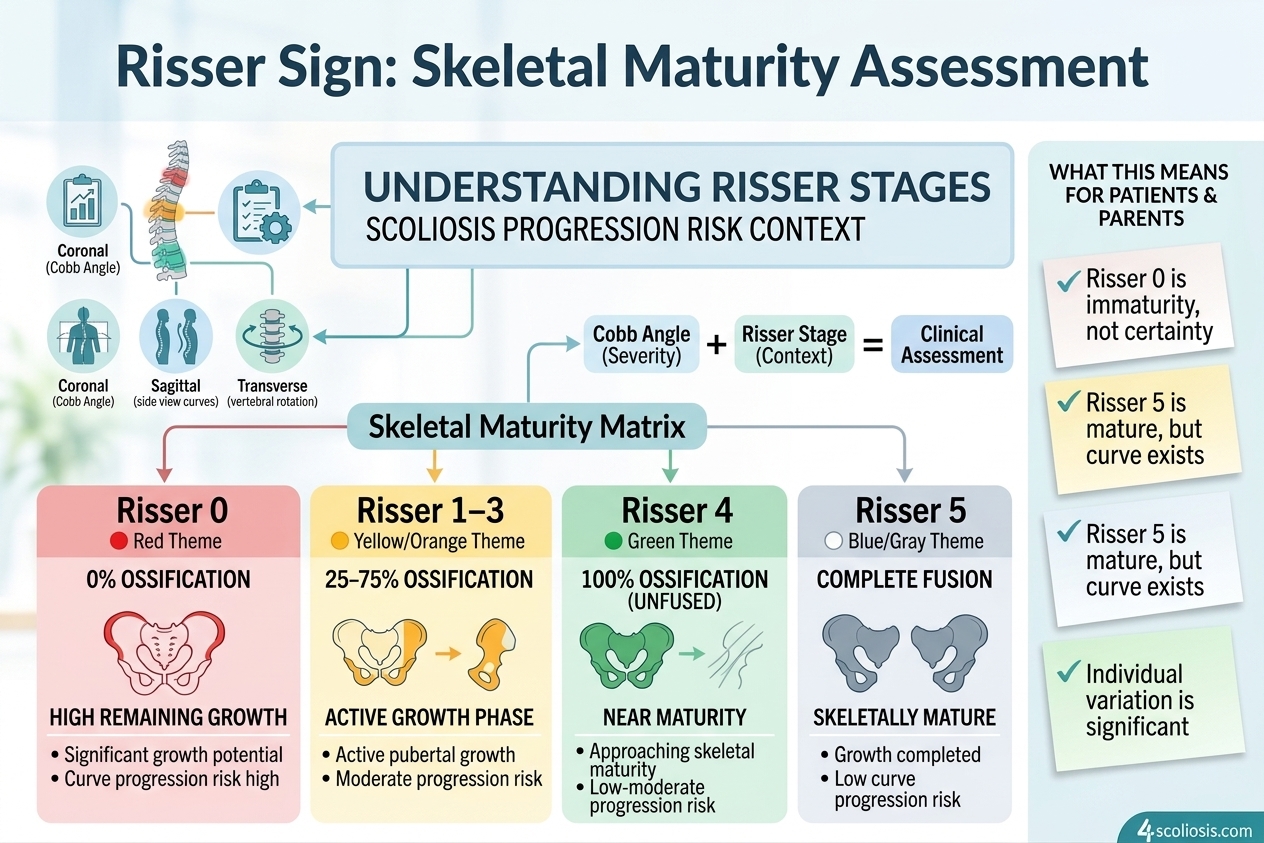
Risser 5: Skeletal Maturity
Risser 5 represents fusion of the iliac apophysis to the iliac crest. It is traditionally considered a marker of skeletal maturity. [2]
When a patient reaches Risser 5, substantial longitudinal skeletal growth is generally considered complete. The risk of progression associated specifically with adolescent growth therefore decreases considerably compared with an immature skeleton. [1][2]
However, reaching skeletal maturity does not mean that scoliosis can never change again.
Some larger curves may continue to progress during adulthood, and adult degenerative changes can also influence spinal alignment. The Scoliosis Research Society notes that some larger adolescent curves, particularly those greater than approximately 60 degrees, may continue progressing in adulthood. [1]
---
Does a Low Risser Score Mean Scoliosis Will Get Worse?
No.
This is one of the most important points for parents.
A low Risser stage indicates that the skeleton is relatively immature. It does not mean that scoliosis progression is inevitable. [1][2]
The risk of progression depends on multiple factors.
Important factors include:
- Cobb angle
- Age
- Sex
- Growth velocity
- Skeletal maturity
- Curve pattern
- Curve location
- Menarchal status
- Previous change in Cobb angle
- Overall spinal alignment
The Scoliosis Research Society emphasizes that predicting progression for an individual patient remains difficult, although larger curves and greater remaining growth are associated with increased progression risk. [5]
Therefore, parents should think of Risser staging as a risk-context tool, not a crystal ball.
---
Why Growth Spurts Are Important
The adolescent growth spurt is one of the most important periods in the natural history of idiopathic scoliosis. During rapid skeletal growth, a spinal curve can increase more quickly than it might before or after the growth acceleration phase. [1][4]
This is why pediatric scoliosis specialists often ask about changes in height over time.
They may also ask girls about menarche, because the timing of the first menstrual period provides additional information about pubertal development. However, menarche is only one clinical indicator and should not be used alone to determine skeletal maturity. [1]
For parents, the practical lesson is straightforward:
A child who is growing rapidly needs to be monitored differently from a child who has nearly finished growing.
The same Cobb angle can therefore have different clinical implications depending on where the child is in the growth process. [1][5]
---
How Is the Risser Sign Determined?
The Risser sign is determined from an X-ray, usually one that includes the pelvis as part of the spinal radiographic assessment. The clinician examines the iliac apophysis along the iliac crest and determines the extent of ossification and subsequent fusion. [2]
The assessment is usually made from a frontal radiograph rather than from a physical examination alone.
This means that parents cannot reliably determine their child's Risser stage simply by looking at posture, shoulder symmetry, or the appearance of the back. The stage requires appropriate radiographic assessment by a trained clinician. [2]
It is also important to understand that Risser staging is not the same as measuring the Cobb angle.
The Cobb angle evaluates the spinal curve.
The Risser sign evaluates skeletal maturity.
Both can appear on the same radiographic study, but they provide different pieces of information. [1][2]
---
Why the Risser Sign Has Limitations
The Risser sign has been used for decades and remains clinically useful, but it is not a perfect measurement of skeletal maturity. [2][6]
One reason is that ossification of the iliac apophysis does not always progress at exactly the same rate as other skeletal maturation processes. Adolescents do not all follow an identical biological timetable. [6][9]
Research has also shown that Risser staging can sometimes overestimate skeletal maturity, meaning that a child may appear relatively mature according to the Risser sign while still having significant growth remaining. [7][8]
This matters because treatment decisions such as bracing depend partly on whether substantial growth remains.
A patient who is incorrectly assumed to be nearly mature could potentially be considered lower risk than they actually are. This is one reason modern scoliosis assessment increasingly considers additional skeletal maturity indicators when the clinical situation requires greater precision. [7][8]
---
Risser Sign vs. Sanders Skeletal Maturity Scale
One of the most important alternatives to the Risser sign is the Sanders Skeletal Maturity Scale, which evaluates maturation of the bones of the hand and wrist. [10]
Why might a doctor use the hand instead of the pelvis?
The bones of the hand undergo a series of recognizable developmental changes during adolescence. These changes can provide a more detailed picture of skeletal maturation and the timing of the adolescent growth spurt. [10]
Research by Sanders and colleagues demonstrated that a simplified skeletal maturity system based on hand radiographs correlated more strongly with the behavior of idiopathic scoliosis than the Risser sign or chronological age alone. [10]
Other research has similarly found that the Sanders system may be more closely associated with the rapid growth phase and curve progression than traditional Risser staging. [7][8]
This does not mean that the Risser sign is obsolete.
Rather, it means that Risser stage is one tool among several, and a clinician may choose a more detailed skeletal maturity assessment when the precise timing of remaining growth is particularly important. [7][10]
---
What Other Factors Help Determine Growth Potential?
Doctors may consider several indicators together when assessing skeletal maturity and scoliosis progression risk.
These may include:
- Chronological age
- Current height
- Height velocity
- Recent growth pattern
- Menarchal status
- Risser stage
- Sanders skeletal maturity stage
- Bone age
- Hand and wrist radiographs
- Pelvic radiographic findings
- Curve magnitude
- Curve pattern
- Previous Cobb angle measurements
The Scoliosis Research Society specifically notes that age, menstrual status, and radiographic parameters can all contribute to assessment of growth potential. [1]
Using multiple indicators can be especially useful when the Risser stage does not appear to match the child's actual physical development.
---
How Risser Stage Can Influence Scoliosis Monitoring
The amount of growth remaining can influence how frequently a child is monitored.
A growing child with scoliosis may undergo periodic clinical assessment and, when medically indicated, repeat radiographs to determine whether the curve is changing. The Scoliosis Research Society notes that observation can involve repeated visits and X-ray examinations during development. [3]
The purpose is not simply to take more X-rays.
The purpose is to understand whether the spinal curve is stable or progressing while the child is still growing. [3]
For example, if a child's Cobb angle changes from 22 degrees to 28 degrees over a period of time, the clinician may consider whether this represents true progression, measurement variability, and how that change relates to the child's stage of growth. [3][5]
This is why a sequence of measurements can be more informative than a single X-ray.
---
Risser Stage and Bracing Decisions
For some adolescents with idiopathic scoliosis, bracing may be recommended when there is substantial growth remaining and the curve is within a range where bracing is considered appropriate. [3][11]
The Scoliosis Research Society generally describes bracing as an option for growing patients with curves larger than approximately 25 degrees but smaller than approximately 45–50 degrees, although treatment decisions must be individualized. [11]
Risser stage can contribute to this assessment because it provides information about skeletal maturity.
However, Risser stage alone should never be used to decide whether a child needs a brace. The decision also depends on the Cobb angle, age, growth potential, curve pattern, previous progression, and other clinical factors. [3][7][11]
The goal of bracing is generally to reduce the likelihood of significant curve progression during remaining growth; it is not simply intended to make the child look straighter while wearing the brace. [11]
---
What Parents Should Ask at a Scoliosis Appointment
If your child has been diagnosed with scoliosis, it is reasonable to ask the treating clinician several specific questions.
Useful questions include:
- What is my child's Cobb angle?
- Where is the main curve located?
- Is the curve structural?
- What is my child's Risser stage?
- How much growth is likely to remain?
- Is my child currently in a rapid growth phase?
- Would a Sanders skeletal maturity assessment be useful?
- Has the Cobb angle changed compared with the previous X-ray?
- How often should the curve be monitored?
- Does my child currently meet criteria for observation, bracing, or another treatment?
These questions can help parents understand the reasoning behind a treatment recommendation rather than focusing on a single number. [1][3][5]
---
What Does Risser Sign Mean for Your Child?
If you see a Risser number on your child's medical report, try not to interpret it by itself.
For example:
Risser 0 does not mean "severe scoliosis."
It means the pelvis shows little or no ossification of the iliac apophysis according to the Risser system, indicating skeletal immaturity. [2]
Likewise:
Risser 5 does not mean "the scoliosis is gone."
It indicates skeletal maturity, while the existing spinal curve may still be present. [1][2]
The Risser stage should therefore be interpreted together with the Cobb angle, curve pattern, spinal alignment, growth history, and clinical examination. [1][5]
---
Important Precautions and Medical Disclaimer
The information provided by 4scoliosis.com is intended for general educational purposes and is not a substitute for an individualized medical evaluation. Risser staging, Cobb angle measurement, skeletal maturity assessment, and scoliosis treatment decisions should be performed and interpreted by appropriately qualified healthcare professionals. [1][2]
A Risser stage cannot independently predict whether an individual child's scoliosis will progress. Research has demonstrated limitations and discrepancies between Risser staging and other skeletal maturity systems, particularly during important periods of adolescent growth. [7][8]
Parents should also avoid interpreting a single X-ray as a complete prediction of their child's future. Scoliosis progression depends on multiple variables, including curve magnitude, growth potential, curve pattern, age, and previous progression. [5]
Radiographs involve ionizing radiation. Repeat imaging should therefore be performed when clinically appropriate and according to the treating clinician's judgment. Modern scoliosis evaluation aims to obtain the information needed for safe management while avoiding unnecessary imaging. [3]
If a child develops significant pain, weakness, numbness, difficulty walking, bowel or bladder changes, breathing problems, or other unusual neurological symptoms, professional medical assessment should be sought promptly. These findings may require evaluation beyond routine monitoring of adolescent idiopathic scoliosis. [1]
This article does not provide a diagnosis or recommend a specific treatment, brace, exercise program, manual therapy, medication, or surgical procedure for an individual patient.
---
Conclusion: The Risser Sign Is About Growth, Not Just a Number
The Risser sign is a traditional radiographic method for estimating skeletal maturity by observing ossification and fusion of the iliac apophysis. Its stages range from Risser 0 to Risser 5, with increasing numbers generally representing increasing skeletal maturity. [2]
Its importance in scoliosis comes from a simple clinical principle:
The more growth a child has remaining, the greater the opportunity for a scoliosis curve to change during growth. [1][5]
However, Risser stage is not a prediction of the future by itself.
A complete assessment combines Cobb angle, skeletal maturity, growth velocity, age, curve pattern, spinal alignment, clinical findings, and previous changes in the curve. [1][5]
Parents should also understand that modern scoliosis care may use additional maturity indicators, particularly the Sanders Skeletal Maturity Scale, because research suggests that hand-based skeletal maturity assessment can provide a more precise indication of growth phase in some adolescents. [7][10]
Perhaps the most useful way to think about the Risser sign is this:
Cobb angle tells you how large the curve is. Risser stage helps tell you how mature the skeleton is. Together, they help clinicians understand the context in which the curve may behave.
If your child has scoliosis, do not be discouraged by unfamiliar terminology on an X-ray report. Ask questions, keep records of Cobb angle measurements over time, understand your child's growth stage, and work with a qualified healthcare professional to determine an appropriate monitoring or treatment plan. [1][3]
At 4scoliosis.com, our goal is to make scoliosis terminology understandable for patients and parents so that you can participate more confidently in decisions about spinal health.
---
References
[1] Scoliosis Research Society (SRS). Adolescent Idiopathic Scoliosis. The SRS explains that adolescent idiopathic scoliosis commonly progresses during rapid growth and that skeletal maturity assessment includes the Risser grading system. Scoliosis Research Society – Adolescent Idiopathic Scoliosis
[2] Scoliosis Research Society (SRS). Glossary – Risser Sign. The SRS defines the Risser sign and describes stages 0 through 5 according to ossification and fusion of the iliac apophysis. Scoliosis Research Society – Glossary
[3] Scoliosis Research Society (SRS). Diagnosis and Treatment – Observation. Information regarding monitoring of scoliosis during growth and the use of serial clinical and radiographic assessment. Scoliosis Research Society – Diagnosis and Treatment
[4] Scoliosis Research Society (SRS). Scoliosis Brace Manual – Growth and Maturity Assessment. Discusses growth potential, chronological age, menarche, bone age, and Risser sign in the assessment of skeletal maturity. SRS Brace Manual
[5] Scoliosis Research Society (SRS). Living With Scoliosis – Curve Progression. Discusses factors associated with progression, including curve size and remaining growth, while emphasizing the difficulty of predicting progression in an individual patient. Scoliosis Research Society – Living With Scoliosis
[6] Little DG, Sussman MD. The Risser sign: a critical analysis. Journal of Pediatric Orthopedics. 1994;14(5):569–575. This review critically evaluated the accuracy of the Risser sign as an indicator of skeletal maturity and scoliosis progression. PubMed – The Risser Sign: A Critical Analysis
[7] Neal KM, Shirley ED, Kiebzak GM. Maturity Indicators and Adolescent Idiopathic Scoliosis: Evaluation of the Sanders Maturity Scale. Spine. 2018. This study discusses the relationship between Risser staging and the Sanders Maturity Scale and reports that the Sanders system is a better predictor of the curve acceleration phase. PubMed – Maturity Indicators and Adolescent Idiopathic Scoliosis
[8] Cheung PWH, Cheung JPY. Does the Use of Sanders Staging and Distal Radius and Ulna Classification Avoid Mismatches in Growth Assessment With Risser Staging Alone? Clinical Orthopaedics and Related Research. 2021;479:2516–2530. The study examined discrepancies among skeletal maturity systems and found limitations in using Risser staging alone to identify important pubertal growth landmarks. PubMed – Skeletal Maturity and Risser Staging
[9] Sanders JO, Browne RH, McConnell SJ, et al. Maturity assessment and curve progression in girls with idiopathic scoliosis. Journal of Bone and Joint Surgery. 2007. This research examined skeletal maturity indicators and scoliosis progression and found that substantial growth may continue after Risser 4. PubMed – Maturity Assessment and Curve Progression
[10] Sanders JO, Khoury JG, Kishan S, et al. Predicting scoliosis progression from skeletal maturity: a simplified classification during adolescence. Journal of Bone and Joint Surgery. 2008;90(3):540–553. The study developed and evaluated a simplified skeletal maturity classification based on hand radiographs and found a stronger correlation with scoliosis behavior than traditional Risser staging. PubMed – Predicting Scoliosis Progression From Skeletal Maturity
[11] Scoliosis Research Society (SRS). Bracing. Provides patient-oriented information about bracing for growing adolescents with idiopathic scoliosis and the role of remaining growth in treatment decisions. Scoliosis Research Society – Bracing
[12] Vira S, Husain Q, Jalai C, et al. The Interobserver and Intraobserver Reliability of the Sanders Classification Versus the Risser Stage. Journal of Pediatric Orthopaedics. 2017. The study compared the reliability of Sanders and Risser skeletal maturity classifications and found greater reliability for the Sanders classification in the study population. PubMed – Sanders Classification Versus Risser Stage
---
Key Takeaway for Parents
Risser stage is useful, but it should never be viewed alone. The most meaningful assessment of a growing child with scoliosis combines the Cobb angle + growth remaining + curve pattern + skeletal maturity + change over time. [1][5][7]
A low Risser stage does not mean that scoliosis will definitely progress, and a high Risser stage does not mean that an existing curve has disappeared. The purpose of skeletal maturity assessment is to help the clinical team understand how much growth remains and how that growth may influence management of the spinal curve. [1][2]