Spine Care
[Exercise, Rehabilitation & Movement Therapy 07] Pelvic Tilts and Hip Alignment Exercises for Lumbar Scoliosis
[Exercise, Rehabilitation & Movement Therapy 07] Learn how pelvic tilt and hip-alignment exercises may support mobility, trunk control, and
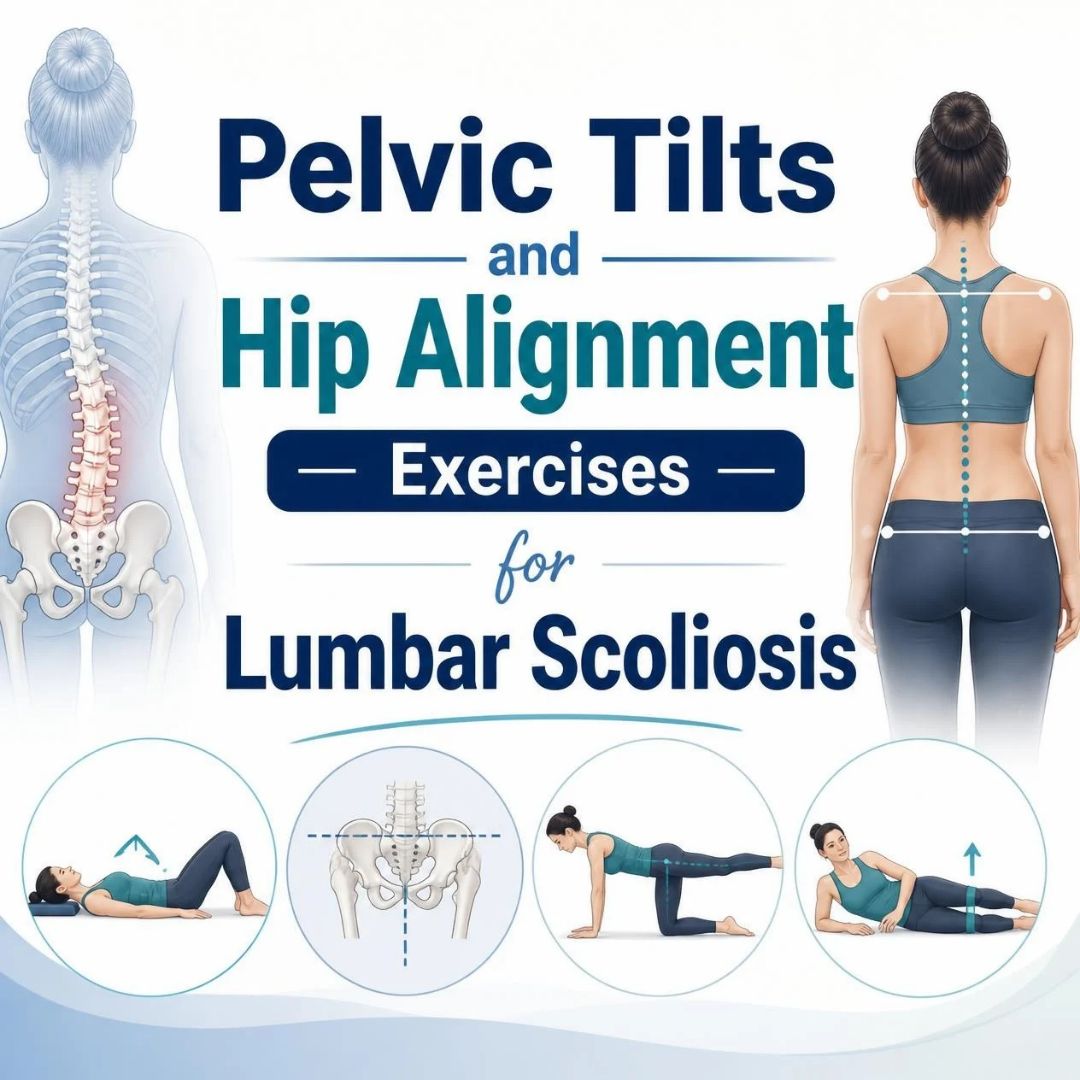
functional balance in lumbar scoliosis—while understanding why exercises must be individualized to each spinal curve.
1. Introduction
When scoliosis affects the lumbar spine, the position and movement of the pelvis and hips can become an important part of the overall movement pattern. Patients may notice an uneven waistline, differences in hip height, or a tendency to shift their weight toward one side. These findings can be related to the spinal curve itself, pelvic positioning, leg-length differences, or combinations of these factors. [1,2] ([PubMed][1])
This is why pelvic tilts and hip-alignment exercises are sometimes included in scoliosis rehabilitation. Their purpose is generally not to “push the spine straight,” but to improve awareness, mobility, strength, and control of the pelvis and trunk. In scoliosis-specific exercise, treatment is expected to be individualized according to the person's curve pattern, functional limitations, and treatment phase. [1] ([PubMed Central (PMC)][2])
For patients and parents, an important distinction is that pelvic alignment and spinal alignment are related but not identical concepts. A change in pelvic position does not necessarily mean that a structural lumbar scoliosis has been corrected.
---
2. Understanding the Relationship Between the Lumbar Spine and Pelvis
The lumbar spine and pelvis function as a connected mechanical system.
The lumbar vertebrae sit directly above the sacrum, which forms the central connection between the spine and pelvis. The pelvis then transfers forces between the trunk and lower extremities.
As a result, movement at one part of this system can influence movement elsewhere.
For example:
- pelvic rotation can influence apparent trunk alignment;
- pelvic tilt can alter lumbar lordosis;
- hip mobility can affect how the pelvis moves during walking;
- leg-length differences can influence pelvic obliquity;
- and a structural spinal curve can itself contribute to an asymmetric pelvic position.
These relationships are dynamic rather than strictly one-directional. [1,2] ([PubMed Central (PMC)][2])
---
3. What Is Pelvic Tilt?
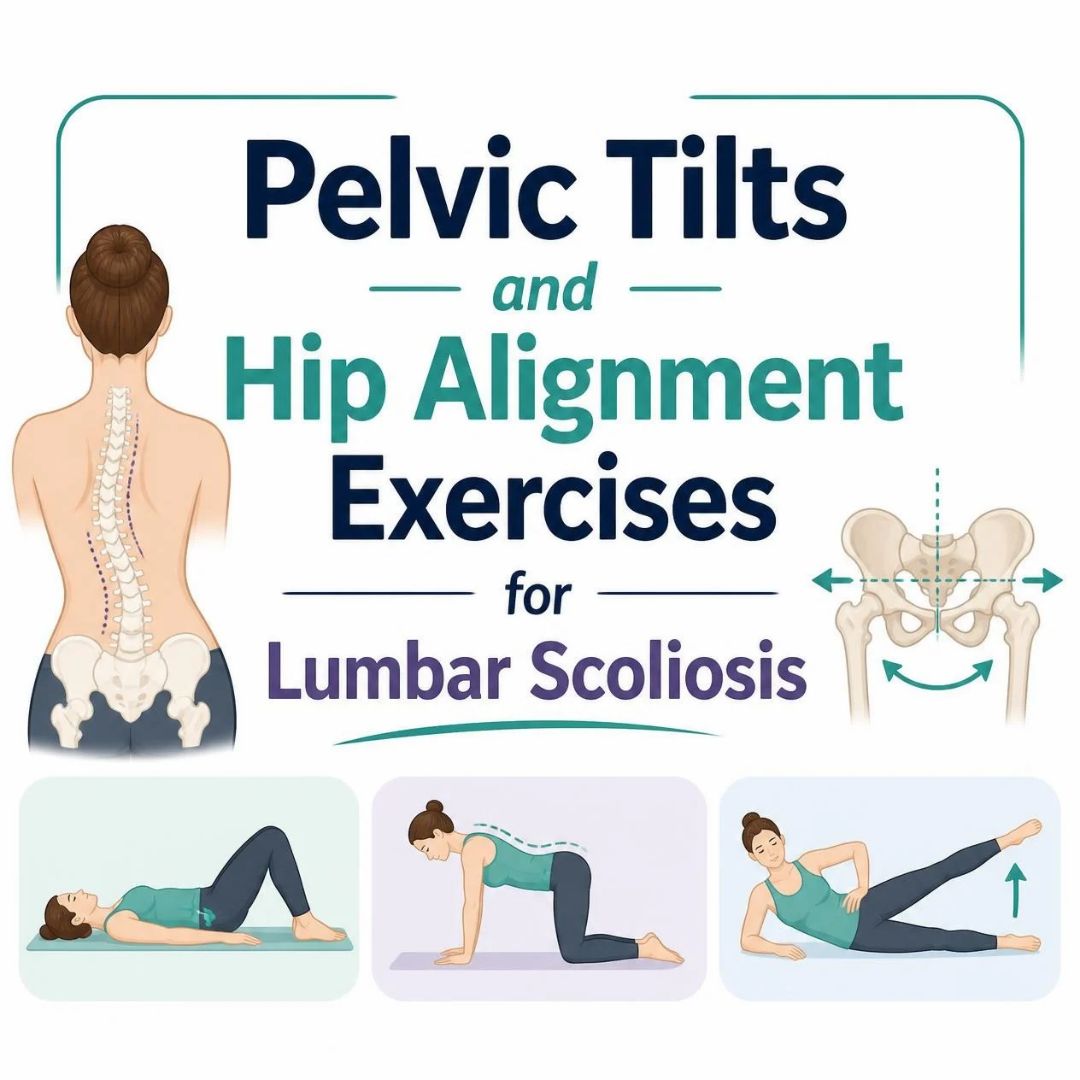
Pelvic tilt describes the orientation of the pelvis relative to the trunk and lower limbs.
In the sagittal plane, clinicians commonly discuss:
Anterior pelvic tilt
The front of the pelvis rotates forward relative to the back.
Posterior pelvic tilt
The pelvis rotates backward.
There can also be pelvic obliquity, in which one side of the pelvis appears higher or lower than the other in the frontal plane.
And there can be pelvic rotation, in which one side of the pelvis moves forward or backward relative to the other.
These different movements should not be confused.
A patient may have a sagittal-plane pelvic tilt, frontal-plane pelvic obliquity, and transverse-plane pelvic rotation at the same time.
---
4. Why Pelvic Position Matters in Lumbar Scoliosis
A lumbar scoliosis curve changes the three-dimensional relationship between the vertebrae and surrounding tissues.
The pelvis may then participate in a compensatory movement pattern.
However, the direction of compensation differs among individuals.
For this reason, it is not scientifically appropriate to say that every person with lumbar scoliosis has the same pelvic position.
Instead, assessment should determine whether the pelvis is:
- level or oblique,
- rotated,
- excessively anteriorly or posteriorly tilted,
- mobile or relatively restricted,
- and stable during movement.
The goal is to understand the individual movement pattern rather than impose a predetermined correction.
---
5. Pelvic Obliquity Is Not Always Caused by Scoliosis
This is one of the most important points for patients.
An uneven pelvis does not automatically mean that the spine is causing it.
Pelvic obliquity can have several possible contributors, including:
- structural spinal deformity,
- functional positioning,
- hip contracture,
- lower-limb alignment,
- leg-length discrepancy,
- neuromuscular conditions,
- or combinations of these factors.
A 2026 systematic review emphasized that distinguishing spinal deformity from leg-length discrepancy in patients with pelvic obliquity can be difficult because these conditions can produce overlapping clinical and radiographic findings. [2] ([PubMed][1])
Therefore, simply looking at the hips and deciding that one side needs to be “lowered” or “raised” is not sufficient for diagnosis.
---
6. What Is Leg-Length Discrepancy?
Leg-length discrepancy (LLD) means that the functional or anatomical length of one lower limb differs from the other.
An apparent difference can also arise from positioning rather than an actual difference in bone length.
This distinction is important.
A person may appear to have one leg shorter because of:
- pelvic rotation,
- hip positioning,
- knee position,
- foot mechanics,
- or spinal and pelvic alignment.
Conversely, a genuine anatomical difference in limb length can contribute to pelvic obliquity.
Because of this complexity, a perceived difference in leg length should not automatically be corrected with a shoe lift or other intervention without appropriate assessment. [2] ([PubMed][1])
---
7. Can Pelvic Tilts Correct Lumbar Scoliosis?
Pelvic tilt exercises can improve movement awareness and control, but this does not mean that they can independently correct a structural scoliosis.
A structural scoliosis involves changes in the vertebral column, including lateral curvature and often vertebral rotation.
Exercise may influence:
- posture,
- muscle performance,
- movement control,
- flexibility,
- functional capacity,
- and potentially some scoliosis-related clinical or radiographic outcomes.
However, no single pelvic exercise should be presented as a guaranteed method of reversing a structural curve.
Research on physiotherapeutic scoliosis-specific exercises (PSSE) has reported improvements in measures such as Cobb angle and angle of trunk rotation, but the evidence varies in quality and interventions are not equivalent to simple pelvic tilting exercises. [3,4] ([PubMed][3])
---
8. The Purpose of a Pelvic Tilt Exercise
A controlled pelvic tilt can be useful for teaching a person to recognize pelvic movement.
For example, lying on the back with the knees bent, a person can gently alternate between:
- allowing the lower back to move slightly away from the floor,
- and gently flattening or reducing the lumbar arch.
The purpose is movement awareness, not forcing the lumbar spine into a particular shape.
This can help patients understand that the pelvis and lumbar spine can move relative to one another.
It may also serve as a simple starting point for developing trunk control.
---
9. A Basic Supine Pelvic Tilt
A general educational version can be performed as follows:
- Lie on your back with your knees comfortably bent.
- Place your feet on the floor.
- Keep the shoulders relaxed.
- Slowly rotate the pelvis backward.
- Allow the lower back to gently move toward the floor.
- Return to a neutral position.
- Repeat slowly.
The movement should remain comfortable and controlled.
The objective is not to press the back forcefully into the floor.
This is a general movement-control exercise, not a curve-specific scoliosis correction.
---
10. Why Neutral Pelvic Position Matters
The word neutral does not mean that there is one perfect pelvic position.
Instead, neutral generally refers to a comfortable and controlled position somewhere between excessive anterior and posterior pelvic rotation.
During functional movement, the pelvis constantly changes position.
A healthy movement system therefore requires the ability to move through different positions rather than maintaining one rigid posture all day.
For scoliosis rehabilitation, the goal is often to develop sufficient control to move between positions efficiently.
---
11. Hip Mobility and Lumbar Scoliosis
The hips and lumbar spine share movement demands.
If hip mobility is restricted, the lumbar spine may contribute more movement during certain activities.
This does not mean that hip stiffness causes scoliosis.
Rather, limited hip mobility can affect how a person performs movements such as:
- walking,
- squatting,
- stepping,
- bending,
- and rotating.
Therefore, evaluating hip mobility can be useful when designing an exercise program for someone with lumbar scoliosis.
---
12. Hip Flexor Mobility
The hip flexors connect the pelvis and thigh.
When their flexibility or control is limited, pelvic position during hip extension can change.
A gentle hip-flexor mobility exercise may involve:
- Taking a comfortable split stance.
- Keeping the trunk upright.
- Gently moving the pelvis forward.
- Maintaining comfortable breathing.
- Avoiding excessive lumbar arching.
The objective is to allow hip extension without compensating excessively through the lower back.
This exercise should not be interpreted as a treatment for the structural scoliosis itself.
---
13. Gluteal Strength and Pelvic Control
The gluteal muscles play an important role in hip extension and pelvic control.
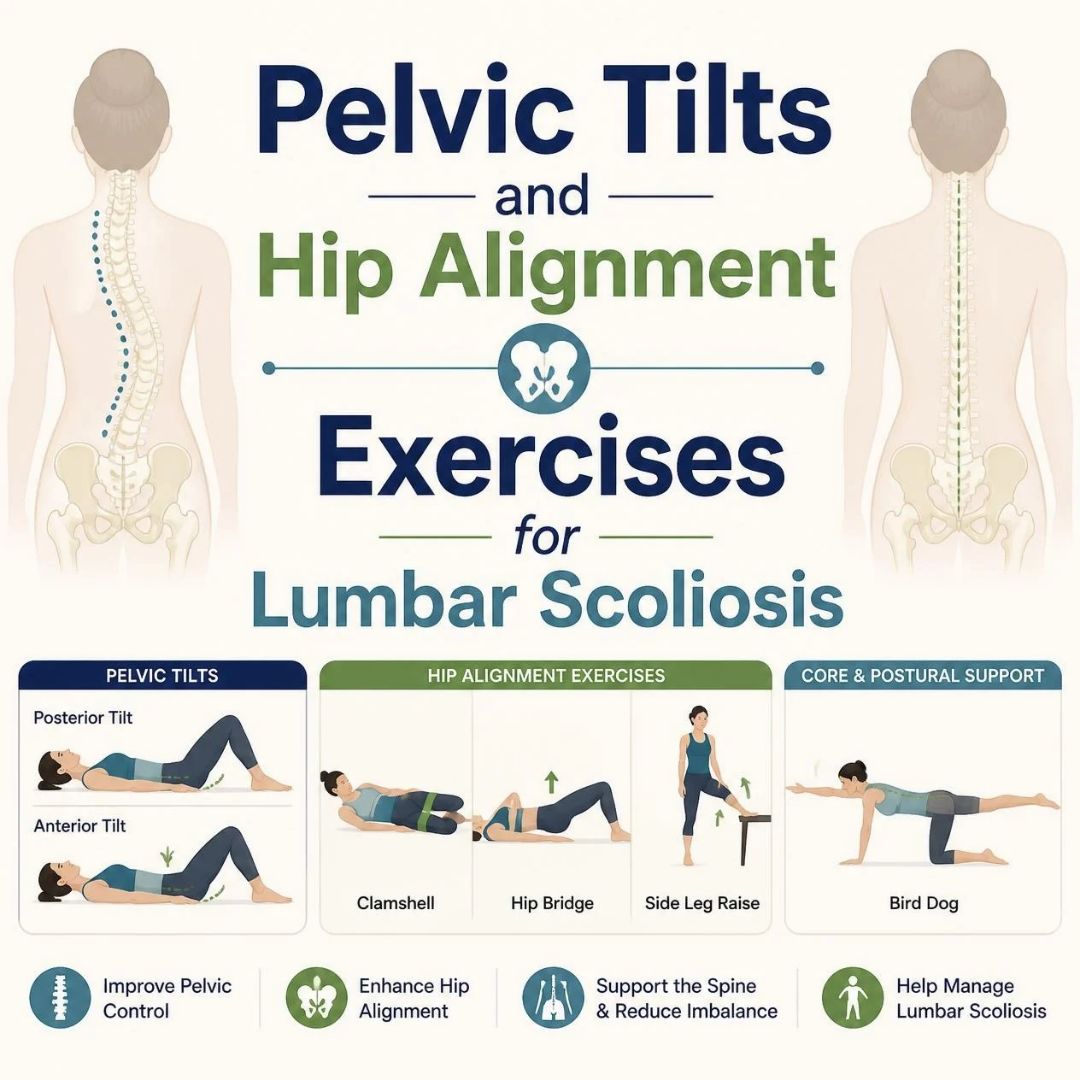
Exercises such as a controlled bridge can develop:
- hip extension strength,
- trunk control,
- coordination,
- and endurance.
A basic bridge involves lying on the back with knees bent and lifting the pelvis while maintaining controlled trunk positioning.
For someone with scoliosis, the objective should be controlled symmetrical or individualized movement, rather than intentionally shifting the pelvis toward one side without professional instruction.
---
14. Hip Abductor Strength
The hip abductors help stabilize the pelvis during standing and walking.
One commonly used exercise is a side-lying hip abduction.
The person lies on one side and raises the upper leg while attempting to keep the pelvis stable.
The exercise can be useful for general hip strength, but it should not automatically be described as a method for “correcting pelvic tilt.”
Its purpose is primarily to improve muscular capacity and pelvic control.
---
15. Clamshell Exercise
The clamshell is another common hip-strengthening exercise.
It targets muscles involved in hip external rotation and abduction.
A controlled version involves:
- Lying on one side.
- Keeping the knees comfortably bent.
- Maintaining the pelvis relatively stable.
- Raising the upper knee without rolling the pelvis backward.
- Returning slowly.
Again, the exercise is not inherently scoliosis-specific.
It becomes relevant to scoliosis rehabilitation when a clinician identifies a hip or pelvic-control deficit that the exercise can address.
---
16. Single-Leg Balance and Pelvic Control
Single-leg balance can reveal how effectively the pelvis and trunk are controlled when one lower limb supports the body.
A person may demonstrate:
- pelvic dropping,
- trunk leaning,
- excessive foot movement,
- or difficulty maintaining alignment.
These findings can provide useful information for rehabilitation.
However, they should not be interpreted in isolation as evidence of the cause of scoliosis.
The body uses multiple strategies to maintain balance, and asymmetry does not necessarily indicate pathology.
---
17. Why the Core and Pelvis Should Work Together
The pelvis cannot be considered independently of the trunk.
The abdominal muscles, back muscles, diaphragm, pelvic floor, and hip muscles all contribute to trunk stability and movement.
A strengthening program may therefore combine:
- pelvic control,
- abdominal activation,
- hip strengthening,
- trunk endurance,
- and functional movement.
This approach is consistent with the broader principle of developing active control rather than relying solely on passive positioning.
---
18. Pelvic Tilt vs. Scoliosis-Specific Self-Correction
These are not the same thing.
A pelvic tilt exercise teaches movement of the pelvis.
A PSSE self-correction strategy is designed around the person's specific three-dimensional spinal deformity.
SOSORT guidelines recommend that PSSE incorporate three-dimensional auto-correction, stabilization of the corrected posture, training in activities of daily living, and patient education. They also emphasize that programs should be individualized according to curve pattern and patient needs. [1] ([PubMed Central (PMC)][2])
Therefore, a general pelvic exercise can be useful without being a complete scoliosis-specific intervention.
---
19. A Three-Dimensional Perspective
Lumbar scoliosis should be understood in three dimensions.
The spine may demonstrate changes in:
Coronal alignment
Side-to-side curvature.
Sagittal alignment
Changes involving lumbar lordosis and overall spinal profile.
Transverse-plane alignment
Vertebral rotation.
The pelvis can also move in multiple planes.
This means that an exercise that appears symmetrical from the front may create an asymmetric movement pattern when viewed from another direction.
For this reason, rehabilitation professionals often assess movement from multiple planes.
---
20. Should Both Hips Always Be Exercised Equally?
Not necessarily.
General strengthening often involves both sides.
However, an individualized rehabilitation program may use different:
- repetitions,
- resistance,
- positions,
- movement directions,
- or stabilization demands
on each side.
This does not mean that every person with lumbar scoliosis needs unilateral exercise.
The decision should be based on the person's assessment.
The 2016 SOSORT guidelines specifically emphasize individualization according to patient needs and curve pattern. [1] ([PubMed Central (PMC)][2])
---
21. Pelvic Alignment and the Cobb Angle
The Cobb angle is the standard radiographic measurement used to quantify the magnitude of a scoliosis curve.
Pelvic alignment can influence the overall appearance of spinal alignment, but pelvic exercises should not be assumed to directly reduce the Cobb angle.
Recent systematic reviews suggest that PSSE can produce improvements in Cobb angle and other measures in adolescent idiopathic scoliosis, but these studies investigate structured scoliosis-specific exercise programs rather than isolated pelvic tilts. [3,4] ([PubMed][3])
This distinction is essential when communicating with patients.
---
22. What About Pain?
Pelvic and hip exercises may be useful for general physical function, but persistent lumbar pain should not automatically be attributed to pelvic misalignment.
Pain can have many causes.
In an individual with scoliosis, persistent or significant pain may warrant clinical assessment to determine whether another condition is contributing.
Exercise should be modified if it consistently causes or significantly increases pain.
---
23. Children and Adolescents With Lumbar Scoliosis
Children and adolescents require particular care because the spine is still developing.
An exercise program should take into account:
- age,
- skeletal maturity,
- curve magnitude,
- curve pattern,
- progression risk,
- and current treatment.
A child should not be given a self-designed pelvic correction program simply because one hip appears higher.
Clinical evaluation is particularly important when spinal asymmetry is changing during a growth period.
---
24. Adults With Lumbar Scoliosis
Adults may have lumbar scoliosis associated with adolescent idiopathic scoliosis, degenerative changes, or other causes.
For adults, exercise goals may include:
- maintaining mobility,
- improving strength,
- increasing endurance,
- improving balance,
- supporting daily activities,
- and reducing movement-related limitations.
The objective may therefore be functional improvement rather than changing the structural curve.
This distinction helps prevent unrealistic expectations.
---
25. A Safe General Exercise Sequence
For someone who has been medically cleared for exercise, a general movement program might include:
Step 1 — Pelvic Awareness
Gentle pelvic tilts in a comfortable position.
Step 2 — Hip Mobility
Controlled hip-flexor or hip-rotation mobility.
Step 3 — Hip Strength
Bridges, hip abduction, or other appropriate exercises.
Step 4 — Trunk Control
Dead bug, bird dog, or another appropriate stabilization exercise.
Step 5 — Functional Movement
Squatting, stepping, walking, or other daily activities.
The sequence should be modified according to the individual's needs.
---
26. When Asymmetric Pelvic Exercises May Be Appropriate
A therapist may use an asymmetric exercise when assessment identifies a specific movement limitation or compensatory pattern.
For example, the therapist may observe that a patient:
- shifts the pelvis during standing,
- rotates the trunk during hip movement,
- loses pelvic control during single-leg stance,
- or cannot maintain an individualized corrected position.
An asymmetric exercise may then be used to address that specific finding.
This is very different from claiming that one side of the pelvis is universally “wrong.”
---
27. When Pelvic Exercises Should Be Reassessed
A rehabilitation program should be reassessed if:
- pain increases consistently,
- neurological symptoms develop,
- weakness progresses,
- balance deteriorates,
- movement becomes more restricted,
- or the exercise repeatedly produces a strong compensatory pattern.
Patients should also seek appropriate evaluation if there is rapidly changing spinal asymmetry or other concerning symptoms.
---
28. What Current Evidence Supports
The evidence supports a cautious interpretation.
Well established
The pelvis, hips, and lumbar spine function as an interconnected movement system.
Supported
Exercise can improve strength, movement control, and physical function.
Increasingly supported
PSSE may improve some clinical and radiographic outcomes in adolescent idiopathic scoliosis. [3,4] ([PubMed][3])
Important uncertainty
There is insufficient evidence to claim that a particular pelvic tilt exercise will independently correct a structural lumbar scoliosis.
Important clinical consideration
Pelvic obliquity should not automatically be attributed to scoliosis because leg-length discrepancy and other factors can produce similar findings. [2] ([PubMed][1])
---
29. Common Misconceptions
“A high hip means the spine is causing it.”
Not necessarily. Pelvic obliquity has multiple possible causes. [2]
“Pelvic tilts straighten lumbar scoliosis.”
There is insufficient evidence to make this claim for isolated pelvic tilts.
“Everyone with lumbar scoliosis should strengthen the same hip.”
No. Exercise selection should be individualized.
“A shoe lift is always needed when the pelvis looks uneven.”
No. A perceived leg-length difference requires appropriate assessment before deciding whether correction is indicated. [2]
“The pelvis must be kept perfectly level during every movement.”
Human movement naturally involves controlled pelvic movement. The goal is functional control, not permanent rigidity.
---
30. How Patients Can Think About Hip Alignment
Instead of asking:
“How do I force my pelvis into the correct position?”
A better question is:
“Can I control my pelvis effectively during different movements?”
This shift is important.
Good movement does not require the pelvis to remain completely motionless.
It requires the pelvis to move appropriately while the trunk and lower limbs coordinate around it.
---
Conclusion
Pelvic tilts and hip-alignment exercises can be useful components of an exercise program for people with lumbar scoliosis, particularly when they are used to improve movement awareness, hip strength, trunk control, and functional stability.
However, they should not be presented as universal methods for correcting a structural spinal curve.
Lumbar scoliosis is a three-dimensional condition, and pelvic position can be influenced by many factors, including spinal alignment, hip mobility, neuromuscular control, and possible leg-length discrepancy. Recent evidence also emphasizes that distinguishing spinal causes from limb-related pelvic obliquity can be clinically challenging. [2] ([PubMed][1])
For scoliosis-specific rehabilitation, current guidelines favor an individualized approach involving three-dimensional self-correction, stabilization, functional training, and patient education rather than relying on one isolated exercise. [1] ([PubMed Central (PMC)][2])
The most useful principle is therefore:
Do not try to force the pelvis into a predetermined “perfect” position. Develop the strength, mobility, and control needed to manage the pelvis and lumbar spine effectively during movement.
For patients and parents, this approach provides a more realistic understanding of what exercise can accomplish while avoiding unsupported promises of structural correction.
Medical Disclaimer
This article is intended for educational and informational purposes only. It does not constitute medical advice, diagnosis, or treatment. Pelvic and hip exercises should be individualized when used for scoliosis, particularly in children and adolescents who are still growing. Anyone with significant or persistent pain, neurological symptoms, weakness, rapidly changing spinal asymmetry, or suspected leg-length discrepancy should seek appropriate professional evaluation before beginning a targeted corrective exercise program.
References
[1] Negrini S, Donzelli S, Aulisa AG, et al. 2016 SOSORT guidelines: Orthopaedic and rehabilitation treatment of idiopathic scoliosis during growth. Scoliosis and Spinal Disorders. 2018;13:3. Original source ([PubMed Central (PMC)][2])
[2] Truumees E, Akkihal K, Griffin J, Singh D, Geck M, Stokes J, Mayer R. Differentiating Spinal Deformity Versus Leg Length Discrepancy in Patients With Pelvic Obliquity: Systematic Review of Diagnostic Methods, Imaging, and Clinical Management. Spine. 2026. PubMed — original article record ([PubMed][1])
[3] Wang H, et al. Effectiveness of Physiotherapeutic Scoliosis-Specific Exercise on 3-Dimensional Spinal Deformities in Patients With Adolescent Idiopathic Scoliosis: A Systematic Review and Meta-analysis. American Journal of Physical Medicine & Rehabilitation. 2024. PubMed — original article record ([PubMed][3])
[4] Dong H, You M, Li Y, Wang B, Huang H. Physiotherapeutic Scoliosis-Specific Exercise for the Treatment of Adolescent Idiopathic Scoliosis: A Systematic Review and Network Meta-analysis. American Journal of Physical Medicine & Rehabilitation. 2024;104(1):14–25. PubMed — original article record ([PubMed][4])
[5] Effects of Stretching or Strengthening Exercise on Spinal and Lumbopelvic Posture: A Systematic Review with Meta-Analysis. 2024. PubMed — original article record ([PubMed][5])
[6] Effectiveness of physical therapeutic scoliosis exercise (PSSE) intervention for adolescent idiopathic scoliosis: a systematic review and meta-analysis. 2025. PubMed — original article record ([PubMed][6])
[1]: https://pubmed.ncbi.nlm.nih.gov/41855582/?utm_source=chatgpt.com "Differentiating Spinal Deformity Versus Leg Length Discrepancy in Patients With Pelvic Obliquity : Systematic Review of Diagnostic Methods, Imaging, and Clinical Management - PubMed" [2]: https://pmc.ncbi.nlm.nih.gov/articles/PMC5795289/?utm_source=chatgpt.com "2016 SOSORT guidelines: orthopaedic and rehabilitation treatment of idiopathic scoliosis during growth - PMC" [3]: https://pubmed.ncbi.nlm.nih.gov/38719166/?utm_source=chatgpt.com "Effectiveness of Physiotherapeutic Scoliosis-Specific Exercises on 3-Dimensional Spinal Deformities in Patients With Adolescent Idiopathic Scoliosis: A Systematic Review and Meta-analysis - PubMed" [4]: https://pubmed.ncbi.nlm.nih.gov/38726971/?utm_source=chatgpt.com "Physiotherapeutic Scoliosis-Specific Exercise for the Treatment of Adolescent Idiopathic Scoliosis: A Systematic Review and Network Meta-analysis - PubMed" [5]: https://pubmed.ncbi.nlm.nih.gov/38834878/?utm_source=chatgpt.com "Effects of Stretching or Strengthening Exercise on Spinal and Lumbopelvic Posture: A Systematic Review with Meta-Analysis - PubMed" [6]: https://pubmed.ncbi.nlm.nih.gov/41073947/?utm_source=chatgpt.com "Effectiveness of physical therapeutic scoliosis exercise (PSSE) intervention for adolescent idiopathic scoliosis: a systematic review and meta-analysis."