Spine Care
[Exercise, Rehabilitation & Movement Therapy 05] How to Safely Stretch the Concave Side of a Scoliotic Curve
Stretching may help improve mobility in restricted areas of a scoliotic curve,
but concave-side stretching should be individualized and integrated with three-dimensional scoliosis-specific exercise when appropriate.
Introduction
Stretching is often recommended to people with scoliosis who notice tightness on one side of the trunk.
A common explanation is that the concave side of a scoliotic curve becomes shortened or restricted, while the convex side becomes relatively elongated. This concept can be useful when describing certain postural and muscular characteristics, but it should not be treated as a universal anatomical rule.
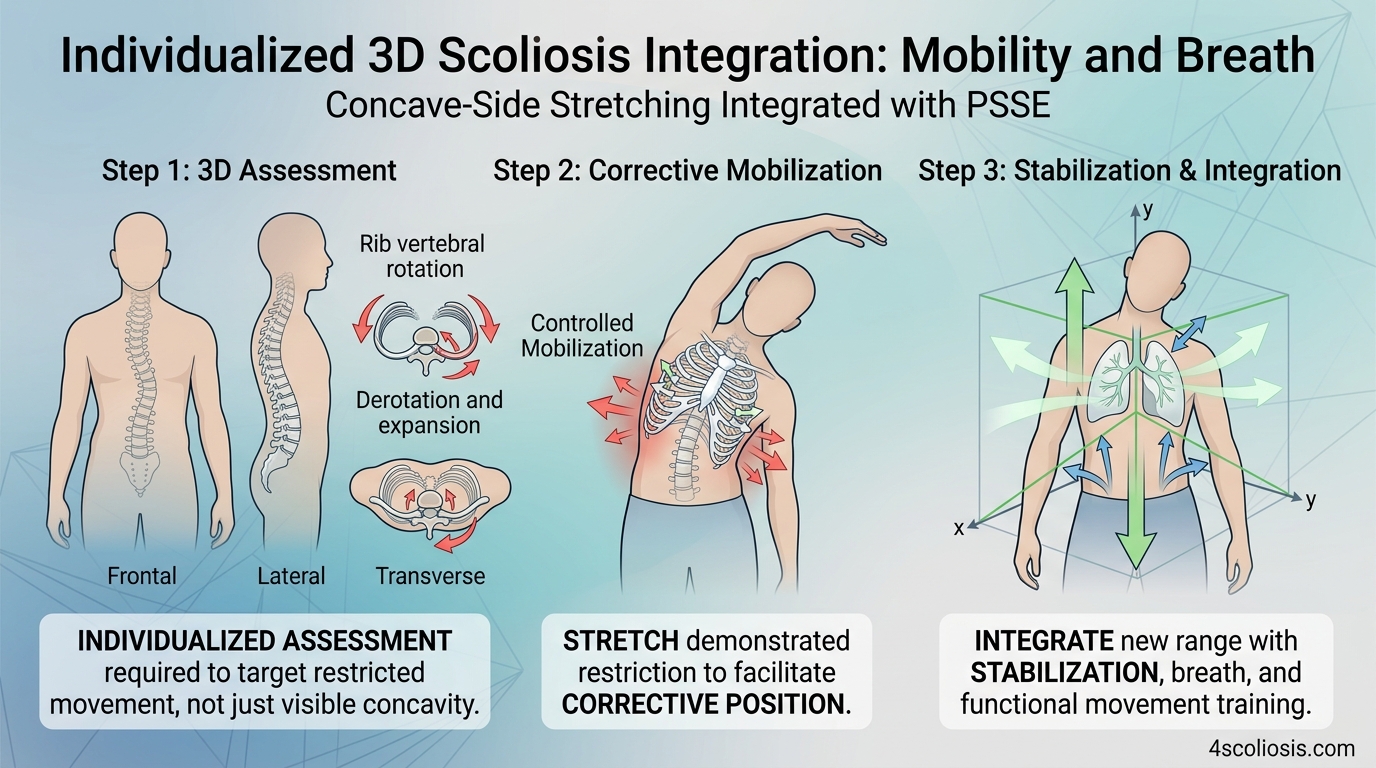
Scoliosis is a three-dimensional spinal deformity involving changes in the coronal, sagittal, and transverse planes. Vertebral rotation, rib-cage configuration, pelvic position, muscle activity, and individual flexibility can all influence how a person's asymmetry presents. [1]
For this reason, stretching the concave side is not simply a matter of “stretching the shorter side.”
The more appropriate principle is:
Stretch restricted tissues or movement directions when assessment indicates that they are limiting function or an intended corrective position.
This distinction is particularly important because scoliosis-specific rehabilitation is generally based on individualized three-dimensional self-correction, stabilization, movement training, and patient education rather than isolated stretching. [2]
---
1. What Does “Concave Side” Mean?
A scoliosis curve has two sides.
The concave side is the relatively inward side of the curve.
The convex side is the outward or more prominent side.
For example, in a right thoracic curve:
- the right side is generally described as the convex side,
- the left side is generally described as the concave side.
However, the spine is not simply bending sideways.
Vertebral rotation and changes in sagittal alignment occur simultaneously.
Therefore, identifying the concave side from a frontal view does not tell us everything about the underlying three-dimensional anatomy.
---
2. Is the Concave Side Always Shorter?
Not necessarily.
The idea that the concave side is “short” and the convex side is “long” is a useful conceptual description of some aspects of scoliosis, but it should not be interpreted as a simple measurement of muscle length.
Several factors may contribute to apparent tightness, including:
- spinal position,
- rib orientation,
- muscle activity,
- soft-tissue stiffness,
- joint mobility,
- habitual posture,
- pain-related guarding,
- and individual movement strategies.
Furthermore, different curves can have different patterns.
A person may have:
- thoracic asymmetry,
- lumbar asymmetry,
- pelvic compensation,
- shoulder-girdle differences,
- or multiple curves.
Therefore, the side that feels tight is not automatically the side that should receive aggressive stretching.
---
3. Why Can the Concave Region Feel Restricted?
Several mechanisms may contribute to a sensation of restriction.
Reduced Available Space
The geometry of a curved and rotated trunk can reduce the apparent space between structures on the concave side.
Rib-Cage Configuration
In thoracic scoliosis, vertebral rotation can alter the orientation of the ribs.
Muscle Activity
Some muscles may remain more active during habitual posture or movement.
Soft-Tissue Adaptation
Long-term positioning may influence the extensibility and mechanical behavior of surrounding tissues.
Motor Control
A person may repeatedly use the same movement strategy, making one direction of movement feel less familiar or less accessible.
These factors can coexist.
Therefore, “tightness” should not automatically be interpreted as a single shortened muscle.
---
4. What Is the Goal of Stretching?
The goal should not simply be:
“Make the concave side longer.”
A more clinically useful objective is to improve an identified mobility restriction that interferes with comfortable movement or an individualized corrective position.
Potential goals may include:
- improving trunk mobility,
- increasing lateral-flexion range,
- improving thoracic movement,
- reducing a feeling of stiffness,
- facilitating a corrective exercise position,
- and improving movement options.
Stretching is therefore best viewed as a mobility intervention, not a stand-alone scoliosis correction method.
---
5. Stretching Is Different From Structural Correction
This distinction is essential.
A stretching exercise can potentially change:
- muscle extensibility,
- soft-tissue tolerance,
- range of motion,
- and movement comfort.
It does not necessarily change:
- vertebral morphology,
- structural rotation,
- Cobb angle,
- or the underlying scoliosis.
Some scoliosis-specific exercise programs may produce improvements in radiographic and clinical measures, but these programs involve much more than isolated stretching. They incorporate individualized correction, stabilization, and functional training. [2,3]
Therefore:
Improved flexibility should not automatically be interpreted as structural correction.
---
6. When Might Concave-Side Stretching Be Useful?
Stretching may be useful when an assessment identifies a meaningful restriction in the direction being trained.
For example, a patient may demonstrate limited:
- lateral trunk flexion,
- thoracic rotation,
- shoulder movement,
- hip mobility,
- or trunk extension.
If that restriction interferes with functional movement or an individualized corrective exercise position, an appropriate mobility exercise may be incorporated.
The important point is that the exercise is selected because of the movement limitation, not simply because the person has scoliosis.
---
7. A Simple Side-Stretch Concept
A general side-body stretch can be performed by standing or sitting in a stable position and gently moving the trunk into lateral flexion.
For a person whose clinician has identified a restricted direction, the movement may be performed toward that direction.
A basic sequence might involve:
- Sit or stand comfortably.
- Keep the pelvis stable.
- Lengthen through the trunk.
- Slowly move into the intended lateral direction.
- Breathe normally.
- Stop at a gentle stretch sensation.
- Return slowly to the starting position.
The goal is controlled mobility, not maximal bending.
This is a general mobility exercise and should not be confused with a curve-specific PSSE maneuver.
---
8. Why “Stretch as Hard as Possible” Is Not the Goal
Aggressive stretching is not necessarily more effective.
Excessive force can produce:
- pain,
- muscle guarding,
- irritation of sensitive tissues,
- loss of control,
- or compensatory movement elsewhere.
For scoliosis, aggressive stretching can also make it more difficult to maintain a desired three-dimensional posture.
A useful principle is:
Use enough force to create controlled mobility, not enough force to provoke symptoms or lose movement control.
---
9. Breathing Can Be Combined With Stretching
Breathing can be useful during a mobility exercise.
A person can maintain a comfortable elongated position while allowing the breath to move through the thorax.
This can help integrate:
mobility + breathing + postural awareness.
In scoliosis-specific exercise, breathing may be deliberately directed toward relatively restricted areas of the thorax.
This is different from simply stretching the concave side.
It involves using respiration as part of an individualized three-dimensional correction strategy. [2,4]
---
10. Why Three-Dimensional Thinking Matters
A side stretch performed entirely in the frontal plane may not address the complete mechanics of scoliosis.
Scoliosis can involve:
- lateral curvature,
- vertebral rotation,
- changes in thoracic kyphosis or lumbar lordosis,
- rib-cage asymmetry,
- and compensatory curves.
Therefore, a movement that appears corrective from the front may produce an unwanted rotation or sagittal compensation.
This is one reason PSSE programs emphasize three-dimensional auto-correction rather than simply bending away from the curve. [2]
---
11. The Pelvis Should Not Be Ignored
Trunk stretching often produces movement at the pelvis as well.
For example, during a side bend, the person may unconsciously:
- shift the pelvis,
- rotate the pelvis,
- lift one hip,
- or move the entire body sideways.
This can make the exercise appear successful while producing little movement in the intended region.
A more controlled approach is to:
- stabilize the pelvis,
- elongate the trunk,
- move gradually,
- and monitor where the movement actually occurs.
This is particularly relevant when the purpose of the exercise is to improve trunk mobility.
---
12. The Shoulder Girdle Can Change the Stretch
The position of the arms can significantly alter which tissues are loaded.
For example, raising one arm overhead can increase the stretch through:
- the latissimus dorsi,
- lateral trunk tissues,
- intercostal region,
- and other structures depending on the position.
However, the same arm position can also change spinal rotation and scapular mechanics.
Therefore, arm position should be selected according to the desired movement rather than assuming that a particular arm position is universally corrective.
---
13. Concave-Side Stretching Is Not Automatically Better Than Bilateral Stretching
Another common misconception is:
“If one side is tight, only that side should be stretched.”
Not necessarily.
A patient may have bilateral restrictions even when one side appears more limited.
In some situations, symmetrical mobility training may be appropriate.
In others, asymmetric training may be more relevant.
The appropriate choice depends on:
- range of motion,
- curve pattern,
- symptoms,
- functional limitations,
- and rehabilitation goals.
Therefore, asymmetry in the spine does not automatically require asymmetry in every exercise.
---
14. When Stretching May Be the Wrong Intervention
Stretching may not be appropriate when the apparent restriction is not primarily a mobility problem.
For example, limited movement may be related to:
- pain,
- neurological symptoms,
- joint pathology,
- acute injury,
- significant instability,
- or protective muscle guarding.
In these situations, repeatedly forcing the restricted direction may not address the underlying problem.
Persistent or unexplained pain should be assessed rather than automatically treated as “tight muscles.”
The Scoliosis Research Society notes that scoliosis itself often does not cause pain, and persistent pain should be evaluated for other possible causes. [5]
---
15. Stretching and Muscle Strength Should Be Considered Together
Mobility and stability are complementary.
If a patient improves mobility without developing sufficient control of the newly available range, the functional benefit may be limited.
This is one reason scoliosis-specific rehabilitation often combines:
mobility
→
active self-correction
→
stabilization
→
functional movement.
The goal is not simply to become more flexible.
It is to develop useful, controlled movement.
---
16. Stretching the Concave Side Within PSSE
Physiotherapeutic scoliosis-specific exercises are more individualized than conventional stretching.
The 2016 SOSORT guidelines describe PSSE around principles including:
- three-dimensional auto-correction,
- stabilization of the corrected posture,
- training in activities of daily living,
- and patient education. [2]
Depending on the specific PSSE school, mobility and elongation may be incorporated into the treatment strategy.
For example, a therapist may use positioning to facilitate:
- elongation,
- derotation,
- trunk expansion,
- and improved active control.
The stretching component is therefore part of a larger corrective strategy, rather than the entire treatment.
---
17. Schroth and the Concept of Elongation
Schroth-based approaches commonly emphasize three-dimensional postural correction, including elongation and breathing strategies.
However, it is important not to reduce Schroth therapy to “stretch the concave side.”
A Schroth program is individualized according to the patient's curve classification and combines several components.
The same exercise is not necessarily appropriate for every curve pattern.
This is why scoliosis-specific exercises are generally taught by therapists with appropriate training in the particular method. [2]
---
18. What Does the Evidence Say About Scoliosis-Specific Exercise?
Research on PSSE has expanded considerably.
A 2024 systematic review and meta-analysis found that PSSE was associated with improvements in Cobb angle, angle of trunk rotation, and thoracic kyphosis compared with other nonsurgical approaches. However, the authors also noted limitations including small samples and inconsistent control interventions, with evidence quality ranging from moderate to very low depending on the analysis. [3]
Another systematic review found that the certainty of evidence for long-term reduction in Cobb-angle progression was extremely low, highlighting the uncertainty surrounding long-term structural outcomes. [6]
Therefore, it is reasonable to say:
PSSE has promising evidence, but the evidence does not justify presenting any single stretching technique as a proven method for correcting scoliosis.
---
19. A Safer Stretching Sequence
For a person who has been assessed and advised to work on a specific restricted direction, a conservative sequence may look like this:
Step 1 — Find a Stable Position
Sit or stand with the pelvis supported and stable.
Step 2 — Create Gentle Axial Length
Imagine the crown of the head moving upward rather than collapsing into the curve.
Step 3 — Move Slowly
Move toward the intended direction without forcing the range.
Step 4 — Maintain Breathing
Avoid holding the breath.
Step 5 — Monitor Compensation
Watch for unwanted pelvic shifting or trunk rotation.
Step 6 — Hold Comfortably
Use a gentle, tolerable stretch rather than maximal intensity.
Step 7 — Return With Control
Come back slowly rather than releasing the position abruptly.
Step 8 — Integrate the New Range
Follow the mobility exercise with an appropriate active-control exercise when prescribed.
This sequence emphasizes mobility followed by control, rather than passive stretching alone.
---
20. How Long Should You Hold the Stretch?
There is no single evidence-based duration that applies specifically to the “concave side” of every scoliosis curve.
Stretching prescriptions vary according to:
- the tissue being targeted,
- the patient's age,
- symptoms,
- exercise experience,
- flexibility,
- and rehabilitation objective.
Therefore, a website article should avoid presenting one exact duration as a universal scoliosis prescription.
For patients following a clinician-designed program, the prescribed duration and repetitions should take priority.
---
21. Signs That the Exercise Should Be Modified
Stop or modify the exercise if it causes:
- sharp pain,
- increasing neurological symptoms,
- numbness or tingling,
- dizziness,
- unusual shortness of breath,
- chest pain,
- or symptoms that persist after the exercise.
A mild stretching sensation can be expected during many mobility exercises.
Pain is different.
The objective is controlled movement, not forcing the body through resistance.
---
22. Children and Adolescents Need Special Consideration
Children and adolescents with scoliosis are still growing.
Their spinal curves may change with growth, and exercise programs should therefore be integrated with appropriate clinical monitoring.
A child should not be given an aggressive self-designed stretching program based solely on the visible appearance of the curve.
For growing patients, the rehabilitation strategy may need to consider:
- skeletal maturity,
- curve magnitude,
- curve pattern,
- progression risk,
- bracing,
- and other clinical factors.
SRS notes that physical activity is generally beneficial for children with scoliosis, while treatment decisions should be individualized according to the clinical situation. [7]
---
23. Adults With Scoliosis May Have Different Goals
Adult scoliosis is not identical to adolescent idiopathic scoliosis.
An adult may seek exercise because of:
- stiffness,
- back pain,
- reduced mobility,
- fatigue,
- or difficulty with daily activities.
In such cases, stretching may be directed primarily toward improving functional mobility rather than attempting to change the structural curve.
The goal may therefore be:
better movement and comfort
rather than:
radiographic curve correction.
This distinction helps set realistic expectations.
---
24. Stretching Should Be Combined With Strength and Control
A useful rehabilitation sequence may be:
Mobility → Active correction → Stabilization → Functional movement
For example:
- Gently mobilize a restricted direction.
- Practice an individualized corrected position.
- Develop active trunk control.
- Integrate the position into functional movement.
This approach reflects the broader PSSE principle of active self-correction and stabilization rather than relying exclusively on passive stretching. [2]
---
25. What Patients Should Remember
Concave does not automatically mean “tight.”
The concave side may demonstrate restricted movement, but this should be assessed rather than assumed.
Stretching does not equal correction.
Improving flexibility does not necessarily change the structural curve.
More stretching is not necessarily better.
Aggressive stretching may cause pain or unwanted compensation.
Three-dimensional assessment matters.
Scoliosis involves more than lateral bending.
Breathing can be useful.
Breathing may be integrated with mobility and postural exercises when appropriate.
Strength and control matter too.
New mobility should be integrated into active movement.
Individualization is important.
The appropriate exercise depends on the person's curve pattern, mobility, symptoms, and goals.
---
Conclusion
Stretching the concave side of a scoliotic curve can be a useful mobility strategy in selected patients, but it should not be treated as a universal rule.
The concave region may demonstrate restricted movement or soft-tissue limitations, but scoliosis is a complex three-dimensional condition. The visible shape of the curve alone cannot determine which tissues should be stretched or which direction of movement is appropriate.
A safer approach is to identify the individual's actual mobility restriction and then use controlled stretching, when appropriate, as part of a broader rehabilitation strategy.
For scoliosis-specific rehabilitation, the emphasis should generally extend beyond passive flexibility to include:
three-dimensional self-correction → stabilization → breathing → movement control → functional integration. [2]
Current evidence suggests that PSSE can improve some clinical and radiographic outcomes in adolescent idiopathic scoliosis, but the evidence remains heterogeneous and the certainty of long-term structural effects is limited. [3,6]
Therefore, the most appropriate principle is:
Do not stretch the concave side simply because it is the concave side. Stretch a demonstrated restriction when doing so supports the individual's movement and rehabilitation goals.
That distinction makes scoliosis exercise safer, more individualized, and more consistent with current rehabilitation principles.
Medical Disclaimer
This article is intended for educational purposes only and does not constitute medical advice, diagnosis, or treatment. Stretching and exercise programs should be individualized by an appropriately qualified healthcare professional, particularly for children and adolescents with scoliosis, people with significant spinal deformity, persistent pain, neurological symptoms, or other medical conditions.
References
[1] Scoliosis Research Society. Scoliosis. Scoliosis Research Society.
[2] Negrini, S., et al. (2018). 2016 SOSORT guidelines: Orthopaedic and rehabilitation treatment of idiopathic scoliosis during growth. Scoliosis and Spinal Disorders, 13, 3. https://pmc.ncbi.nlm.nih.gov/articles/PMC5795289/
[3] Dong, H., You, M., Li, Y., Wang, B., & Huang, H. (2024). Physiotherapeutic Scoliosis-Specific Exercise for the Treatment of Adolescent Idiopathic Scoliosis: A Systematic Review and Network Meta-analysis. American Journal of Physical Medicine & Rehabilitation, 104(1), 14–25. https://pubmed.ncbi.nlm.nih.gov/38726971/
[4] Berdishevsky, H., et al. (2016). Physiotherapy scoliosis-specific exercises – a comprehensive review of seven major schools. Scoliosis and Spinal Disorders, 11, 20. https://pmc.ncbi.nlm.nih.gov/articles/PMC4973373/
[5] Scoliosis Research Society. Diagnosing Scoliosis. Scoliosis Research Society.
[6] Oba, H., et al. (2025). Effects of Physiotherapeutic Scoliosis-Specific Exercise for Adolescent Idiopathic Scoliosis Cobb Angle: A Systematic Review. Spine Surgery and Related Research. https://pmc.ncbi.nlm.nih.gov/articles/PMC11983111/
[7] Scoliosis Research Society. Living with Scoliosis. Scoliosis Research Society.