Spine Care
[Exercise, Rehabilitation & Movement Therapy 08] Physical Therapy Methods for Scoliosis: A Comparative Overview
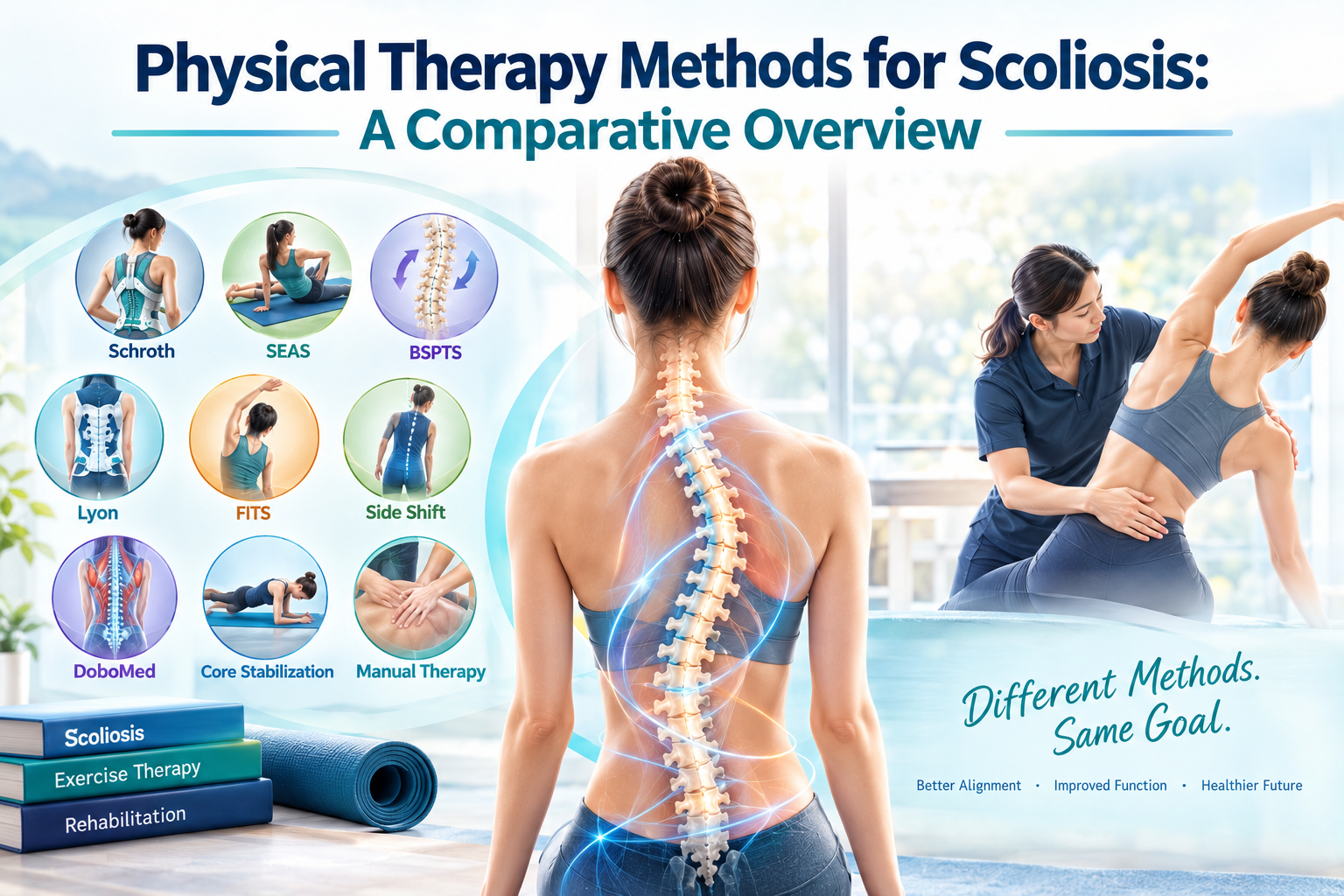
Scoliosis physical therapy includes several specialized approaches, including Schroth, SEAS, BSPTS, Lyon, FITS, Side Shift, and DoboMed, with shared principles but different correction strategies.
Introduction
Physical therapy for scoliosis is not a single standardized exercise program. Over several decades, specialized scoliosis-specific exercise approaches have been developed in Europe and elsewhere, including Schroth, SEAS, Barcelona Scoliosis Physical Therapy School (BSPTS), Lyon, Functional Individual Therapy of Scoliosis (FITS), Side Shift, and DoboMed. Although these methods differ in exercise selection and correction strategies, they share several principles: individualized assessment, three-dimensional self-correction, stabilization of the corrected position, postural awareness, breathing strategies, and integration into daily activities. [1][2]
The purpose of this article is not to determine which method is universally "best." Current evidence does not support a definitive ranking of all scoliosis-specific physical therapy methods. Instead, the methods can be understood as different clinical frameworks that use overlapping principles to address different curve patterns, movement strategies, and patient needs. [2][3]
---
What Is Scoliosis-Specific Physical Therapy?
Scoliosis-specific physical therapy is different from ordinary general exercise. General exercise may improve cardiovascular fitness, strength, flexibility, and overall physical function, while scoliosis-specific exercise is designed around the individual's spinal deformity and movement pattern. SOSORT guidelines emphasize individualized three-dimensional autocorrection, stabilization of the corrected posture, activities of daily living, and patient education as important components of PSSE. [3]
This distinction does not mean that general exercise is inappropriate for people with scoliosis. Physical activity remains an important part of overall health. Rather, scoliosis-specific therapy attempts to add a more targeted layer of rehabilitation when curve management, postural control, or specific functional limitations require it. [3][4]
---
The Common Foundation of Major Methods
Although the major schools use different exercises, they share a broad therapeutic philosophy.
A typical scoliosis-specific program may include:
- Three-dimensional postural correction
- Active self-correction
- Trunk stabilization
- Breathing exercises
- Proprioceptive training
- Balance and postural control
- Muscle endurance
- Functional movement training
- Patient education
- Integration into daily activities
This common foundation is important because it shows that the major approaches are not completely unrelated systems. Instead, they represent different ways of organizing similar rehabilitation objectives around the three-dimensional nature of scoliosis. [1][2]
---
Schroth Method
The Schroth method is one of the most widely studied scoliosis-specific exercise approaches. It emphasizes three-dimensional postural correction, rotational breathing, stabilization of the corrected position, and individualized exercises based on the patient's curve pattern. [1]
One characteristic feature is the use of breathing strategies to encourage expansion of relatively restricted areas of the rib cage while simultaneously supporting three-dimensional trunk correction. Exercises are generally adapted to the individual's curve classification rather than applied identically to every patient. [1]
Schroth has accumulated a relatively large research base compared with several other PSSE approaches. Systematic reviews and randomized trials have reported improvements in outcomes such as Cobb angle, trunk rotation, posture, and quality of life, although study protocols and evidence quality vary. [1][5]
---
SEAS: Scientific Exercise Approach to Scoliosis
The Scientific Exercise Approach to Scoliosis (SEAS) was developed in Italy and places strong emphasis on active self-correction and the patient's ability to maintain corrected alignment during functional activities. [1]
Rather than relying primarily on passive positioning, SEAS focuses on teaching the patient to actively recognize and correct their posture. Exercises are then integrated with functional tasks so that the correction becomes relevant to everyday movement. [1][3]
A randomized controlled trial cited in the SOSORT guidelines found that active self-correction and task-oriented exercises consistent with the SEAS approach were associated with improved Cobb angle compared with traditional exercises in adolescents with idiopathic scoliosis. However, individual trial results should not be interpreted as proof that SEAS is universally superior to other PSSE methods. [3]
---
BSPTS: Barcelona Scoliosis Physical Therapy School
The Barcelona Scoliosis Physical Therapy School (BSPTS) developed from the Schroth tradition and emphasizes individualized three-dimensional correction of the spine and trunk. Its approach considers the relationship between spinal curvature, rib-cage deformity, posture, breathing, and stabilization. [1]
The method is particularly concerned with helping patients understand their individual three-dimensional posture and actively reproduce a corrected position. This makes patient education an important part of the treatment rather than simply prescribing a collection of exercises. [1]
Evidence reviews have reported positive effects from BSPTS-related interventions, but the available research is smaller than the overall Schroth literature. Consequently, BSPTS should be regarded as a recognized PSSE framework with emerging evidence rather than as a definitively superior method. [2][6]
---
Lyon Approach
The Lyon approach originated in France and has historically been closely associated with casting and bracing. Physiotherapy within the Lyon framework includes three-dimensional mobilization, postural correction, activities of daily living, and preparation for or integration with orthotic treatment. [1]
This approach illustrates an important point about scoliosis rehabilitation: physical therapy does not always operate independently from bracing. In some patients, exercise, orthotic management, education, and monitoring may form a combined conservative treatment strategy. [1][3]
Therefore, comparing Lyon only as an "exercise method" can be misleading. Its historical development includes a broader conservative treatment philosophy involving physiotherapy and orthopaedic management. [1]
---
FITS: Functional Individual Therapy of Scoliosis
Functional Individual Therapy of Scoliosis (FITS) was developed in Poland and emphasizes individualized treatment. It incorporates techniques such as proprioceptive neuromuscular facilitation and selected mobilization or soft-tissue techniques alongside corrective exercises. [1]
The central concept is that treatment should respond to the patient's specific functional limitations rather than relying on one standardized exercise sequence. Three-dimensional corrective breathing and postural correction may also be incorporated depending on the individual's presentation. [1]
The evidence base for FITS is smaller than that for Schroth, making it difficult to determine its comparative effectiveness with confidence. This illustrates a recurring problem in scoliosis rehabilitation research: many methods have clinical histories and plausible mechanisms, but not all have been evaluated through equally large or rigorous randomized trials. [2][6]
---
Side Shift
The Side Shift approach emphasizes active lateral movement of the trunk toward the corrective direction. It was developed around the concept that flexible curves may respond to repeated active trunk shifts and postural correction. [1]
Side Shift can also incorporate breathing exercises, core stabilization, proprioceptive training, balance work, and integration of corrective movements into activities of daily living. The method therefore extends beyond a single lateral exercise and attempts to make the corrected position functionally reproducible. [1]
Its clinical logic is particularly relevant to patients whose curves demonstrate meaningful flexibility and who can actively reproduce a corrective movement. However, the available evidence remains more limited than the evidence base for some better-studied approaches. [1][2]
---
DoboMed
The DoboMed approach was developed in Poland and combines postural correction with respiratory strategies and specific spinal positioning. It incorporates elements influenced by earlier approaches, including Klapp and Schroth concepts. [1]
A characteristic feature is attention to thoracic and lumbar sagittal alignment together with rotational breathing. The method therefore considers scoliosis as a three-dimensional deformity rather than treating the lateral curve alone. [1]
As with other specialized schools, DoboMed has published clinical research, but the overall evidence base is relatively limited compared with the broader literature on PSSE. Current evidence therefore supports considering it as one established scoliosis-specific rehabilitation framework rather than establishing it as universally superior. [1][2]
---
General Core Stabilization
Core stabilization deserves separate consideration because it is frequently included in scoliosis rehabilitation but is not synonymous with PSSE.
Core stabilization generally aims to improve trunk control through coordinated activation of the abdominal wall, diaphragm, multifidus, pelvic floor, paraspinal muscles, and other trunk muscles. The goal is improved control of spinal and pelvic movement rather than simply increasing abdominal strength. [7]
A 2025 systematic review and meta-analysis of 10 studies involving 449 participants reported improvements in Cobb angle, angle of trunk rotation, apical vertebral rotation, and quality of life with core stabilization exercise compared with no exercise. However, the authors also noted heterogeneity, and some outcomes favored three-dimensional exercise approaches. [7]
This suggests that core stabilization can be a useful component of rehabilitation, but it should not automatically be considered a substitute for individualized scoliosis-specific exercise.
---
Manual Therapy and Mobilization
Manual therapy may also appear in scoliosis rehabilitation, particularly when pain, stiffness, or restricted mobility limits exercise performance. Techniques may include gentle mobilization or soft-tissue approaches. [3]
However, manual therapy should be distinguished from structural correction. Earlier SOSORT guidance noted insufficient evidence to establish manual therapy as an independent treatment for correcting idiopathic scoliosis and recommended that it be used, when appropriate, in association with stabilization exercises rather than as a stand-alone corrective treatment. [3]
This distinction remains clinically important. Improving mobility or reducing discomfort may help a patient participate more effectively in an exercise program, but symptom relief should not automatically be interpreted as correction of the underlying structural deformity. [3]
---
How Do the Methods Compare?
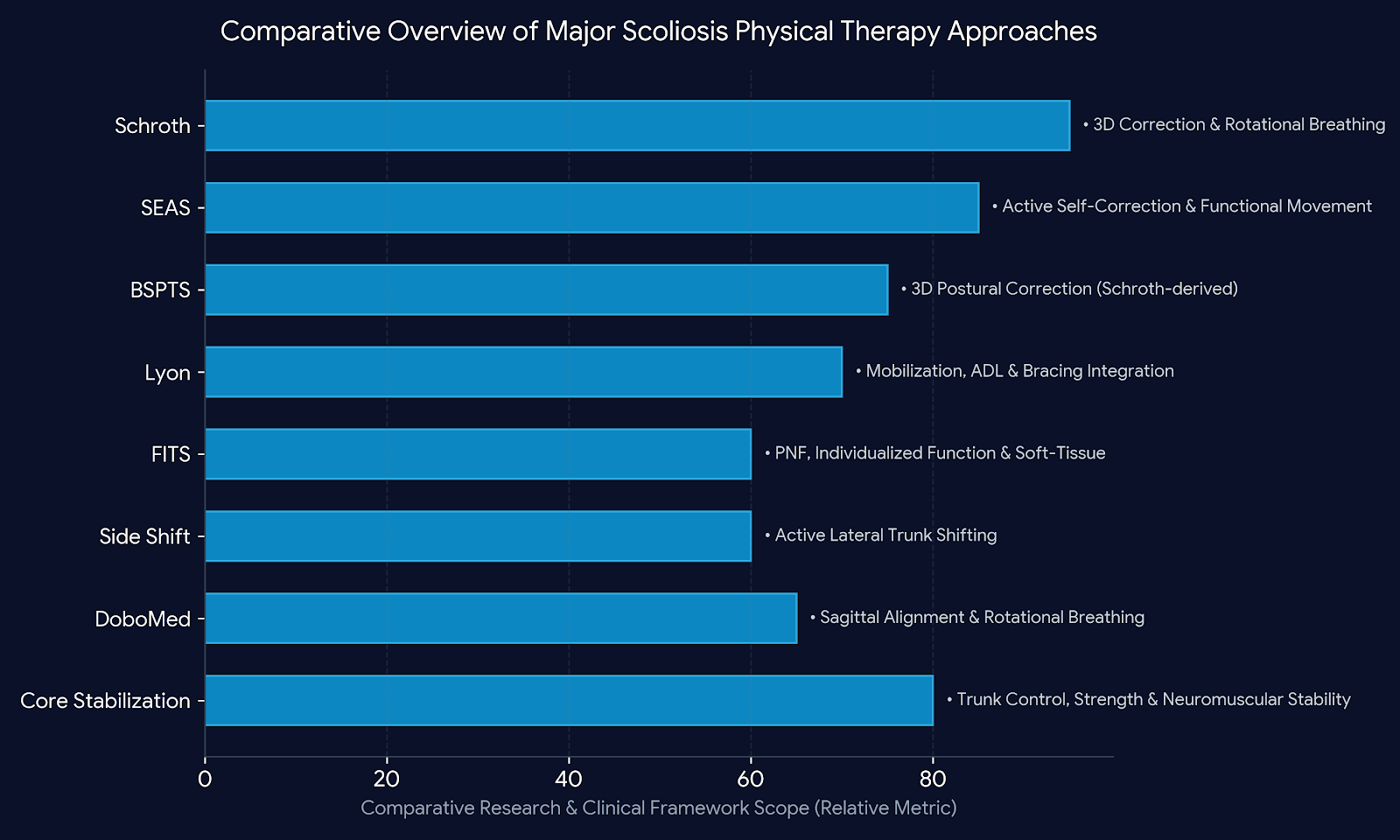
| Method | Main emphasis | Distinctive features | | ------------------ | ----------------------------- | ----------------------------------------------- | | Schroth | 3D correction | Rotational breathing, curve-specific correction | | SEAS | Active self-correction | Functional movement and motor control | | BSPTS | 3D postural correction | Schroth-derived individualized approach | | Lyon | Correction + orthopaedic care | Mobilization, ADL, bracing integration | | FITS | Individualized function | PNF, mobilization, soft-tissue techniques | | Side Shift | Lateral self-correction | Active trunk shifting and stabilization | | DoboMed | 3D correction + breathing | Sagittal alignment and rotational breathing | | Core stabilization | Trunk control | Strength, endurance, neuromuscular stability |
The important point is that these categories overlap considerably. A trained therapist may incorporate principles from several approaches while still following the central requirement of individualized scoliosis management. [1][2]
---
Is One Method Better Than Another?
Current evidence does not justify a simple answer.
A 2024 systematic review and network meta-analysis included 17 randomized controlled trials involving 857 patients and found that PSSE improved Cobb angle, angle of trunk rotation, and quality of life compared with conventional rehabilitation. However, differences between specific PSSE methods were not sufficient to establish one universal winner. [6]
A 2026 umbrella review of 14 systematic reviews involving more than 30,000 participants also reported generally favorable effects of exercise interventions on posture, spinal curvature, physical function, and quality of life. At the same time, the authors noted substantial variation among exercise programs and emphasized the value of integrated therapeutic strategies. [8]
Therefore, the most evidence-consistent conclusion is not that one school is universally superior. Rather, individualization, therapist expertise, adherence, curve characteristics, and integration with the broader treatment plan are likely to be important determinants of outcome. [3][6][8]
---
Why Individualization Matters
Two patients can have the same Cobb angle but very different clinical presentations.
They may differ in:
- Curve pattern
- Vertebral rotation
- Curve flexibility
- Sagittal alignment
- Pelvic position
- Rib-cage asymmetry
- Muscle activation
- Balance
- Pain
- Skeletal maturity
- Ability to perform active self-correction
For this reason, a standardized exercise program may not produce the same response in every patient. SOSORT guidelines specifically recommend that PSSE be individualized according to the patient's needs, curve pattern, and treatment phase. [3]
---
Physical Therapy Should Be Viewed as a Process
Effective scoliosis rehabilitation is not simply a list of exercises.
A comprehensive process may involve:
Assessment → Classification → Active Correction → Stabilization → Functional Integration → Home Practice → Reassessment
The therapist first identifies the patient's structural and functional characteristics. Corrective movements are then taught, stabilized, and gradually incorporated into everyday activities. Progress can subsequently be reassessed using appropriate clinical and radiographic measures. [3]
This process also helps explain why therapist training matters. SOSORT recommendations emphasize that PSSE programs should be delivered by therapists specifically trained in the approach they use and that treatment should be coordinated within the broader scoliosis care team. [3]
---
What Patients Should Know
For patients and parents, the most important message is that scoliosis physical therapy is not simply about "strengthening the weak side" or "stretching the tight side."
Modern PSSE approaches generally aim to improve the patient's ability to recognize, actively correct, stabilize, and function within a more controlled three-dimensional posture. [1][3]
Exercise should also be considered within the context of curve magnitude, skeletal maturity, progression risk, symptoms, and whether bracing or other treatment is indicated. Physical therapy does not replace bracing or surgery when those treatments are clinically necessary. Instead, it may function as an important component of a broader conservative or perioperative treatment strategy. [3]
---
Conclusion
Physical therapy for scoliosis has evolved from general strengthening and stretching toward more individualized, three-dimensional rehabilitation strategies.
Schroth, SEAS, BSPTS, Lyon, FITS, Side Shift, and DoboMed differ in their specific techniques, but they share important principles: individualized correction, three-dimensional alignment, stabilization, movement awareness, and functional integration. [1][2]
Current research supports the use of scoliosis-specific exercise as part of conservative management, but the evidence does not establish one physical therapy method as universally superior for every patient. Recent systematic reviews suggest meaningful benefits for spinal alignment, trunk rotation, physical function, and quality of life, while also emphasizing heterogeneity among interventions and limitations in study quality. [6][8]
The most appropriate method is therefore likely to depend less on choosing a universally "best" school and more on matching the rehabilitation strategy to the patient, curve pattern, skeletal maturity, movement characteristics, treatment goals, and ability to perform the program consistently. [3]
For modern scoliosis rehabilitation, the key question is not simply:
"Which exercise method is best?"
It is:
"Which combination of assessment, corrective exercise, neuromuscular training, and functional practice is most appropriate for this individual spine?"
References
[1] Berdishevsky, H., Lebel, V. A., Bettany-Saltikov, J., et al. Physiotherapy scoliosis-specific exercises – a comprehensive review of seven major schools. Scoliosis and Spinal Disorders. 2016;11:20.
[2] Negrini, S., et al. Physiotherapeutic scoliosis-specific exercises for adolescents with idiopathic scoliosis. Minerva Medica. 2014.
[3] Negrini, S., Donzelli, S., Aulisa, A. G., et al. 2016 SOSORT guidelines: Orthopaedic and rehabilitation treatment of idiopathic scoliosis during growth. Scoliosis and Spinal Disorders. 2018;13:3.
[4] Scoliosis Research Society. Scoliosis. Scoliosis Research Society.
[5] Schreiber, S., Parent, E. C., Moez, E. K., et al. The effect of Schroth exercises added to the standard of care on the quality of life and muscular endurance in adolescents with idiopathic scoliosis. European Journal of Physical and Rehabilitation Medicine. 2015.
[8] Wang, X., Yang, T., Chen, H., et al. Effectiveness of exercise interventions for adolescent idiopathic scoliosis: An umbrella review. Journal of Pediatric Nursing. 2026;88:12–21.