Spine Care
[Exercise, Rehabilitation & Movement Therapy 06] Strengthening the Convex Side: Specific Workouts for Back Balance
Targeted strengthening may improve trunk control and muscular balance in some people with scoliosis, but
exercises should be individualized to the curve pattern rather than based on the convex side alone.
Introduction
People with scoliosis often notice that one side of the back appears more prominent, while the opposite side may look flatter or more compressed.
This visible difference naturally leads to an important question:
Should the more prominent, or convex, side of the back be strengthened to restore balance?
The answer is more complicated than simply strengthening whichever side looks weaker.
Scoliosis is a three-dimensional spinal deformity involving changes in spinal alignment, vertebral rotation, and sometimes rib-cage configuration. Muscle activity and trunk control can also differ between individuals, but these differences do not follow one universal pattern. [1,2]
Historically, some exercise approaches have included strengthening of muscles on the convex side and stretching of muscles on the concave side. Earlier clinical studies and scoliosis exercise programs used variations of this concept. However, modern physiotherapeutic scoliosis-specific exercise (PSSE) places greater emphasis on individualized three-dimensional self-correction, stabilization, and functional movement, rather than prescribing the same strengthening pattern to every patient. [2]
Therefore, the most useful modern interpretation is:
Strengthening can be used to improve trunk capacity and control, but the exercise should be selected according to the individual's movement pattern and rehabilitation goals—not simply because a muscle lies on the convex side of the curve.
---
1. What Is the Convex Side of a Scoliosis Curve?
A spinal curve has two sides.
The convex side is the outward or more prominent side of the curve.
The concave side is the inward side.
For example, in a typical right thoracic curve:
- the right side is generally convex,
- the left side is generally concave.
However, scoliosis is not simply a side-to-side bend.
The vertebrae can also rotate, and the thoracic cage may change its three-dimensional shape.
This means that the visible prominence of one side does not automatically tell us:
- which muscles are weak,
- which muscles are tight,
- which muscles are overactive,
- or which muscles should be strengthened.
---
2. Does the Convex Side Always Have Weaker Muscles?
No.
This is one of the most important points for patients and parents to understand.
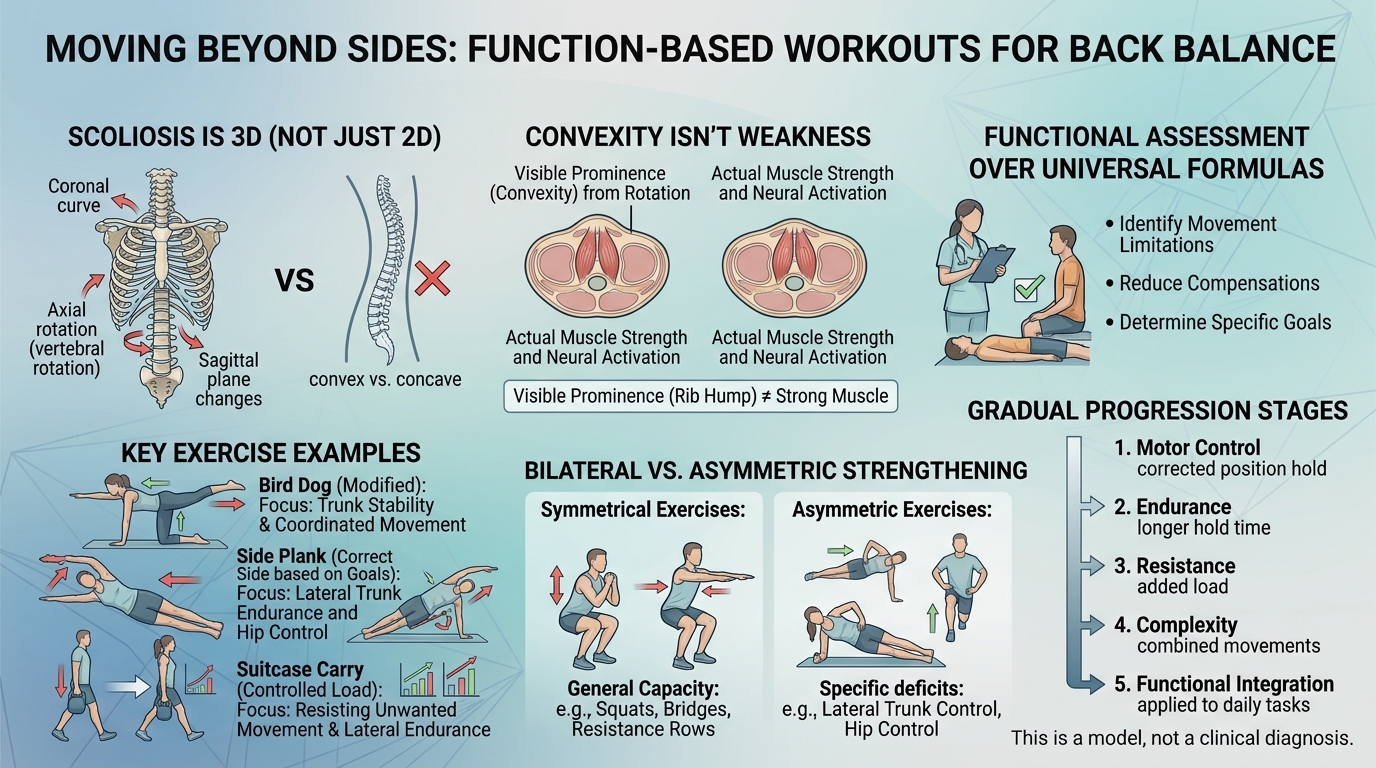
A visible convex prominence is not equivalent to muscle weakness.
Muscle performance depends on:
- muscle length,
- neural activation,
- joint position,
- leverage,
- fatigue,
- physical conditioning,
- pain,
- movement strategy,
- and the individual's specific curve.
Some patients may demonstrate asymmetric muscle activation, while others may not show a simple convex-versus-concave pattern.
Therefore:
A convex side should not automatically be labeled “weak.”
A physical therapist may assess actual strength and movement control before deciding whether asymmetric strengthening is appropriate.
---
3. Why Can the Back Look Asymmetric?
The appearance of the back in scoliosis can be influenced by several structures.
These include:
- vertebral rotation,
- rib rotation,
- paraspinal muscle contours,
- scapular position,
- pelvic alignment,
- soft-tissue distribution,
- and overall posture.
In thoracic scoliosis, vertebral rotation can contribute to a rib prominence, sometimes called a rib hump.
The prominence therefore does not necessarily represent a large or strong muscle.
It may primarily reflect the three-dimensional rotation of the spine and rib cage.
This is why strengthening exercises should not be prescribed solely from visual appearance.
---
4. What Does “Back Balance” Mean?
The phrase back balance can have several meanings.
It may refer to:
- more symmetrical muscle performance,
- improved trunk control,
- improved posture,
- better load distribution,
- improved balance,
- or improved functional movement.
It does not necessarily mean making both sides of the spine visually identical.
Perfect anatomical symmetry is not a realistic goal for most people.
A more useful rehabilitation objective is:
Develop sufficient strength and control to perform movement efficiently and comfortably despite the individual's spinal structure.
---
5. Why Strengthening Matters in Scoliosis Rehabilitation
Strength is an important component of physical function.
Adequate trunk and hip strength can help a person:
- maintain posture during activities,
- control movement,
- lift and carry objects,
- participate in sports,
- tolerate physical activity,
- and perform daily tasks.
For someone with scoliosis, strengthening may therefore be useful as part of an overall exercise program.
However, strengthening should be viewed as a functional intervention, not automatically as a method of changing the underlying spinal structure.
---
6. Structural Curve vs. Functional Muscle Performance
This distinction is particularly important.
A structural scoliosis curve involves changes in the shape and alignment of the spine.
Muscle strength is a measure of functional capacity.
Improving muscle strength does not automatically change:
- the Cobb angle,
- vertebral rotation,
- vertebral morphology,
- or skeletal alignment.
Conversely, improvements in strength may occur without measurable radiographic changes.
Therefore, a successful strengthening program should not be judged exclusively by whether an X-ray becomes straighter.
Functional outcomes also matter.
---
7. The Role of Physiotherapeutic Scoliosis-Specific Exercises
Modern PSSE approaches generally do not rely on a simple formula such as:
convex side = strengthen
concave side = stretch
Instead, PSSE emphasizes individualized correction.
The 2016 SOSORT guidelines describe PSSE as incorporating:
- three-dimensional auto-correction,
- stabilization of the corrected posture,
- training in activities of daily living,
- and patient education.
The guidelines also recommend that programs be individualized according to the patient's needs, curve pattern, and treatment phase. [2]
This is a much more sophisticated approach than treating the two sides of the body as mirror images.
---
8. Can Convex-Side Strengthening Still Be Used?
Yes.
There may be situations in which targeted strengthening of a particular muscle or movement direction is appropriate.
For example, a therapist may identify:
- reduced lateral trunk control,
- reduced scapular control,
- reduced hip strength,
- or difficulty maintaining an individualized corrected position.
An exercise can then be selected to address that specific limitation.
The exercise may happen to emphasize muscles on the convex side.
But the reason for selecting it should be the functional deficit or movement objective, rather than simply its location on the curve.
---
9. Exercise Example: Side Plank
The side plank is commonly used to develop lateral trunk strength.
It challenges the body to resist lateral movement while maintaining trunk control.
Depending on how it is performed, the exercise can place significant demands on:
- the lateral abdominal muscles,
- quadratus lumborum,
- shoulder stabilizers,
- hip abductors,
- and other trunk muscles.
However, there is no universal rule that a person with scoliosis should always perform the side plank on the convex side.
The appropriate side, position, duration, and progression depend on the individual's curve and training objective.
This is a good example of why exercise selection should follow assessment rather than a simple scoliosis formula.
---
10. Exercise Example: Bird Dog
The bird dog combines:
- trunk stabilization,
- hip movement,
- shoulder movement,
- balance,
- and coordination.
A basic version involves extending one arm and the opposite leg while maintaining controlled trunk positioning.
For scoliosis rehabilitation, the exercise may be modified according to the patient's ability.
Possible modifications include:
- reducing the range,
- performing only the arm movement,
- performing only the leg movement,
- increasing the hold time,
- or introducing controlled resistance.
The purpose is not to force the spine into a particular shape.
It is to develop controlled movement while maintaining trunk stability.
---
11. Exercise Example: Resistance Row
A resistance-band or cable row can develop the muscles involved in pulling and scapular control.
The exercise may be useful for people who need to improve:
- upper-back strength,
- scapular control,
- trunk stability,
- and functional pulling capacity.
However, the exercise should not be described as a way to “straighten the convex side.”
Instead, it develops general physical capacity and may be adapted to an individual's movement strategy.
---
12. Exercise Example: Suitcase Carry
A suitcase carry involves walking while holding a load on one side.
The trunk must resist unwanted lateral movement.
This makes it an interesting exercise for developing:
- lateral trunk endurance,
- balance,
- grip strength,
- hip control,
- and whole-body coordination.
However, unilateral loading should not be prescribed automatically to a person with scoliosis.
The side carrying the load can change the mechanical demands on the trunk.
Therefore, this type of exercise should be selected and progressed carefully when used in scoliosis rehabilitation.
---
13. Exercise Example: Split-Stance or Functional Strength Training
Many strengthening exercises do not need to look like traditional “back exercises.”
Exercises such as:
- split squats,
- step-ups,
- hip hinges,
- controlled squats,
- resistance rows,
- and carries
can develop whole-body strength while requiring trunk control.
This is important because the spine does not function independently from the hips and lower limbs.
Functional strengthening therefore considers the entire kinetic chain.
---
14. Why Bilateral Strengthening May Still Be Appropriate
A common misconception is that an asymmetric spine requires every exercise to be asymmetric.
That is not necessarily true.
Some exercises are best performed symmetrically because their purpose is to develop general physical capacity.
Examples may include:
- squats,
- bridges,
- certain rowing exercises,
- general resistance training,
- and aerobic conditioning.
Other exercises may be modified asymmetrically when a specific movement problem has been identified.
The distinction is:
Asymmetry in spinal structure does not automatically require asymmetry in every exercise.
---
15. The Importance of Three-Dimensional Control
Scoliosis involves more than the frontal plane.
A person may simultaneously demonstrate:
- coronal curvature,
- vertebral rotation,
- sagittal-plane changes,
- rib-cage asymmetry,
- and pelvic compensation.
A strengthening exercise that improves one movement characteristic could theoretically create an unwanted compensation elsewhere if performed without adequate control.
This is one reason PSSE places emphasis on three-dimensional self-correction and stabilization. [2]
---
16. Strengthening Should Follow Mobility When Necessary
Some patients may have mobility restrictions that interfere with their ability to perform a corrective movement.
In such cases, a rehabilitation sequence might involve:
mobility
→
active self-correction
→
strengthening
→
functional integration
This does not mean that every patient needs this exact sequence.
It illustrates a broader principle:
Strengthening is most useful when the person can access and control the movement that the exercise is intended to train.
---
17. Strengthening and Muscle Endurance
Muscular endurance may be particularly relevant to posture.
A person might demonstrate adequate strength during a short test but lose trunk control during:
- prolonged sitting,
- standing,
- walking,
- school activities,
- work,
- or sports.
For this reason, rehabilitation may gradually develop both:
strength
and
endurance.
A useful progression can move from short, controlled efforts toward longer periods of functional activity.
---
18. How Should Exercises Be Progressed?
Progression should be gradual.
A general sequence might be:
Stage 1 — Motor Control
Learn the movement accurately.
Stage 2 — Endurance
Maintain control for longer periods.
Stage 3 — Resistance
Add appropriate external load.
Stage 4 — Complexity
Combine multiple movements.
Stage 5 — Functional Integration
Apply the skill to daily activities, work, or sports.
This approach allows strengthening to develop alongside movement quality.
---
19. What About the Cobb Angle?
The Cobb angle is a radiographic measurement used to quantify the magnitude of a spinal curve.
It is an important clinical measure, but it is not a direct measurement of muscle strength.
A person can become stronger without a measurable change in Cobb angle.
Similarly, a change in Cobb angle does not necessarily tell us whether a person has become stronger or more physically capable.
Current research on PSSE suggests possible improvements in Cobb angle and trunk rotation in some populations, but the evidence remains heterogeneous. A 2025 systematic review of 18 randomized controlled trials involving 1,014 patients found overall benefits associated with PSSE, while a separate systematic review concluded that the certainty of evidence for long-term Cobb-angle progression remains extremely low. [3,4]
Therefore, strengthening should not be promoted as a guaranteed method of reducing the Cobb angle.
---
20. Muscle Balance Is Not the Same as Symmetry
The term muscle balance can be misleading.
A balanced movement system does not necessarily mean that:
- both sides have identical strength,
- both sides have identical muscle size,
- or both sides produce identical force.
Instead, balance can mean that the body can produce and control force appropriately for the task.
A person with scoliosis may naturally have some asymmetry.
The rehabilitation goal is often to improve functional control, not to eliminate every anatomical difference.
---
21. What Parents Should Know
Parents may notice that their child's:
- shoulder appears higher,
- waist looks uneven,
- shoulder blade is more prominent,
- or back appears asymmetric when bending forward.
These observations can be useful reasons to seek assessment, but they do not reveal the child's exact muscle-strength pattern.
Parents should avoid independently deciding:
“This side looks weak, so we need to strengthen it.”
A trained clinician can determine whether the observed asymmetry is associated with:
- structural curvature,
- rotation,
- muscle performance,
- pelvic position,
- or another factor.
---
22. What Adults With Scoliosis Should Know
For adults, the purpose of strengthening may be different.
An adult may want to improve:
- general fitness,
- back endurance,
- lifting ability,
- work capacity,
- balance,
- or exercise tolerance.
In these situations, the goal may be primarily functional capacity, rather than structural curve correction.
A well-designed strengthening program can therefore be valuable even when the Cobb angle does not change.
---
23. When Should Asymmetric Strengthening Be Avoided?
Unsupervised asymmetric strengthening may be inappropriate when:
- the exercise causes pain,
- neurological symptoms are present,
- the movement produces significant compensations,
- the curve pattern is not understood,
- or the exercise is being performed specifically to “correct” the spine without professional assessment.
A patient should seek appropriate medical or rehabilitation assessment for persistent pain, weakness, numbness, progressive neurological symptoms, or significant changes in spinal appearance.
---
24. A Practical Framework for Back-Balance Training
A useful framework is:
Assess
Identify the curve pattern and relevant functional limitations.
Mobilize
Address genuine mobility restrictions when necessary.
Self-Correct
Learn an individualized three-dimensional correction strategy when appropriate.
Strengthen
Develop the muscles and movement patterns needed to maintain control.
Integrate
Use the improved control during functional activities.
Progress
Increase resistance or complexity gradually according to ability.
This framework is consistent with the broader principles of PSSE, which emphasize individualized correction and stabilization rather than a universal exercise prescription. [2]
---
25. A Sample General Workout Structure
The following is an educational example, not an individualized prescription.
Warm-Up
- gentle walking,
- controlled trunk movement,
- shoulder mobility,
- hip mobility.
Trunk Control
- bird dog,
- dead bug,
- controlled side plank.
Functional Strength
- squat,
- hip hinge,
- resistance row,
- step-up.
Whole-Body Integration
- controlled carry,
- walking,
- light aerobic activity.
The exact exercises, resistance, repetitions, and side-specific modifications should depend on the person's physical assessment and goals.
---
26. Why “Specific Workouts” Should Be Individualized
There is no single workout that can be accurately prescribed for every person with scoliosis.
Two people may have the same Cobb angle but different:
- curve patterns,
- vertebral rotation,
- flexibility,
- muscle performance,
- pain levels,
- skeletal maturity,
- and functional goals.
Therefore, the same exercise may have different purposes for different people.
This is precisely why SOSORT recommends that PSSE programs be individualized according to patient needs, curve pattern, and treatment phase. [2]
---
27. What Current Evidence Supports
Current evidence supports several cautious conclusions.
Supported
Exercise can improve general physical fitness and functional capacity.
Increasingly Supported
PSSE may improve some clinical outcomes in adolescents with idiopathic scoliosis.
Still Uncertain
The magnitude and durability of structural curve changes from exercise remain uncertain.
Not Established
There is insufficient evidence to claim that simply strengthening the convex side will reliably correct a scoliotic curve.
This distinction helps patients understand what exercise can reasonably accomplish.
---
28. The Most Important Principle
The central question should not be:
“Which side should I strengthen?”
A better question is:
“What movement or functional limitation should this exercise address?”
If an assessment shows that a particular muscle group or movement direction needs strengthening, targeted exercise may be appropriate.
If the limitation is mobility, stretching may be more relevant.
If the problem is motor control, stabilization may be emphasized.
If the goal is general fitness, bilateral resistance and aerobic training may be appropriate.
This approach avoids reducing a complex three-dimensional condition to a simple left-versus-right formula.
---
Conclusion
Strengthening the convex side of a scoliotic curve can sound intuitive: if one side appears more prominent or mechanically disadvantaged, perhaps strengthening that side will restore balance.
However, scoliosis does not follow such a simple formula.
The convex side is not automatically weak, and the concave side is not automatically tight.
Muscle performance varies between individuals, and the three-dimensional structure of the spine and rib cage means that visible asymmetry cannot reliably determine which muscles require strengthening.
Modern scoliosis-specific rehabilitation therefore focuses increasingly on:
- individualized assessment,
- three-dimensional self-correction,
- stabilization,
- functional movement,
- appropriate strengthening,
- and progressive exercise. [2]
Recent systematic reviews suggest that PSSE can improve several outcomes in adolescents with idiopathic scoliosis, although evidence concerning long-term structural change remains limited and heterogeneous. [3,4]
For this reason, targeted convex-side strengthening is best understood as a possible component of an individualized rehabilitation program, rather than a universal scoliosis correction technique.
The practical principle is simple:
Strengthen the movement that needs strengthening—not simply the side that looks more prominent.
That approach allows exercise to address the person's actual functional needs while respecting the complex three-dimensional nature of scoliosis.
Medical Disclaimer
This article is intended for educational purposes only and does not constitute medical advice, diagnosis, or treatment. Exercise selection should be individualized by an appropriately qualified healthcare professional, particularly for children and adolescents with scoliosis, significant spinal deformity, persistent pain, neurological symptoms, or other medical conditions. Do not begin an asymmetric strengthening program solely on the basis of the visible appearance of your spinal curve.
References
[1] Scoliosis Research Society. Scoliosis. Scoliosis Research Society.
[2] Negrini, S., et al. (2018). 2016 SOSORT guidelines: Orthopaedic and rehabilitation treatment of idiopathic scoliosis during growth. Scoliosis and Spinal Disorders, 13, 3. https://pmc.ncbi.nlm.nih.gov/articles/PMC5795289/
[3] Effectiveness of physical therapeutic scoliosis exercise (PSSE) intervention for adolescent idiopathic scoliosis: a systematic review and meta-analysis. (2025). PubMed. https://pubmed.ncbi.nlm.nih.gov/41073947/
[4] Oba, H., et al. (2025). Effects of Physiotherapeutic Scoliosis-Specific Exercise for Adolescent Idiopathic Scoliosis Cobb Angle: A Systematic Review. Spine Surgery and Related Research, 9(2), 120–129. https://pubmed.ncbi.nlm.nih.gov/40223832/
[5] Lee, S. Y., & Tak, J. Y. (2026). Effect of Supervised Versus Hybrid Delivery of Physiotherapeutic Scoliosis-Specific Exercises in Adolescents with Idiopathic Scoliosis: Systematic Review and Meta-Analysis. Medicina, 62(4), 768. https://pubmed.ncbi.nlm.nih.gov/42075639/
[6] Berdishevsky, H., et al. (2016). Physiotherapy scoliosis-specific exercises – a comprehensive review of seven major schools. Scoliosis and Spinal Disorders, 11, 20. https://pmc.ncbi.nlm.nih.gov/articles/PMC4973373/