Spine Care
[Exercise, Rehabilitation & Movement Therapy 04] Targeted Breathing Techniques for Thoracic Decompression
Targeted breathing can help improve thoracic expansion and respiratory control in scoliosis, particularly when breathing is integrated with individualized three-dimensional movement strategies.
Introduction
Breathing appears automatic, but it is also a highly adaptable movement.
With every breath, the diaphragm, ribs, intercostal muscles, thoracic spine, abdominal wall, and surrounding soft tissues participate in a coordinated process of expansion and recoil.
For people with scoliosis, this process can become more complex.
A three-dimensional spinal deformity can alter the shape and movement of the rib cage. In thoracic scoliosis, vertebral rotation may be accompanied by rib asymmetry, which can influence thoracic mobility and respiratory mechanics. Larger thoracic curves and greater apical vertebral rotation have been associated with lower pulmonary function in people with adolescent idiopathic scoliosis (AIS), although the available evidence is not sufficient to assume that every patient with scoliosis has clinically important respiratory impairment. [1,2]
This has led to increasing interest in targeted breathing techniques as part of scoliosis rehabilitation.
One frequently discussed approach is rotational angular breathing (RAB), used within Schroth-based physiotherapeutic scoliosis-specific exercises (PSSE). The technique directs inhalation toward areas of the rib cage that are relatively restricted or collapsed while the patient maintains an individualized corrective posture. [3,4]
The term “thoracic decompression” should be interpreted carefully.
Breathing exercises do not literally decompress the thoracic spine in the same way that a surgical or traction procedure might alter mechanical loading.
Instead, the term can be used functionally to describe attempts to:
- increase expansion in restricted regions of the rib cage,
- improve thoracic mobility,
- reduce breathing asymmetry,
- facilitate three-dimensional postural control,
- and improve respiratory mechanics.
---
1. Why Does Scoliosis Affect Breathing?
The thoracic spine and rib cage function as an integrated mechanical system.
When the thoracic spine rotates or changes its three-dimensional shape, the ribs and sternum can also change their orientation.
This may influence:
- rib movement,
- chest-wall expansion,
- thoracic volume,
- respiratory muscle mechanics,
- and the efficiency of ventilation.
Research examining AIS has found associations between greater thoracic Cobb angles, greater apical vertebral rotation, and measures of reduced pulmonary function. A 2022 systematic review and meta-analysis involving 27 studies and 3,162 participants found that larger thoracic curves and greater apical vertebral rotation were associated with lower measures including FVC and total lung capacity, although the authors characterized the overall evidence as limited. [1]
A larger systematic review involving 126 studies and 8,723 patients similarly found an inverse relationship between thoracic Cobb angle and several pulmonary-function measures. [2]
These findings describe associations between spinal deformity and respiratory function.
They do not mean that a particular breathing pattern is the cause of scoliosis.
---
2. The Rib Cage Is More Than a Protective Structure
The ribs protect the heart and lungs, but they also participate actively in respiration.
During inhalation, the thoracic cage changes its dimensions through coordinated movement of the ribs and sternum.
During exhalation, the thoracic cage returns toward its resting configuration.
This movement can be influenced by:
- spinal position,
- rib orientation,
- muscle activity,
- connective-tissue mobility,
- breathing strategy,
- and the individual's posture.
In thoracic scoliosis, the rib cage may become asymmetric because the vertebrae and ribs are mechanically connected.
This is one reason scoliosis-specific rehabilitation may address the rib cage as well as the spine.
---
3. What Is Rotational Angular Breathing?
Rotational angular breathing (RAB) is a breathing strategy associated particularly with the Schroth method.
Instead of simply asking a patient to “take a deep breath,” the therapist provides instructions based on the person's individual curve pattern.
The patient adopts a corrected three-dimensional posture and attempts to direct inhalation toward relatively restricted regions of the thorax.
The approach is intended to combine:
breathing + postural correction + thoracic expansion + neuromuscular control.
The technique is therefore different from ordinary diaphragmatic breathing or general deep-breathing exercises.
The specific direction of breathing depends on the individual's scoliosis pattern.
---
4. Why Direct the Breath Toward a Restricted Area?
A simple analogy is to think about an inflatable structure.
If one region has less available expansion, directing air and respiratory movement toward that region may help the person become more aware of its movement.
In scoliosis rehabilitation, the objective is not simply to increase the total volume of air inhaled.
It may also involve improving where and how the thorax expands.
Schroth-based approaches use this concept within a broader three-dimensional correction strategy. The breathing technique is combined with posture, elongation, derotation, stabilization, and active self-correction rather than being treated as an isolated maneuver. [3,4]
---
5. “Thoracic Decompression” Does Not Mean Separating the Vertebrae
The term decompression can be misleading.
Breathing does not mechanically pull the thoracic vertebrae apart in a clinically established sense.
Instead, targeted breathing may influence:
- rib movement,
- thoracic expansion,
- muscle activation,
- postural awareness,
- and the ability to maintain a corrected position.
Therefore, a safer interpretation is:
Targeted breathing seeks to improve thoracic expansion and movement control rather than literally decompressing the spine.
This distinction is particularly important when communicating with patients.
---
6. Breathing and Three-Dimensional Scoliosis
Scoliosis is not simply a side-to-side curve.
It is a three-dimensional deformity involving changes in:
- coronal alignment,
- sagittal alignment,
- vertebral rotation,
- and rib-cage configuration.
A breathing strategy based only on frontal-plane symmetry may therefore be insufficient.
Three-dimensional rehabilitation approaches attempt to address the spatial characteristics of the individual's curve.
For example, a therapist may combine:
auto-elongation
with
derotation
and
directed breathing
while maintaining a specific pelvic and shoulder position.
The objective is to make breathing part of the movement strategy rather than treating respiration as an isolated function.
---
7. Concave and Convex Areas of the Thorax
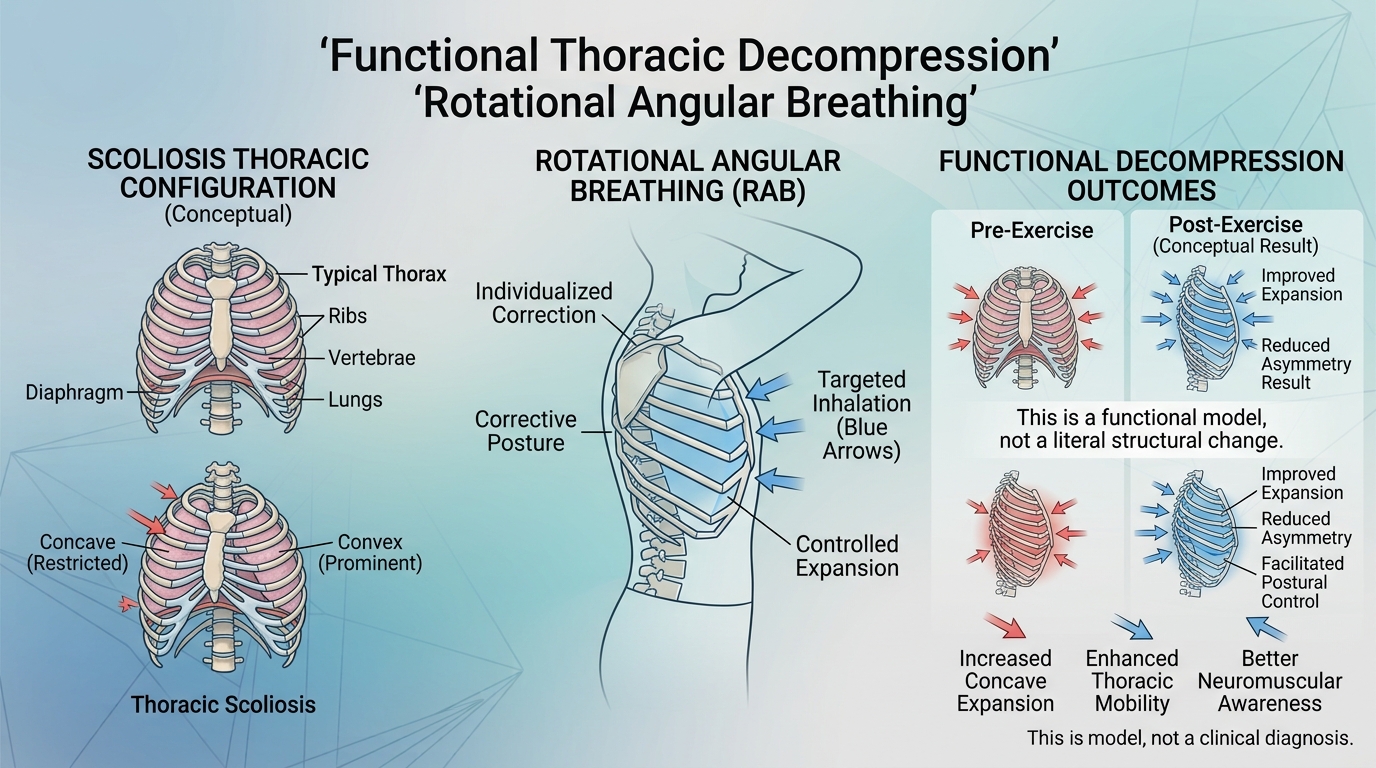
In a typical thoracic scoliosis pattern, one side of the thoracic cage may appear relatively more prominent while another region may appear more restricted.
The exact pattern varies between patients.
The commonly used terms are:
- convex side — the more prominent side of the curve,
- concave side — the relatively indented side.
These terms should not be interpreted as universal descriptions of respiratory function.
Not every patient has the same rib-cage mechanics, and the direction of targeted breathing should therefore be individualized.
This is one reason generic instructions such as:
“Always breathe into the left side.”
or
“Always expand the concave side.”
are inappropriate without considering the individual's curve pattern.
---
8. How Breathing May Influence Rib-Cage Mobility
The mechanical rationale behind targeted breathing involves several interacting structures.
During inhalation:
- The diaphragm contracts.
- The thoracic cavity expands.
- The ribs change position.
- Intercostal muscles contribute to rib movement.
- The abdominal wall adapts to changes in pressure.
- The thoracic spine and rib cage respond to the altered mechanical configuration.
In a scoliosis-specific exercise position, these movements occur while the patient attempts to maintain an individualized corrective posture.
The result is not simply “more air.”
The exercise is intended to create a controlled movement pattern involving the thorax and trunk.
---
9. Breathing Can Also Provide Sensory Feedback
Breathing is useful not only because it moves the rib cage.
It can also provide sensory information.
When patients are instructed to expand a specific region of the thorax, they must pay attention to:
- where movement occurs,
- how much expansion occurs,
- whether the corrected posture is maintained,
- and whether unwanted compensations develop.
This creates an interaction between:
respiration → proprioception → posture → movement control.
For this reason, targeted breathing can function as part of a motor-learning strategy.
---
10. Breathing and Postural Correction
In Schroth-based rehabilitation, breathing is generally performed within a specific postural configuration.
The patient may first be guided into an individualized correction involving:
- pelvic positioning,
- spinal elongation,
- shoulder positioning,
- trunk translation,
- and derotation.
The breathing technique is then incorporated into that position.
This is important because breathing alone does not reproduce the full therapeutic strategy.
The intervention is better understood as:
corrected posture + directed breathing + stabilization + functional integration.
---
11. What Does the Evidence Show?
Evidence for exercise-based rehabilitation and respiratory outcomes in scoliosis has been developing.
A 2026 systematic review and meta-analysis of 10 clinical trials found statistically significant improvements in several respiratory measures, including FVC, FEV1, and peak expiratory flow, in exercise-based interventions, particularly Schroth-based approaches. However, the authors also reported substantial heterogeneity and noted that the pooled changes in spinal curvature were small and did not reach commonly accepted thresholds for clinical significance. [5]
This provides support for the possibility that exercise-based rehabilitation can influence respiratory outcomes, but it does not establish that targeted breathing alone is responsible for those improvements.
That distinction matters because many studies use multimodal programs involving:
- corrective exercise,
- breathing,
- posture,
- stabilization,
- stretching,
- and home exercise.
It is therefore difficult to isolate the independent contribution of breathing.
---
12. Recent Evidence on Derotational Breathing
A 2026 prospective quasi-experimental study examined a four-week Schroth-based rotational angular breathing program in 20 adolescent females with thoracic idiopathic scoliosis.
The investigators reported increased intercostal distance on the concave side and a reduction in measured vertebral rotation. However, the observed reduction in Cobb angle was not statistically significant. [6]
These findings are interesting because they provide preliminary evidence that targeted breathing may influence thoracic cage dimensions and rotational characteristics.
However, the study was:
- small,
- short-term,
- single-group,
- and non-randomized.
Therefore, the findings should be considered preliminary rather than definitive evidence that targeted breathing produces structural correction.
---
13. Breathing May Be More Relevant in Thoracic Curves
Targeted breathing is particularly relevant when thoracic deformity and rib-cage asymmetry are present.
However, the clinical objective may differ between patients.
For one person, the priority may be:
- improving thoracic expansion.
For another:
- improving breathing awareness.
For another:
- integrating breathing with three-dimensional self-correction.
For someone with significant respiratory impairment:
- formal pulmonary assessment may be more important than simply adding breathing exercises.
This illustrates why breathing strategies should be patient-specific rather than universally prescribed.
---
14. Deep Breathing Is Not the Same as Targeted Breathing
These two concepts should not be confused.
General Deep Breathing
Usually emphasizes:
- larger inhalation,
- relaxation,
- diaphragmatic movement,
- and general respiratory control.
Targeted Scoliosis-Specific Breathing
May emphasize:
- a particular thoracic region,
- an individualized corrective posture,
- rib-cage expansion,
- derotation,
- stabilization,
- and integration with movement.
Both can be useful for different purposes.
One should not automatically be considered superior to the other.
---
15. Breathing Exercises Should Not Cause Pain
Targeted breathing should generally be performed within a comfortable range.
Patients should not forcefully expand the rib cage to the point of:
- sharp pain,
- dizziness,
- severe shortness of breath,
- chest discomfort,
- or significant distress.
If these symptoms occur, the exercise should be stopped and appropriately assessed.
People with known cardiopulmonary disease or significant respiratory symptoms may require medical evaluation before undertaking specialized respiratory exercise.
---
16. Who May Need More Than Exercise?
Exercise-based breathing strategies are not a substitute for medical evaluation when clinically significant respiratory symptoms are present.
A person experiencing:
- unexplained shortness of breath,
- persistent chest pain,
- reduced exercise tolerance,
- fainting,
- cyanosis,
- or progressive respiratory symptoms
should receive appropriate medical assessment.
Pulmonary function testing may be considered when clinically indicated.
This distinction is important because scoliosis-related respiratory mechanics and independent pulmonary disease can coexist.
---
17. Breathing and Exercise Capacity
Respiratory function is not determined by lung volume alone.
Exercise capacity also depends on:
- cardiovascular function,
- respiratory muscle performance,
- skeletal muscle strength,
- movement efficiency,
- conditioning,
- and overall health.
Recent reviews suggest that cardiopulmonary function can be affected in pediatric scoliosis, particularly with greater curve severity and thoracic deformity, although pulmonary-function measurements do not capture every aspect of exercise capacity. [7]
Therefore, rehabilitation should not focus exclusively on breathing exercises.
General physical activity and appropriate aerobic conditioning remain important components of healthy movement.
---
18. Breathing Should Be Integrated Into Movement
The most useful role for targeted breathing may be as part of a larger movement strategy.
For example:
Step 1 — Establish posture
The patient learns an individualized corrected position.
Step 2 — Add breathing
The patient directs inhalation toward the intended thoracic region.
Step 3 — Maintain correction
The patient attempts to preserve the postural strategy during respiration.
Step 4 — Add movement
The breathing pattern is maintained during increasingly complex movements.
Step 5 — Integrate into daily activities
The patient applies the strategy during sitting, standing, walking, and other relevant activities.
This progression moves breathing from a clinic exercise toward functional motor control.
---
19. Can Breathing Exercises Straighten Scoliosis?
This question requires a careful answer.
Targeted breathing may contribute to improvements in:
- thoracic mobility,
- chest-wall expansion,
- respiratory function,
- postural awareness,
- and aspects of movement control.
Some studies also report changes in measures such as vertebral rotation or Cobb angle when breathing is part of a broader scoliosis-specific exercise program. [5,6]
However:
Breathing exercises alone should not be presented as a proven method for permanently straightening a structural scoliosis.
The available research generally examines breathing as part of broader rehabilitation programs.
Therefore, it is more accurate to describe targeted breathing as a supportive component of individualized scoliosis rehabilitation.
---
20. The Concept of Functional Thoracic Decompression
Within this context, “thoracic decompression” can be understood as a functional concept involving:
- expansion of relatively restricted thoracic regions,
- improved rib mobility,
- reduced feeling of thoracic restriction,
- improved breathing distribution,
- and improved movement awareness.
It should not be interpreted as radiographic decompression of the spinal column.
This distinction allows the concept to remain clinically useful without making an unsupported structural claim.
---
21. A Patient-Specific Approach
A targeted breathing program should ideally consider:
- curve pattern,
- thoracic versus lumbar involvement,
- vertebral rotation,
- rib-cage asymmetry,
- sagittal alignment,
- pelvic position,
- respiratory symptoms,
- physical capacity,
- and treatment goals.
The same breathing instruction may not be appropriate for every scoliosis pattern.
This is consistent with the broader principle of scoliosis-specific rehabilitation:
The exercise should follow the patient's three-dimensional pattern rather than forcing every patient into the same movement strategy.
---
22. Breathing as Part of a Broader Rehabilitation Program
Targeted breathing can be combined with:
- three-dimensional self-correction,
- trunk stabilization,
- mobility exercises,
- postural training,
- strengthening,
- aerobic activity,
- and functional movement training.
This broader approach is more consistent with current scoliosis-specific exercise frameworks than treating breathing as a stand-alone intervention.
The 2016 SOSORT guidelines specifically describe respiratory exercises as part of PSSE and note that many PSSE schools incorporate specific breathing techniques to facilitate derotation and improve expansion of relatively collapsed trunk areas. [3]
---
23. What Patients Should Remember
Several principles are especially important.
1. Breathing is a movement
Every breath changes the configuration of the thorax.
2. Scoliosis can alter thoracic mechanics
Especially when thoracic curvature and vertebral rotation are substantial.
3. Targeted breathing is different from ordinary deep breathing
It uses deliberate positioning and directional expansion.
4. “Decompression” is a functional term here
It does not mean that breathing literally separates the thoracic vertebrae.
5. Breathing is usually one component of treatment
It should not be presented as a stand-alone cure for scoliosis.
6. Individualization matters
The appropriate breathing strategy depends on the person's curve and thoracic characteristics.
7. Evidence is promising but still developing
Research supports potential respiratory and functional benefits, but the independent effect of targeted breathing remains difficult to isolate.
---
Conclusion
The relationship between breathing and scoliosis is more complex than simply asking whether a person can “take a deep breath.”
Thoracic scoliosis can alter the three-dimensional configuration of the spine and rib cage, and greater thoracic deformity has been associated with reductions in several measures of pulmonary function. [1,2]
Targeted breathing techniques, particularly rotational angular breathing within Schroth-based PSSE, attempt to use respiration as an active component of three-dimensional postural and thoracic movement control. [3,4]
Recent evidence suggests that exercise-based scoliosis rehabilitation can improve some respiratory outcomes, while early research on derotational breathing has reported short-term changes in thoracic expansion and vertebral rotation. However, the studies remain heterogeneous, and breathing cannot yet be separated confidently from the other components of comprehensive scoliosis-specific exercise programs. [5,6]
Therefore, the most evidence-consistent way to understand targeted breathing for thoracic decompression is:
It is a strategy for improving thoracic expansion, respiratory control, and movement awareness—not a literal method of spinal decompression.
For appropriate patients, breathing can become more than an automatic physiological process. It can be incorporated into an individualized rehabilitation strategy that connects respiration, rib-cage mobility, spinal alignment, and movement control.
Medical Disclaimer
This article is intended for educational purposes only and does not constitute medical advice, diagnosis, or treatment. Breathing and exercise programs should be individualized by an appropriately qualified healthcare professional, particularly for people with significant spinal deformity, persistent pain, neurological symptoms, cardiopulmonary disease, or unexplained respiratory symptoms.
References
[1] Fan, Y., et al. (2022). Is impaired lung function related to spinal deformities in patients with adolescent idiopathic scoliosis? A systematic review and meta-analysis—SOSORT 2019 award paper. European Spine Journal. https://pubmed.ncbi.nlm.nih.gov/36509885/
[2] Kempen, D. H. R., et al. (2022). Pulmonary function in children and adolescents with untreated idiopathic scoliosis: a systematic review with meta-regression analysis. Spine Journal. https://pubmed.ncbi.nlm.nih.gov/34963629/
[3] Negrini, S., et al. (2018). 2016 SOSORT guidelines: Orthopaedic and rehabilitation treatment of idiopathic scoliosis during growth. Scoliosis and Spinal Disorders, 13, 3. https://pmc.ncbi.nlm.nih.gov/articles/PMC5795289/
[4] Berdishevsky, H., et al. (2016). Physiotherapy scoliosis-specific exercises – a comprehensive review of seven major schools. Scoliosis and Spinal Disorders, 11, 20. https://pmc.ncbi.nlm.nih.gov/articles/PMC4973373/
[5] Velázquez Saornil, J., Sosa Reina, M. D., Pérez de la Cruz, S., & Sánchez Milá, Z. (2026). Effects of conservative exercise-based interventions on spinal curvature, respiratory function, and quality of life in patients with idiopathic scoliosis: A systematic review and meta-analysis. Asian Spine Journal. https://pubmed.ncbi.nlm.nih.gov/42157370/
[6] Kilimci Demir, A., Acar, N., & Demir, E. (2026). Effects of Derotational Breathing Exercises on Thoracic Cage Asymmetry in Adolescents with Thoracic Scoliosis. Studies in Health Technology and Informatics. https://pubmed.ncbi.nlm.nih.gov/42290452/
[7] Cardiopulmonary Consequences of Scoliosis and the Clinical Implications of VO2max: A Systematic Review. (2026). PubMed. https://pubmed.ncbi.nlm.nih.gov/42088379/