Spine Care
[Exercise, Rehabilitation & Movement Therapy 03] The Role of Core Muscle Engagement in Supporting Spinal Alignment
Core muscle engagement contributes to trunk control and load management during movement, but it does not independently correct scoliosis or guarantee structural spinal alignment.
Introduction
The term “core strength” is widely used in fitness, sports, and rehabilitation.
People are often told that a strong core can improve posture, protect the back, and help maintain spinal alignment. While trunk muscles clearly contribute to movement and force management, these relationships are more complex than the simple idea that a strong core equals a straight spine.
The muscles surrounding the trunk contribute to trunk control, movement, and the management of forces during everyday activities. Their activity changes continuously as the body responds to gravity, movement, breathing, external resistance, and changes in position.
For people with scoliosis, trunk control may be one relevant component of a broader rehabilitation strategy. Scoliosis is a three-dimensional spinal deformity involving lateral curvature and vertebral rotation, meaning that rehabilitation may need to consider more than general abdominal strength. [1]
Core stabilization exercise has been studied in adolescent idiopathic scoliosis (AIS), and recent research suggests that it may provide benefits for some patients. However, current evidence does not support presenting core exercise as an independent method for correcting scoliosis or as a universal treatment. [2]
The more accurate concept is:
Core muscle engagement can support controlled movement and load management, but it is only one component of spinal and postural function.
---
1. What Does “Core” Actually Mean?
The core is not a single muscle.
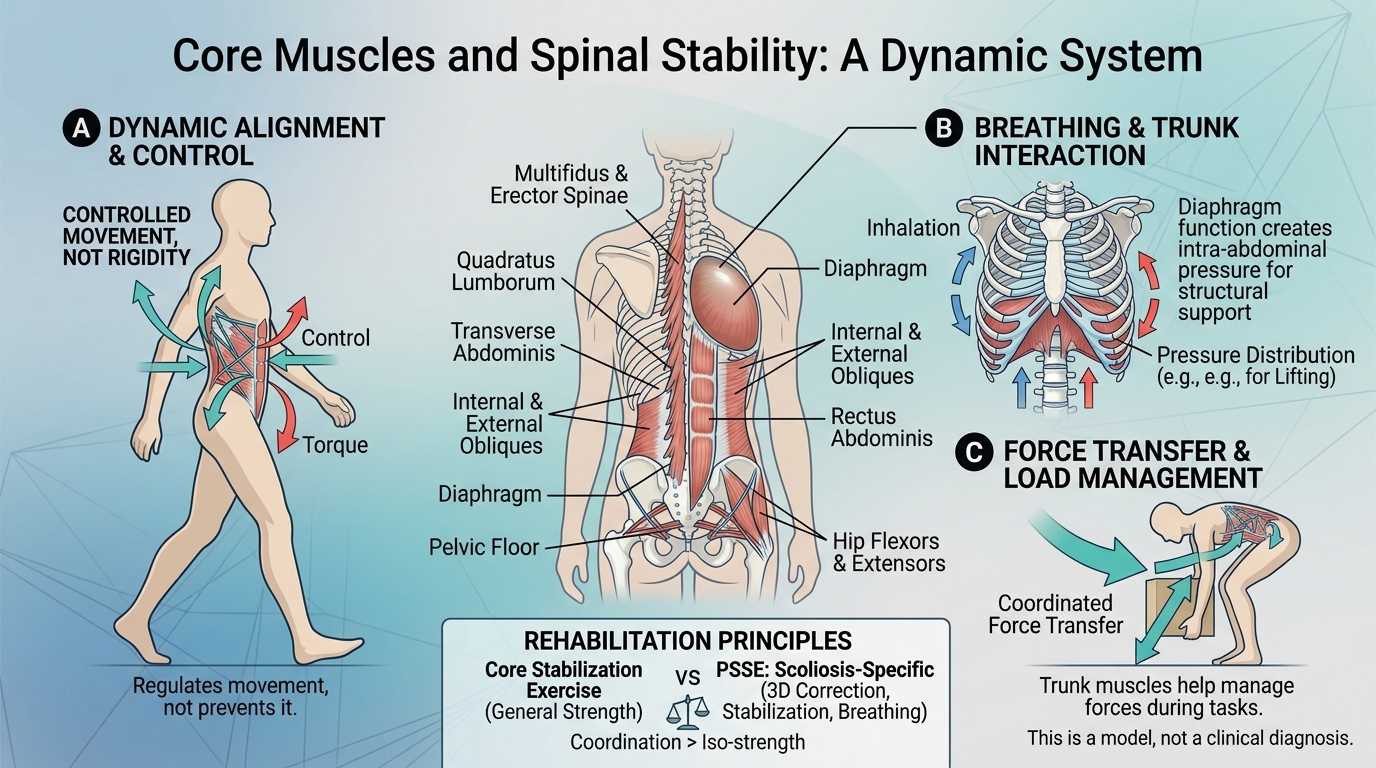
It is better understood as a functional region involving multiple muscles that contribute to control of the trunk and lumbopelvic region.
These include, depending on the movement:
- abdominal muscles,
- internal and external obliques,
- transverse abdominis,
- multifidus,
- erector spinae,
- quadratus lumborum,
- diaphragm,
- pelvic floor muscles,
- and muscles surrounding the pelvis and hips.
The contribution of each muscle varies according to the task.
For example, the muscular demands of a plank are different from those of walking, lifting, running, or rotating the trunk.
Therefore, core function is dynamic rather than simply a state of keeping the abdomen tight.
---
2. Spinal Alignment Is Not a Fixed Position
The word alignment can sometimes create the impression that the spine should remain perfectly straight and motionless.
That is not how the human body normally functions.
The spine moves during:
- walking,
- running,
- sitting,
- standing,
- lifting,
- reaching,
- rotation,
- and breathing.
Maintaining appropriate alignment therefore does not mean eliminating spinal movement.
Instead, it involves the ability to control movement while responding appropriately to changing forces and tasks.
Core muscle activity is one part of this process.
A useful way to understand core engagement is:
The core contributes to the regulation of trunk movement rather than simply preventing movement.
---
3. What Is Dynamic Spinal Stability?
Spinal stability is sometimes incorrectly interpreted as rigidity.
In normal movement, the spine needs both:
sufficient control to transmit forces
and
sufficient mobility to allow movement.
During a squat, for example, the trunk needs to remain controlled while the hips and knees move.
During walking, the trunk needs to accommodate movements generated by the lower limbs.
During lifting, the trunk and hip muscles work together to manage forces transferred through the body.
This is often described as dynamic stability.
The objective is not to eliminate all spinal movement.
It is to develop appropriate control of movement for the task being performed.
---
4. How Core Muscles Contribute to Load Management
Daily activities expose the body to many types of forces.
These can arise from:
- body weight,
- gravity,
- muscle contraction,
- external objects,
- ground reaction forces,
- acceleration,
- and changes in body position.
Trunk muscles contribute to how the body responds to these forces.
For example, when lifting an object, the muscles of the trunk and hips help control the relationship between the spine, pelvis, and lower limbs.
When reaching overhead, the trunk adjusts to changes in the body's center of mass.
When walking, trunk activity is coordinated with movement of the pelvis and lower limbs.
Therefore, core engagement is better understood as part of a broader force-management and movement-control system.
It does not mean that the muscles simply hold individual vertebrae in a fixed position.
---
5. Why Trunk Control May Be Relevant to Scoliosis
A person with scoliosis may have differences in:
- spinal alignment,
- vertebral rotation,
- trunk position,
- pelvic position,
- muscle activation,
- thoracic shape,
- balance,
- and habitual movement patterns.
These characteristics can influence how the trunk behaves during movement.
Trunk-control exercises may therefore be useful for developing the ability to perform movements with greater control.
However, this should not be confused with structural correction.
There is an important distinction between:
Core training → developing strength or trunk-control capacity
and
Structural correction → changing the underlying spinal deformity.
Improving one does not automatically produce the other.
---
6. Core Engagement Is Not Simply “Tightening Your Abs”
A common exercise instruction is:
“Tighten your core.”
This can be a useful teaching cue, but maximal abdominal contraction is not necessarily the goal of every movement.
Excessive or prolonged bracing may interfere with:
- normal breathing,
- movement,
- relaxation,
- or task-specific coordination.
The appropriate level of trunk muscle activity depends on what the person is doing.
A person lifting a heavy object may require a different strategy from someone walking or performing a gentle mobility exercise.
Effective core training therefore involves both:
activation
and
controlled movement.
---
7. The Diaphragm and Trunk Function
The diaphragm is primarily a respiratory muscle, but breathing is also closely related to trunk function.
During inhalation, the diaphragm changes its position and interacts mechanically with the abdominal contents and surrounding trunk structures.
At the same time, the body must continue to control posture and movement.
This creates an ongoing interaction between:
breathing + trunk control + posture + movement.
In people with thoracic scoliosis, the relationship between the spine and rib cage may have additional relevance because thoracic deformity can affect thoracic geometry and respiratory mechanics.
Some scoliosis-specific exercise approaches therefore incorporate breathing with individualized postural correction. [3,4]
This does not mean that breathing exercises alone are established as a method for correcting structural scoliosis.
Rather, breathing can be incorporated into a broader movement strategy.
---
8. Core Muscles Function as a Coordinated System
It is tempting to identify one muscle as the “most important” core muscle.
In reality, trunk control involves coordinated activity among multiple structures.
Abdominal Muscles
Contribute to trunk control and force transmission.
Spinal Muscles
Contribute to spinal movement and control.
Diaphragm
Contributes primarily to respiration and also interacts with trunk function.
Pelvic Floor
Participates in pressure regulation and lumbopelvic function.
Hip Muscles
Contribute to force transfer between the lower limbs and pelvis.
The exact contribution of each structure varies according to the task.
Therefore, coordination is at least as important as isolated muscle strength when considering functional trunk control.
---
9. The Relationship Between Core and Pelvic Control
The pelvis forms an important connection between the spine and lower limbs.
During walking, running, squatting, or lifting, forces are transferred through the kinetic chain:
feet → legs → pelvis → spine → trunk
and in the opposite direction:
trunk → spine → pelvis → legs → ground.
Control of the pelvis can therefore influence how movement is transferred through the trunk.
For people with scoliosis, pelvic position may also interact with their existing spinal alignment.
This does not mean that pelvic position is established as the cause of idiopathic scoliosis.
Instead, it means that pelvic and trunk control may be relevant to how an individual moves with an existing spinal deformity.
---
10. Stability Does Not Mean a Rigid Spine
One of the most important concepts in movement rehabilitation is that stability does not necessarily require rigidity.
A completely rigid spine would interfere with many normal activities.
The body needs controlled mobility.
The trunk must be able to participate in:
- flexion,
- extension,
- rotation,
- lateral flexion,
- and translation
when the task requires it.
Core muscles contribute to controlling these movements.
Therefore, the objective of core training is generally not to make the spine permanently stiff.
It is to improve the ability to control movement under different conditions.
---
11. Core Exercise Is Not the Same as Scoliosis-Specific Exercise
This distinction is especially important for patients with scoliosis.
General core exercises may include:
- planks,
- side planks,
- bridges,
- bird dogs,
- dead bugs,
- abdominal strengthening,
- and resistance exercises.
These exercises can be used to develop general trunk strength or control.
Physiotherapeutic scoliosis-specific exercises (PSSE), however, have additional principles.
Depending on the specific method, these may include:
- individualized three-dimensional self-correction,
- stabilization of the corrected posture,
- elongation,
- breathing strategies,
- and integration into daily activities. [3,4]
Therefore:
Core exercise and scoliosis-specific exercise are not interchangeable terms.
Core training may be incorporated into a broader rehabilitation program, but it does not replace individualized scoliosis assessment or scoliosis-specific treatment when such treatment is indicated.
---
12. What Does the Research Say About Core Stabilization?
Research specifically examining core stabilization exercise in AIS has increased in recent years.
A 2025 systematic review and meta-analysis included 10 randomized controlled trials involving 449 participants with mild to moderate AIS. The authors reported that core stabilization exercise was associated with improvements in Cobb angle, angle of trunk rotation, apical vertebral rotation, and SRS-22 quality-of-life scores compared with a no-treatment or blank-control condition. However, core stabilization showed weaker effects than three-dimensional exercise for several outcomes, and the authors emphasized heterogeneity, small sample sizes, multiple comparisons, and the need for longer-term research. [2]
Other systematic reviews have reported potential benefits from PSSE more broadly. A 2024 network meta-analysis of 17 randomized controlled trials involving 857 patients reported improvements in Cobb angle, angle of trunk rotation, and quality of life compared with conventional rehabilitation. [5]
However, the evidence is not uniform.
A systematic review specifically examining medium- to long-term Cobb-angle outcomes concluded that the available evidence was limited and that there was insufficient high-certainty evidence to establish the long-term effect of PSSE on curve progression. [6]
These findings support a measured conclusion:
Core stabilization may be useful for some patients with AIS, but current evidence does not establish it as an independent or universal method of structural correction.
---
13. Core Strength and Cobb Angle Are Different Outcomes
This distinction is essential.
The Cobb angle is a radiographic measurement used to quantify the magnitude of a spinal curve in the coronal plane.
Core strength is a measure of physical capacity.
They are not equivalent outcomes.
A person may become:
- stronger,
- more physically active,
- better able to control their trunk,
- and more capable during daily activities
without experiencing a substantial change in Cobb angle.
Conversely, a change in radiographic measurement does not necessarily tell us everything about functional improvement.
A comprehensive assessment may therefore consider both:
structural outcomes
and
functional outcomes.
---
14. Dynamic Control May Matter More Than Static Appearance
A person may look well aligned while standing still but demonstrate different trunk mechanics during movement.
Conversely, a person may have visible asymmetry at rest while demonstrating effective control during functional activities.
This is one reason rehabilitation assessment should not rely exclusively on static posture.
Depending on the patient's goals, clinicians may consider movement during:
- walking,
- squatting,
- reaching,
- lifting,
- stair climbing,
- balance tasks,
- trunk rotation,
- and sport-specific activities.
The question becomes not only:
“What does the spine look like?”
but also:
“How does the person control their body while moving?”
---
15. Core Training Does Not Need to Be Identical for Everyone
People with scoliosis do not necessarily need identical core programs.
Two patients may both have AIS while differing in:
- curve location,
- curve magnitude,
- vertebral rotation,
- skeletal maturity,
- flexibility,
- symptoms,
- physical capacity,
- and functional goals.
A general core exercise may therefore be appropriate for one person while requiring modification for another.
This does not mean that every patient needs a highly specialized or asymmetric exercise.
It means that exercise selection should follow the purpose of training and the individual's characteristics.
---
16. Examples of Core Exercises
Common exercises used to develop trunk strength and control include:
Plank
Challenges the ability to maintain controlled trunk positioning while resisting movement.
Side Plank
Places greater demand on lateral trunk control.
Bird Dog
Combines trunk control with movement of the limbs.
Dead Bug
Challenges coordination between the trunk and extremities.
Bridge
Combines trunk and pelvic control with hip extension.
Resistance Exercises
Squats, rows, carries, and other resistance exercises can require substantial trunk control even when they are not traditionally labeled “core exercises.”
The important question is not whether an exercise is universally “good for scoliosis.”
It is whether the exercise is appropriate for the individual's capacity, symptoms, movement pattern, and rehabilitation goal.
---
17. Quality of Engagement Is More Important Than Maximum Tension
Effective core training does not necessarily mean producing the greatest possible abdominal tension.
A useful exercise should allow the person to:
- breathe appropriately,
- maintain the intended position,
- perform the required movement,
- control unwanted compensations,
- and progressively increase the challenge.
This is particularly relevant when exercise is being used as part of rehabilitation.
The goal is not simply:
“How hard can I brace?”
A more useful question is:
“Can I control my trunk while performing the task?”
---
18. Progression Should Be Individualized
Core training can be progressed gradually.
A general progression might move from:
basic control
→
controlled limb movement
→
more complex movement
→
external resistance
→
functional movement
→
sport- or work-specific activity
The appropriate progression depends on the individual's starting ability and goals.
Holding a plank for a longer period does not automatically mean that the person has achieved better overall trunk control.
Different components of physical capacity may need to be developed separately.
---
19. The Goal Is Functional Transfer
The purpose of core training is not simply to become better at performing core exercises.
The desired outcome is improved physical capacity and movement control that can be used in everyday life.
This may include:
- sitting,
- walking,
- lifting,
- carrying,
- climbing stairs,
- recreational exercise,
- work,
- and sports.
The ability to transfer exercise skills into real-world movement is therefore an important part of rehabilitation.
---
20. A Patient-Specific Framework
A useful framework for scoliosis rehabilitation is:
Assess → Correct When Appropriate → Stabilize → Move → Integrate
Assess
Consider the individual's spinal curve, symptoms, movement characteristics, physical capacity, and functional goals.
Correct When Appropriate
If clinically indicated, learn an individualized three-dimensional self-correction strategy.
Stabilize
Develop control of the desired position during appropriate tasks.
Move
Introduce progressively more challenging movements.
Integrate
Apply the movement strategy to daily activities and broader physical exercise.
Core training can contribute to several stages of this process.
It does not replace assessment, individualized treatment, or other indicated forms of scoliosis management.
---
21. The Future of Core Training in Scoliosis
Scoliosis rehabilitation may become increasingly individualized as assessment technology develops.
Potential tools include:
- three-dimensional surface scanning,
- motion analysis,
- wearable sensors,
- electromyography,
- force measurement,
- respiratory assessment,
- and radiographic analysis.
These technologies may help clinicians better understand how an individual's trunk responds to different movements and external loads.
Future research may therefore focus on questions such as:
- Which movement strategies improve trunk control?
- How does muscle activation change during individualized correction?
- Which exercises transfer best to daily activities?
- How does improved trunk control relate to symptoms and function?
- Which exercise characteristics are most useful for different patient groups?
The long-term goal is not necessarily to find one universally “best” core exercise.
It is to develop better-matched exercise strategies for individual patients.
---
Conclusion
Core muscle engagement contributes to trunk control and the management of forces during movement.
For people with scoliosis, trunk control may be one relevant component of a broader rehabilitation strategy because spinal alignment, movement, and body mechanics can differ between individuals.
However, core strengthening should not be presented as synonymous with scoliosis correction.
A stronger core does not automatically straighten a scoliotic spine.
Current evidence suggests that core stabilization exercise may provide useful benefits for some patients with mild to moderate adolescent idiopathic scoliosis. At the same time, the evidence remains limited by differences among studies, relatively small samples, and variation in exercise protocols and comparison groups. [2]
PSSE approaches add individualized three-dimensional self-correction, stabilization, breathing, and functional integration to exercise therapy. Evidence suggests potential benefits, but the magnitude and long-term clinical significance of these effects remain areas of active research. [5,6]
The most accurate goal is therefore not simply:
“Strengthen the core.”
It is:
“Develop appropriate trunk control for movement, breathing, load management, and functional activity.”
Core training can be one part of that process.
It should be viewed as a supporting component of individualized rehabilitation, rather than as an independent method for correcting structural scoliosis.
Medical Disclaimer
This article is intended for educational purposes only and does not constitute medical advice, diagnosis, or treatment. Exercise selection and modification should be individualized by an appropriately qualified healthcare professional, particularly for people with significant spinal deformity, persistent pain, neurological symptoms, or other medical conditions.
References
[1] Scoliosis Research Society. Scoliosis. Scoliosis Research Society.
[2] Liu, X., Wang, Y., Liu, M., Zhang, Y., Wu, Q., & Wang, Q. (2025). The efficacy of core stabilization exercise in mild and moderate adolescent idiopathic scoliosis: A systematic review and meta-analysis. Journal of Orthopaedic Surgery and Research, 20, 214. https://pubmed.ncbi.nlm.nih.gov/40016756/
[3] Berdishevsky, H., et al. (2016). Physiotherapy scoliosis-specific exercises – a comprehensive review of seven major schools. Scoliosis and Spinal Disorders, 11, 20. https://doi.org/10.1186/s13013-016-0076-9
[4] Scoliosis Research Society. SRS Statement on Physiotherapy Scoliosis Specific Exercises. Scoliosis Research Society.
[5] Dong, H., You, M., Li, Y., Wang, B., & Huang, H. (2024). Physiotherapeutic Scoliosis-Specific Exercise for the Treatment of Adolescent Idiopathic Scoliosis: A Systematic Review and Network Meta-analysis. American Journal of Physical Medicine & Rehabilitation, 104(1), 14–25. https://pubmed.ncbi.nlm.nih.gov/38726971/
[6] Oba, H., et al. (2024). Effects of Physiotherapeutic Scoliosis-Specific Exercise for Adolescent Idiopathic Scoliosis Cobb Angle: A Systematic Review. Spine Surgery and Related Research, 9(2), 120–129. https://pubmed.ncbi.nlm.nih.gov/40223832/
[7] Scoliosis Research Society. Living with Scoliosis. Scoliosis Research Society.