Spine Care
[Exercise, Rehabilitation & Movement Therapy 02] Why One-Size-Fits-All Exercises May Not Suit an Asymmetric Spine
Symmetric exercise is not inherently harmful for scoliosis, but a one-size-fits-all program may overlook individual differences in spinal alignment, rotation, movement control, and loading.
Introduction
Most exercise programs are designed around symmetry.
People are often instructed to train both sides equally, perform the same number of repetitions, and develop similar strength and mobility on the left and right sides.
For general fitness, this approach can be practical and effective.
But scoliosis presents a different mechanical situation.
A scoliotic spine is not simply a straight spine that has been bent sideways. Scoliosis is a three-dimensional spinal deformity involving lateral curvature, vertebral rotation, and changes that can affect the sagittal and transverse planes. [1]
This raises an important rehabilitation question:
Does a symmetrical exercise program always provide the most appropriate stimulus for an asymmetric spine?
The answer is not that symmetrical exercise is harmful.
In fact, physical activity is generally encouraged for people with scoliosis, and many patients can participate in ordinary exercise and sports without restriction. [2]
The more important issue is individualization.
A generalized exercise program may improve strength, endurance, mobility, and physical fitness while not specifically addressing the three-dimensional characteristics of an individual's scoliosis.
This is why it is useful to distinguish between general exercise and scoliosis-specific exercise.
---
1. Scoliosis Creates a Three-Dimensional Asymmetry
The human body is never perfectly symmetrical.
Even healthy individuals have differences in:
- muscle size,
- limb dominance,
- joint mobility,
- pelvic position,
- shoulder position,
- and habitual movement patterns.
Scoliosis adds structural and functional asymmetry to this naturally variable system.
Depending on the curve pattern, a person may have:
- lateral trunk displacement,
- vertebral rotation,
- rib prominence,
- asymmetric waist contours,
- differences in shoulder position,
- pelvic asymmetry,
- altered sagittal alignment,
- and differences in trunk movement.
These characteristics mean that the left and right sides of the body may not perform identical mechanical roles during movement.
However, this does not mean that one side is simply "weak" and the other is simply "tight."
A more complete assessment considers:
alignment + rotation + mobility + muscle activation + breathing + motor control + loading.
---
2. Symmetrical Movement Does Not Necessarily Mean Symmetrical Loading
One of the most important concepts in scoliosis rehabilitation is that the appearance of a movement does not always tell us how forces are distributed internally.
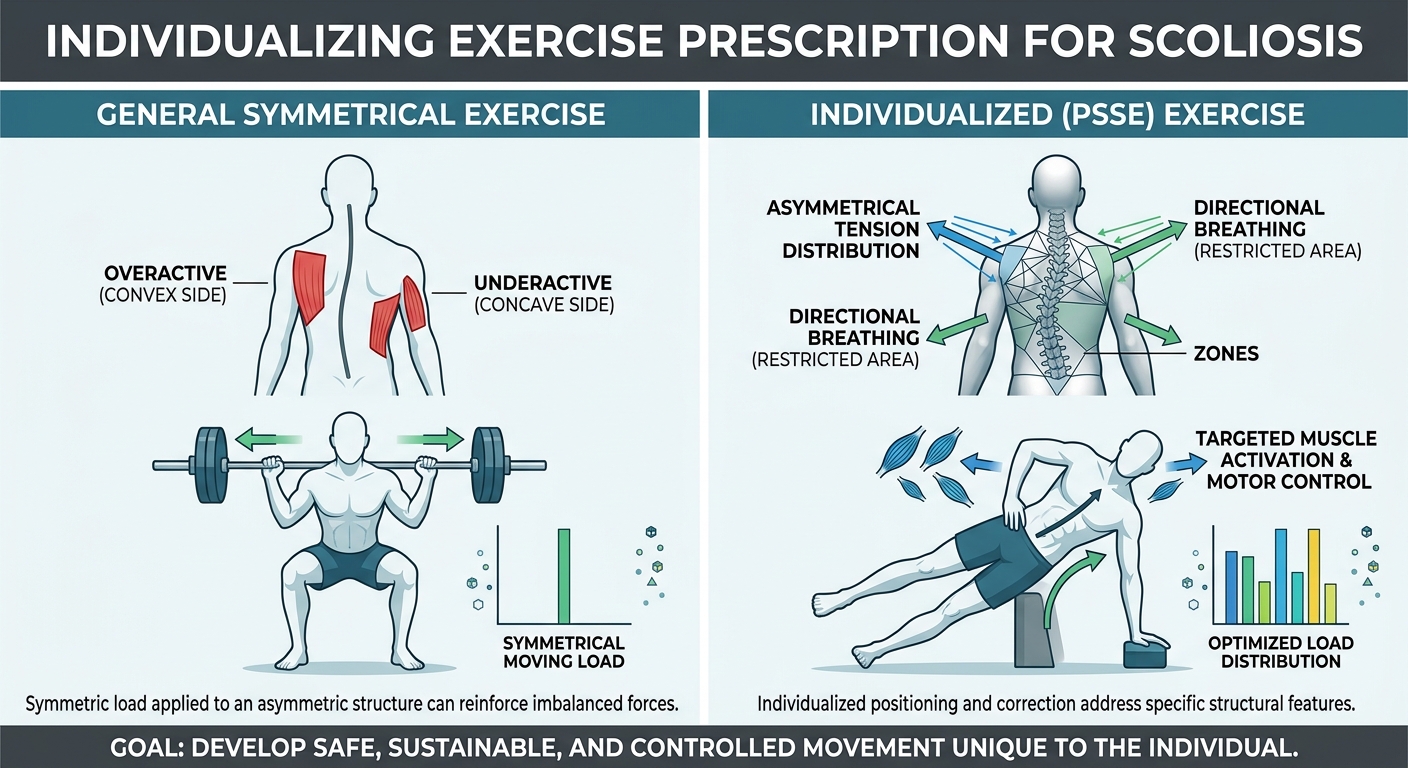
Consider a bilateral squat.
The movement appears symmetrical:
- both feet are positioned on the floor,
- both knees bend,
- both hips move,
- and the trunk moves as a single unit.
But a person with scoliosis may have differences in:
- weight distribution,
- pelvic position,
- trunk rotation,
- hip mobility,
- or habitual movement strategy.
Consequently, the internal mechanical loading may not be perfectly symmetrical.
The same principle can apply to exercises such as:
- planks,
- bridges,
- push-ups,
- rows,
- resistance-band exercises,
- deadlifts,
- and general core strengthening.
The movement may be bilateral even though the body does not respond to it in exactly the same way on both sides.
This is not necessarily a problem.
It simply means that exercise appearance and exercise effect are not always identical.
---
3. General Exercise and Scoliosis-Specific Exercise Have Different Goals
This distinction is central to understanding scoliosis rehabilitation.
General Exercise
General exercise is primarily intended to improve overall physical capacity.
It may develop:
- strength,
- endurance,
- cardiovascular fitness,
- mobility,
- coordination,
- balance,
- bone health,
- and general physical well-being.
These benefits are important for people with scoliosis as well as for the general population. [2]
Scoliosis-Specific Exercise
Physiotherapeutic scoliosis-specific exercises (PSSE) have a more specific purpose.
Common principles include:
- individualized assessment,
- three-dimensional self-correction,
- stabilization of the corrected posture,
- elongation,
- breathing strategies,
- and integration of the corrected position into daily activities. [3,4]
The objective is therefore not simply to make both sides equally strong.
It is to help the patient develop better control of their particular spinal and trunk configuration.
---
4. Why Equal Exercise Does Not Necessarily Produce Equal Correction
Imagine an adolescent with a right thoracic curve.
A general strengthening program might prescribe:
10 repetitions on the right + 10 repetitions on the left.
This is perfectly reasonable if the goal is general bilateral strengthening.
But if the therapeutic goal is three-dimensional postural correction, equal repetitions may not be the most relevant measurement.
The therapist may instead focus on:
- trunk position,
- rotational control,
- pelvic alignment,
- breathing,
- weight distribution,
- and maintaining a corrected posture during movement.
This is why PSSE programs do not simply prescribe identical movements to both sides.
They use individualized positioning and correction strategies according to the patient's curve characteristics. [3,4]
The key principle is:
Equal exercise volume is not necessarily the same as individualized rehabilitation.
---
5. The Importance of Vertebral Rotation
A major reason scoliosis requires more than a two-dimensional exercise strategy is vertebral rotation.
A lateral curve can be accompanied by axial rotation of the vertebrae.
This rotation can contribute to:
- rib prominence,
- changes in thoracic shape,
- altered trunk contours,
- asymmetric movement,
- and changes in the relationship between the spine and rib cage.
Consequently, an exercise that moves the trunk equally toward the left and right does not necessarily create equivalent three-dimensional movement.
For example, bilateral trunk extension does not automatically correct vertebral rotation.
Similarly, strengthening both shoulders equally does not automatically normalize rotational trunk alignment.
This is one reason scoliosis-specific exercise approaches emphasize three-dimensional correction rather than simply strengthening the muscles on both sides. [3,4]
---
6. Breathing Can Also Be Part of Scoliosis-Specific Exercise
The relationship between the thoracic spine and rib cage is another reason individualized exercise may be useful.
Thoracic scoliosis can alter the shape and orientation of the rib cage.
Some PSSE approaches therefore incorporate breathing strategies together with postural correction. These may involve directing expansion toward areas of the thorax that are relatively restricted while maintaining a corrected posture. [3,4]
This is different from simply instructing a patient to take a deep breath.
The exercise may combine:
posture + breathing + three-dimensional correction + motor control.
The purpose is not to suggest that ordinary breathing exercises are harmful.
Rather, it demonstrates how a scoliosis-specific program can address features that a general exercise program may not specifically target.
---
7. Symmetric Exercise Is Not the Enemy
This point deserves particular emphasis.
There is no good basis for telling people with scoliosis to avoid ordinary symmetrical exercise simply because their spine is asymmetric.
The Scoliosis Research Society states that physical activity is generally beneficial for children with scoliosis and that, in general, patients should continue activities and sports unless pain or specific medical instructions require modification. [2]
For many people, bilateral exercises are entirely appropriate.
They can improve:
- general strength,
- muscular endurance,
- cardiovascular fitness,
- physical confidence,
- functional capacity,
- and overall health.
Therefore, the question should not be:
"Is symmetric exercise bad for scoliosis?"
A better question is:
"Is this particular exercise appropriate for this person's goals, symptoms, movement pattern, and spinal characteristics?"
That is a much more useful clinical question.
---
8. The Potential Limitation of a One-Size-Fits-All Program
The concern is not symmetry itself.
The concern is using the same exercise prescription for everyone regardless of their individual characteristics.
Two people may both have a diagnosis of adolescent idiopathic scoliosis while having very different:
- curve locations,
- curve magnitudes,
- rotational characteristics,
- skeletal maturity,
- flexibility,
- symptoms,
- pelvic alignment,
- movement patterns,
- and functional goals.
A single standardized exercise routine may therefore be useful for general conditioning while being insufficient for individualized correction.
This distinction is especially important when the treatment goal extends beyond general fitness.
---
9. Strength, Mobility, and Motor Control Are Different
An exercise program should not be judged only by whether it makes a muscle stronger.
Several different physical characteristics may need to be considered.
Strength
How much force can the muscle produce?
Endurance
How long can the muscle maintain activity?
Mobility
Can the relevant joint or body segment move through the required range?
Motor Control
Can the person coordinate the movement effectively?
Alignment
Where is the body positioned while the movement occurs?
Load Distribution
How are forces transferred through the body?
These characteristics are related, but they are not interchangeable.
A person may have excellent trunk strength while still demonstrating poor movement control.
Likewise, increasing flexibility does not automatically correct a structural spinal curve.
This is why scoliosis rehabilitation may require more than simply increasing overall muscular strength.
---
10. Symmetry and Balance Are Not the Same Thing
One of the most useful concepts in scoliosis rehabilitation is the distinction between symmetry and balance.
A person may appear more symmetrical after changing their standing position.
But if the thorax, pelvis, and spine remain poorly coordinated in three dimensions, visual symmetry alone does not necessarily represent complete correction.
Conversely, a scoliosis-specific exercise may temporarily look asymmetric because the patient is deliberately positioned to address an existing asymmetry.
The movement may therefore look uneven while the therapeutic objective is to improve overall control.
This is why patients should not judge an exercise solely by whether it looks symmetrical.
---
11. When Asymmetric Exercise May Be Appropriate
Asymmetric exercise can be useful when the therapeutic objective is specific.
A qualified clinician may modify:
- starting position,
- trunk orientation,
- arm position,
- pelvic position,
- resistance direction,
- weight distribution,
- breathing direction,
- or range of motion.
The purpose may be to help the patient achieve and maintain a particular three-dimensional correction.
However, asymmetric exercise is not automatically better than symmetric exercise.
There is no universal rule stating that every scoliosis patient should train one side more than the other.
The appropriate exercise depends on the individual's assessment and treatment goal.
---
12. A Better Approach: Combine General and Specific Exercise
General exercise and scoliosis-specific exercise do not need to compete.
They can complement one another.
A rehabilitation program may progress through several stages:
Step 1: Assessment
Identify the individual's spinal curve, trunk alignment, movement characteristics, symptoms, and functional goals.
Step 2: Self-Correction
Learn an individualized three-dimensional corrective position.
Step 3: Stabilization
Develop the ability to maintain that position.
Step 4: Strengthening
Add resistance while maintaining appropriate alignment and movement control.
Step 5: Functional Integration
Apply the movement strategy to walking, sitting, lifting, sports, work, and other daily activities.
Step 6: General Physical Activity
Continue broader exercise to maintain overall physical capacity.
This approach avoids creating a false choice between "symmetric" and "asymmetric" exercise.
---
13. The Role of Core Stability
Core strengthening is commonly included in scoliosis rehabilitation.
But core strength should not be equated with structural correction.
A stronger abdominal wall does not automatically straighten a scoliotic spine.
Core stability is better understood as the ability to control the trunk while forces are transferred between the upper and lower body.
Depending on the exercise, this involves coordinated activity of:
- abdominal muscles,
- spinal muscles,
- diaphragm,
- pelvic floor,
- hip musculature,
- and other muscles involved in trunk control.
A bilateral plank, for example, may be useful for general trunk endurance.
But a patient with a specific three-dimensional deformity may also require exercises that address their individual alignment and movement control.
Thus:
Strength provides capacity; motor control determines how that capacity is used.
---
14. What Current Research Says About Scoliosis-Specific Exercise
Research on PSSE has expanded considerably.
A 2024 systematic review and network meta-analysis included 17 randomized controlled trials involving 857 participants and reported improvements in Cobb angle, angle of trunk rotation, and quality of life compared with conventional rehabilitation approaches. [5]
Another 2024 systematic review and meta-analysis examining three-dimensional spinal deformities reported positive effects of PSSE on Cobb angle, angle of trunk rotation, and thoracic kyphosis. However, the authors rated the overall certainty of evidence from moderate to low for randomized trials and very low for non-randomized studies, and noted limitations such as small samples and inconsistent control interventions. [6]
Other evidence is more cautious.
A systematic review specifically examining the medium- and long-term effects of PSSE found that the certainty of evidence regarding reduction of Cobb-angle progression was extremely low. The included studies also varied substantially in intervention methods, control groups, and follow-up periods. [7]
A 2024 systematic review and meta-analysis of 26 studies similarly found potential benefits from PSSE, but the randomized-trial data showed a relatively small average Cobb-angle difference, emphasizing the importance of interpreting statistical significance separately from clinical significance. [8]
More recent evidence continues to report potential benefits, while also noting heterogeneity and risk-of-bias concerns. [9]
Therefore, the evidence supports continued research and appropriately selected PSSE, but does not support the claim that asymmetric exercise is universally superior or that symmetrical exercise causes scoliosis progression.
---
15. What Patients Should Ask About Exercise
Rather than asking only:
"Which exercise is best for scoliosis?"
patients may benefit from asking more specific questions:
- What is my curve pattern?
- Where is the primary curve located?
- Is there significant vertebral rotation?
- How is my trunk positioned relative to my pelvis?
- Are there important differences in mobility between sides?
- Is this exercise intended for general fitness or scoliosis-specific correction?
- Does the exercise need to be modified for my particular pattern?
- How should I control my breathing?
- How will my progress be measured?
- Are there symptoms that mean I should modify or stop the exercise?
These questions help distinguish general exercise prescription from individualized rehabilitation.
---
16. Toward Patient-Specific Exercise Prescription
Future scoliosis rehabilitation may become increasingly individualized.
Technologies such as:
- three-dimensional surface scanning,
- motion capture,
- wearable sensors,
- electromyography,
- force measurements,
- respiratory measurements,
- radiographic analysis,
- and computational modeling
could eventually help clinicians understand how an individual responds to different movement and loading strategies.
The question could gradually shift from:
"Which exercise is best for scoliosis?"
to:
"Which movement strategy is most appropriate for this individual's three-dimensional spinal pattern and functional goal?"
This approach does not reject conventional exercise.
Instead, it adds another layer of assessment and personalization.
---
Conclusion
A scoliotic spine has three-dimensional characteristics that may not be fully addressed by a generalized exercise program.
However, this does not mean that symmetrical exercise is harmful.
For many patients, bilateral strengthening and general physical activity are valuable components of a healthy and active lifestyle. [2]
The more useful principle is:
Do not confuse equal exercise with individualized rehabilitation.
General exercise can build strength, endurance, mobility, and physical capacity.
Scoliosis-specific exercise can add individualized three-dimensional correction, stabilization, breathing strategies, and movement control.
The two approaches can complement each other.
Ultimately, the goal is not to make every movement perfectly symmetrical.
The goal is to develop safe, efficient, controlled, and sustainable movement that is appropriate for the individual's spinal structure, symptoms, physical capacity, and functional needs.
That is the difference between simply exercising with scoliosis and developing an exercise program for the individual with scoliosis.
Medical Disclaimer
This article is intended for educational purposes only and does not constitute medical advice, diagnosis, or treatment. Exercise selection and modification should be individualized by an appropriately qualified healthcare professional, particularly for people with significant spinal deformity, pain, neurological symptoms, or other medical conditions.
References
[1] Scoliosis Research Society. Scoliosis. Scoliosis Research Society.
[2] Scoliosis Research Society. Living with Scoliosis. Scoliosis Research Society.
[3] Berdishevsky, H., et al. (2016). Physiotherapy scoliosis-specific exercises – a comprehensive review of seven major schools. Scoliosis and Spinal Disorders, 11, 20. https://doi.org/10.1186/s13013-016-0076-9
[4] Scoliosis Research Society. SRS Statement on Physiotherapy Scoliosis Specific Exercises. Scoliosis Research Society.
[5] Dong, H., You, M., Li, Y., Wang, B., & Huang, H. (2024). Physiotherapeutic Scoliosis-Specific Exercise for the Treatment of Adolescent Idiopathic Scoliosis: A Systematic Review and Network Meta-analysis. American Journal of Physical Medicine & Rehabilitation, 104(1), 14–25. https://pubmed.ncbi.nlm.nih.gov/38726971/
[6] You, M. J., et al. (2024). Effectiveness of Physiotherapeutic Scoliosis-Specific Exercises on 3-Dimensional Spinal Deformities in Patients With Adolescent Idiopathic Scoliosis: A Systematic Review and Meta-analysis. Archives of Physical Medicine and Rehabilitation, 105(12), 2375–2389. https://pubmed.ncbi.nlm.nih.gov/38719166/
[7] Oba, H., et al. (2024/2025). Effects of Physiotherapeutic Scoliosis-Specific Exercise for Adolescent Idiopathic Scoliosis Cobb Angle: A Systematic Review. Spine Surgery and Related Research, 9(2), 120–129. https://pubmed.ncbi.nlm.nih.gov/40223832/
[8] Baumann, A. N., et al. (2024). The impact of patient scoliosis-specific exercises for adolescent idiopathic scoliosis: a systematic review and meta-analysis of randomized controlled trials with subgroup analysis using observational studies. Spine Deformity, 12(3), 545–559. https://pubmed.ncbi.nlm.nih.gov/38243155/
[9] Effect of Supervised Versus Hybrid Delivery of Physiotherapeutic Scoliosis-Specific Exercises in Adolescents with Idiopathic Scoliosis: Systematic Review and Meta-Analysis. Medicina, 62(4), 768. (2026). https://pubmed.ncbi.nlm.nih.gov/42075639/