Spine Care
[Exercise, Rehabilitation & Movement Therapy 01] Isometric Exercises for Scoliosis: Strengthening Without Joint Strain
Isometric exercises strengthen muscles without large joint movements and may support spinal stability, posture, and movement control in people with scoliosis.
Introduction
Exercise is an important part of maintaining strength, mobility, balance, and physical function in people with scoliosis. However, not every exercise needs to involve large movements of the spine or joints.
Isometric exercise provides another approach.
During an isometric contraction, a muscle produces force while its overall length and the associated joint position remain relatively stable. Examples include holding a plank, maintaining a wall sit, or pressing against an immovable object.
For people with scoliosis, this type of exercise can be particularly interesting because strengthening can be performed while minimizing repetitive joint movement. It may therefore be useful as one component of a broader rehabilitation program focused on spinal stability, postural control, and muscular endurance.
However, isometric exercise should not be confused with a stand-alone treatment for scoliosis. Current evidence supports exercise and physiotherapeutic scoliosis-specific exercise (PSSE) as areas of active research, but the certainty of evidence regarding long-term structural curve correction remains limited. [1,2]
The most appropriate role of isometric exercise is therefore to support muscular capacity, postural control, and functional movement, while individualized scoliosis assessment determines which exercises are appropriate.
1. What Is an Isometric Exercise?
The word isometric comes from the Greek roots meaning “same length.”
In practical terms, an isometric contraction occurs when a muscle generates force without substantial visible movement of the joint.
For example, imagine pushing your hands against a wall.
Your muscles are producing force, but the wall does not move.
The same principle can be applied to the spine.
A person can activate the abdominal, back, hip, or shoulder muscles while maintaining a relatively stable spinal position.
Common examples include:
- plank holds
- side plank holds
- wall sits
- static bridges
- abdominal bracing
- isometric hip abduction
- isometric trunk extension
- resistance against an immovable object
The exact exercise should be selected according to the individual's alignment, symptoms, strength, and rehabilitation goals.
2. How Isometric Exercise Differs From Dynamic Exercise
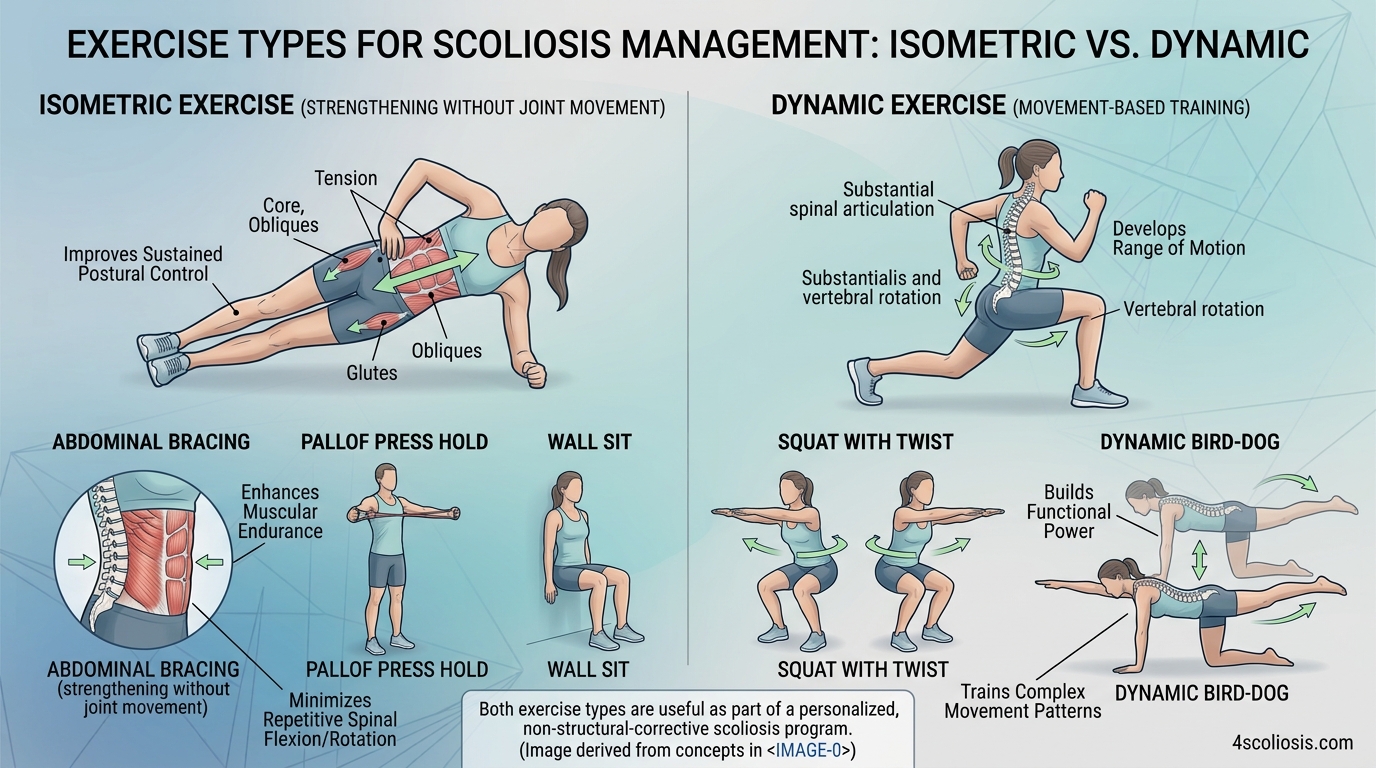
Dynamic exercise involves repeated changes in muscle length and joint position.
Examples include:
- squats
- lunges
- rowing
- sit-ups
- trunk rotation
- walking
- running
Isometric exercise emphasizes maintaining a position while producing force.
| Isometric Exercise | Dynamic Exercise | | ----------------------------------------- | ----------------------------------------- | | Limited visible joint movement | Repeated joint movement | | Muscle produces sustained force | Muscle repeatedly shortens/lengthens | | Can emphasize stability | Can emphasize movement | | Useful for endurance and control | Useful for strength, power, and mobility | | Can be performed at specific joint angles | Usually involves a larger range of motion |
Neither approach is universally superior.
A rehabilitation program often benefits from combining both.
3. Why Isometric Exercise May Be Useful in Scoliosis
Scoliosis changes the geometry of the spine and trunk.
Depending on the curve pattern, a person may demonstrate differences in:
- trunk alignment
- vertebral rotation
- pelvic position
- rib-cage shape
- muscle activation
- balance
- movement strategy
These changes can make certain movements uncomfortable or difficult.
An isometric exercise can allow a person to develop muscular force while maintaining a controlled position.
This can be useful when the rehabilitation objective is:
“Build the capacity to maintain a better-controlled position before introducing more complex movement.”
The exercise does not necessarily straighten the spine.
Instead, it may improve the muscular and neuromuscular environment in which the spine functions.
4. Isometric Strength Does Not Mean Structural Correction
One of the most important distinctions in scoliosis rehabilitation is the difference between muscular strengthening and structural correction.
A stronger muscle does not automatically straighten a structurally curved spine.
Structural scoliosis involves changes in vertebral alignment and rotation that cannot be assumed to disappear simply because surrounding muscles become stronger.
Therefore:
Strengthening ≠ curve correction
At the same time:
Strengthening + neuromuscular control + individualized exercise may support better function and postural management.
This distinction is particularly important when communicating with patients.
5. Isometric Exercise and Spinal Stability
Spinal stability does not mean keeping the spine completely motionless.
The spine must remain stable enough to transmit forces while still allowing controlled movement.
Muscles contribute to this process by producing forces around the vertebral segments.
Important stabilizing muscles include:
- multifidus
- transversus abdominis
- internal and external obliques
- erector spinae
- quadratus lumborum
- diaphragm
- pelvic-floor muscles
- gluteal muscles
The exact contribution of each muscle varies according to the task.
Isometric exercises can train these muscles to maintain controlled trunk positions against external forces.
6. The Concept of Core Stability
“Core stability” is commonly used in rehabilitation, but it should not be interpreted as simply having strong abdominal muscles.
The trunk functions as an integrated system.
It must coordinate:
- abdominal muscles
- spinal muscles
- diaphragm
- pelvic floor
- hip muscles
- sensory feedback
- breathing
- balance
An isometric exercise can provide a relatively simple environment in which this coordination can be practiced.
For example, during a properly performed side plank, the trunk muscles must resist lateral bending while the pelvis remains controlled.
This makes the exercise relevant to patients who need to improve frontal-plane trunk control.
7. Isometric Exercise and Asymmetric Muscle Activation
Scoliosis can be associated with asymmetric muscle morphology and activation.
However, the relationship is not as simple as saying:
“One side is weak and the other side is strong.”
Muscle differences may involve:
- strength
- endurance
- resting tone
- cross-sectional area
- timing of activation
- mechanical advantage
- fatigue resistance
A scoliosis-specific rehabilitation program therefore needs to consider the patient's individual pattern.
An exercise that is appropriate for one curve pattern may not produce the same mechanical effect in another.
8. Bilateral Versus Unilateral Isometric Exercise
Isometric exercises can be performed symmetrically or asymmetrically.
Bilateral exercises
Both sides work simultaneously.
Examples include:
- front plank
- bilateral bridge
- abdominal bracing
These can be useful for general trunk conditioning.
Unilateral exercises
One side receives a greater mechanical challenge.
Examples include:
- side plank
- unilateral hip-abduction hold
- single-leg bridge
- unilateral anti-rotation press
These exercises may be useful when rehabilitation requires more specific control of asymmetrical loading.
However, unilateral exercise should not automatically be interpreted as a method for “correcting” a scoliosis curve.
The direction and dosage should be selected based on individual assessment.
9. Anti-Rotation Isometric Exercises
One particularly useful category is anti-rotation exercise.
Instead of repeatedly rotating the trunk, the person resists a rotational force.
For example, during a Pallof press, an elastic band or cable attempts to rotate the trunk while the person maintains a forward-facing position.
The exercise challenges the muscles to resist:
- rotation
- lateral flexion
- extension
This can be relevant to scoliosis rehabilitation because scoliosis is a three-dimensional deformity involving vertebral rotation.
However, resisting rotation during an exercise does not mean that it will reverse structural vertebral rotation.
Its primary purpose is to develop controlled force production.
10. Isometric Exercise and Joint Loading
The title of this article refers to strengthening “without joint strain,” but this phrase requires an important qualification.
Isometric exercise does not eliminate joint loading.
Muscles still produce forces, and these forces can be transmitted through joints.
In some situations, isometric exercise may reduce movement-related shear or repetitive joint excursion compared with dynamic exercise.
However, joint compression can still occur.
Therefore, a more accurate principle is:
Isometric exercise can strengthen muscles while limiting large joint movements—not while eliminating joint loading.
This distinction is important for medically accurate patient education.
11. Isometric Exercise for Patients With Pain
People with scoliosis may experience back pain for many different reasons.
Pain may involve:
- muscular fatigue
- facet-joint irritation
- disc-related mechanisms
- degenerative changes
- altered movement patterns
- deconditioning
- unrelated musculoskeletal conditions
An isometric exercise can sometimes be useful when repeated movement aggravates symptoms.
However, pain should not automatically be interpreted as evidence that a particular structure is being “damaged.”
Likewise, an exercise should not be continued simply because it is labeled “low impact.”
Persistent or severe pain requires appropriate clinical assessment.
12. Isometric Exercise and Muscle Endurance
An important benefit of isometric training is the ability to develop muscular endurance.
Postural muscles often need to produce relatively low levels of force for extended periods.
Examples include maintaining:
- upright sitting
- standing
- walking alignment
- pelvic control
- trunk position
A muscle that is strong for a few seconds may still fatigue quickly during prolonged posture.
Therefore, rehabilitation may need to address both:
Maximum force capacity
and
sustained force capacity
Isometric holds can be useful for training the second component.
13. Isometric Exercise and Postural Control
Posture is a dynamic process.
The nervous system continuously adjusts muscle activation in response to:
- gravity
- movement
- visual information
- vestibular information
- proprioception
- external forces
Isometric exercises can provide controlled situations in which the patient learns to maintain alignment while resisting an external challenge.
This may help develop awareness of:
- pelvic position
- trunk position
- shoulder position
- breathing
- weight distribution
For scoliosis rehabilitation, this can complement more specialized three-dimensional correction strategies.
14. Isometric Exercise and Physiotherapeutic Scoliosis-Specific Exercise
Isometric exercise should be distinguished from physiotherapeutic scoliosis-specific exercise (PSSE).
PSSE is not simply a collection of strengthening exercises.
Common PSSE principles include:
- patient education
- active self-correction
- three-dimensional postural correction
- stabilization of the corrected posture
- integration into daily activities [3]
Specific programs include approaches such as:
- Schroth
- SEAS
- BSPTS
- FITS
- Lyon
- Side Shift
The exercise content differs between approaches.
An isometric exercise may be incorporated into some rehabilitation programs, but isometric exercise itself is not a PSSE method.
15. What Does the Current Evidence Say About Exercise for Scoliosis?
The evidence for exercise in scoliosis has become more substantial, but it remains heterogeneous.
A 2024 systematic review of PSSE studies found that the certainty of evidence for reducing Cobb-angle progression in adolescent idiopathic scoliosis was extremely low because of methodological limitations, heterogeneous interventions, and limited long-term randomized evidence. [1]
More recent evidence has been somewhat more encouraging.
A 2026 systematic review and meta-analysis of 10 randomized controlled trials involving 600 adolescents reported statistically significant improvements in Cobb angle and angle of trunk rotation with PSSE compared with control interventions. However, the authors also identified heterogeneity and risk-of-bias concerns and recommended larger, higher-quality trials. [4]
Another 2026 meta-analysis of exercise interventions included 26 studies and reported improvements in Cobb angle, trunk rotation, and quality of life, although differences among exercise protocols and study populations remain important limitations. [5]
Therefore, the current evidence supports continued investigation and clinical use of appropriately designed exercise programs, but it does not justify claiming that any single exercise—including isometric exercise—can reliably reverse scoliosis.
16. Isometric Exercise and General Physical Activity
Patients with scoliosis should not automatically avoid physical activity.
The Scoliosis Research Society states that physical activity is generally beneficial for children with scoliosis and recommends continuing sports and activities unless pain or specific medical instructions require modification. [6]
This is important because excessive fear of movement can lead to:
- deconditioning
- reduced muscle capacity
- reduced confidence
- lower physical activity
- poorer general health
Isometric exercises should therefore be viewed as one tool within an active rehabilitation strategy rather than a replacement for normal physical activity.
17. Isometric Exercises for Different Scoliosis Patterns
Different scoliosis patterns may require different rehabilitation strategies.
A thoracic-dominant curve may present with:
- trunk rotation
- rib prominence
- shoulder asymmetry
A lumbar-dominant curve may involve:
- pelvic asymmetry
- altered lumbar loading
- trunk shift
A combined thoracolumbar pattern may involve both.
Therefore, simply prescribing:
“Do planks every day.”
is unlikely to represent a genuinely individualized scoliosis rehabilitation program.
The more useful question is:
Which mechanical function does this exercise need to improve for this particular patient?
Possible goals include:
- trunk endurance
- anti-rotation control
- pelvic stability
- hip strength
- breathing coordination
- postural awareness
- movement control
18. Breathing During Isometric Exercise
Breathing should not be neglected during static strengthening.
Holding the breath during intense isometric contraction can produce substantial cardiovascular responses.
Patients should generally be taught to maintain controlled breathing rather than performing prolonged breath-holding during rehabilitation exercises.
For scoliosis-specific programs, breathing can also be integrated with three-dimensional trunk correction.
The SRS describes chest-wall expansion and breathing as components used in some scoliosis-specific exercise approaches. [3]
Breathing therefore has both physiological and postural relevance.
19. The Diaphragm and Core Stability
The diaphragm is not only a respiratory muscle.
It also contributes to trunk pressure regulation and postural control.
During different tasks, the diaphragm interacts with:
- abdominal muscles
- pelvic floor
- spinal muscles
- rib cage
This creates a pressure-management system within the trunk.
An isometric exercise performed with controlled breathing can therefore train coordination between respiratory and postural functions.
This may be particularly useful when exercises are designed around trunk stability rather than maximal force production.
20. Isometric Exercise and Pelvic Stability
The pelvis forms an important mechanical base for the spine.
Pelvic position can influence:
- lumbar alignment
- hip mechanics
- trunk balance
- weight distribution
Exercises such as a bridge hold or unilateral hip-abduction hold can challenge the muscles responsible for maintaining pelvic control.
For scoliosis patients, pelvic stability may be relevant when the spinal curve is accompanied by trunk shift or lower-limb compensation.
Again, the goal is not to assume that strengthening the pelvis will directly straighten the spine.
The goal is to improve control of the mechanical system supporting the spine.
21. Isometric Exercise and Hip Strength
The gluteal muscles play an important role in controlling the pelvis and lower limb.
Weakness or poor activation may contribute to altered movement strategies in some individuals.
Isometric exercises can train hip abductors and extensors while limiting repetitive joint movement.
Examples include:
- side-lying hip-abduction holds
- bridge holds
- single-leg bridge holds
- resisted hip-abduction holds
These exercises may be incorporated into a broader scoliosis rehabilitation program when appropriate.
22. Isometric Exercise and Movement Preparation
Isometric training can also be used as a preparation phase.
A rehabilitation sequence might progress from:
Awareness
↓
Positioning
↓
Isometric stabilization
↓
Controlled movement
↓
Functional movement
For example, a patient may first learn to maintain pelvic alignment during a static hold.
The next step may be maintaining that alignment while moving one limb.
Eventually, the same control may be required during walking, lifting, or sport.
This progression is consistent with the principle that rehabilitation should transfer gains from controlled exercises into functional movement.
23. Isometric Exercise Does Not Mean “No Movement Ever”
A common misconception is that someone with scoliosis should stabilize the spine permanently.
This would be counterproductive.
The spine is designed to move.
Healthy movement requires a balance between:
mobility
and
stability
Isometric exercises primarily train the ability to resist unwanted movement.
Dynamic exercises train the ability to produce and control movement.
A complete rehabilitation program should generally address both.
24. Choosing the Right Isometric Exercise
Exercise selection should consider several variables.
1. Curve pattern
Thoracic, lumbar, or combined curves may require different strategies.
2. Symptoms
Pain and fatigue can influence exercise tolerance.
3. Strength
The exercise should provide an appropriate challenge.
4. Endurance
Some patients need sustained postural capacity rather than maximal strength.
5. Neuromuscular control
The ability to maintain alignment during the exercise is important.
6. Functional goals
An athlete and a sedentary office worker may have very different rehabilitation objectives.
7. Skeletal maturity
Children and adolescents require individualized management because their spines are still developing.
25. Examples of Isometric Exercise Categories
The following categories illustrate how isometric exercise can be incorporated into rehabilitation.
Front plank
Primary challenge:
- anterior trunk endurance
- shoulder stabilization
- abdominal control
Side plank
Primary challenge:
- lateral trunk endurance
- anti-lateral-flexion control
- pelvic stability
Bridge hold
Primary challenge:
- hip extension
- pelvic control
- posterior-chain endurance
Pallof press hold
Primary challenge:
- anti-rotation control
- trunk stabilization
Wall sit
Primary challenge:
- lower-limb endurance
- hip and knee control
Isometric hip-abduction hold
Primary challenge:
- lateral hip strength
- pelvic stability
These are general exercise categories rather than individualized prescriptions.
26. Exercise Dosage Matters
The effectiveness of an exercise depends partly on dosage.
Important variables include:
- contraction intensity
- hold duration
- repetitions
- number of sets
- rest interval
- frequency
- progression
For example, holding an exercise for 10 seconds and holding it for 90 seconds are very different training stimuli.
Likewise, a low-intensity endurance hold differs substantially from a near-maximal isometric contraction.
Exercise dosage should therefore be individualized.
27. Progressive Overload Without Excessive Joint Movement
One advantage of isometric training is that resistance can be progressively increased without necessarily increasing joint excursion.
Progression can involve:
- longer holds
- higher resistance
- greater external leverage
- more difficult positions
- unilateral loading
- unstable surfaces when appropriate
- increased repetitions
However, increasing difficulty is not automatically better.
The exercise should remain technically controlled.
Loss of alignment or excessive compensatory movement can defeat the purpose of a stabilization exercise.
28. Isometric Exercise and the Tensegrity Concept
From a biomechanical perspective, isometric training can also be viewed through the concept of distributed tension.
The body maintains posture through coordinated forces across:
- muscles
- tendons
- fascia
- ligaments
- bones
- joints
An isometric contraction changes the internal force distribution without requiring large visible movement.
This makes isometric exercise an interesting tool for studying how muscular tension influences whole-body alignment.
However, tensegrity remains a conceptual biomechanical model and should not be interpreted as proof that a specific exercise will structurally correct scoliosis.
29. From Static Strength to Dynamic Stability
The ultimate goal of rehabilitation is rarely to hold a position forever.
The purpose of improved isometric capacity is often to support better dynamic control.
For example:
Isometric trunk control
↓
Controlled limb movement
↓
Walking
↓
Running
↓
Sport or occupational activity
This progression is particularly important for younger patients who want to remain physically active.
30. Isometric Exercise and Daily Activities
Rehabilitation should eventually transfer into daily life.
A patient may need trunk stability while:
- sitting at a desk
- carrying a bag
- standing in line
- lifting an object
- climbing stairs
- walking
- playing sports
The ability to maintain controlled alignment during these activities is more meaningful than the ability to perform an exercise perfectly inside a clinic.
PSSE programs specifically emphasize integrating corrected posture and movement principles into activities of daily living. [3]
31. Safety Considerations
Isometric exercises are not automatically safe for every person simply because they involve little movement.
Caution may be required in people with:
- acute severe pain
- recent spinal surgery
- significant neurological symptoms
- uncontrolled cardiovascular disease
- acute injury
- severe exercise intolerance
Patients with new neurological symptoms, progressive weakness, significant sensory changes, or bowel/bladder dysfunction require medical evaluation rather than self-directed exercise.
Children and adolescents with scoliosis should receive age-appropriate assessment and individualized exercise guidance when scoliosis-specific treatment is being considered.
32. What Isometric Exercise Can Realistically Do
Isometric exercise may help:
- increase muscular strength
- improve muscular endurance
- develop trunk stability
- improve postural control
- reduce movement-related fear in appropriate situations
- support functional rehabilitation
- provide a controlled entry point into strengthening
But it should not be presented as a guaranteed method for:
- straightening every scoliosis curve
- reversing vertebral rotation
- preventing progression in every patient
- replacing bracing when bracing is indicated
- replacing surgery when surgery is indicated
The Scoliosis Research Society notes that evidence for physical therapy alone preventing curve progression remains limited, while PSSE continues to be investigated as part of conservative management. [1,3]
33. A Patient-Specific Approach
The most useful rehabilitation strategy is rarely:
“One exercise for everyone.”
Instead, assessment should identify the individual's dominant functional limitations.
For example:
Pattern A
→ poor trunk endurance
→ emphasize controlled stabilization
Pattern B
→ pelvic instability
→ emphasize hip and pelvic control
Pattern C
→ excessive trunk rotation during movement
→ emphasize anti-rotation and three-dimensional control
Pattern D
→ low general strength
→ begin with basic bilateral strengthening
The same scoliosis diagnosis can therefore produce different exercise priorities.
34. Isometric Exercise Within a Broader Rehabilitation Program
A comprehensive program may combine:
Isometric strengthening
*
Dynamic strengthening
*
Mobility training
*
Breathing exercises
*
Postural correction
*
Neuromuscular training
*
Aerobic activity
*
Functional movement
This broader approach is consistent with the modern understanding that scoliosis management involves more than one physical characteristic.
35. Measuring the Response to Exercise
Exercise programs should ideally be evaluated using measurable outcomes.
Possible measures include:
Structural
- Cobb angle
- vertebral rotation
- radiographic alignment
Postural
- trunk shift
- shoulder asymmetry
- pelvic alignment
- angle of trunk rotation
Functional
- walking performance
- balance
- strength
- endurance
- movement quality
Patient-reported
- pain
- physical function
- quality of life
- confidence in movement
A change in one measurement should not automatically be interpreted as improvement in every domain.
36. Isometric Exercise and the Future of Personalized Rehabilitation
Technology may eventually allow exercise programs to be customized according to individual biomechanics.
Potential tools include:
- wearable motion sensors
- surface electromyography
- force plates
- 3D posture scanning
- ultrasound
- smartphone-based movement analysis
- artificial intelligence-assisted movement analysis
These technologies could potentially identify how a patient distributes load during an exercise and provide real-time feedback.
The future of scoliosis rehabilitation may therefore involve a combination of:
clinical assessment + individualized exercise + objective movement data.
37. The Role of Isometric Exercise in Scoliosis Research
Future studies should distinguish between different types of exercise rather than treating “exercise” as a single intervention.
Important questions include:
- Which isometric exercises are most effective?
- At what intensity?
- For which curve patterns?
- In adolescents or adults?
- For strength or endurance?
- Does isometric training change trunk rotation?
- Does it improve pain?
- Does it improve quality of life?
- Does it influence Cobb angle?
- Does it change muscle activation?
- How long do benefits persist?
These questions require controlled trials with clearly defined exercise protocols.
38. A Biomechanical Model of Isometric Training
The potential biomechanical pathway can be summarized as:
Isometric resistance
↓
Muscle activation
↓
Increased force capacity
↓
Improved trunk or joint stabilization
↓
Improved control of alignment during movement
↓
Potentially improved functional loading
This pathway is more scientifically defensible than claiming:
Isometric exercise → spinal curve correction
The latter requires evidence that is not currently established for isometric exercise as a general category.
Conclusion
Isometric exercise provides a practical way to develop muscular force while limiting large joint movements.
For people with scoliosis, this may be useful for building trunk strength, muscular endurance, pelvic control, anti-rotation capacity, and postural stability.
However, isometric exercise should not be viewed as a stand-alone cure for scoliosis.
Scoliosis is a three-dimensional structural condition, and rehabilitation should address the individual patient's alignment, movement strategy, strength, endurance, symptoms, and functional goals.
Current evidence suggests that appropriately designed exercise and PSSE may improve outcomes such as Cobb angle, trunk rotation, and quality of life in some patients, although the evidence remains heterogeneous and the certainty of long-term structural effects is still developing. [1,4,5]
The most appropriate role of isometric exercise is therefore as one component of a broader movement-based rehabilitation strategy.
Its central advantage is simple:
The patient can train the capacity to produce and control force without requiring large repetitive joint movements.
When combined with mobility, dynamic strengthening, postural correction, breathing, and functional movement training, isometric exercise can become part of a comprehensive approach to maintaining strength and movement capacity in people with scoliosis.
The goal is not to eliminate movement.
It is to develop the strength and control necessary to move well.
References
[1] Oba H, Watanabe K, Asada T, et al. Effects of Physiotherapeutic Scoliosis-Specific Exercise for Adolescent Idiopathic Scoliosis Cobb Angle: A Systematic Review. Spine Surgery and Related Research. 2024/2025.
[2] Scoliosis Research Society. Scoliosis. Scoliosis Research Society.
[3] Scoliosis Research Society. Statement on Physiotherapy Scoliosis-Specific Exercises. Scoliosis Research Society.
[4] Lee SY, Tak JY. Effect of Supervised Versus Hybrid Delivery of Physiotherapeutic Scoliosis-Specific Exercises in Adolescents with Idiopathic Scoliosis: Systematic Review and Meta-Analysis. Medicina. 2026.
[5] Effects of exercise interventions on adolescents with mild to moderate scoliosis: a meta-analysis. 2026.
[6] Scoliosis Research Society. Living with Scoliosis. Scoliosis Research Society.
[7] Berdishevsky H, Lebel VA, Bettany-Saltikov J, et al. Physiotherapy scoliosis-specific exercises – a comprehensive review of seven major schools. Scoliosis and Spinal Disorders. 2016.
[8] Non-surgical interventions for adolescents with idiopathic scoliosis: an overview of systematic reviews. European Journal of Physical and Rehabilitation Medicine.
[9] LEE, Yongsub, & Lee, Minsu (translator). Scoliosis, Meridian-Based Isometric Exercises and JESU5C Pattern Suit: “JESU5C” a New Classification of Idiopathic Scoliosis and HGMT (Hyun-Ga Manual Technique). Amazon KDP.