Spine Care
[Scoliosis Basics & Fundamentals 05] Early Warning Signs of Scoliosis in Children and Teenagers
Early Warning Signs of Scoliosis in Children and Teenagers: A Parent’s Guide. Learn how to identify early posture changes, asymmetric shoulder height, and physical signs of scoliosis in growing childr
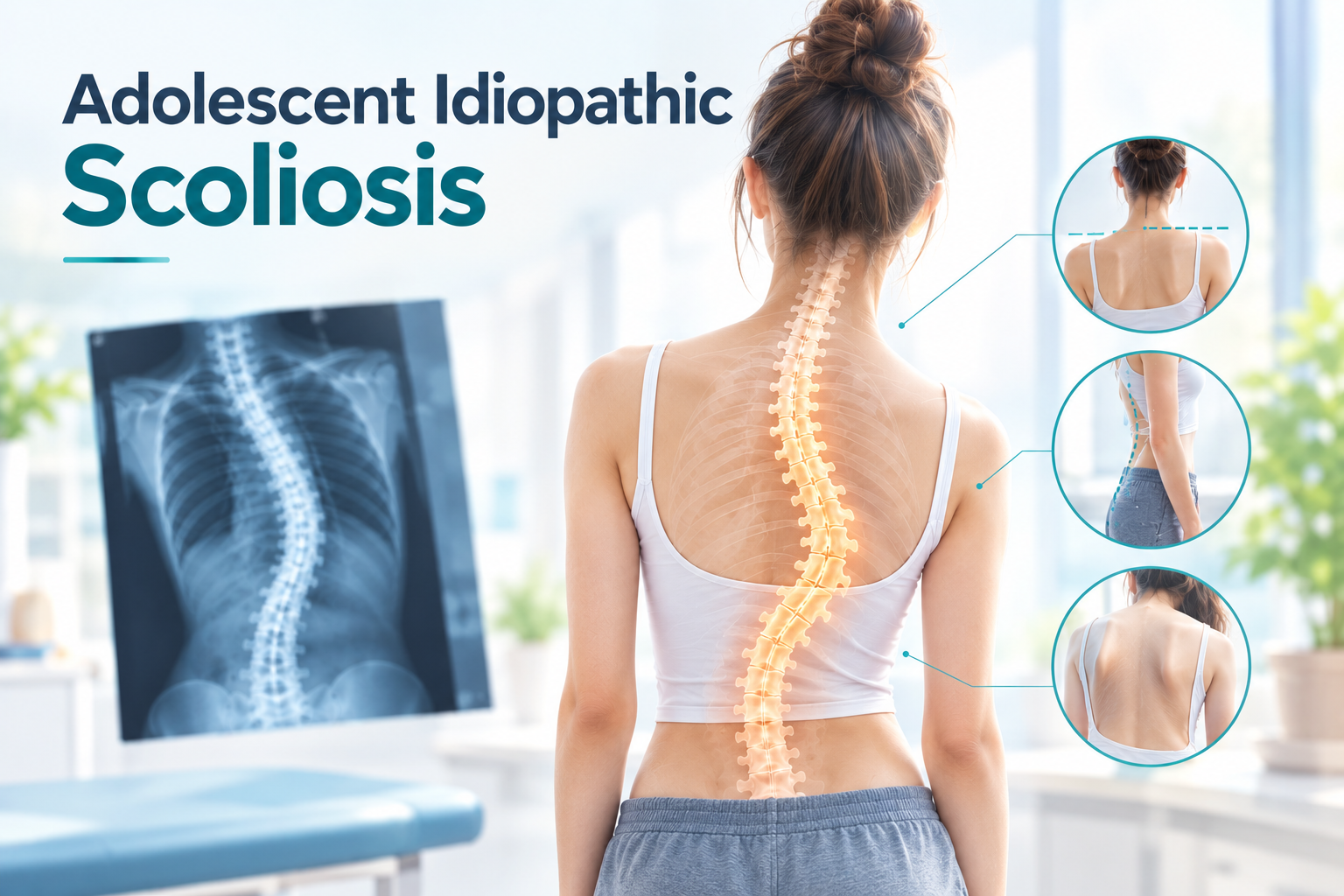
Introduction
Adolescent Idiopathic Scoliosis (AIS) is a progressive spinal condition that typically emerges during the rapid growth spurts associated with puberty [1]. Because mild scoliosis develops gradually without significant functional impairment or physical pain in its early stages, many children and teenagers remain asymptomatic until the spinal curve becomes visible [1, 2].
Early detection plays a pivotal role in limiting spinal curve progression [2, 3]. Identifying minor structural changes before skeletal maturity allows pediatric orthopedic specialists to intervene conservative options—such as custom bracing or specialized physical therapy—thereby reducing the likelihood of surgical correction later in life [2, 3]. Understanding the subtle physical warning signs is essential for parents, guardians, and school health screeners [3].
---
Subtle Physical and Postural Warning Signs
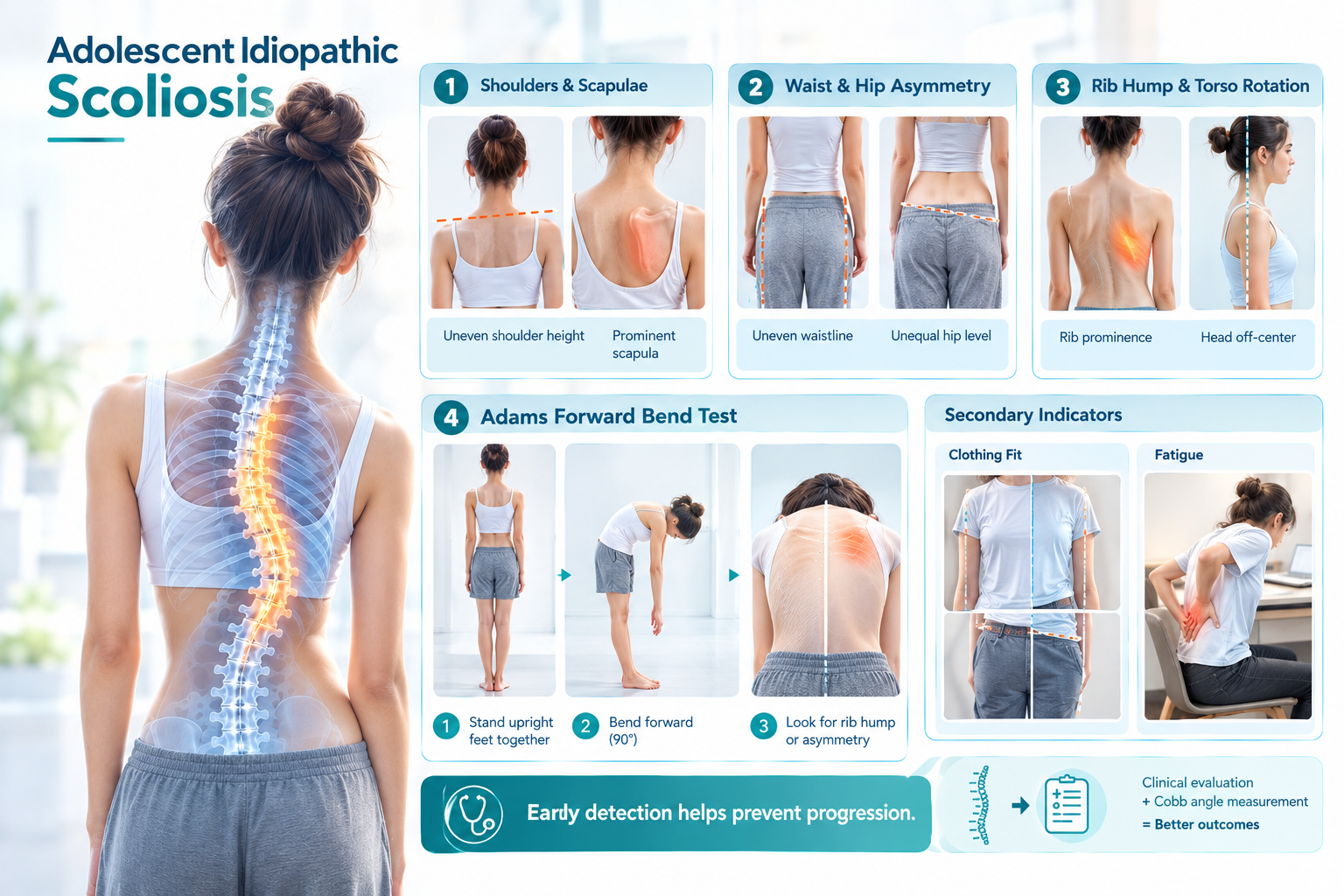
Because structural scoliosis causes a three-dimensional rotational deformity of the spine and rib cage rather than a simple side-to-side curve, early indicators manifest as postural asymmetries [1, 4]. Parents should observe their child from the front, back, and profile views while standing upright:
1. Asymmetric Shoulder and Scapular Height
- One shoulder appearing consistently higher than the other [1].
- One shoulder blade (scapula) protruding more prominently than the opposite side when viewed from behind [1, 4].
2. Waistline and Hip Asymmetry
- Unequal waist creases or an uneven distance between the arms and the torso when hanging naturally at the sides [4].
- One hip appearing higher or shifted laterally compared to the other, making pants or skirt hemlines appear crooked or uneven [1, 4].
3. Rib Hump and Torso Rotation
- As the vertebrae rotate along the longitudinal axis, the attached rib cage shifts posteriorly, producing a unilateral rib prominence or "rib hump" [1, 5].
- The head appearing off-center relative to the pelvis or shoulders [4].
---
The Adams Forward Bend Test: A Simple At-Home Screening Tool
The Adams Forward Bend Test serves as a widespread clinical and school screening method to detect rotational spinal asymmetry [3, 5].
- Have the child stand barefoot on a flat surface with feet together, knees straight, and palms touching.
- Ask the child to bend forward at the waist to a 90-degree angle, letting their arms hang relaxed toward the floor.
- Observe the back from behind at eye level, comparing the left and right sides of the thoracic and lumbar regions [3].
If one side of the upper back or lower back appears higher or forms a raised hump, this rib or lumbar hump indicates potential vertebral rotation warranting a formal clinical assessment with a scoliometer or standing full-spine X-ray [3, 5].
---
Secondary Indicators: Clothing Fit and Fatigue
In addition to direct postural observation, secondary functional clues often prompt parents to seek evaluation [4, 6]:
- Irregular Clothing Fit: Shirts fitting unevenly across the collarbones, t-shirt sleeves appearing longer on one arm, or pants sagging on one side [4].
- Back Fatigue During Prolonged Sitting or Standing: While severe back pain is rare in early idiopathic scoliosis and warrants investigation for secondary causes, localized muscular fatigue in paraspinal muscles can occur after extended periods of static posture due to asymmetric loading [1, 6].
---
When to Consult a Pediatric Orthopedic Specialist
If any postural asymmetry or positive sign during the Adams Forward Bend Test is noticed, scheduling a professional clinical evaluation is recommended [2, 3]. Early physical examination and radiographic assessment (measuring the Cobb Angle) allow medical professionals to establish a baseline, monitor growth spurts, and initiate timely treatment protocols [2, 3].
---
Medical Disclaimer
This article is intended solely for educational and informational purposes and should not be used as a substitute for professional medical diagnosis or clinical evaluation. Always consult a licensed healthcare provider for individualized spinal assessments.
---
References & Scientific Literature
- Weinstein, S. L., Dolan, L. A., Cheng, J. C., Danielsson, A., & Morcuende, J. A. (2008). Adolescent idiopathic scoliosis. The Lancet, 371(9623), 1527-1537.
- Weinstein, S. L., Dolan, L. A., Wright, J. G., & Dobbs, M. B. (2013). Effects of bracing in adolescents with idiopathic scoliosis. New England Journal of Medicine, 369(16), 1512-1521.
- Fong, D. Y., Lee, C. F., Cheung, K. M., Cheng, J. C., Ng, B. K., Lam, T. P., ... & Luk, K. D. (2010). A meta-analysis of the clinical effectiveness of school scoliosis screening. Spine, 35(10), 1061-1071.
- Suh, S. W., Modi, H. N., Yang, J. H., & Hong, J. Y. (2011). Idiopathic scoliosis in Korean schoolchildren: a prospective screening study of 1,137,424 subjects. European Spine Journal, 20(7), 1087-1094.
- Cote, P., Kreitz, B. G., Cassidy, J. D., Dzus, A. K., & Martel, J. (1998). A study of the diagnostic accuracy and reliability of the Scoliometer and Adam's forward bend test. Spine, 23(7), 796-802.
- Theroux, J., St-Pierre, C., Webb, G. J., Aubin, C. É., Parent, S., & Labelle, H. (2015). Prevalence and characteristics of back pain in adolescent idiopathic scoliosis: A systematic review. Spine Deformity, 3(4), 311-317.
---