Spine Care
[Biomechanics, Tensegrity & Meridian Concepts 09] Dynamic Tension vs. Rigid Fixation in Spinal Correction
Dynamic tension and rigid fixation use fundamentally different strategies for spinal correction.
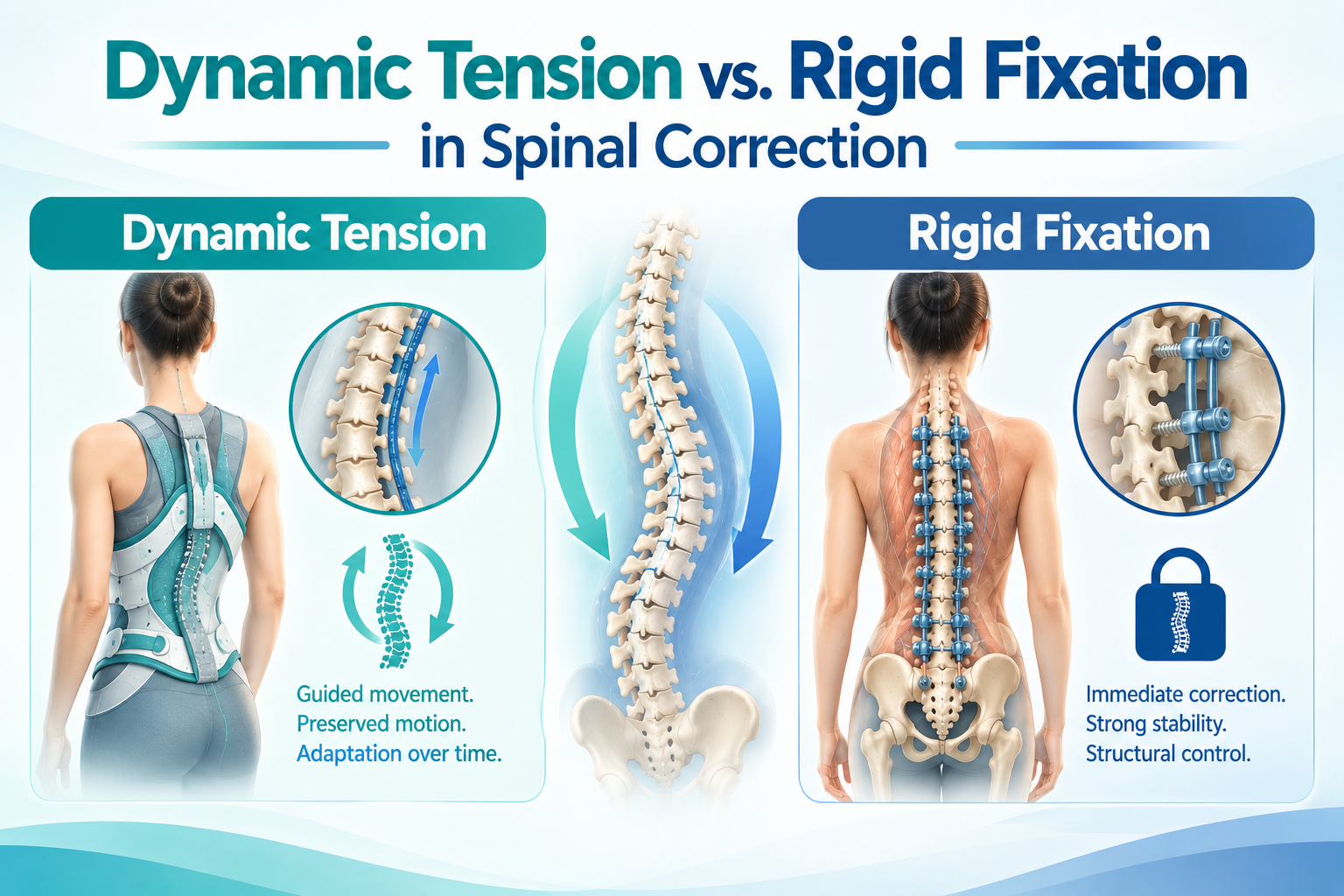
Understanding how each distributes force helps explain bracing, fusion, and motion-preserving scoliosis treatment.
Introduction
Spinal correction can be approached in two fundamentally different ways: rigid fixation, which attempts to hold the spine in a corrected position, and dynamic tension, which applies controlled forces while allowing some movement or adaptation.
This distinction is particularly important in scoliosis. A scoliotic spine is not simply a spine that bends sideways. It is a three-dimensional deformity involving coronal curvature, vertebral rotation, and changes in sagittal alignment. Therefore, correcting scoliosis requires more than simply pushing the spine toward a straighter position. The way corrective forces are applied—and how the spine is allowed to respond to those forces—may influence both immediate correction and long-term adaptation. [1]
Rigid fixation is most familiar in spinal fusion surgery, where screws, rods, and other implants are used to achieve substantial deformity correction and stabilize the corrected position. Dynamic strategies, in contrast, attempt to preserve some motion, distribute loads differently, or use controlled tension to influence spinal alignment over time. [2]
These approaches should not be understood as simply "good" versus "bad." Each has a different biomechanical purpose, and the appropriate strategy depends on the patient's age, skeletal maturity, curve characteristics, flexibility, symptoms, and treatment goals.
---
What Is Rigid Fixation?
Rigid fixation is a method of mechanically stabilizing spinal segments so that they move very little relative to one another.
In spinal deformity surgery, pedicle screws and rods can create powerful corrective forces through combinations of:
- compression
- distraction
- rod derotation
- translation
- segmental fixation
- three-dimensional manipulation
Once fusion occurs, the instrumented vertebrae are intended to function as a mechanically consolidated segment rather than as individually mobile motion segments.
This approach can produce substantial immediate correction. However, the correction comes with a fundamental trade-off: the corrected region loses normal motion and growth potential when the involved segments are fused. [2]
Rigid fixation therefore prioritizes:
Immediate structural stability and powerful deformity correction.
It is particularly important when a spinal deformity is severe, progressive, or no longer sufficiently flexible for nonoperative treatment.
---
What Is Dynamic Tension?
Dynamic tension takes a different approach.
Rather than attempting to completely immobilize a region, a dynamic system applies a controlled tensile or compressive force while permitting some degree of movement or adaptation.
The principle can be illustrated simply:
Rigid fixation
Correct → Fix → Stabilize
Dynamic tension
Load → Adapt → Rebalance → Continue to move
The objective is not necessarily to force the spine into one fixed position. Instead, the goal may be to influence how forces are distributed across the spine while preserving some physiological movement.
This concept appears in several different areas of spinal treatment, including:
- soft or flexible bracing
- dynamic orthotic systems
- growth-modulating tethering
- fusionless scoliosis correction
- dynamic spinal stabilization
- rehabilitation approaches that use active muscular forces
Importantly, these techniques are not equivalent. A soft brace, a vertebral body tether, and a dynamic spinal implant operate through very different mechanisms.
---
The Fundamental Biomechanical Difference
The simplest distinction is constraint versus controlled freedom.
| Feature | Rigid fixation | Dynamic tension | | -------------------- | --------------------------------------- | --------------------------------------------- | | Primary strategy | Stabilize corrected position | Guide movement or adaptation | | Motion | Strongly restricted | Partially preserved | | Force application | Often high and mechanically constrained | Controlled and responsive | | Immediate correction | Usually substantial | Variable | | Long-term adaptation | Less dependent on growth | May depend on growth or remodeling | | Fusion | Common in rigid surgical correction | Usually designed to avoid fusion | | Growth potential | Reduced in fused segments | May be preserved | | Load sharing | Can shift loads to adjacent regions | May allow greater load sharing | | Main objective | Structural correction and stability | Correction while preserving motion/adaptation |
This comparison is conceptual rather than a statement that one strategy is universally superior.
---
Why Movement Matters in the Spine
The spine is designed to move.
Normal spinal function requires controlled movement in:
- flexion
- extension
- lateral bending
- axial rotation
Movement also permits the distribution of mechanical loads between the vertebral bodies, intervertebral discs, facet joints, ligaments, and muscles.
Biomechanical studies of dynamic versus rigid spinal constructs demonstrate this distinction clearly. In one cadaveric study, a hinged dynamic pedicle screw system allowed substantially more range of motion than a standard rigid screw-rod construct while still restricting motion compared with an intact spine. The dynamic construct also changed the mechanical loading experienced by the instrumentation. [3]
This illustrates an important principle:
Dynamic does not mean uncontrolled.
A dynamic system can restrict excessive movement while still permitting a controlled amount of physiological motion.
---
Rigid Fixation: The Advantage of Immediate Correction
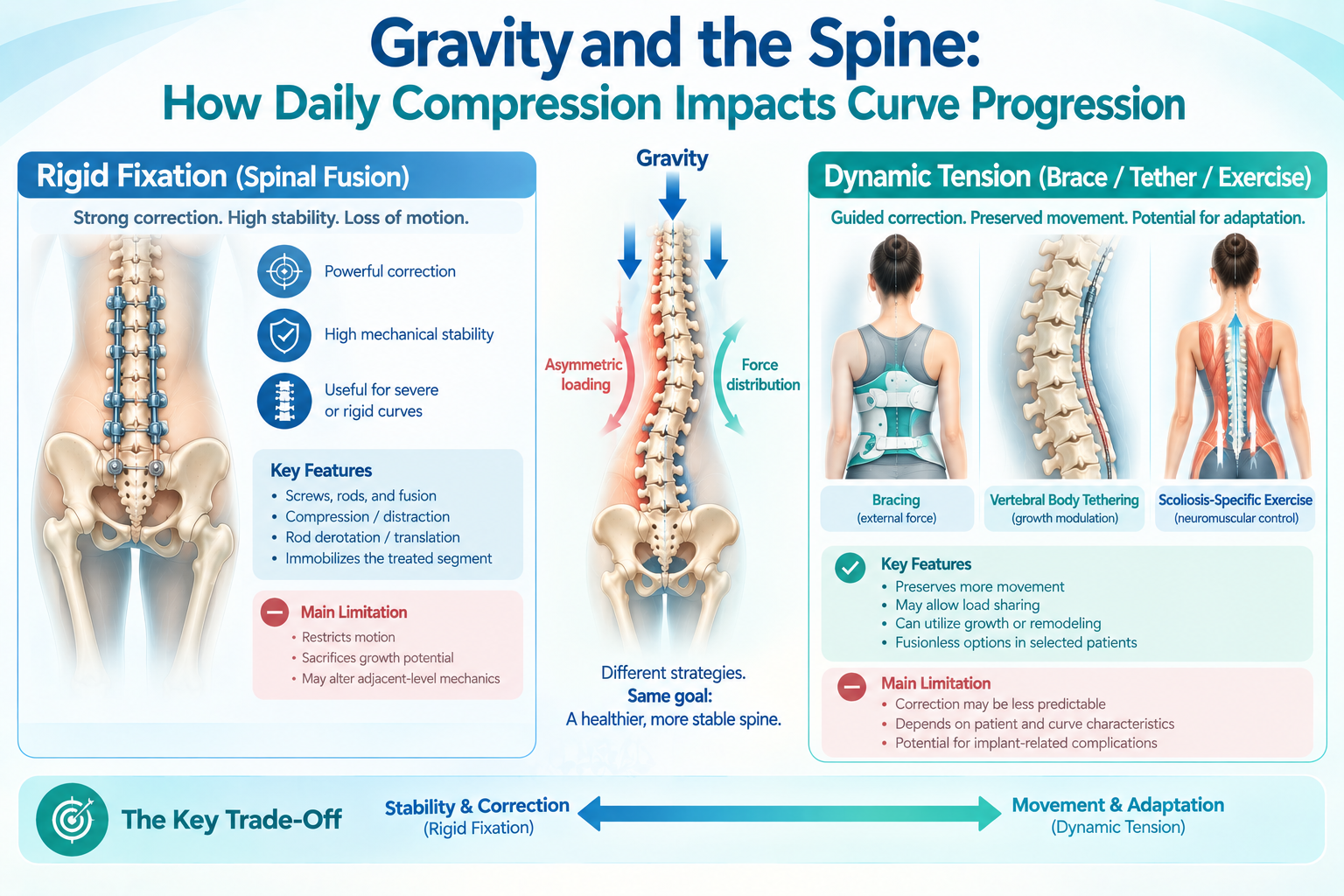
One of the major strengths of rigid fixation is its ability to produce powerful immediate correction.
During spinal deformity surgery, instrumentation can apply forces directly to vertebrae. Surgeons can manipulate the spine in multiple planes, including:
- coronal correction
- axial derotation
- sagittal contour restoration
- translation
- segmental compression or distraction
This is particularly valuable for large or rigid curves.
However, rigid fixation changes the mechanical environment of the spine. When multiple motion segments are immobilized, forces and motion that would previously have been distributed across those segments may be redistributed to adjacent levels.
Biomechanical investigations of rigid versus dynamic stabilization have demonstrated differences in implant loading, spinal motion, and adjacent-level mechanical behavior. [3][4]
Therefore, rigid fixation solves one biomechanical problem—instability or deformity—while potentially creating a different mechanical environment that must be considered over the long term.
---
Dynamic Tension: Correction Without Complete Immobilization
Dynamic correction attempts to use mechanical forces without completely eliminating spinal movement.
One of the clearest examples in scoliosis is vertebral body tethering (VBT).
VBT uses a flexible tether attached along the convex side of the vertebral bodies. In skeletally immature patients, the system is intended not merely to bend the spine mechanically but also to influence subsequent vertebral growth.
The theoretical mechanism involves applying compression to the convex and anterior portions of the vertebral bodies, allowing differential growth to gradually contribute to correction. This approach is related to the Hueter-Volkmann principle. [5][6]
Thus, VBT illustrates a fundamentally different concept:
The correction can continue to evolve after the procedure rather than being produced entirely at the moment of surgery.
However, VBT is an advanced surgical treatment with specific indications and important complications. It should not be interpreted as proof that all dynamic tension systems are superior to fusion.
---
Dynamic Tension and Growth Modulation
Growth introduces another important distinction.
A rigid fusion construct essentially establishes a mechanical correction and then prevents movement and growth across the fused segments.
A growth-modulating system attempts to use the patient's remaining growth as part of the correction process.
This is particularly relevant to skeletally immature patients with progressive scoliosis.
VBT is designed around this concept. By applying asymmetric mechanical loading, the system attempts to influence vertebral growth and progressively reduce the deformity. Early systematic reviews have demonstrated meaningful curve reduction in selected patients, while also reporting complications such as tether breakage, overcorrection, pulmonary complications, and revision surgery. [6][7]
A 2023 systematic review and meta-analysis found that VBT significantly reduced Cobb angle at follow-up, but also reported an overall complication rate of approximately 23%, with tether breakage being the most common complication. [7]
Therefore:
Dynamic correction can preserve growth and motion, but it introduces its own mechanical uncertainties.
---
Dynamic Bracing vs. Rigid Bracing
The same conceptual difference appears in nonsurgical scoliosis treatment.
Traditional rigid braces apply external forces to the trunk and spine to resist curve progression. Their effectiveness in appropriately selected adolescents with idiopathic scoliosis is supported by clinical evidence. [8]
Soft and dynamic braces attempt to achieve correction with greater flexibility and potentially greater comfort.
However, the current evidence does not show that dynamic or soft bracing is universally superior to rigid bracing.
A systematic review and meta-analysis comparing different brace concepts found that rigid braces generally demonstrated higher success rates than soft braces, although the literature had substantial methodological limitations. [9]
A newer 2026 meta-analysis similarly reported short-term effectiveness of soft bracing in mild-to-moderate AIS, but found lower success compared with rigid bracing despite greater comfort and longer daily wearing time. [10]
This leads to an important distinction:
Preserving movement is not automatically equivalent to achieving better scoliosis correction.
The mechanical objective must be matched to the clinical problem.
---
Dynamic Tension Does Not Mean Weak Correction
It is tempting to assume:
Rigid = strong
Dynamic = weak
That is not necessarily correct.
A dynamic system can generate substantial corrective forces while still permitting movement.
For example, biomechanical testing of a scoliosis brace incorporating a dynamic cantilever apical pad found that dynamically loading the apical region increased distractive forces applied to the spine. [11]
Similarly, experimental studies of fusionless anterior tether constructs have demonstrated that tethering can produce measurable correction while maintaining greater range of motion than rigid constructs. [12]
The difference is therefore not simply the magnitude of force.
It is the behavior of the force over time.
---
Force vs. Tension vs. Constraint
Three concepts are useful when thinking about spinal correction.
1. Force
A force attempts to move a structure.
For example:
- a brace pad pushes against the trunk
- a muscle contracts against the spine
- an implant applies compression
- a tether pulls on a vertebral segment
2. Tension
Tension is a pulling force transmitted through a structure.
A flexible band or tether can transmit tension while allowing the overall system to move.
3. Constraint
Constraint limits how much movement can occur.
Rigid fixation is primarily a constraint-based strategy.
This produces an important biomechanical continuum:
Free movement → guided movement → constrained movement → rigid fixation
Different scoliosis treatments occupy different points along this continuum.
---
The Spine as a Load-Sharing System
The spine does not function as a collection of isolated vertebrae.
Loads are distributed through:
- vertebral bodies
- discs
- facet joints
- ligaments
- muscles
- fascia
- rib cage
- pelvis
- lower extremities
When one component becomes rigid, the distribution of mechanical forces can change throughout the system.
This is particularly important in long spinal constructs.
Biomechanical research suggests that rigid long-segment fixation can increase stress near the end of the construct and alter adjacent-disc loading. Dynamic stabilization may permit greater load sharing and reduce certain abrupt changes in mechanical loading, although these effects depend strongly on the implant design and clinical situation. [4]
Thus, spinal correction should not be evaluated only by asking:
"How straight is the spine?"
A second question is:
"How are forces distributed through the corrected spine?"
---
Immediate Correction vs. Adaptive Correction
Another way to understand the difference is to divide correction into two time scales.
Immediate correction
Rigid fixation primarily produces correction through mechanical manipulation at the time of treatment.
The surgeon changes the position of the vertebrae and then fixes them in that configuration.
Adaptive correction
Dynamic systems may allow correction to develop progressively.
The correction may involve:
- growth
- tissue remodeling
- muscle adaptation
- altered movement patterns
- gradual redistribution of mechanical forces
VBT is the clearest example because its intended mechanism explicitly incorporates continued skeletal growth. [5][6]
This distinction may become increasingly important as researchers develop patient-specific spinal modeling and technologies capable of applying controlled forces over longer periods.
---
Dynamic Tension and Muscle Function
There is another form of dynamic correction that does not require an implant.
The muscles themselves are dynamic force generators.
Unlike a metal rod, muscle can:
- contract
- relax
- change force
- respond to posture
- respond to movement
- adapt to training
- coordinate with other muscles
This means that active spinal correction through exercise can be conceptualized as a neuromuscular dynamic tension system.
Scoliosis-specific exercise approaches attempt to modify posture, trunk alignment, breathing mechanics, muscle activation, and active self-correction rather than simply holding the patient passively in one position. Evidence reviews support the use of scoliosis-specific exercise as part of conservative management, although outcomes vary by method and study quality. [13]
This creates an interesting biomechanical spectrum:
Passive rigid correction
→ brace
→ flexible/dynamic brace
→ active self-correction
→ neuromuscular control
→ normal spontaneous movement
The clinical goal is not necessarily to move toward either extreme. The appropriate balance depends on the patient's condition.
---
Why Rigid Fixation Still Has an Important Role
The concept of dynamic correction should not lead patients to conclude that rigid fixation is outdated.
For severe, progressive, or structurally rigid deformities, fusion with instrumentation remains a major treatment strategy.
Rigid fixation provides:
- powerful correction
- immediate stability
- predictable mechanical control
- substantial correction of large deformities
- stabilization when growth or remodeling cannot reasonably be relied upon
In growing children with severe progressive deformity, traditional fusion remains an important standard treatment, although growth-preserving technologies are being developed for selected patients. [5]
The question is therefore not:
"Is dynamic better than rigid?"
It is:
"Which degree of constraint is appropriate for this spinal problem?"
---
A Three-Dimensional View of Dynamic Correction
Scoliosis correction cannot be reduced to the Cobb angle.
The Cobb angle describes coronal-plane curvature, but scoliosis is a three-dimensional deformity.
A complete biomechanical assessment may consider:
- Cobb angle
- vertebral rotation
- apical vertebral translation
- thoracic kyphosis
- lumbar lordosis
- pelvic alignment
- trunk balance
- shoulder balance
- rib prominence
- curve flexibility
- skeletal maturity
A treatment that improves the Cobb angle while producing undesirable sagittal or rotational changes may not represent optimal three-dimensional correction.
This is particularly relevant to dynamic systems because a flexible structure can respond differently depending on the direction, magnitude, timing, and location of applied forces.
---
Dynamic Tension and the Concept of Force Distribution
A useful conceptual model is to imagine the spine as a structure under multiple interacting forces.
A corrective system may influence:
Compression
↓
Tension
↓
Shear
↓
Bending
↓
Rotation
↓
Muscle response
↓
Whole-body compensation
These forces interact rather than operating independently.
For example, a force applied laterally to the thoracic region may also produce rotational and bending effects. Similarly, a corrective force at the pelvis can influence the lumbar spine and, indirectly, the thoracic and cervical regions.
This is why the location of force may be as important as its magnitude.
---
Could Dynamic Tension Be More Physiological?
Conceptually, dynamic correction may resemble the way biological tissues normally respond to mechanical loading.
The body constantly adapts to mechanical demands.
Bone remodels.
Muscle adapts.
Connective tissue changes its mechanical properties.
Movement patterns change.
During growth, the vertebral column also responds to mechanical conditions.
However, this does not mean that every dynamic tension treatment is automatically physiological or beneficial.
A poorly positioned force can create undesirable loading.
Excessive tension can cause discomfort or tissue problems.
An inappropriate brace can interfere with movement.
An improperly designed dynamic implant can fail mechanically.
Therefore, "dynamic" should describe a mechanical behavior, not serve as a synonym for "natural" or "safe."
---
Dynamic Tension and Patient-Specific Correction
One of the most promising directions for scoliosis research is patient-specific biomechanics.
Two patients with the same Cobb angle may have very different:
- vertebral rotation
- curve flexibility
- sagittal alignment
- pelvic compensation
- muscle activation
- skeletal maturity
- mechanical loading patterns
Consequently, the same corrective force may produce different results.
Computational biomechanical models are increasingly being investigated to understand how spinal geometry, material properties, muscle forces, implants, and external loads interact. Such models may eventually help researchers determine where forces should be applied and how strongly they should be applied for individual patients.
This could lead toward a future model of:
Measure → Model → Apply controlled force → Monitor → Adjust
rather than:
Measure → Apply fixed correction → Immobilize
The latter will continue to have an important role, but personalized dynamic correction could potentially expand the range of motion-preserving options.
---
Dynamic Tension and the JESU5C Concept
A clinician-developed approach described in Scoliosis, Meridian-Based Isometric Exercises and JESU5C Pattern Suit proposes a pattern-based framework for understanding scoliosis and using directional forces, isometric exercise, and a specialized compression suit as part of a broader correction strategy. This represents a clinical framework rather than established evidence equivalent to randomized controlled trials or consensus guidelines. [14]
From a biomechanical perspective, the concept is relevant to the broader question explored in this article:
Can corrective forces be distributed through a flexible system rather than relying exclusively on rigid structural fixation?
That question is scientifically testable.
Future research could investigate:
- three-dimensional force mapping
- interface pressure
- tissue deformation
- muscle activation
- changes in trunk rotation
- Cobb angle
- sagittal alignment
- patient-specific finite-element models
- changes during movement
- long-term structural adaptation
Such studies would be necessary to determine which dynamic tension strategies produce meaningful clinical benefits.
---
Rigid Fixation vs. Dynamic Tension: The Key Trade-Off
The central trade-off can be summarized as follows:
Rigid fixation
Strengths
- powerful immediate correction
- high mechanical stability
- useful for severe deformity
- predictable structural control
Limitations
- restricts motion
- fusion sacrifices growth and mobility
- may alter adjacent-level mechanics
- requires surgery in most applications
Dynamic tension
Strengths
- preserves more movement
- may permit load sharing
- can potentially use growth or remodeling
- offers a fusionless treatment concept in selected patients
Limitations
- correction may be less predictable
- depends on patient and curve characteristics
- dynamic implants can fail
- overcorrection is possible
- long-term evidence remains more limited for newer technologies
Clinical studies of VBT illustrate both sides of this equation: meaningful curve correction and preservation of motion have been reported, but complications and revision procedures remain important considerations. [7][15]
---
What This Means for Patients
For patients and parents, the most important lesson is that spinal correction is not simply about making the spine straight.
A good treatment strategy must consider:
- How much correction is required?
- Is the curve flexible or rigid?
- Is the patient still growing?
- How much motion should be preserved?
- Where should corrective forces be applied?
- How will the forces affect the rest of the spine?
- What happens after the treatment is removed or adjusted?
- What are the risks of overcorrection or mechanical failure?
- What does long-term evidence show?
For a growing adolescent with a moderate curve, bracing may be appropriate. For a severe progressive deformity, surgery may be necessary. For selected skeletally immature patients, growth-preserving approaches such as VBT may be considered. The decision must be individualized by a qualified spinal deformity team. [8][15]
---
Conclusion
Rigid fixation and dynamic tension represent two different philosophies of spinal correction.
Rigid fixation attempts to establish and maintain a corrected structure.
Dynamic tension attempts to guide the spine while preserving some degree of movement, load sharing, or biological adaptation.
Neither principle is universally superior.
Rigid fixation remains extremely valuable when substantial and immediate structural correction is required. Dynamic approaches are particularly interesting when preservation of growth and motion is an important objective.
The future of scoliosis treatment may not depend on choosing between "rigid" and "dynamic" as absolute categories. Instead, increasingly sophisticated treatment may combine precise three-dimensional assessment, controlled force distribution, preserved movement where appropriate, and patient-specific mechanical modeling.
The key question may ultimately become not simply how much correction can be applied, but how correction can be achieved while maintaining the most appropriate mechanical environment for the individual spine.
References
[1] Scoliosis Research Society. Scoliosis. Scoliosis Research Society.
[2] Shah S, Kraft DB, Miyanji F. Anterior Vertebral Body Tethering: A Review of the Available Evidence. Journal of the American Academy of Orthopaedic Surgeons. 2024;32(6):247–256.
[3] Bozkuş H, Senoğlu M, Baek S, et al. Dynamic lumbar pedicle screw-rod stabilization: in vitro biomechanical comparison with standard rigid pedicle screw-rod stabilization. Journal of Neurosurgery: Spine. 2010;12(2):183–189.
[4] Biomechanical Evaluation of a Dynamic Stabilization System for the Prevention of Proximal Junctional Failure in Adult Deformity Surgery. PubMed. 2021.
[5] Spinal growth tethering: indications and limits. PubMed. Annals of Translational Medicine. 2020.
[6] Zhang H, Fan Y, Ni S, Pi G. The preliminary outcomes of vertebral body tethering in treating adolescent idiopathic scoliosis: a systematic review. Spine Deformity. 2022;10(6):1233–1243.
[7] Roser MJ, Askin GN, Labrom RD, et al. Vertebral body tethering for idiopathic scoliosis: a systematic review and meta-analysis. Spine Deformity. 2023;11(6):1297–1307.
[8] Negrini S, Donzelli S, Aulisa AG, et al. 2016 SOSORT guidelines: orthopaedic and rehabilitation treatment of idiopathic scoliosis during growth. Scoliosis and Spinal Disorders. 2018;13:3.
[9] The Effectiveness of Different Concepts of Bracing in Adolescent Idiopathic Scoliosis (AIS): A Systematic Review and Meta-Analysis. European Spine Journal. 2021.
[14] LEE, Yongsub, & Lee, Minsu (translator). Scoliosis, Meridian-Based Isometric Exercises and JESU5C Pattern Suit: “JESU5C” a New Classification of Idiopathic Scoliosis and HGMT (Hyun-Ga Manual Technique). Amazon Kindle Edition.
[15] Anterior Vertebral Body Tethering Versus Posterior Spinal Fusion in Adolescent Idiopathic Scoliosis: A Systematic Review and Meta-Analysis of Comparative Outcomes. Journal of Clinical Medicine. 2025.