Spine Care
[Biomechanics, Tensegrity & Meridian Concepts 15] Integrating Traditional Meridian Concepts with Modern Biomechanics
Traditional meridian concepts may offer a useful framework for exploring whole-body mechanical relationships when interpreted alongside modern anatomy, fascia, neuromuscular control, and biomechanics.
Introduction
Traditional East Asian medicine has long described the human body as an interconnected system rather than a collection of independent anatomical structures. Within Traditional Chinese Medicine (TCM), meridians and collaterals, commonly referred to as the jingluo system, provide a framework for describing relationships among different regions of the body.
Modern biomechanics approaches the body from a different historical and scientific tradition. It examines how bones, joints, muscles, connective tissues, gravity, external forces, and nervous-system control interact to produce movement and maintain stability.
At first glance, these two frameworks appear fundamentally different.
However, they share an important conceptual feature:
The body is treated as an interconnected mechanical and functional system.
This does not mean that traditional meridians have been proven to be anatomical structures such as nerves, muscles, or fascia. The anatomical basis of meridians remains unresolved, and several competing hypotheses have been proposed. [1,2]
Instead, modern biomechanics may provide a useful language for investigating some of the structural and functional relationships traditionally described through meridian concepts.
The purpose of this approach is not to replace traditional theory with modern anatomy, nor to claim that modern anatomy has already proven the meridian system.
It is to explore where the two frameworks may intersect—and where important differences remain.
1. What Are Meridians in Traditional Medicine?
Meridians are part of the traditional theoretical framework used in acupuncture and other East Asian medical practices.
Traditional descriptions organize the body into interconnected channels through which physiological relationships are understood. Acupuncture points are located along these pathways, and different meridian systems are associated with particular anatomical regions and functional relationships.
The World Health Organization has developed standardized terminology for Traditional Chinese Medicine, including terminology for acupuncture and meridian-related concepts, reflecting the international use of TCM terminology in clinical and educational contexts. [3]
However, the traditional concept of a meridian should not automatically be translated into a modern anatomical structure.
For example:
Meridian ≠ nerve
Meridian ≠ blood vessel
Meridian ≠ muscle
Meridian ≠ fascia
These structures may occur in or near regions described by traditional pathways, but none has been conclusively established as the anatomical equivalent of the entire meridian system.
2. Why Compare Meridian Theory With Biomechanics?
Modern biomechanics asks questions such as:
- How is force transmitted through the body?
- How does one joint influence another?
- How do muscles stabilize the skeleton?
- How does connective tissue transmit mechanical stress?
- How does posture affect load distribution?
- How does the nervous system control movement?
- How does the body compensate for asymmetry?
Traditional meridian theory asks different but sometimes conceptually related questions:
- How are different body regions functionally connected?
- Why can stimulation at one location influence another?
- How does imbalance in one region relate to symptoms elsewhere?
- How can treatment be organized according to interconnected pathways?
The terminology and explanatory models are different.
Nevertheless, both can encourage clinicians to look beyond an isolated painful structure and consider relationships across the body.
3. From “Pathways” to Mechanical Networks
One of the most useful points of comparison is the concept of a network.
Modern anatomy increasingly recognizes that muscles, connective tissues, nerves, vessels, and bones do not function as completely independent structures.
Fascial tissues, for example, form continuous connective-tissue networks throughout the body. These tissues surround and connect muscles, bones, vessels, nerves, and organs.
Research has proposed that this connective-tissue continuity may provide one possible anatomical framework for investigating some of the spatial relationships described by traditional meridian pathways. [1]
This is an intriguing hypothesis.
It is not yet proof that the fascia is the meridian system.
The distinction is essential.
4. Fascia as a Mechanical Continuum
Fascia is particularly relevant to biomechanics because connective tissue can transmit mechanical forces between anatomical structures.
Muscle contraction does not always produce force only through a simple muscle-to-tendon-to-bone pathway.
Forces can also be transmitted through connective tissues surrounding and between muscles.
This means that a local change in muscle tension may influence neighboring tissues and, under certain conditions, mechanically affect structures farther away.
Modern research has investigated these forms of myofascial force transmission and connective-tissue continuity.
Such findings provide a possible biomechanical explanation for why movement or tension in one region can sometimes influence movement elsewhere.
5. Meridian Pathways and Fascial Planes
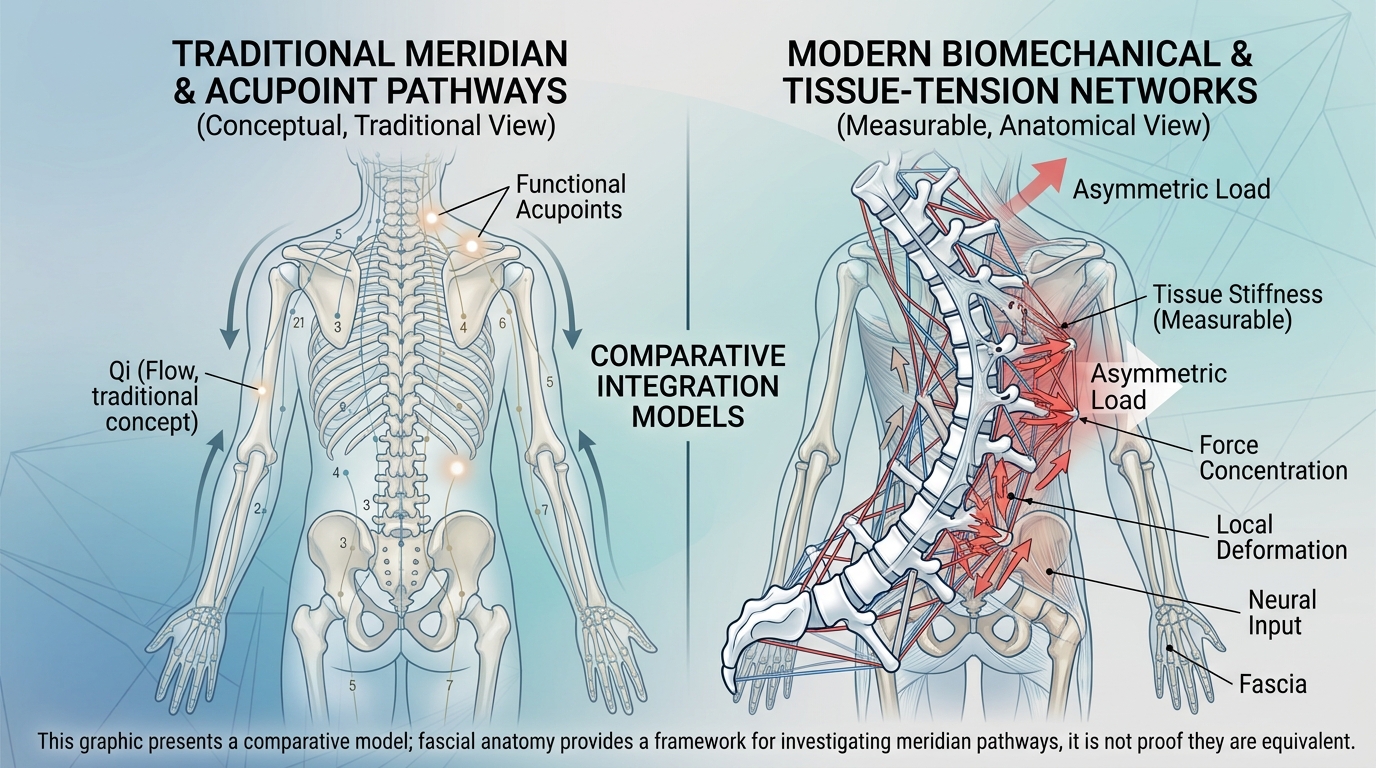
Several researchers have examined whether traditional meridian pathways overlap spatially with fascial structures.
A review by Bai and colleagues proposed that the fascial network may represent a possible physical substrate corresponding to some features of the traditional meridian system. The authors emphasized anatomical, physiological, and clinical observations but also acknowledged that the exact nature of meridians remained unresolved. [1]
An anatomical cadaver study subsequently reported that fascia and extracellular-matrix structures occurred along some areas corresponding to traditional meridian pathways. However, the investigators did not establish fascia as a complete anatomical equivalent of meridians. [2]
Therefore, the most scientifically appropriate statement is:
Fascial anatomy provides one possible framework for investigating meridian pathways.
It is not:
Fascia has been proven to be the meridian system.
6. The Mechanical Meaning of “Connection”
Traditional medicine often describes relationships between distant anatomical regions.
Modern biomechanics can investigate such relationships through measurable variables.
For example:
Muscle activation
→
Connective-tissue deformation
→
Force transmission
→
Joint movement
→
Postural adaptation
A similar chain may occur in the opposite direction:
Joint alignment
→
Altered muscle length
→
Changed connective-tissue tension
→
Changed sensory feedback
→
Modified movement strategy
The modern biomechanical model therefore provides a measurable way to investigate whole-body interrelationships without requiring traditional concepts to be interpreted literally as anatomical structures.
7. Acupuncture as a Mechanical Stimulus
Acupuncture provides an especially interesting intersection between traditional medicine and modern biomechanics.
When an acupuncture needle is inserted into connective tissue and manipulated, it produces a mechanical interaction with the surrounding tissue.
Research has shown that needle manipulation can produce measurable deformation of connective tissue and can influence fibroblast morphology and cytoskeletal organization. [4,5]
This has led researchers to investigate acupuncture not only through neurophysiology but also through mechanotransduction.
Mechanotransduction describes the process by which cells detect mechanical forces and convert them into biochemical signals.
The basic concept can be represented as:
Mechanical stimulus
↓
Tissue deformation
↓
Cellular mechanosensing
↓
Biochemical signaling
↓
Physiological response
This provides a modern biological framework for studying at least some effects of acupuncture.
8. Fibroblasts as Mechanical Sensors
Fibroblasts are important cells within connective tissue.
They produce and maintain components of the extracellular matrix, including collagen and other structural molecules.
Modern research suggests that fibroblasts can respond to mechanical deformation and alter their cytoskeleton, extracellular matrix interactions, and signaling behavior.
Recent reviews have proposed fibroblasts as potential intermediaries between acupuncture-induced mechanical stimulation and downstream biological responses. [4]
This does not prove traditional explanations of acupuncture.
Instead, it provides a testable biological mechanism through which mechanical stimulation of connective tissue may produce cellular responses.
9. The Concept of De Qi and Tissue Mechanics
The traditional acupuncture concept of De Qi is often described as a characteristic sensation experienced during acupuncture.
Modern research has investigated whether some components of this sensation are associated with mechanical interaction between the needle and connective tissue.
When a needle is manipulated, collagen fibers can wrap around the needle and produce measurable resistance.
This mechanical interaction has been proposed as one contributor to the sensation traditionally described as De Qi. [4,6]
This provides an interesting example of how a traditional clinical observation can be investigated using modern biomechanical measurements.
However, De Qi should not be reduced to a single mechanical event.
Sensory nerves, connective tissue, local biochemical responses, and central nervous-system processing may all contribute.
10. From Meridian “Flow” to Mechanical Force Transmission
Traditional descriptions frequently use the language of flow.
Modern biomechanics generally does not describe mechanical relationships in terms of Qi flow.
Instead, researchers can measure:
- tissue displacement
- strain
- stress
- stiffness
- shear
- pressure
- muscle activation
- neural activity
- blood flow
- tissue elasticity
For example, when connective tissue is mechanically deformed, the deformation can propagate through the tissue network.
Dynamic ultrasound research has demonstrated measurable connective-tissue deformation extending away from the acupuncture needle, particularly along connective-tissue planes. [5]
This provides a measurable phenomenon that can be studied without assuming that mechanical deformation is identical to traditional Qi.
11. Qi Should Not Simply Be Translated as “Mechanical Force”
One of the most important cautions in integrating traditional medicine with biomechanics is translation.
It is tempting to say:
Qi = energy
and then:
energy = mechanical force
This is scientifically problematic.
Qi is a broader traditional concept that has been interpreted in different ways across historical medical texts and modern practice.
Mechanical force is a precisely defined physical quantity.
Therefore, they should not be treated as equivalent terms.
A more appropriate approach is to ask:
Can some physiological phenomena traditionally described using the language of Qi be investigated using measurable mechanical, neural, vascular, or biochemical variables?
This question can be scientifically tested.
12. Meridian Theory and Neuromuscular Control
Biomechanics increasingly recognizes the importance of the nervous system in maintaining posture.
The brain continuously receives information from:
- muscle spindles
- Golgi tendon organs
- joint receptors
- cutaneous receptors
- the vestibular system
- vision
This sensory information contributes to postural control.
A change in joint position can therefore influence muscle activation and movement strategy.
From an integrative perspective, meridian-based clinical observations could potentially be investigated alongside:
- electromyography
- motion capture
- force plates
- balance testing
- pressure mapping
- proprioceptive testing
This creates an opportunity to transform traditionally described patterns into measurable biomechanical variables.
13. Meridian Concepts and Muscle Chains
Modern movement science sometimes describes coordinated muscle groups as functional chains or kinetic chains.
For example:
Foot → ankle → knee → hip → pelvis → spine
A change in one region can alter movement elsewhere.
This is not identical to a traditional meridian pathway.
Nevertheless, both frameworks recognize that isolated anatomical structures do not always explain whole-body movement.
For scoliosis research, this distinction can be particularly useful.
A spinal curve may be accompanied by changes in:
- pelvic orientation
- lower-limb loading
- shoulder position
- trunk rotation
- muscle activation
- gait
A whole-body biomechanical model can therefore examine these relationships quantitatively.
14. Meridian Concepts and Postural Alignment
Traditional approaches often place importance on balance.
Modern biomechanics also studies balance, although it defines it using measurable variables.
These include:
- center of mass
- center of pressure
- joint moments
- muscle activation
- ground-reaction forces
- postural sway
- spinal alignment
For example, when a person shifts body weight toward one side, the center of pressure changes.
The nervous system then adjusts muscle activation to maintain equilibrium.
Repeated asymmetric positioning can influence movement habits and mechanical loading.
This creates a modern biomechanical interpretation of one aspect of “balance” without claiming that traditional and modern definitions are identical.
15. Meridian Theory and Scoliosis
Scoliosis provides an especially interesting area for comparison.
Structural scoliosis is a three-dimensional spinal deformity involving:
- coronal curvature
- vertebral rotation
- sagittal alignment
- rib-cage deformation
- changes in trunk balance
These changes can alter muscular and connective-tissue relationships throughout the body.
A traditional meridian-based approach may describe some of these relationships as interconnected pathways.
A modern biomechanical approach can investigate them through:
- spinal imaging
- surface topography
- electromyography
- gait analysis
- force measurements
- movement analysis
- computational modeling
The two approaches can therefore be placed side by side without assuming that one has already scientifically validated the other.
16. Meridian Concepts and Asymmetric Muscle Tension
One practical area of overlap is the observation of asymmetric muscle tension.
Patients with scoliosis may demonstrate differences in:
- paraspinal muscle activity
- muscle cross-sectional area
- muscle length
- trunk rotation
- movement strategy
Modern biomechanical assessment can quantify some of these differences.
Traditional clinical examination may describe them using concepts such as imbalance, stagnation, or altered meridian relationships.
These descriptions belong to different explanatory systems.
The important research question is whether traditional pattern classifications correspond to reproducible differences in measurable anatomy, movement, muscle activity, or tissue properties.
17. Acupoints as Functional Mechanical Sites
Another important question is whether acupuncture points possess measurable properties that distinguish them from surrounding tissue.
Researchers have investigated:
- connective-tissue density
- electrical properties
- vascularity
- innervation
- mechanical stiffness
- tissue displacement
- sensory nerve distribution
Evidence remains mixed and does not establish a single anatomical characteristic shared by all acupuncture points.
Therefore, it may be more scientifically useful to investigate acupoints as potentially specialized functional tissue environments rather than assume that every point corresponds to a unique anatomical structure.
18. Mechanotransduction Provides a Bridge
Mechanotransduction may be one of the most useful concepts for connecting traditional acupuncture with modern biomechanics.
Consider the following sequence:
Acupuncture stimulation
↓
Mechanical deformation
↓
Connective-tissue response
↓
Fibroblast and sensory-cell activation
↓
Biochemical and neural signaling
↓
Local and potentially systemic physiological effects
This model does not require a literal anatomical meridian to be established.
It instead identifies measurable biological processes that can be investigated experimentally.
Recent reviews continue to explore fibroblasts, extracellular matrix remodeling, mechanosensitive channels, and immune-cell interactions as possible components of acupuncture's biological mechanisms. [4,7]
19. The Role of the Nervous System
A connective-tissue model should not be interpreted as replacing neurophysiology.
Acupuncture can stimulate sensory nerves.
Neural pathways can influence:
- spinal reflexes
- autonomic function
- pain processing
- muscle activity
- central nervous-system networks
Modern acupuncture research therefore increasingly considers several mechanisms simultaneously rather than searching for a single explanation.
Possible mechanisms include:
Neural regulation
Connective-tissue mechanotransduction
Vascular responses
Immune and inflammatory signaling
Endogenous analgesic mechanisms
These mechanisms may interact rather than operate independently. [4,8]
20. From Meridian Diagnosis to Quantifiable Biomechanics
A particularly promising research direction is converting qualitative observations into measurable variables.
For example:
| Traditional observation | Potential modern measurement | | ----------------------- | ----------------------------------------------------- | | Local tension | Tissue stiffness / elastography | | Asymmetric posture | 3D surface topography | | Muscle imbalance | EMG | | Weight imbalance | Force plate | | Movement restriction | Motion capture | | Tissue mobility | Ultrasound | | Joint loading | Musculoskeletal modeling | | Pain response | Patient-reported outcomes + sensory testing | | Acupuncture response | Neural, vascular, mechanical and biochemical measures |
This does not prove that the traditional concept and the measurement are equivalent.
It creates a framework for testing whether reproducible relationships exist.
21. Shear-Wave Elastography and Meridian Research
Modern imaging technologies may be particularly useful in this area.
Shear-wave elastography can estimate tissue mechanical properties by measuring the propagation of shear waves through tissue.
This allows researchers to investigate whether certain clinically identified regions differ in:
- stiffness
- elasticity
- tissue mobility
Such methods could potentially be used to study acupuncture points, painful tissues, or regions identified through traditional pattern diagnosis.
This is an example of how modern biomechanics can transform a qualitative clinical observation into a measurable research question.
22. The Importance of Three-Dimensional Assessment
Traditional meridian descriptions are often represented as lines on a two-dimensional anatomical diagram.
The human body, however, is three-dimensional.
Modern imaging can investigate:
- fascial planes
- muscle architecture
- vertebral rotation
- rib orientation
- pelvic alignment
- joint position
- tissue deformation
For scoliosis, this is particularly important because a two-dimensional Cobb angle cannot completely describe the three-dimensional deformity.
An integrative biomechanical model should therefore ideally consider:
coronal + sagittal + transverse + dynamic movement
rather than relying on a single plane.
23. A Biotensegrity Perspective
The concept of biotensegrity provides another possible bridge between traditional holistic models and modern biomechanics.
In a tensegrity-inspired model, the body is understood as a network in which compression and tension are distributed across interconnected structures.
This emphasizes:
- force transmission
- structural continuity
- dynamic stability
- distributed loading
- adaptation
These principles can be useful when thinking about the body as an integrated mechanical system.
However, biotensegrity itself is a conceptual biomechanical model and should not be used as proof of traditional meridian theory.
Instead, both frameworks can be examined as different models for understanding interconnection.
24. Meridian Concepts and Dynamic Posture
Posture is not a fixed position.
A person continuously makes small adjustments to maintain balance.
During standing:
Gravity
↓
Center of mass
↓
Ground-reaction force
↓
Joint moments
↓
Muscle activation
↓
Postural correction
This continuous feedback system provides a modern explanation for dynamic balance.
Traditional descriptions of bodily balance may provide a complementary clinical language, but modern biomechanics allows these changes to be measured directly.
25. Why “Meridian = Fascia” Is Too Simple
The fascia hypothesis is scientifically interesting but should not be overstated.
The evidence currently supports several observations:
- Fascia forms extensive connective-tissue networks.
- Some acupuncture points are located within or near connective-tissue planes.
- Acupuncture can mechanically interact with connective tissue.
- Connective-tissue cells respond to mechanical stimulation.
- Some traditional meridian pathways show anatomical correspondence with connective-tissue structures.
However:
These observations do not establish that fascia is the complete anatomical basis of meridians.
The anatomical nature of meridians remains an open research question. [1,2]
Maintaining this distinction strengthens rather than weakens the scientific discussion.
26. A Multilayer Model of Integration
A useful way to integrate traditional and modern perspectives is to think in layers.
Layer 1: Traditional clinical observation
Pattern, pathway, tenderness, movement, and symptom relationships.
↓
Layer 2: Anatomical structures
Muscles, fascia, joints, nerves, vessels, and bones.
↓
Layer 3: Mechanical behavior
Force, tension, compression, shear, stiffness, and movement.
↓
Layer 4: Neuromuscular control
Sensory feedback, motor control, reflexes, and central processing.
↓
Layer 5: Cellular biology
Mechanotransduction, inflammation, extracellular-matrix remodeling, and cellular signaling.
This model does not require every traditional concept to have a direct modern equivalent.
Instead, it creates multiple levels at which hypotheses can be tested.
27. Integrating Meridian Concepts Into Scoliosis Research
For scoliosis research, an integrative framework could examine whether traditional pattern classifications correspond to measurable biomechanical characteristics.
Potential variables include:
- Cobb angle
- vertebral rotation
- rib prominence
- pelvic tilt
- trunk shift
- center of pressure
- muscle activation
- tissue stiffness
- gait asymmetry
- respiratory mechanics
A future study could compare patients classified according to a traditional pattern system and determine whether statistically reproducible biomechanical differences exist.
Such a study would transform a traditional clinical hypothesis into a testable scientific question.
28. The JESU5C Perspective
The JESU5C framework described by LEE and Lee represents a clinician-developed attempt to classify idiopathic scoliosis according to different structural and functional patterns and to connect those patterns with exercise and supportive strategies.
From a modern research perspective, such a framework could potentially be investigated by measuring whether different pattern classifications correspond to differences in:
- spinal geometry
- vertebral rotation
- rib-cage morphology
- pelvic alignment
- muscle activity
- postural loading
- movement patterns
At present, this should be presented as a clinician-developed framework and research hypothesis, rather than as an independently validated scientific classification system. [9]
This distinction is particularly important when communicating with an international medical audience.
29. From Traditional Pattern to Research Hypothesis
A useful research process might look like this:
Traditional observation
↓
Operational definition
↓
Measurable anatomical variable
↓
Biomechanical measurement
↓
Statistical comparison
↓
Clinical validation
For example:
“This traditional pattern is associated with asymmetric trunk loading.”
could become:
“Patients classified according to Pattern X demonstrate a reproducible difference in center-of-pressure distribution and paraspinal muscle activation compared with matched controls.”
The second statement can be experimentally tested.
This is where traditional clinical knowledge can potentially contribute to modern research without requiring unverified assumptions.
30. What Modern Biomechanics Can Add
Modern biomechanics can contribute several advantages to traditional clinical models.
It can provide:
- objective measurements
- reproducible definitions
- three-dimensional imaging
- dynamic assessment
- quantitative force analysis
- computational modeling
- statistical validation
This allows researchers to ask whether traditionally described patterns have measurable structural or functional characteristics.
31. What Traditional Clinical Models May Add
Traditional medicine may also offer useful hypotheses.
Centuries of clinical observation have produced systems for describing:
- regional relationships
- movement patterns
- tenderness
- functional changes
- symptom distribution
- treatment responses
These observations can potentially generate research questions.
However, historical longevity alone does not establish scientific validity.
WHO emphasizes that traditional medicine should be evaluated for safety, quality, and effectiveness using appropriate scientific evidence. [10]
The most productive approach is therefore neither automatic rejection nor automatic acceptance.
It is testable integration.
32. A New Model of Integrative Biomechanics
A modern integrative model could combine:
Traditional pattern recognition
*
Anatomical mapping
*
Biomechanical measurement
*
Neuromuscular assessment
*
Tissue mechanics
*
Clinical outcomes
The objective would be to determine whether traditional patterns contain clinically useful information that can be independently measured and validated.
This could be especially relevant to chronic musculoskeletal conditions in which symptoms, posture, movement, and structural findings do not always correlate perfectly.
33. Clinical Implications
For clinicians, integrating traditional concepts with modern biomechanics does not require abandoning either framework.
Instead, traditional concepts can be used to generate hypotheses while modern tools provide objective assessment.
For example, a clinician might observe:
- asymmetric trunk tension
- pelvic imbalance
- altered weight bearing
- localized tenderness
- restricted movement
Rather than assuming that a particular meridian is physically responsible, the clinician could investigate:
- muscle activity
- joint mobility
- tissue stiffness
- postural loading
- movement patterns
- spinal alignment
This approach preserves the clinical observation while improving its scientific testability.
34. The Future of Meridian-Based Biomechanical Research
Future research may combine several technologies:
- 3D motion capture
- ultrasound
- shear-wave elastography
- surface topography
- electromyography
- force plates
- MRI
- CT when clinically justified
- wearable sensors
- finite-element modeling
- machine-learning analysis
These technologies could help determine whether specific traditional patterns correspond to reproducible anatomical and biomechanical phenotypes.
The result could be a new form of evidence-based traditional medicine research in which traditional observations are neither accepted uncritically nor discarded without investigation.
Conclusion
Traditional meridian theory and modern biomechanics emerged from very different intellectual traditions.
Meridian theory describes the body through interconnected pathways and functional relationships.
Biomechanics describes the body through measurable forces, movements, structures, and control systems.
They should not be treated as identical systems.
Nevertheless, there are areas of meaningful scientific intersection.
Fascial continuity, mechanical force transmission, mechanotransduction, neuromuscular control, tissue stiffness, and whole-body movement provide modern research frameworks through which some traditional observations can be investigated.
The most scientifically responsible position is not to claim that “meridians have been proven to be fascia.”
Instead, it is to ask:
Do some anatomical, mechanical, neurological, and physiological relationships described traditionally correspond to measurable biological phenomena?
That question is testable.
For scoliosis and other musculoskeletal disorders, this approach may be particularly valuable. Traditional pattern recognition can generate hypotheses, while imaging, biomechanics, movement analysis, tissue mechanics, and clinical outcomes can determine whether those hypotheses are reproducible.
The future of integrative medicine may therefore lie not in forcing traditional concepts into modern anatomical terminology, but in developing a common research language in which traditional observations can be translated into measurable variables, tested rigorously, refined when necessary, and incorporated into clinical practice only when supported by evidence.
In this sense, the most productive connection between meridian theory and modern biomechanics is not equivalence.
It is investigation.
References
[1] Bai Y, Wang J, Wu JP, et al. Review of Evidence Suggesting That the Fascia Network Could Be the Anatomical Basis for Acupoints and Meridians in the Human Body. Evidence-Based Complementary and Alternative Medicine. 2011.
[2] Stecco C, et al. Anatomical Evidence of Acupuncture Meridians in the Human Extracellular Matrix: Results from a Macroscopic and Microscopic Interdisciplinary Multicentre Study on Human Corpses. Evidence-Based Complementary and Alternative Medicine. 2019.
[3] World Health Organization. WHO International Standard Terminologies on Traditional Chinese Medicine. World Health Organization. 2022.
[4] Fibroblasts as key cellular targets in acupuncture therapy: a mechanistic perspective. Frontiers in Physiology. 2025.
[5] Integrative research on the mechanisms of acupuncture mechanics and interdisciplinary innovation. 2025.
[6] Langevin HM, Churchill DL, Cipolla MJ. Mechanical signaling through connective tissue: a mechanism for the therapeutic effect of acupuncture. FASEB Journal. 2001.
[8] The Status and Future of Acupuncture Mechanism Research. Journal of Alternative and Complementary Medicine.
[9] LEE, Yongsub, & Lee, Minsu (translator). Scoliosis, Meridian-Based Isometric Exercises and JESU5C Pattern Suit: “JESU5C” a New Classification of Idiopathic Scoliosis and HGMT (Hyun-Ga Manual Technique). Amazon KDP.
[10] World Health Organization. Traditional Medicine: Questions and Answers. World Health Organization. 2025.