Spine Care
[Biomechanics, Tensegrity & Meridian Concepts 14] How Asymmetric Load Bearing Accelerates Joint Wear and Tear
Asymmetric load bearing can concentrate stress on specific joint surfaces, altering cartilage, bone, and movement patterns and potentially accelerating degenerative changes.
Introduction
Human joints are designed to distribute mechanical forces across articular surfaces during standing, walking, lifting, and other everyday activities. This does not mean that joints require equal loading at every moment. Healthy joints constantly adapt to changing forces, and moderate mechanical loading is an important part of maintaining cartilage and other joint tissues. [1]
The problem arises when mechanical loading becomes excessive, repeatedly concentrated, or poorly distributed.
When one part of a joint consistently receives more mechanical stress than another, the biological and mechanical environment can gradually change. Cartilage may experience abnormal deformation, subchondral bone may remodel, joint stability may change, and surrounding muscles may alter their activation patterns. Over time, these changes can contribute to degenerative joint disease, including osteoarthritis. [1,2]
This principle is particularly relevant to scoliosis and other alignment disorders. A change in spinal or lower-limb alignment can shift the location and magnitude of mechanical forces. The resulting asymmetry may influence the spine, pelvis, hips, knees, and ankles.
Understanding this process helps explain why alignment is not merely a matter of appearance. Alignment determines how forces travel through the musculoskeletal system.
1. What Is Asymmetric Load Bearing?
Asymmetric load bearing occurs when mechanical forces are distributed unevenly between the two sides of a joint or between different regions of the same joint.
For example, during standing, a person may habitually place more weight on one leg. During walking, altered alignment may increase loading in one compartment of the knee. In scoliosis, spinal curvature and rotation can modify the distribution of forces between different vertebral segments and facet joints.
Asymmetry can occur in several forms:
- Left-right loading asymmetry
- Anterior-posterior loading asymmetry
- Medial-lateral loading asymmetry
- Axial compression asymmetry
- Shear-force asymmetry
- Rotational loading asymmetry
These forces rarely occur independently.
Compression, shear, bending, and rotation interact continuously during movement.
2. Joints Need Mechanical Loading
It is important not to equate mechanical loading with damage.
Healthy cartilage requires mechanical stimulation.
Moderate dynamic loading contributes to cartilage homeostasis and can stimulate anabolic processes that help maintain tissue quality. In contrast, both excessive loading and insufficient mechanical stimulation can negatively affect joint tissues. [3]
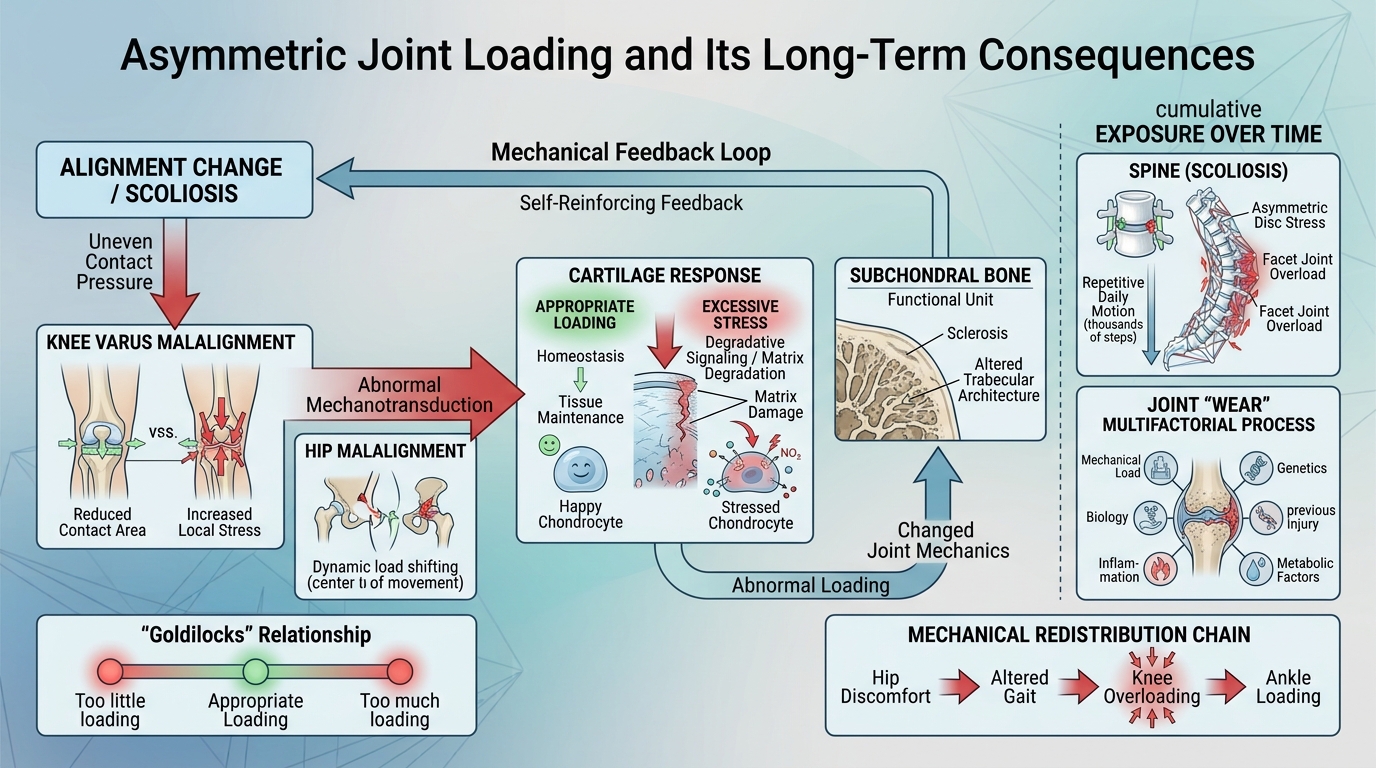
This creates what has sometimes been described as a “Goldilocks” relationship:
Too little loading → reduced mechanical stimulation
Appropriate loading → tissue maintenance and adaptation
Excessive or abnormal loading → tissue stress and degeneration
Therefore, the goal of musculoskeletal health is not to eliminate mechanical forces.
The goal is to maintain appropriate magnitude, direction, distribution, and variability of loading.
3. Why Load Distribution Matters
Consider a simple example.
Imagine two surfaces designed to share a load equally. If the total force remains the same but the contact area shifts toward one region, that region experiences a greater local stress.
This principle is important in biological joints.
Joint tissues respond not only to the total force acting on the joint but also to:
- where the force is applied
- how large the contact area is
- how quickly the force is applied
- how long the tissue is loaded
- how frequently loading occurs
- whether the joint is stable
- whether the surfaces remain congruent
Biomechanical studies of knee osteoarthritis have shown that malalignment can shift the center of pressure and increase local cartilage stress in specific regions of the joint. [4]
Thus, the same total body weight can produce very different local mechanical environments depending on alignment.
4. The Cartilage Response to Abnormal Loading
Articular cartilage is a specialized tissue designed to withstand repeated mechanical loading.
Its extracellular matrix contains collagen and proteoglycans that provide both tensile and compressive properties.
Chondrocytes—the cells within cartilage—respond to mechanical stimuli.
Under appropriate conditions, mechanical loading contributes to tissue homeostasis.
When mechanical stress becomes excessive or abnormal, however, cellular responses can change.
Research has shown that excessive mechanical loading can stimulate pathways associated with:
- matrix degradation
- inflammatory signaling
- chondrocyte dysfunction
- oxidative stress
- extracellular-matrix breakdown
Mechanical stress can therefore influence cartilage not only physically but also biologically. [1,5]
This is one reason why osteoarthritis should not be understood simply as “cartilage wearing out.”
It is a complex interaction between mechanical, biological, metabolic, inflammatory, and structural processes.
5. From Local Overloading to Cartilage Damage
Repeated excessive loading can create a gradual cycle.
A simplified model is:
Asymmetric alignment
↓
Uneven contact pressure
↓
Repeated local mechanical stress
↓
Altered cartilage response
↓
Matrix damage and tissue remodeling
↓
Changed joint mechanics
↓
Further abnormal loading
This does not mean that every person with asymmetric loading will develop osteoarthritis.
Age, genetics, previous injury, body weight, muscle strength, joint morphology, activity level, and other biological factors also influence risk.
Mechanical asymmetry is therefore best understood as one contributor within a multifactorial process.
6. The Role of Subchondral Bone
Cartilage is not the only tissue affected by abnormal loading.
Immediately beneath articular cartilage lies subchondral bone.
This bone responds to mechanical stress and can remodel when loading patterns change.
In osteoarthritis, changes in subchondral bone may include:
- increased bone density
- sclerosis
- altered trabecular architecture
- bone marrow lesions
- osteophyte formation
These changes can modify the mechanical properties of the joint and further influence load transmission.
The cartilage and subchondral bone should therefore be considered a functional unit rather than two completely independent tissues. [1,2]
7. Asymmetric Loading and Knee Osteoarthritis
The knee provides one of the clearest examples of how asymmetric loading can influence joint degeneration.
During walking, the knee experiences substantial forces.
When alignment changes—for example, through varus or valgus positioning—the distribution of forces between the medial and lateral compartments can change.
In knee biomechanics, the knee adduction moment is frequently studied as an indirect indicator of medial compartment loading.
Higher mechanical loading of the medial compartment has been associated with knee osteoarthritis severity and progression. [6]
However, this relationship is not simply a matter of “more force equals more damage.”
Joint kinematics, cartilage condition, meniscal integrity, muscle forces, and walking patterns all influence the actual intra-articular loads.
8. Joint Malalignment Can Shift the Center of Pressure
One important mechanism is the movement of the body's center of pressure.
When alignment changes, the line of action of the ground-reaction force can move relative to the joint center.
This changes the moment arm.
A larger moment arm requires greater internal muscle or joint reaction forces to maintain stability.
For example:
Changed limb alignment
↓
Changed ground-reaction force direction
↓
Changed moment arm
↓
Changed joint torque
↓
Changed internal joint loading
The result can be a redistribution of mechanical stress across the joint.
This is why apparently small changes in alignment can have significant biomechanical consequences when repeated thousands of times during daily movement.
9. Repetition Is a Critical Factor
A single episode of asymmetric loading does not necessarily cause degeneration.
The problem is often cumulative exposure.
A person may take thousands of steps each day.
If a particular region of a joint experiences slightly elevated stress during each step, the cumulative mechanical exposure can become substantial over months and years.
This can be represented as:
Load magnitude × loading frequency × duration × mechanical disadvantage
The exact biological response is more complicated than this equation, but the concept illustrates why chronic loading patterns matter.
10. Asymmetric Loading and the Hip
The hip is another major load-bearing joint.
The hip must transfer forces between the trunk and lower extremities while allowing substantial three-dimensional movement.
Changes in pelvic orientation, femoral alignment, leg-length discrepancy, or gait mechanics can modify hip joint loading.
A shift in the center of pressure can increase loading in particular regions of the femoral head or acetabulum.
Over time, abnormal mechanical loading may interact with cartilage degeneration and structural changes.
Importantly, hip osteoarthritis is also multifactorial.
Mechanical loading is one component of a larger biological system.
11. The Spine as a Load-Bearing System
The spine differs from the knee and hip because it contains multiple motion segments rather than one large synovial joint.
Each spinal segment includes:
- vertebral bodies
- intervertebral discs
- facet joints
- ligaments
- muscles
- neural structures
Mechanical loads are distributed among these structures.
When spinal alignment changes, the distribution of forces between segments can also change.
For example, eccentric loading of intervertebral discs can produce asymmetric stress distributions, particularly when disc and endplate geometry are altered. [7]
This makes spinal alignment especially important in long-term mechanical behavior.
12. Asymmetric Loading in Scoliosis
Scoliosis provides a particularly important example of asymmetric spinal loading.
A structural scoliosis involves changes in multiple planes:
- coronal curvature
- axial rotation
- sagittal alignment
- vertebral and disc geometry
These changes can modify the way forces are transmitted through individual motion segments.
Research on scoliosis biomechanics has proposed that asymmetric loading may contribute to changes in vertebral growth and deformity progression, particularly during skeletal growth. [8]
However, the relationship is complex.
Mechanical loading is not considered a complete explanation for the development of idiopathic scoliosis.
Instead, it is one component of a multifactorial process involving growth, neuromuscular control, genetic susceptibility, morphology, and other factors.
13. Facet Joints and Asymmetric Spinal Loading
The facet joints are particularly important because they help control spinal motion and contribute to load transmission.
A recent study combining finite-element modeling with surgical specimens reported asymmetric facet-joint loading and structural changes in patients with adolescent idiopathic scoliosis. The authors found greater degenerative-type changes in certain facet joints and related these findings to asymmetric contact forces. [9]
These findings provide a useful example of how spinal deformity can create localized mechanical environments.
The important distinction is:
Scoliosis does not mean that every joint is overloaded equally.
Instead, specific segments may experience different combinations of compression, shear, and rotation.
14. Intervertebral Disc Degeneration
The intervertebral disc also responds to mechanical loading.
Disc tissue requires an appropriate mechanical environment to maintain its biological function.
Abnormal or sustained loading can alter:
- disc cell behavior
- extracellular matrix metabolism
- fluid movement
- disc height
- stress distribution
- endplate loading
Recent experimental work examining asymmetric loading found that loading conditions can influence intervertebral-disc cell phenotype and may contribute to degenerative changes under pathological loading conditions. [10]
These findings are particularly relevant to spinal deformity research because asymmetric loading is a recurring feature of many spinal alignment disorders.
15. The “Weakest Link” Principle
The musculoskeletal system is a connected mechanical chain.
When load distribution changes, the tissue that is least capable of tolerating the altered stress may become the first site of dysfunction.
Depending on the individual, this could involve:
- cartilage
- meniscus
- intervertebral disc
- facet joint
- subchondral bone
- ligament
- tendon
- muscle
This explains why two people with apparently similar alignment abnormalities can develop different symptoms.
The mechanical environment may be similar, but the biological capacity of individual tissues may differ.
16. Muscle Forces Can Amplify or Reduce Joint Loading
External body weight is only one source of joint loading.
Muscles generate substantial internal forces.
Muscles must often produce force to:
- maintain posture
- stabilize a joint
- control movement
- resist gravity
- decelerate the body
This means that muscle activation can either increase joint compression or redistribute forces depending on the movement strategy.
For example, excessive co-contraction around an unstable joint can increase compressive loading even when external forces remain unchanged.
Therefore:
Joint loading = external forces + internal muscle forces + joint reaction forces + dynamic effects
This is one reason why movement analysis is often more informative than static posture alone.
17. Compensation Can Move the Load Elsewhere
The body frequently responds to asymmetry through compensation.
If one joint becomes painful or mechanically disadvantaged, a person may alter:
- stride length
- foot position
- pelvic rotation
- trunk lean
- knee flexion
- muscle activation
The original joint may experience reduced loading, but another region may receive greater stress.
This can create a mechanical redistribution chain.
For example:
Hip discomfort
↓
Altered gait
↓
Pelvic compensation
↓
Changed knee loading
↓
Changed ankle loading
This does not mean that compensation inevitably causes degeneration.
Rather, persistent compensatory movement can modify mechanical exposure throughout the kinetic chain.
18. Asymmetric Loading and Movement Variability
Healthy movement is not perfectly symmetrical.
Small variations occur from step to step.
This variability can distribute mechanical stress across tissues rather than repeatedly loading exactly the same location.
A rigid or highly repetitive movement strategy may reduce this distribution.
Consequently, biomechanical health is not necessarily about achieving perfect left-right symmetry.
Instead, it involves maintaining an appropriate range of movement and load distribution.
19. Static Alignment Versus Dynamic Loading
Standing posture provides useful information, but it cannot completely predict joint loading during movement.
A person may appear relatively symmetrical while standing but develop significant asymmetry during:
- walking
- running
- climbing stairs
- lifting
- sitting down
- rising from a chair
- reaching
- rotating
Conversely, someone with visible static asymmetry may compensate effectively during movement.
This distinction is particularly important in scoliosis and lower-limb alignment disorders.
A comprehensive biomechanical evaluation therefore may include both:
Static alignment
and
Dynamic movement
20. Asymmetric Loading Does Not Mean “Bad Posture”
It is tempting to interpret every asymmetry as pathological.
That would be an oversimplification.
Human bodies are naturally asymmetrical.
Small differences in limb length, muscle morphology, joint shape, handedness, and habitual movement are common.
The more important questions are:
- Is the asymmetry persistent?
- Is the loading excessive?
- Is the joint stable?
- Is the tissue healthy?
- Is there pain?
- Is function impaired?
- Is the loading pattern changing over time?
Biomechanics should therefore be interpreted in context rather than through visual symmetry alone.
21. From Mechanical Stress to Biological Degeneration
One of the most important developments in musculoskeletal science is the recognition that mechanical loading affects cellular behavior.
Chondrocytes, disc cells, bone cells, and other connective-tissue cells respond to their mechanical environment.
Mechanical signals can influence:
- gene expression
- matrix synthesis
- matrix degradation
- inflammatory signaling
- cellular survival
- tissue remodeling
Excessive mechanical stress can therefore produce a biological response that eventually changes tissue structure. [1,5]
This process is known as mechanotransduction.
It helps explain how a mechanical problem can gradually become a biological and structural problem.
22. The Mechanical Degeneration Cycle
The process can be summarized as a feedback loop:
Alignment change
↓
Asymmetric loading
↓
Local tissue stress
↓
Biological adaptation or damage
↓
Structural change
↓
Altered joint mechanics
↓
Further load redistribution
This cycle may become self-reinforcing.
For example, cartilage loss can alter joint congruence. Altered congruence can further concentrate forces. The new loading pattern can then increase stress on remaining cartilage.
This is one reason why early biomechanical changes may be important even before advanced radiographic degeneration becomes visible.
23. Why “Wear and Tear” Is an Incomplete Explanation
The phrase “wear and tear” is useful for general communication but can be misleading.
Osteoarthritis is not simply the result of a joint being mechanically rubbed until the cartilage disappears.
It involves interactions among:
- mechanical loading
- cartilage biology
- subchondral bone
- synovium
- inflammation
- aging
- previous injury
- genetics
- metabolic factors
- body composition
Mechanical stress is therefore better understood as a biological signal as well as a physical force.
Appropriate loading can support tissue health, while excessive or abnormal loading can contribute to pathological remodeling. [3]
24. Can Correcting Alignment Reduce Joint Stress?
Biomechanically, changing alignment can alter load distribution.
This principle is already used in several areas of orthopaedic practice.
Examples include:
- orthotics
- gait modification
- rehabilitation
- exercise therapy
- unloading braces
- surgical realignment procedures
The goal is not necessarily to eliminate load.
Instead, the objective may be to redistribute load toward a more favorable mechanical pattern.
However, whether a particular alignment intervention slows structural degeneration depends on the specific joint, disease stage, patient characteristics, and intervention.
Biomechanical plausibility should not automatically be interpreted as proven disease modification.
25. Exercise and Mechanical Loading
Exercise provides an important example of the difference between beneficial and harmful loading.
Moderate dynamic loading can have positive effects on cartilage and joint tissues, whereas excessive repetitive loading or high-impact loading may be harmful in certain circumstances. [3,11]
Therefore, “protecting a joint” does not necessarily mean avoiding movement.
For many musculoskeletal conditions, the objective is to find an appropriate loading range that:
- maintains muscle strength
- supports joint stability
- preserves movement
- avoids excessive tissue stress
- improves neuromuscular control
This principle is particularly relevant to rehabilitation.
26. Asymmetric Loading and the Kinetic Chain
The body functions as a connected kinetic chain.
A mechanical change at one location can influence another.
For example:
Foot position
→
Ankle mechanics
→
Knee loading
→
Hip mechanics
→
Pelvic position
→
Spinal loading
The relationship is bidirectional.
A spinal alignment abnormality can also influence lower-limb mechanics.
Therefore, evaluating only the painful joint may miss contributing mechanical factors elsewhere in the body.
27. A Three-Dimensional View of Load Distribution
Traditional alignment assessment often focuses on two-dimensional measurements.
However, real joints operate in three dimensions.
Mechanical loading can involve:
- compression
- tension
- shear
- bending
- torsion
These forces interact.
In scoliosis, for example, a vertebral segment may simultaneously experience asymmetric compression and rotational forces.
In the knee, malalignment can alter both frontal-plane moments and three-dimensional joint kinematics.
A patient-specific biomechanical model should therefore ideally consider all relevant loading directions.
28. Computational Modeling of Asymmetric Loading
Finite-element and musculoskeletal models can help researchers estimate forces that are difficult to measure directly in living patients.
Models can incorporate:
- bone geometry
- cartilage thickness
- joint surfaces
- ligaments
- muscle forces
- body weight
- alignment
- movement patterns
Researchers can then simulate how changes in alignment affect local stresses.
This approach is particularly promising for personalized musculoskeletal assessment.
However, computational models depend on assumptions and input data.
They should therefore complement clinical measurements rather than replace them.
29. What This Means for Scoliosis
For patients with scoliosis, asymmetric loading is particularly relevant because spinal curvature can change the mechanical environment of multiple segments.
Potentially affected structures include:
- vertebral endplates
- intervertebral discs
- facet joints
- rib-vertebral joints
- spinal ligaments
- paraspinal muscles
In growing patients, asymmetric mechanical forces have also been proposed as one factor that may interact with vertebral growth and curve progression. [8]
In adults, degenerative changes can further alter alignment, potentially creating additional asymmetry.
This creates an important distinction:
Adolescent scoliosis and degenerative adult scoliosis may involve different biological mechanisms even though both can produce asymmetric spinal loading.
30. A Patient-Specific Approach to Load Distribution
No single loading pattern applies to every patient.
Two individuals may have the same Cobb angle but different:
- vertebral rotation
- pelvic alignment
- leg-length difference
- muscle activation
- trunk balance
- gait pattern
- disc condition
- facet-joint morphology
Consequently, the mechanical consequences of scoliosis may differ substantially between individuals.
This supports the use of patient-specific biomechanical assessment rather than relying on a single measurement.
31. Pattern-Based Assessment
A pattern-based approach can consider the interaction among:
Spinal alignment + pelvic position + lower-limb alignment + muscle activity + movement strategy + joint loading
For example, a patient with a thoracic curve may compensate through pelvic rotation or altered weight bearing.
Another patient with a similar spinal curve may use a different strategy.
The visible spinal curvature therefore represents only one part of the overall mechanical pattern.
The JESU5C framework described by LEE and Lee approaches idiopathic scoliosis through pattern-based classification and incorporates alignment, movement, and muscular considerations. It should be regarded as a clinician-developed framework rather than established peer-reviewed evidence. [12]
32. What Asymmetric Loading Can and Cannot Explain
Asymmetric loading provides a useful biomechanical explanation for why some areas of a joint may experience greater mechanical stress than others.
It can help explain:
- local cartilage stress
- altered subchondral remodeling
- changes in joint mechanics
- asymmetric spinal degeneration
- altered gait
- compensatory movement
However, asymmetric loading alone cannot explain every case of osteoarthritis or scoliosis.
Degenerative joint disease is multifactorial.
Similarly, mechanical loading is only one part of the complex biology underlying idiopathic scoliosis.
Maintaining this distinction is essential for evidence-based clinical communication.
Conclusion
Asymmetric load bearing is an important component of musculoskeletal biomechanics.
Joints are designed to adapt to mechanical loading, and moderate dynamic loading is necessary for healthy tissue maintenance. The problem arises when forces become excessive, repetitive, concentrated, or poorly distributed relative to the tissue's capacity.
Persistent asymmetry can shift mechanical stress toward particular regions of cartilage, subchondral bone, intervertebral discs, or facet joints. These tissues respond not only mechanically but biologically, potentially initiating remodeling and degenerative processes.
In scoliosis, altered spinal geometry can contribute to asymmetric loading across vertebral segments, discs, and facet joints. In the lower extremities, alignment changes can similarly alter load distribution across the hip, knee, and ankle.
The most useful concept is therefore not simply “more load causes more wear.”
Instead:
Appropriate loading supports tissue health.
Abnormal loading can change tissue behavior.
Persistent load asymmetry can alter structure and function.
Structural changes can then create further mechanical asymmetry.
This mechanical feedback loop helps explain why alignment, movement, muscle control, and joint health should be considered together rather than as separate problems.
For scoliosis and other musculoskeletal conditions, future assessment may increasingly combine radiographic alignment, three-dimensional morphology, dynamic movement analysis, muscle activity, and computational modeling to identify individual patterns of load distribution.
The goal is not to eliminate mechanical loading.
The goal is to help the musculoskeletal system distribute and tolerate mechanical forces in a way that supports long-term function.
References
[1] Guilak F. The Role of Mechanical Forces in the Initiation and Progression of Osteoarthritis. Osteoarthritis and Cartilage.
[2] Buckwalter JA, Anderson DD, Sheinkop MB, et al. The Roles of Mechanical Stresses in the Pathogenesis of Osteoarthritis: Implications for Treatment of Joint Injuries. Cartilage.
[3] Leong DJ, Sun HB. Mechanical Loading: Potential Preventive and Therapeutic Strategy for Osteoarthritis. Annals of the New York Academy of Sciences.
[4] Andriacchi TP, Mündermann A. The Pathophysiology and Pathomechanics of Osteoarthritis of the Knee. Journal of Biomechanics.
[5] Jahn J, Ehlen QT, Huang CY. Finding the Goldilocks Zone of Mechanical Loading: A Comprehensive Review of Mechanical Loading in the Prevention and Treatment of Knee Osteoarthritis. Bioengineering. 2024.
[6] Biomechanical factors in osteoarthritis. Osteoarthritis and Cartilage.
[7] Biomechanics of Degenerative Spinal Disorders. Journal of Orthopaedic Research.
[8] Grivas TB, et al. A comprehensive model of idiopathic scoliosis progression, based on the patho-biomechanics of the deforming “three joint complex”.
[10] Diurnal Asymmetric Loading Modulates Cell Phenotype in Intervertebral Disc.
[11] Osteoarthritis Year in Review 2018: Mechanics. Osteoarthritis and Cartilage.
[12] LEE, Yongsub, & Lee, Minsu (translator). Scoliosis, Meridian-Based Isometric Exercises and JESU5C Pattern Suit: “JESU5C” a New Classification of Idiopathic Scoliosis and HGMT (Hyun-Ga Manual Technique). Amazon KDP.