Spine Care
[Biomechanics, Tensegrity & Meridian Concepts 11] How Core Stability Restores Tension Balance Across the Vertebrae
Core stability helps coordinate the muscles that control spinal movement and load distribution, potentially improving alignment, balance, and mechanical efficiency.
Introduction
The spine is constantly exposed to forces. Gravity compresses the body, muscles generate stabilizing forces, the ground produces reaction forces, and movements of the arms, pelvis, and legs transmit additional loads through the trunk.
A healthy spine does not eliminate these forces. Instead, it continuously distributes and manages them.
This is where core stability becomes important.
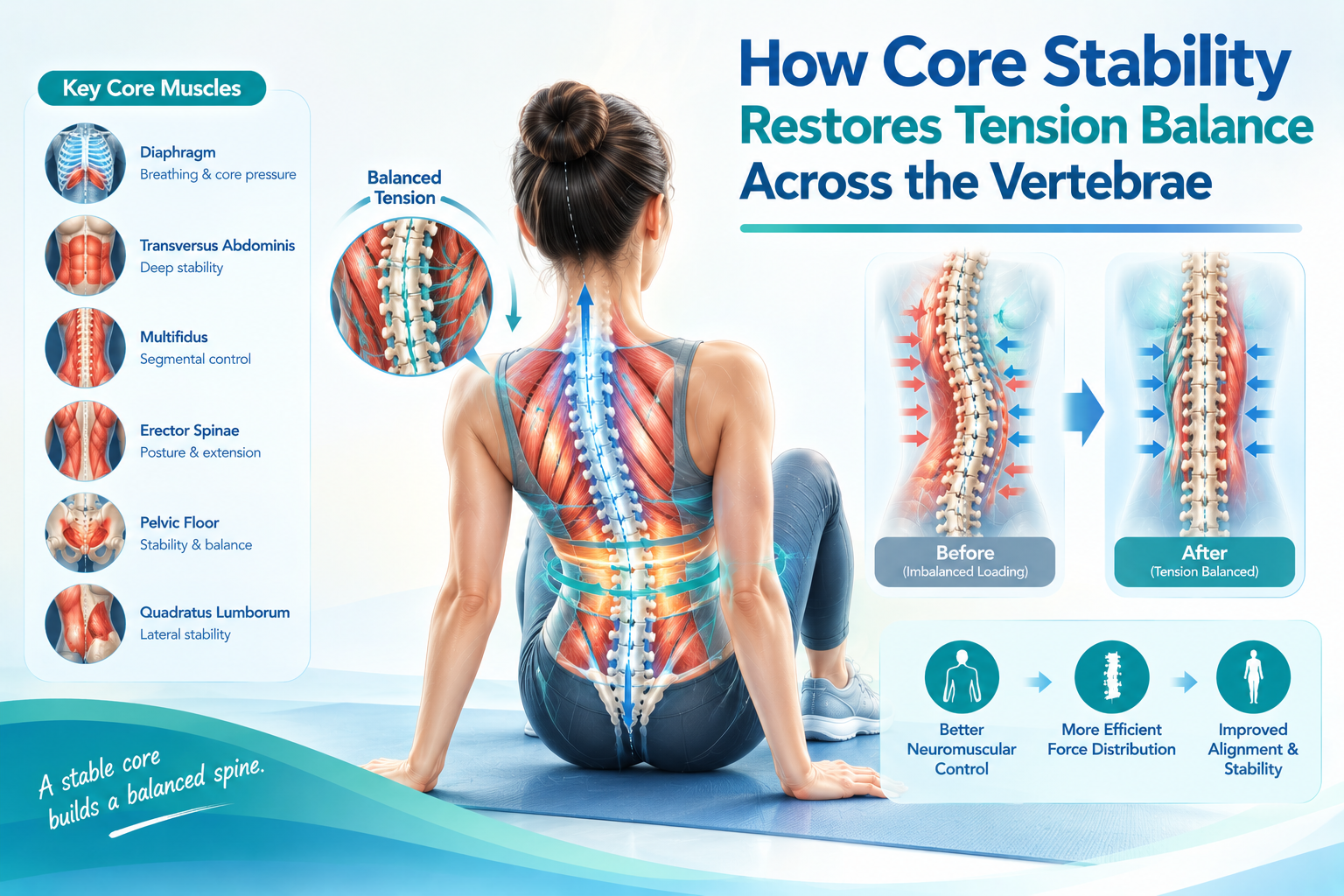
The term core stability is often used to describe the ability of the trunk and surrounding musculature to control the position and movement of the spine and pelvis. It involves much more than abdominal strength. The diaphragm, abdominal wall, multifidus, erector spinae, pelvic floor, quadratus lumborum, and other muscles contribute to trunk control in different ways.
In scoliosis, asymmetric spinal geometry can change how these muscles work. Differences in vertebral position, spinal rotation, pelvic alignment, and muscle morphology may alter the distribution of mechanical loads across the trunk. Research has identified associations between paraspinal muscle characteristics and spinal curvature, although the direction of causation remains uncertain. [1]
Core stabilization exercise has been studied as one component of conservative scoliosis management. A 2025 systematic review and meta-analysis of 10 studies involving 449 participants found that core stabilization exercise was associated with improvements in Cobb angle, trunk rotation, apical vertebral rotation, and quality of life compared with no exercise, although the evidence was heterogeneous and the effects were smaller than those reported for some three-dimensional exercise programs. [2]
The important question, therefore, is not simply whether stronger abdominal muscles straighten the spine.
A more useful question is:
Can better neuromuscular control help the body distribute spinal forces more efficiently and maintain a more balanced alignment?
---
1. What Is Core Stability?
Core stability is the ability of the trunk to control the position and movement of the spine and pelvis during static and dynamic activities.
It involves coordination among multiple systems rather than the contraction of one particular muscle.
Important contributors include:
- Diaphragm
- Transversus abdominis
- Internal and external obliques
- Rectus abdominis
- Multifidus
- Erector spinae
- Quadratus lumborum
- Pelvic floor muscles
- Gluteal muscles
- Hip musculature
These muscles work together with the nervous system to regulate trunk stiffness and movement.
The objective is not to make the spine completely rigid.
Instead, the trunk must be stable enough to control movement while remaining mobile enough to move efficiently.
This distinction is essential.
A completely rigid spine would not be functional. Walking, breathing, reaching, and rotating all require controlled spinal movement.
---
2. Stability Does Not Mean Rigidity
The word “stability” can be misleading.
A stable spine is not necessarily a motionless spine.
During normal movement, the spine undergoes small changes in:
- Flexion
- Extension
- Rotation
- Lateral bending
- Compression
- Shear
The muscles continuously adjust their activation to control these movements.
Therefore, core stability can be understood as controlled adaptability.
The nervous system must determine:
How much muscle activation is necessary for this particular movement?
Too little activation may reduce control.
Too much activation may increase stiffness, fatigue, and energy expenditure.
The ideal strategy is therefore not maximal contraction but appropriate coordination.
---
3. What Does “Tension Balance” Mean?
“Tension balance” is a useful biomechanical concept, but it should not be confused with a formally established clinical diagnosis.
In this context, it refers to the relationship among:
- Muscle tension
- Ligament tension
- Fascial tension
- Compression
- Shear
- Bending moments
- Torsional forces
- Ground-reaction forces
The spine constantly seeks mechanical equilibrium.
For example, when a person stands upright, gravity produces a downward force. Muscles generate opposing forces that help prevent excessive forward, backward, or sideways displacement.
If the trunk shifts, the muscular forces required to maintain equilibrium change.
This can be represented conceptually as:
External force → spinal displacement → sensory feedback → muscle response → redistribution of force
Core stability contributes to this feedback system.
---
4. The Spine as a Load-Distribution System
Each vertebral segment participates in transmitting loads through the spine.
Structures involved include:
- Vertebral bodies
- Intervertebral discs
- Facet joints
- Ligaments
- Paraspinal muscles
- Abdominal muscles
- Thoracolumbar fascia
- Pelvis
The load is not carried by the vertebral bodies alone.
Muscles can change the mechanical environment of the spine by producing forces across multiple segments.
For example, activation of the trunk muscles can increase spinal stiffness and influence how external loads are transmitted through the vertebral column.
This is why core stability is better understood as load management rather than simply “abdominal strengthening.”
---
5. What Changes When the Spine Becomes Asymmetric?
In scoliosis, the vertebral column becomes three-dimensionally asymmetric.
This may include:
- Coronal curvature
- Vertebral rotation
- Vertebral wedging
- Rib-cage asymmetry
- Altered sagittal alignment
- Pelvic compensation
- Trunk shift
These structural changes can alter the mechanical environment of the muscles.
A systematic review of paraspinal muscle characteristics in AIS found low- to very-low-strength evidence for differences between the concave and convex sides, including differences in muscle volume, fiber characteristics, activity, and fatty infiltration. The review also emphasized that these muscle changes may be either a cause or a consequence of the spinal curvature. [1]
This distinction is critical.
A person may develop altered muscle activation because the spine is asymmetric, rather than the muscle imbalance being the original cause of the scoliosis.
The relationship can therefore be bidirectional.
---
6. How Muscle Forces Influence Spinal Loading
Muscles generate forces that can influence spinal compression and stability.
When the trunk muscles contract, they create forces around the spinal column.
These forces can:
- Increase segmental stability
- Control movement
- Resist external perturbations
- Modify spinal loading
- Help maintain upright posture
However, stronger contraction does not automatically mean better alignment.
Excessive or poorly coordinated contraction can increase compression without producing useful corrective movement.
Therefore, the important variable is not simply how much force the muscles generate.
It is:
where, when, and in which direction the force is generated.
---
7. Why Direction Matters
A force has both magnitude and direction.
Suppose a muscle produces a force that helps resist lateral displacement. That may improve frontal-plane stability.
Another muscle activation pattern may primarily resist rotation.
Another may control flexion or extension.
The trunk therefore requires coordinated forces across multiple planes.
This is particularly important in scoliosis because scoliosis is three-dimensional.
A rehabilitation strategy that addresses only lateral bending may not fully address:
- Axial rotation
- Sagittal alignment
- Rib-cage position
- Pelvic orientation
This is one reason why scoliosis-specific exercise approaches frequently emphasize three-dimensional correction rather than isolated strengthening.
A 2024 systematic review and meta-analysis found that physiotherapeutic scoliosis-specific exercises produced positive effects on Cobb angle, angle of trunk rotation, and thoracic kyphosis compared with other nonsurgical approaches, although the evidence quality varied and further research was recommended. [3]
---
8. Core Stability and the Neutral Spine
A commonly used concept in exercise rehabilitation is the neutral spine.
Neutral does not mean perfectly straight.
The human spine normally contains:
- Cervical lordosis
- Thoracic kyphosis
- Lumbar lordosis
- Sacral curvature
A functional neutral position is therefore a region in which the spine can tolerate movement and loading efficiently.
In scoliosis, however, the patient's neutral position may be asymmetric.
One shoulder may sit higher.
The pelvis may shift.
The rib cage may rotate.
The trunk may translate relative to the pelvis.
Therefore, core training should not simply force every patient into the same generic “neutral” posture.
The appropriate target should be individualized.
---
9. Deep and Superficial Muscles Work Together
Core stability is sometimes incorrectly reduced to the deep abdominal muscles.
In reality, trunk control involves coordination between deep and superficial muscles.
Deep stabilizing muscles
These include:
- Multifidus
- Transversus abdominis
- Diaphragm
- Pelvic floor
They contribute to segmental and pressure-related control.
Larger movement muscles
These include:
- Rectus abdominis
- External oblique
- Internal oblique
- Erector spinae
- Quadratus lumborum
- Gluteal muscles
They contribute to larger trunk and pelvic movements.
The two groups are not independent.
During functional movement, they operate as a coordinated system.
---
10. The Diaphragm Is Part of the Core
Breathing and trunk stability are closely connected.
The diaphragm is the primary muscle of respiration, but its position and activity also influence abdominal pressure and trunk mechanics.
During inhalation, the diaphragm descends.
During exhalation, it rises.
The abdominal muscles and pelvic floor interact with these changes in pressure.
For this reason, some rehabilitation approaches integrate:
- Breathing
- Trunk elongation
- Rib-cage correction
- Abdominal control
- Postural stabilization
This is especially relevant to scoliosis because thoracic deformity can alter rib-cage mechanics.
However, breathing exercises should not be described as directly correcting the underlying vertebral deformity unless supported by appropriate evidence.
---
11. Core Stability and the Pelvis
The pelvis forms the mechanical bridge between the spine and lower extremities.
Its position influences the orientation of the lumbar spine.
Pelvic position can change with:
- Hip position
- Leg-length discrepancy
- Muscle imbalance
- Foot mechanics
- Standing strategy
- Spinal curvature
For example, pelvic obliquity may produce compensatory trunk movement.
Core muscles must then work to maintain the head and trunk over the base of support.
This creates another mechanical chain:
Feet → legs → pelvis → lumbar spine → thorax → head
Core stability therefore cannot be understood independently of the pelvis and lower extremities.
---
12. Core Stability and the Tensegrity Concept
The idea of biotensegrity provides one conceptual model for understanding how tension and compression interact throughout the body.
In a tensegrity-inspired model, stability emerges from the interaction of:
- Tension elements
- Compression elements
- Structural geometry
- Distributed forces
The human body is considerably more complex than a simple engineered tensegrity structure, and biotensegrity should therefore be regarded as a conceptual biomechanical model rather than an established explanation for idiopathic scoliosis.
Nevertheless, the concept is useful for visualizing why a change in one region may alter mechanical demands elsewhere.
For example:
Pelvic position → trunk muscle activity → spinal loading → shoulder and head position
Core stability can therefore be viewed as part of a distributed system rather than an isolated abdominal function.
---
13. What Happens When Core Control Is Poor?
Poor core control does not necessarily mean that the abdominal muscles are weak.
A person may have strong muscles but poor coordination.
Possible characteristics include:
- Delayed muscle activation
- Excessive co-contraction
- Poor pelvic control
- Reduced trunk endurance
- Excessive trunk movement
- Difficulty maintaining alignment during movement
- Compensatory shoulder or pelvic motion
For example, an athlete may produce substantial abdominal force during a static exercise but still lose trunk control during single-leg movement.
Functional stability is therefore different from isolated muscle strength.
---
14. Core Stability and Neuromuscular Feedback
Core stability depends heavily on sensory information.
The nervous system receives information from:
- Muscles
- Tendons
- Joints
- Skin
- Vestibular system
- Vision
It then adjusts muscle activation.
This creates a continuous loop:
Position → sensory information → nervous-system processing → muscle activation → movement → new position
This is particularly relevant in scoliosis because spinal asymmetry may alter the sensory and mechanical information available to the nervous system.
Research has identified differences in proprioception, postural stability, and muscle activation in some patients with AIS. These findings support the importance of neuromuscular control but do not prove that impaired feedback causes scoliosis. [4]
---
15. Why Core Training May Improve Alignment
Core stabilization may improve alignment through several overlapping mechanisms.
1. Better trunk control
The patient may become better able to resist unwanted displacement.
2. Improved endurance
The muscles may maintain appropriate activation for longer periods.
3. Improved movement coordination
Different muscle groups may activate at more appropriate times.
4. Better pelvic control
Improved trunk-pelvis coordination can reduce unnecessary compensatory movement.
5. Improved force distribution
More coordinated muscle activation may help distribute mechanical demands across the trunk.
6. Improved proprioceptive awareness
Patients may become better at recognizing and correcting their position.
These mechanisms are plausible and supported to varying degrees by rehabilitation research, but they should not be interpreted as proof that core stabilization reverses the structural pathology of scoliosis.
---
16. What Does the Research Show?
The evidence for core stabilization exercise in scoliosis has become increasingly substantial, but important limitations remain.
A 2022 systematic review and meta-analysis found positive effects from both Schroth exercise and core stabilization exercise in idiopathic scoliosis, while subgroup analysis suggested larger effects for Schroth than for core stabilization on some outcomes. [5]
A 2025 systematic review and meta-analysis specifically examining core stabilization exercise included 10 studies with 449 participants. Compared with no intervention, core stabilization was associated with improvements in several outcomes, including Cobb angle and trunk rotation. However, the authors reported that its effects appeared weaker than those of three-dimensional exercise in some comparisons and emphasized heterogeneity, small samples, and limited long-term evidence. [2]
A 2024 network meta-analysis of physiotherapeutic scoliosis-specific exercises included 17 randomized controlled trials involving 857 patients and found improvements in Cobb angle, trunk rotation, and quality of life compared with conventional rehabilitation. [6]
These studies suggest that exercise-based stabilization can be useful, but core stabilization should not be equated with a universal or stand-alone solution for structural scoliosis.
---
17. Core Stability Versus Scoliosis-Specific Exercise
Generic core training and scoliosis-specific exercise are not the same.
Generic core training
Examples include:
- Planks
- Side planks
- Dead bugs
- Bird dogs
- Bridges
- Anti-rotation exercises
These exercises can improve general trunk strength and control.
Scoliosis-specific exercise
These approaches may additionally address:
- Curve pattern
- Trunk rotation
- Pelvic position
- Rib-cage asymmetry
- Sagittal alignment
- Active self-correction
- Breathing
- Three-dimensional posture
A 2024 systematic review found that PSSE can influence multiple dimensions of spinal deformity, including coronal, horizontal, and sagittal parameters. [3]
Therefore, generic core strengthening may be one component of rehabilitation, while scoliosis-specific exercise attempts to match the intervention to the individual's deformity pattern.
---
18. Can Core Stability “Straighten” the Spine?
This requires careful wording.
Core stabilization may improve:
- Functional posture
- Trunk control
- Balance
- Muscular endurance
- Movement efficiency
- Some radiographic measures in selected patients
But it does not follow that strengthening the core will mechanically straighten every structural scoliosis.
Structural curves involve changes in:
- Vertebral geometry
- Disc shape
- Ligaments
- Rotation
- Growth
- Skeletal structure
These cannot necessarily be reversed through muscle strengthening alone.
A more scientifically defensible statement is:
Core stability may help the neuromuscular system control and distribute forces around an asymmetric spine, and exercise-based interventions may produce modest improvements in some structural and functional outcomes in selected patients.
---
19. Restoring Balance Rather Than Creating Symmetry
The phrase “tension balance” can sometimes create the impression that the goal is to make every muscle equally strong or every side perfectly symmetrical.
That is not necessarily the goal.
The human body is naturally asymmetrical.
The objective is usually functional balance rather than geometric perfection.
A successful rehabilitation program may allow a patient to:
- Maintain the trunk with less unnecessary effort
- Control rotation
- Stabilize the pelvis
- Move efficiently
- Breathe comfortably
- Resist external perturbations
- Perform daily activities without excessive compensation
Therefore, the relevant question is not:
Are both sides identical?
It is:
Can the neuromuscular system distribute forces effectively for this individual's structure and movement demands?
---
20. A Three-Dimensional Model of Core Stability
A useful conceptual model divides spinal control into three planes.
Coronal plane
The system controls:
- Lateral trunk displacement
- Pelvic obliquity
- Side bending
Sagittal plane
The system controls:
- Flexion
- Extension
- Lumbar lordosis
- Thoracic kyphosis
- Pelvic tilt
Transverse plane
The system controls:
- Axial rotation
- Rib-cage rotation
- Pelvic rotation
Because scoliosis involves all three planes, core stabilization should ideally consider all three.
A patient who can hold a perfect plank but cannot control trunk rotation during walking may still have significant functional asymmetry.
---
21. Core Stability During Dynamic Movement
The real test of core stability is often movement.
During walking:
Foot contact → ground reaction force → leg → pelvis → spine → trunk → head
During reaching:
Arm movement → shoulder girdle → thorax → spine → pelvis
During lifting:
External load → arms → trunk → pelvis → lower extremities
The trunk must adapt continuously.
This is why functional exercises may be more relevant than isolated muscle testing for some patients.
A strong core that cannot adapt to movement is not necessarily a well-controlled core.
---
22. The Role of Fatigue
Muscle activation changes as fatigue develops.
A patient may maintain excellent alignment for several minutes but gradually lose control during prolonged standing or exercise.
Fatigue can lead to:
- Increased trunk sway
- Altered muscle recruitment
- Greater reliance on passive structures
- Increased compensatory movement
- Reduced postural precision
For scoliosis patients, endurance may therefore be as important as maximal strength.
A rehabilitation program should consider whether the patient can maintain appropriate alignment throughout the duration of the activity, not just for a few seconds.
---
23. Core Stability and the Dynamic Tension Concept
Dynamic tension describes the idea of influencing spinal alignment through controlled, adaptable forces rather than rigid immobilization.
Core stability fits naturally within this framework.
Muscles can function as active tension elements that continuously adapt to:
- Gravity
- Movement
- External loads
- Postural changes
- Respiratory activity
- Balance demands
Unlike a rigid brace or spinal implant, muscle-generated tension changes from moment to moment.
This allows the nervous system to adapt the force distribution according to the task.
However, muscle-generated tension is not equivalent to structural correction.
It is better understood as a mechanism of dynamic control and load management.
---
24. A Pattern-Based Approach
Because scoliosis varies considerably between individuals, core training may need to be individualized.
Relevant variables include:
- Curve location
- Curve magnitude
- Vertebral rotation
- Trunk shift
- Pelvic position
- Sagittal profile
- Muscle activation
- Balance
- Skeletal maturity
- Symptoms
- Functional limitations
For example, a patient with a thoracic curve and significant trunk rotation may require different movement strategies from a patient with a primarily lumbar curve and pelvic asymmetry.
A clinician-developed framework such as the JESU5C pattern classification, Meridian-Based Isometric Exercises, and HGMT may be used as a conceptual model for organizing individual alignment and force-distribution patterns. Such a framework should be distinguished from established clinical classifications and requires independent clinical validation before its specific claims can be considered established evidence. [7]
---
25. Core Stability as Part of a Larger System
Core stability should not be isolated from the rest of the body.
A more complete model includes:
Feet
↓
Legs
↓
Pelvis
↓
Lumbar spine
↓
Thoracic spine
↓
Rib cage
↓
Cervical spine
↓
Head
At every level, muscles and connective tissues transmit and modify forces.
This is why a patient with apparent trunk asymmetry may require assessment of the pelvis, hips, lower extremities, and overall movement pattern rather than focusing exclusively on the abdominal muscles.
---
26. Future Directions: Measuring Tension Balance
One challenge is that “tension balance” cannot currently be measured directly as a single clinical variable.
Future research may combine:
- Three-dimensional imaging
- Surface EMG
- Ultrasound muscle imaging
- Motion capture
- Force plates
- Inertial sensors
- Pressure mapping
- Finite element modeling
- Musculoskeletal modeling
These technologies could help estimate how forces are distributed during:
- Standing
- Walking
- Sitting
- Exercise
- Lifting
- Bracing
- Active self-correction
Patient-specific computational models may eventually help determine which muscles or external forces are most relevant to an individual's alignment.
Such modeling remains a research tool rather than a routine clinical replacement for physical examination and radiographic assessment.
---
Conclusion
Core stability is best understood as the coordinated ability of the trunk and pelvis to control spinal movement and distribute mechanical forces, rather than simply as abdominal strength.
In scoliosis, structural asymmetry can alter the mechanical demands placed on muscles. In turn, altered muscle activation and movement strategies may influence how forces are transmitted through the spine. Research supports associations between paraspinal muscle characteristics, spinal curvature, postural control, and exercise outcomes, but it does not establish a simple one-way causal relationship. [1][2][4]
The concept of tension balance provides a useful biomechanical framework for understanding this interaction.
A well-coordinated core may help:
- Stabilize the spine
- Control unwanted movement
- Coordinate the pelvis and trunk
- Distribute forces across multiple segments
- Improve endurance
- Enhance proprioceptive control
- Support more efficient movement
But core stabilization should not be presented as a universal method for structurally correcting scoliosis.
The more accurate model is:
Spinal structure → sensory feedback → muscle activation → force distribution → movement → new sensory feedback.
Core stability operates within this continuous loop.
For scoliosis management, the goal is therefore not simply to make the trunk stronger or to make both sides identical. It is to develop an appropriate balance between mobility, stability, force distribution, and neuromuscular control for the individual's specific spinal pattern.
That perspective connects core stability with the broader biomechanics of scoliosis: the spine is not merely a stack of vertebrae, but a continuously adapting mechanical and neuromuscular system.
References
[1] Chan, W. W. Y., Fu, S. N., Chong, T. F., et al. “Associations between paraspinal muscle characteristics and spinal curvature in conservatively treated adolescent idiopathic scoliosis: a systematic review.” PubMed. The Spine Journal, 2024.
[2] “The efficacy of core stabilization exercise in mild and moderate adolescent idiopathic scoliosis: a systematic review and meta-analysis.” PubMed. 2025.
[3] You, M. J., Lu, Z. Y., Xu, Q. Y., et al. “Effectiveness of Physiotherapeutic Scoliosis-Specific Exercises on 3-Dimensional Spinal Deformities in Patients With Adolescent Idiopathic Scoliosis: A Systematic Review and Meta-analysis.” PubMed. Archives of Physical Medicine and Rehabilitation, 2024.
[4] Ng, P. T. T., Claus, A., Izatt, M. T., Pivonka, P., & Tucker, K. “Is spinal neuromuscular function asymmetrical in adolescents with idiopathic scoliosis compared to those without scoliosis?: A narrative review of surface EMG studies.” PubMed. Journal of Electromyography and Kinesiology, 2022.
[5] Dimitrijević, V., Viduka, D., Šćepanović, T., et al. “Effects of Schroth method and core stabilization exercises on idiopathic scoliosis: a systematic review and meta-analysis.” PubMed. European Spine Journal, 2022.
[6] Dong, H., You, M., Li, Y., Wang, B., & Huang, H. “Physiotherapeutic Scoliosis-Specific Exercise for the Treatment of Adolescent Idiopathic Scoliosis: A Systematic Review and Network Meta-analysis.” PubMed. American Journal of Physical Medicine & Rehabilitation, 2024.
[7] LEE, Yongsub, & Lee, Minsu (translator). Scoliosis, Meridian-Based Isometric Exercises and JESU5C Pattern Suit: “JESU5C” a New Classification of Idiopathic Scoliosis and HGMT (Hyun-Ga Manual Technique). Amazon Kindle Edition.