Spine Care
[Biomechanics, Tensegrity & Meridian Concepts 08] Gravity and the Spine: How Daily Compression Impacts Curve Progression
Discover how gravity, spinal compression, growth, and asymmetric loading interact in scoliosis—and why daily gravitational forces may influence an existing curve without being its sole cause.
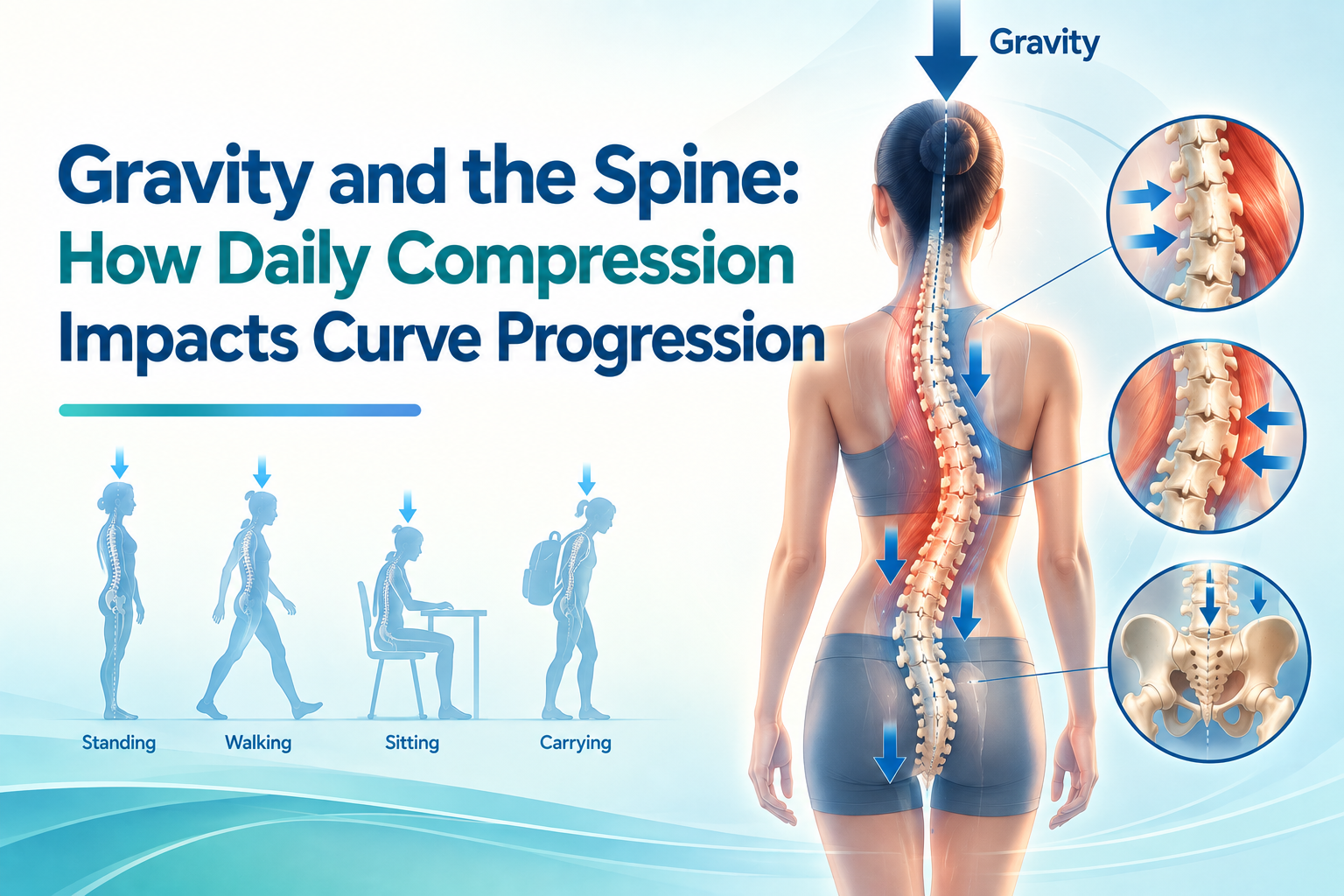
Introduction
Gravity is one of the most constant mechanical forces acting on the human spine.
Every time we stand, walk, sit, or carry something, the spine must support the weight of the head, trunk, and upper limbs while responding to forces generated by the ground, muscles, discs, and surrounding tissues.
For a healthy spine, these forces are distributed through a three-dimensional structure that is continuously adjusting to movement and posture. In scoliosis, however, the geometry of the spine is already altered. A lateral curve, vertebral rotation, changes in sagittal alignment, and asymmetrical loading can modify how gravitational forces are transmitted through the spinal column. [1][2]
This raises an important question:
Can gravity make scoliosis worse?
The answer is more nuanced than simply saying that gravity causes scoliosis.
Current evidence suggests that gravity and mechanical loading can contribute to the progression of an existing spinal deformity, particularly when combined with growth, altered disc mechanics, asymmetric muscle forces, and other biological factors. Computational and biomechanical studies support a model in which asymmetric loading can create a feedback loop during growth. However, gravity alone has not been shown to initiate idiopathic scoliosis in an otherwise normal spine. [2][3][4]
Understanding this distinction is essential for patients and parents.
---
What Does Gravity Actually Do to the Spine?
Gravity pulls the body toward the ground.
When standing, the weight of the head, trunk, and upper limbs generates an axial load through the spinal column.
The spine must resist this load while remaining sufficiently flexible to allow movement.
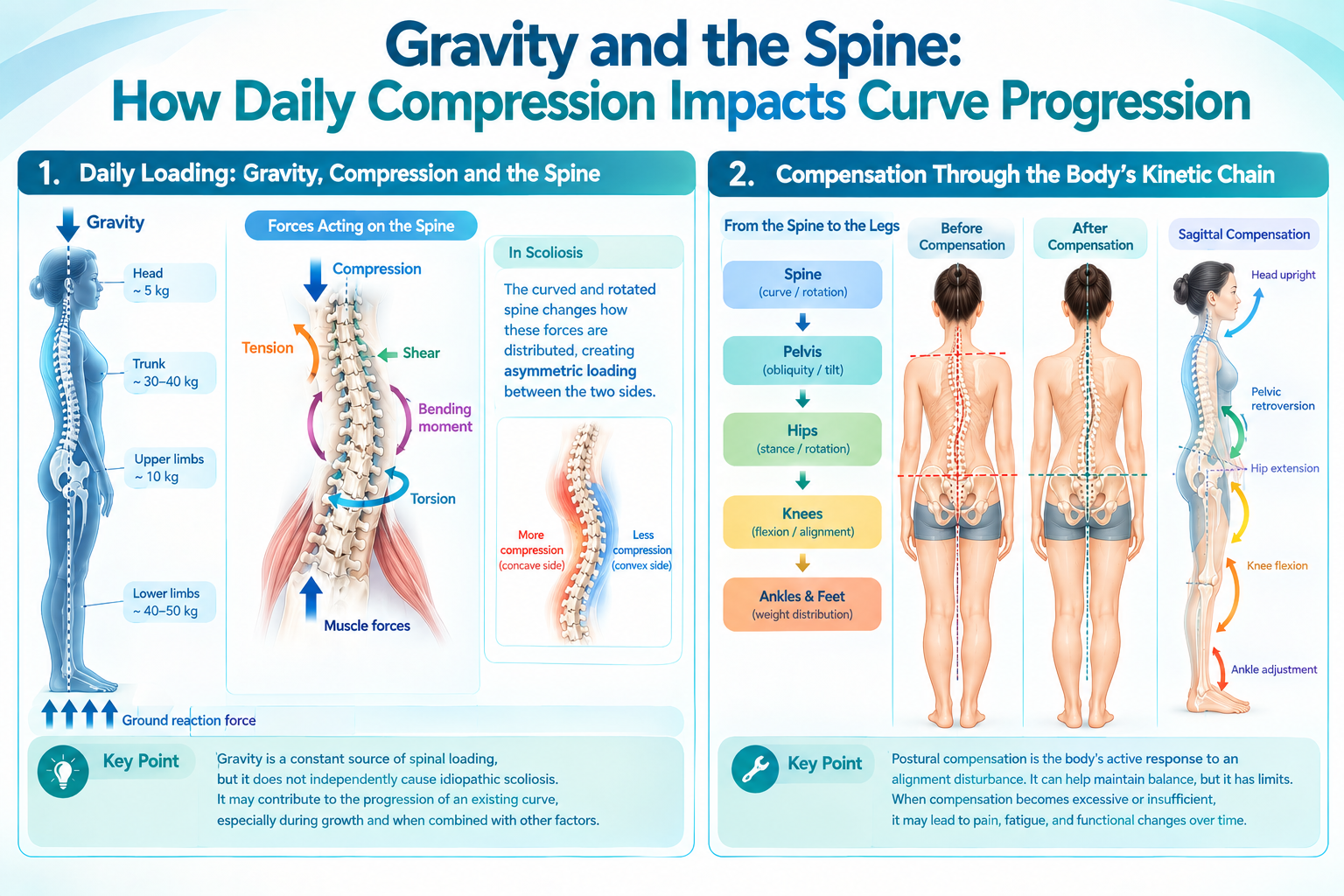
The resulting mechanical environment includes several types of force:
- Compression
- Tension
- Shear
- Bending
- Torsion
- Muscle-generated forces
- Ground-reaction forces
These forces do not act independently.
A change in spinal alignment can alter the direction and magnitude of forces acting on individual vertebrae and discs.
This becomes particularly important in scoliosis because the spine is no longer geometrically symmetrical.
---
Compression Is Not Automatically Harmful
The word compression can sound alarming, but spinal compression is a normal part of everyday life.
Standing produces axial loading.
Walking produces repeated loading and unloading.
Sitting changes the magnitude and direction of spinal forces.
Lifting and carrying can substantially increase mechanical demands.
The intervertebral discs, vertebral bodies, ligaments, and muscles are all designed to tolerate mechanical loading.
The important issue is therefore not whether the spine experiences compression.
It is:
How is compression distributed?
A symmetrical spine can distribute loading relatively evenly.
A curved and rotated spine may distribute loading asymmetrically.
That difference may become important over many months and years.
---
Why a Curved Spine Experiences Asymmetric Loading
Imagine a flexible rod that is perfectly straight.
A downward force applied through its center tends to create relatively symmetrical loading.
Now imagine that the rod is already curved.
The same downward force no longer acts through a symmetrical structure.
The curve changes the location of the body's center of mass relative to the vertebral segments and alters the mechanical moments acting around the spine.
This can create different loading conditions on opposite sides of the curve.
In scoliosis, the concave and convex sides can therefore experience different combinations of:
- compression;
- tension;
- bending moment;
- muscle force;
- disc loading.
Biomechanical studies and computational models have been used to investigate precisely these relationships. [2][3]
---
The Spine Is More Than a Stack of Bones
It is tempting to imagine the spine as a column of vertebrae.
Biomechanically, it is more accurate to think of it as a dynamic system consisting of:
- vertebral bodies;
- intervertebral discs;
- facet joints;
- ligaments;
- muscles;
- connective tissues;
- neural control systems.
The muscles can substantially alter the forces acting on the spine.
For example, the muscles required to maintain an upright posture generate forces that may be several times greater than the external gravitational force acting on a particular segment.
Consequently, the mechanical environment of the spine is determined not only by gravity but also by how the body responds to gravity.
This is one reason why postural control and muscle activation are important components of scoliosis biomechanics. Recent reviews have identified differences in gait, trunk and pelvic motion, postural control, muscle activation, loading patterns, and spinal mobility in adolescents with idiopathic scoliosis. [5]
---
Gravity Does Not Affect Every Curve in the Same Way
The effect of gravitational loading depends partly on the geometry of the curve.
Important factors include:
- curve magnitude;
- curve location;
- vertebral rotation;
- sagittal alignment;
- pelvic position;
- flexibility;
- disc properties;
- muscle activation;
- skeletal maturity.
A thoracic curve does not necessarily behave mechanically like a lumbar curve.
A flexible curve in a young adolescent is also different from a rigid adult deformity.
Computational studies have demonstrated that gravity can produce different effects depending on the pre-existing curve and spinal region. Some simulations found greater progression in thoracolumbar configurations than in certain lumbar configurations when gravity and growth were combined. [3]
This reinforces the idea that “gravity” is not a single mechanical variable with the same effect on every scoliosis patient.
---
Gravity and the Growth of the Spine
The relationship between gravity and scoliosis becomes particularly interesting during growth.
The vertebrae of a child or adolescent are not simply static structures. They are growing tissues.
During periods of rapid growth, the mechanical environment of the spine may influence how vertebral growth occurs.
This concept is central to the Hueter-Volkmann principle, which broadly describes how increased mechanical compression can inhibit growth at a growth plate, while reduced compression can permit relatively greater growth.
In scoliosis research, this principle has been incorporated into theories of mechanical modulation of spinal growth.
Ian Stokes proposed a biomechanical model in which a pre-existing curvature creates asymmetric loading, which may produce asymmetric growth and further increase the curvature. This creates a potential self-reinforcing process sometimes described as a vicious cycle. [4]
The concept is important, but it should not be interpreted as a complete explanation of idiopathic scoliosis.
---
The “Vicious Cycle” Model
A simplified version of the biomechanical progression model is:
Small spinal asymmetry
↓
Asymmetric loading
↓
Unequal mechanical stimulation of growth
↓
Asymmetric vertebral growth
↓
Greater spinal curvature
↓
Greater asymmetric loading
↓
Further progression
This is one of the most influential biomechanical concepts in scoliosis research.
Stokes' mathematical modeling demonstrated that a small lateral curvature could potentially produce asymmetric spinal loading sufficient to contribute to progressive deformity during skeletal growth. [4]
However, scoliosis is multifactorial.
Growth alone does not explain why some children with small curves progress while others remain stable.
Genetic, neurological, hormonal, musculoskeletal, and biomechanical factors may all interact.
---
Gravity Alone Does Not Create Idiopathic Scoliosis
This point deserves emphasis.
If gravity alone caused scoliosis, essentially every human being would develop a progressive spinal curve because everyone lives under Earth's gravitational field.
They do not.
Computational studies provide additional support for this distinction.
In one patient-specific finite element study, gravity acting alone produced lateral deviation in already mildly curved spines, but did not initiate a scoliosis-like deformity in asymptomatic subjects. Progression became more apparent when gravity was combined with anterior spinal growth and reduced disc mechanical stiffness. [3]
This suggests an important model:
Gravity may amplify an existing mechanical asymmetry rather than independently creating idiopathic scoliosis.
That distinction is clinically important.
---
Compression and the Concave Side
In a curved spine, the concave side is generally subjected to greater compressive loading than the convex side in many biomechanical models.
This can create a mechanically asymmetric environment.
If the spine is still growing, greater compression on one side may theoretically influence growth on that side differently from the opposite side.
This concept helps explain why vertebral wedging and progression can become associated with an established curve.
However, real spinal mechanics are considerably more complicated than a simple “compression on the concave side” model.
Muscle forces, vertebral rotation, disc behavior, ligament tension, posture, and three-dimensional geometry all modify the actual loading environment.
---
Vertebral Rotation Changes the Loading Pattern
Scoliosis is a three-dimensional deformity.
The vertebrae do not merely move sideways.
They can also rotate around the spinal axis and change their orientation in the sagittal plane.
This rotation changes:
- the orientation of the vertebral endplates;
- the direction of muscle forces;
- facet-joint loading;
- disc loading;
- the relationship between the center of mass and spinal segments.
Consequently, two spines with the same Cobb angle may experience different internal loading patterns.
The Scoliosis Research Society emphasizes that Cobb angle is primarily a radiographic measure of curvature and does not completely describe three-dimensional spinal deformity. [6]
This is one reason why modern scoliosis biomechanics increasingly uses three-dimensional imaging and computational models.
---
Why the Cobb Angle Alone Cannot Describe Mechanical Stress
The Cobb angle is extremely useful clinically.
It provides a standardized way to quantify the magnitude of a spinal curve and monitor changes over time.
But the Cobb angle does not directly measure:
- vertebral stress;
- disc pressure;
- muscle force;
- spinal compression;
- shear forces;
- torsional loading;
- tissue strain.
Two patients can have the same 30° Cobb angle but different spinal shapes, vertebral rotations, sagittal profiles, and muscle activation patterns.
Therefore:
Curve magnitude ≠ mechanical stress.
Biomechanical research attempts to bridge this gap by estimating internal forces that cannot be measured directly during routine clinical examination.
---
What Happens During Walking?
Gravity is not the only force acting on the spine while walking.
Each step produces a changing pattern of ground-reaction forces.
The spine and pelvis respond dynamically to these forces.
Recent review-level evidence indicates that adolescents with idiopathic scoliosis may demonstrate differences in gait, pelvic movement, trunk movement, balance, muscle activation, and loading patterns compared with individuals without scoliosis. [5]
This means that daily spinal loading is not simply:
Body weight × time standing.
It is a constantly changing mechanical environment.
Walking, running, climbing stairs, carrying a backpack, sitting, and standing all create different loading patterns.
---
Does Standing All Day Make Scoliosis Progress?
There is currently no strong clinical evidence showing that simply standing for long periods causes adolescent idiopathic scoliosis to progress.
This distinction is important because people sometimes assume:
More time upright = more gravity = faster scoliosis progression.
The relationship is not that simple.
The spine is designed to tolerate daily gravitational loading.
Progression depends on many factors, particularly in adolescents:
- initial curve magnitude;
- curve type;
- skeletal maturity;
- growth velocity;
- remaining growth;
- sex;
- curve flexibility;
- vertebral rotation;
- other biological and mechanical factors.
The Scoliosis Research Society notes that larger curves and greater remaining growth are associated with greater risk of progression, while individual prediction remains difficult. [7]
A systematic review likewise found that Cobb angle, curve type, and flexibility are among the more consistently supported predictors of progression. [8]
Therefore, it would be misleading to tell patients that ordinary standing or walking is damaging their spine simply because gravity is present.
---
Growth Matters More Than Gravity Exposure Alone
The most important period for many cases of adolescent idiopathic scoliosis is skeletal growth.
During rapid growth, vertebral tissues are changing quickly.
A mechanical asymmetry that might have little structural consequence in a mature spine could potentially interact differently with growing vertebrae.
Research on untreated adolescent idiopathic scoliosis has consistently shown that curve progression is strongly related to growth velocity and skeletal maturity. [9]
The SRS similarly states that curves are more likely to progress when a patient is farther from full skeletal growth. [7]
Therefore, when discussing gravity and scoliosis progression, the more accurate concept is:
Gravity + existing deformity + growth + tissue properties + neuromuscular control
rather than:
Gravity alone.
---
What Happens When Disc Stiffness Changes?
Intervertebral discs contribute significantly to spinal mechanics.
A healthy disc allows movement while distributing loads between adjacent vertebral bodies.
If disc mechanical properties change, the way gravitational forces are distributed can also change.
Patient-specific finite element models have demonstrated that reduced disc stiffness can amplify the effects of gravity and growth on a pre-existing spinal curve. [10]
This provides one possible explanation for why mechanical loading may have a greater effect under certain biological conditions.
It also highlights the limitation of thinking about scoliosis as a simple bone problem.
The mechanical properties of the entire spinal motion segment matter.
---
Gravity, Muscle Forces, and Posture
The body actively responds to gravity.
Paraspinal and trunk muscles continuously adjust their activity to keep the head and trunk upright.
If the spine is curved, maintaining an upright position may require asymmetric muscle forces.
This can produce a feedback relationship:
Spinal asymmetry
→
Altered muscle activation
→
Asymmetric spinal loading
→
Further mechanical adaptation
Recent biomechanical reviews describe adolescent idiopathic scoliosis as involving interactions among passive structures such as bone and ligaments, active structures such as muscles, and neural control systems. [2]
This is why the mechanical effect of gravity cannot be separated completely from neuromuscular control.
---
Is Compression Always Bad for Bone?
No.
Mechanical loading is essential for healthy bone.
Bones respond to mechanical stimulation, and appropriate loading is part of normal skeletal development.
The problem in scoliosis is not simply “too much compression.”
It is potentially uneven or asymmetric loading within a developing and already deformed spine.
This distinction is important.
The objective of scoliosis management is therefore not to eliminate spinal loading.
It is to promote appropriate alignment, movement, muscle control, and mechanical distribution while reducing excessive or harmful asymmetry when possible.
---
Gravity and Bracing
Bracing is another example of how mechanical forces can be deliberately modified.
A scoliosis brace does not remove gravity.
Instead, it applies external forces designed to influence the position and loading of the trunk and spine.
The biomechanical principle involves a combination of:
- corrective forces;
- counterforces;
- pressure zones;
- areas of relief;
- three-dimensional trunk shaping.
The SRS explains that the goal of bracing in growing adolescents is generally to prevent or reduce progression rather than permanently cure the structural curve. [11]
This provides a useful clinical analogy:
Gravity continuously influences the spine, while a brace attempts to modify how the body responds to those forces.
---
Can Exercise Change How the Spine Handles Gravity?
Exercise does not switch gravity off.
Instead, it can influence the way the body controls and distributes mechanical forces.
Scoliosis-specific exercise programs may target:
- active self-correction;
- trunk muscle coordination;
- postural awareness;
- breathing;
- balance;
- movement control;
- endurance.
Recent evidence supports the use of physiotherapeutic scoliosis-specific exercises in appropriately selected patients, although the magnitude and quality of evidence vary across outcomes and techniques. [12]
The potential benefit is therefore better understood as improving neuromuscular control and mechanical behavior, rather than physically eliminating gravitational compression.
---
Why Posture Matters
Posture determines how the body's mass is positioned relative to the supporting joints.
A person who stands with the trunk shifted forward or sideways changes the moment arms of gravitational forces.
The muscles must then generate different counterforces to maintain equilibrium.
For example, a forward shift of the trunk can increase the demand on posterior spinal and hip muscles.
Similarly, lateral trunk displacement can increase asymmetrical loading.
This is one reason postural compensation can become mechanically important over time.
However, posture is dynamic, and no single “perfect” position exists.
The body naturally moves and changes its loading pattern throughout the day.
---
Sitting Does Not Eliminate Spinal Loading
Another common misconception is that gravity primarily affects the spine while standing.
Sitting also produces spinal loading.
The magnitude and distribution differ depending on:
- seat design;
- pelvic position;
- lumbar posture;
- trunk angle;
- duration;
- muscle activation.
A slouched posture changes the geometry of the lumbar spine and pelvis and can alter the distribution of forces through the discs and posterior structures.
Nevertheless, ordinary sitting should not be described as a cause of idiopathic scoliosis.
There is insufficient evidence to claim that sitting posture alone creates adolescent idiopathic scoliosis.
---
Carrying Backpacks and Daily Loads
External loads can increase spinal forces.
A backpack, heavy schoolbag, sports equipment, or occupational load adds mass to the body and can change trunk posture.
The response depends on:
- load magnitude;
- load position;
- duration;
- symmetry;
- individual's posture;
- muscle strength;
- spinal alignment.
A person with scoliosis may adapt differently to an external load than someone with a symmetrical spine.
However, there is insufficient evidence to conclude that ordinary backpack use causes idiopathic scoliosis.
Parents should therefore focus on reasonable load management and comfortable carrying strategies rather than assuming that every daily load will accelerate the curve.
---
Gravity and the “Vicious Cycle” of Progression
The most interesting biomechanical concept is the possibility of a self-reinforcing loop.
Consider an already curved spine:
Pre-existing curve
↓
Asymmetric gravitational loading
↓
Unequal stress and strain
↓
Altered growth or tissue adaptation
↓
Greater curvature
↓
Greater asymmetry
↓
More asymmetric loading
This model is supported by mathematical and computational research and is biologically plausible during growth. [3][4]
But it should not be presented as a proven universal mechanism of idiopathic scoliosis.
Current research continues to describe AIS as a multifactorial condition.
Mechanical loading may be one component of a larger biological system.
---
Why Some Curves Progress and Others Do Not
If gravitational loading contributes to progression, why do some scoliosis curves remain stable?
Because mechanical loading is only one part of the equation.
Progression is influenced by:
- curve magnitude;
- curve pattern;
- skeletal maturity;
- growth velocity;
- vertebral rotation;
- curve flexibility;
- genetic and biological factors;
- neuromuscular control;
- spinal tissue properties.
A 2024 systematic review of skeletal maturity indices emphasized that no single predictor can reliably explain the progression of every adolescent idiopathic scoliosis curve. [13]
Another systematic review found strong evidence for initial Cobb angle and moderate evidence for curve type and flexibility as predictors of progression in different treatment contexts. [8]
This reinforces a key principle:
Mechanical loading matters, but it is not destiny.
---
A Three-Dimensional Model of Gravity and Scoliosis
A useful conceptual model is to view gravity as acting on a three-dimensional structure.
Coronal plane
Gravity can contribute to lateral bending moments when the trunk and spinal mass are displaced from the center of support.
Sagittal plane
Gravity influences the relationship between the head, trunk, pelvis, and feet and therefore affects sagittal balance.
Transverse plane
Vertebral rotation changes the orientation of anatomical structures and can modify the way muscles and other tissues respond to loading.
These planes interact.
A scoliosis curve is therefore not simply a sideways deviation under a downward force.
It is a three-dimensional mechanical system.
---
Can Gravity Explain Vertebral Wedging?
Biomechanical models suggest that asymmetric loading during growth can contribute to vertebral wedging.
If one side of a vertebral growth region experiences different mechanical conditions from the other, growth may become asymmetric.
Over time, this can reinforce the three-dimensional shape of the vertebral column.
However, vertebral wedging in scoliosis should not be interpreted as proof that gravity was the original cause.
The relationship may involve:
- growth biology;
- mechanical loading;
- vertebral geometry;
- disc behavior;
- muscle forces;
- genetic susceptibility.
The current evidence supports interaction rather than a single-cause explanation. [2][4]
---
What This Means for Patients
For a patient or parent, the most important message is reassuring:
You do not need to fear ordinary gravity.
Standing, walking, sitting, and normal daily activity are not inherently damaging to a scoliotic spine.
In fact, maintaining appropriate physical activity is generally an important part of healthy musculoskeletal function.
The concern is not gravity itself.
The scientific question is how gravitational loading interacts with an already asymmetric and growing spine.
This is particularly relevant when monitoring an adolescent during periods of rapid growth.
---
What Clinicians Monitor During Growth
Because growth strongly affects progression risk, clinicians may monitor:
- Cobb angle;
- curve pattern;
- skeletal maturity;
- growth velocity;
- vertebral rotation;
- curve flexibility;
- sagittal alignment;
- pelvic alignment;
- clinical trunk asymmetry.
Standing radiographs are commonly used to quantify the spinal curve and assess changes over time. The SRS notes that a standing full-spine X-ray is used to evaluate scoliosis and measure the Cobb angle. [14]
Importantly, repeated imaging should be clinically justified because radiation exposure, although low with modern techniques, should still be minimized.
---
The Future of Gravity-Based Scoliosis Research
Computational biomechanics may eventually allow clinicians to estimate how an individual's unique spinal geometry responds to gravitational loading.
Patient-specific models can potentially incorporate:
- three-dimensional spinal shape;
- vertebral geometry;
- disc properties;
- muscle forces;
- growth characteristics;
- external loading.
Systematic reviews of scoliosis modeling have shown rapid development in finite element and other computational approaches for understanding stresses, strains, and curve progression. [15]
However, these methods are not yet routine clinical tools for predicting exactly how an individual patient's curve will behave.
The translation from sophisticated computer modeling to everyday clinical decision-making remains an important research challenge. [5]
---
Gravity, Compression, and the Future of Scoliosis Treatment
Future scoliosis treatment may increasingly focus on how forces are distributed, rather than simply how much the spine is curved.
Potential strategies include:
- patient-specific bracing;
- individualized exercise;
- three-dimensional postural correction;
- muscle activation training;
- computational modeling;
- wearable movement monitoring;
- improved growth prediction;
- biomechanically informed interventions.
The ultimate goal would be to identify patients whose mechanical environment places them at greater risk of progression and intervene before a small deformity becomes a larger structural problem.
That approach would complement, rather than replace, established clinical measures such as the Cobb angle and skeletal maturity.
---
A Broader Biomechanical Perspective
Gravity should be considered one component of a much larger system.
The spine is constantly exposed to:
Gravity + muscle forces + ground-reaction forces + tissue stiffness + growth + movement + posture
These forces interact continuously.
When the spine is straight and balanced, the system can distribute loads efficiently.
When the spine becomes curved and rotated, loading becomes more asymmetric.
If the individual is still growing, that asymmetry may have greater significance because the tissues are actively changing.
This provides a reasonable biomechanical explanation for why an existing scoliosis curve may progress during growth.
But it does not mean that gravity independently causes scoliosis.
---
A Pattern-Based Approach to Spinal Loading
Instead of asking only:
“How much compression is the spine experiencing?”
a more clinically useful question may be:
“Where is the load being transmitted, and how does the body compensate for it?”
Assessment can consider:
- Cobb angle;
- vertebral rotation;
- curve location;
- sagittal alignment;
- pelvic position;
- muscle asymmetry;
- trunk shift;
- skeletal maturity;
- movement patterns;
- curve flexibility.
This approach connects radiographic structure with biomechanics and functional movement.
A clinician-developed framework such as JESU5C and HGMT similarly emphasizes individualized scoliosis patterns and structural balance. It should be understood as a clinician-developed framework requiring further independent validation, rather than as established evidence that a specific loading pattern causes idiopathic scoliosis. [16]
---
Key Takeaways
- Gravity is a constant source of spinal loading, but gravity alone does not cause idiopathic scoliosis.
- Normal standing and walking are not inherently harmful to people with scoliosis.
- A pre-existing spinal curve can change how gravitational forces are distributed through the spine.
- Asymmetric loading may become particularly important when the spine is still growing.
- Computational models suggest that the combination of pre-existing curvature, gravity, growth, and altered tissue properties can contribute to curve progression. [3][4]
- The concave and convex sides of a curve may experience different mechanical loading.
- Vertebral rotation makes the loading pattern three-dimensional.
- Muscle forces are an important part of the spinal mechanical environment and interact with gravitational forces.
- Growth velocity and skeletal maturity are major factors in scoliosis progression risk. [7][9][13]
- The Cobb angle measures curve magnitude but does not directly measure spinal stress, compression, or muscle forces.
- Scoliosis-specific exercise and bracing aim in part to influence alignment and mechanical behavior, but neither eliminates gravitational loading. [11][12]
- Patient-specific computational modeling may eventually help predict how individual spines respond to mechanical loading.
- The most accurate model is not “gravity causes scoliosis,” but rather “gravity interacts with an existing spinal asymmetry, growth, tissue properties, and neuromuscular control.”
References
[1] Scoliosis Research Society. “Glossary.” Scoliosis Research Society.
[2] Li, D., Mo, H., & Yang, S. “From a biomechanical perspective: pathogenesis, clinical manifestations and treatment strategies of adolescent idiopathic scoliosis.” Frontiers in Pediatrics. 2025. PubMed.
[3] Villemure, I., Aubin, C.-É., Dansereau, J., & Labelle, H. “Analysis of idiopathic scoliosis progression by using numerical simulation.” Clinical Biomechanics. 2010. PubMed.
[4] Stokes, I. A. F. “Mechanical modulation of spinal growth and progression of adolescent scoliosis.” Studies in Health Technology and Informatics. 2008. PubMed.
[5] Chockalingam, N., Jasani, V., Gardner, A., & Needham, R. “Movement Related Biomechanics in Adolescent Idiopathic Scoliosis: A Review of Reviews.” Studies in Health Technology and Informatics. 2026. PubMed.
[6] Scoliosis Research Society. “Glossary: Cobb Method and Curvature Angle.” Scoliosis Research Society.
[7] Scoliosis Research Society. “Living with Scoliosis.” Scoliosis Research Society.
[8] “Curve type, flexibility, correction, and rotation are predictors of curve progression in patients with adolescent idiopathic scoliosis undergoing conservative treatment: a systematic review.” European Spine Journal. 2022. PubMed.
[9] Nachemson, A. L., & Peterson, L.-E. “Effectiveness of treatment with a brace in girls who have adolescent idiopathic scoliosis. A prospective, controlled study based on data from the Brace Study of the Scoliosis Research Society.” Journal of Bone and Joint Surgery. Related evidence on growth and progression. PubMed.
[10] “Analysis of the mechanisms of idiopathic scoliosis progression using finite element simulation.” European Spine Journal. 2008. PubMed.
[11] Scoliosis Research Society. “Bracing.” Scoliosis Research Society.
[12] “Physiotherapeutic Scoliosis-Specific Exercise for the Treatment of Adolescent Idiopathic Scoliosis: A Systematic Review and Network Meta-analysis.” 2024. PubMed.
[13] Manzetti, M., et al. “Is there a skeletal age index that can predict accurate curve progression in adolescent idiopathic scoliosis? A systematic review.” Pediatric Radiology. 2024. PubMed.
[14] Scoliosis Research Society. “Diagnosing Scoliosis.” Scoliosis Research Society.
[15] Smit, T. H., et al. “Current models to understand the onset and progression of scoliotic deformities in adolescent idiopathic scoliosis: a systematic review.” 2022. PubMed.
[16] LEE, Yongsub, & Lee, Minsu (translator). [Scoliosis, Meridian-Based Isometric Exercises and JESU5C Pattern Suit: “JESU5C” a New Classification of Idiopath]()