Spine Care
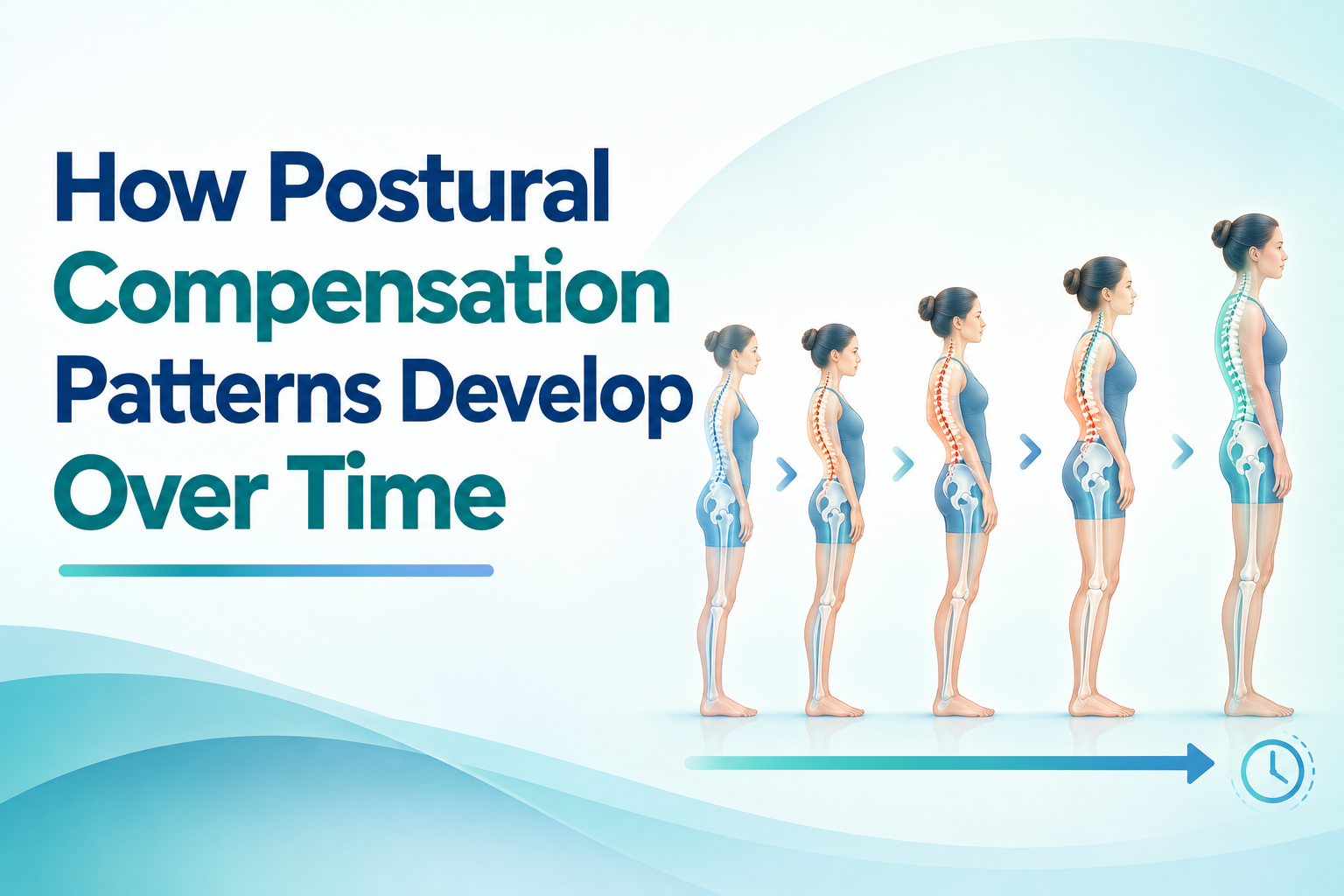
[Biomechanics, Tensegrity & Meridian Concepts 07] How Postural Compensation Patterns Develop Over Time
Learn how scoliosis can trigger postural compensation, how the body adapts through the spine, pelvis, hips, and legs, and why these patterns may change as scoliosis progresses.
Introduction
The human body rarely allows a spinal imbalance to remain isolated.
When the spine begins to deviate from its optimal alignment, the nervous and musculoskeletal systems continuously adjust posture to keep the head upright, maintain the eyes level, distribute body weight, and preserve the ability to stand and walk. These adjustments are known as postural compensation patterns.
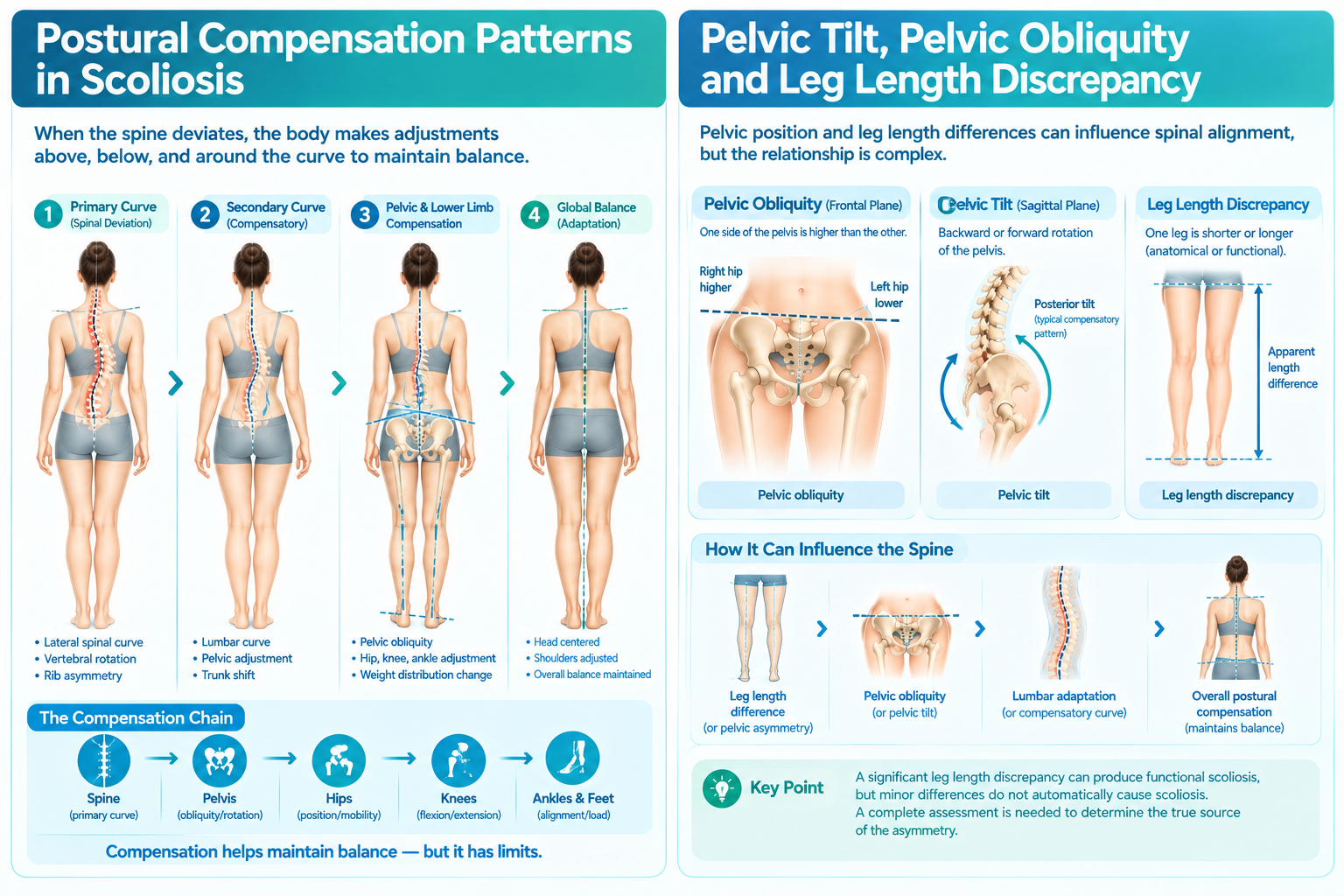
In scoliosis, compensation can occur above and below the primary curve. A secondary curve may develop, the pelvis may change position, the shoulders may shift, and muscles may alter their activity. In more advanced spinal deformity, compensation can extend into the hips, knees, and ankles. [1][2]
Importantly, compensation is not necessarily harmful. In its early stages, it is often an adaptive mechanism that helps a person maintain balance despite spinal asymmetry. The problem arises when compensation becomes persistent, increasingly demanding, or insufficient to maintain overall balance.
Understanding how these patterns develop over time provides a more complete picture of scoliosis than looking at the Cobb angle alone.
---
What Is Postural Compensation?
Postural compensation is the body's active adjustment of one or more body segments in response to an alignment disturbance elsewhere.
The Scoliosis Research Society distinguishes between balance and compensation. Balance describes the resulting alignment of the body, while compensation refers to the active process through which the body attempts to achieve that balanced position. [1]
In practical terms:
A spinal curve creates an imbalance → the body changes another segment → overall alignment improves.
For example, a person with a structural thoracic curve may develop a smaller curve in the lumbar region that helps keep the trunk centered over the pelvis.
The secondary curve is called a compensatory curve when it develops above or below a primary structural curve to help maintain body alignment. [2]
Compensation can therefore be viewed as a form of biological problem-solving.
---
Why Does the Body Compensate?
The body has several important postural priorities.
It attempts to:
- keep the head relatively upright;
- maintain horizontal visual orientation;
- keep the trunk over the pelvis;
- maintain the body's center of mass within a stable base of support;
- distribute forces efficiently;
- preserve walking and standing ability;
- prevent excessive loading on individual joints and muscles.
These priorities involve the nervous system, vestibular system, vision, proprioception, muscles, joints, and skeletal structures.
Research in adolescent idiopathic scoliosis has identified differences in postural control, balance, gait, pelvic and trunk movement, muscle activation, and loading patterns compared with individuals without scoliosis. [3][4]
This means that postural compensation is not simply a visible change in the shape of the back. It is a whole-body process.
---
Stage 1: The Initial Asymmetry
Postural compensation may begin with a relatively small asymmetry.
This could involve:
- a developing spinal curve;
- pelvic asymmetry;
- altered trunk position;
- lower-limb asymmetry;
- differences in muscle activation;
- changes in balance or proprioception.
At this stage, the person may not consciously notice anything.
The nervous system continuously receives information from the eyes, vestibular system, joints, muscles, and skin. It uses this information to adjust muscle activity and joint position.
In adolescent idiopathic scoliosis, research has identified differences in sensory integration, postural control, and balance compared with controls. A systematic review concluded that abnormalities in visual-spatial perception, body orientation, and sensory integration may be involved in the postural response associated with scoliosis. [4]
This does not mean that impaired balance causes every case of scoliosis. Rather, it suggests that the developing spinal deformity and the systems responsible for controlling posture may interact.
---
Stage 2: The Body Creates a Compensation
Asymmetry that persists requires repeated adjustment.
Suppose the thoracic spine moves laterally toward one side.
The body may respond by shifting another region in the opposite direction.
This can produce a pattern such as:
Primary thoracic curve → compensatory lumbar curve → pelvis remains relatively centered
The secondary curve may initially be flexible.
The Scoliosis Research Society describes a compensatory curve as a secondary curve above or below the structural curvature that develops to maintain normal body alignment. [2]
This is an important distinction because not every curve seen on an X-ray has the same structural significance.
A major structural curve and a flexible compensatory curve may look different on standing and bending radiographs.
---
Stage 3: Muscle Activation Changes
Maintaining a compensated posture requires muscular control.
The muscles surrounding the spine, pelvis, hips, and legs may alter their activation to stabilize the body.
This can contribute to:
- asymmetric muscle tone;
- different muscle activation patterns;
- increased endurance demands;
- localized fatigue;
- changes in muscle stiffness;
- altered movement strategies.
Research using electromyography and other quantitative methods has found evidence of altered neuromuscular function in adolescent idiopathic scoliosis, although findings are not completely uniform across studies. [4]
More recent research has also demonstrated that individuals with adolescent idiopathic scoliosis can use different multi-segmental strategies during balance tasks, involving the trunk, pelvis, and lower limbs. [5]
This helps explain why a person may develop a sensation of one side of the back working harder than the other.
The muscle difference may be part of the body's attempt to maintain equilibrium rather than the original cause of the spinal deformity.
---
Stage 4: The Pelvis Becomes Part of the Compensation
When spinal alignment changes, the pelvis often becomes an important link between the trunk and lower limbs.
In the coronal plane, the pelvis may develop pelvic obliquity, with one side positioned higher than the other.
In the sagittal plane, the pelvis may rotate or tilt to help maintain global balance.
These are different mechanisms and should not be confused.
A pelvic adjustment may temporarily improve the position of the trunk, but it can also change loading through the hips and lower extremities.
The Scoliosis Research Society recognizes pelvic position and pelvic obliquity as important components of spinal deformity assessment. [1]
This is why a scoliosis assessment should not stop at the vertebral curve.
---
Stage 5: The Head and Shoulders Adapt
The body prioritizes keeping the head upright.
If the trunk shifts laterally, the upper spine and shoulder girdle may adapt to keep the head closer to the body's central axis.
This can create visible patterns such as:
- one shoulder appearing higher;
- uneven shoulder prominence;
- lateral trunk shift;
- head shifted relative to the pelvis;
- asymmetric neck muscle activity.
These changes do not necessarily represent separate diseases.
They may be components of the body's attempt to maintain global balance.
The SRS defines spinal balance in relation to the alignment of the upper spine with the sacrum and pelvis and emphasizes that balance is a property of the spine as a whole rather than simply one local region. [1]
---
Stage 6: Compensation Becomes a Repeated Movement Strategy
A posture that is repeatedly used can gradually become the body's preferred movement strategy.
This is especially important during growth.
A child or adolescent does not remain in one static position. They:
- sit;
- stand;
- walk;
- run;
- carry objects;
- participate in sports;
- bend;
- rotate;
- sleep in different positions.
If an asymmetrical strategy is repeatedly used, the neuromuscular system may become increasingly familiar with that strategy.
This does not mean that posture alone causes idiopathic scoliosis.
Instead, it means that the body can adapt to an existing structural or functional asymmetry through repeated movement.
Recent reviews of movement-related biomechanics in adolescent idiopathic scoliosis have identified differences in gait, pelvic and trunk motion, balance, postural control, muscle activation, loading patterns, and spinal mobility. [3]
---
Stage 7: Compensation Can Spread Through the Kinetic Chain
The body does not compensate only at the spine.
The entire kinetic chain can participate.
A simplified sequence can be:
Spine → pelvis → hip → knee → ankle → foot
or, depending on the direction of imbalance:
Foot → ankle → knee → hip → pelvis → spine
This is particularly important in adults with significant sagittal spinal deformity.
When lumbar lordosis is reduced, the pelvis may rotate backward to help maintain an upright trunk. If pelvic compensation becomes insufficient, the hips and knees may also change their position. [6][7]
Studies of adult spinal deformity have demonstrated compensation through pelvic retroversion, hip position, knee flexion, ankle position, and changes in the location of the pelvis relative to the feet. [7][8]
Thus, a person with spinal deformity may appear to have a knee or hip posture problem when the lower-limb position is actually part of a larger compensation strategy.
---
Stage 8: Sagittal Compensation Becomes Increasingly Important
Many people associate scoliosis primarily with side-to-side curvature.
However, the spine functions in three dimensions.
The sagittal plane—the side view—is especially important for understanding compensation.
A person with loss of lumbar lordosis may develop:
Reduced lumbar lordosis → pelvic retroversion → hip extension → knee flexion
These mechanisms help keep the head and trunk in a more upright position.
The Scoliosis Research Society describes this process in fixed sagittal imbalance: patients may bend their hips and knees to compensate for loss of spinal alignment and maintain an upright posture. [9]
Research has also demonstrated that pelvic tilt is an important compensatory mechanism when lumbar lordosis is reduced, while hip extension and knee flexion can provide additional compensation. [6]
---
Stage 9: Compensation Has a Capacity
The body can compensate—but compensation is not unlimited.
Every individual has a certain capacity to adjust posture while maintaining acceptable balance.
Early in a deformity, the body may be able to compensate effectively.
As the deformity becomes more pronounced, however, one compensation may become insufficient and another may be recruited.
Research in adult spinal deformity demonstrates a progression in which pelvic retroversion and changes in thoracic alignment can contribute to compensation initially, while increasing deformity may lead to greater recruitment of the lower limbs, including knee flexion and pelvic shift. [7]
This can be understood as a compensation cascade.
For example:
Spinal imbalance
↓
Pelvic compensation
↓
Hip adjustment
↓
Knee flexion
↓
Ankle adjustment
↓
Increasing muscular demand
The exact sequence differs among individuals, but the general principle is that compensation can migrate through multiple body segments.
---
Stage 10: Compensation May Become Exhausted
Eventually, a person may no longer be able to maintain normal global alignment through compensation.
This is sometimes described as decompensation.
The SRS defines decompensation in scoliosis as a loss of spinal balance, including situations in which the thoracic cage is no longer centered over the pelvis. [2]
In sagittal deformity, the SRS distinguishes between flexible imbalance, where a person can still straighten with effort, and fixed imbalance, where the person cannot fully restore an upright posture despite attempting to do so. [9]
This distinction is clinically important.
A person may appear relatively balanced while standing because the pelvis and legs are compensating for the spinal deformity.
A radiograph alone may therefore underestimate how much effort the body is using to maintain that position.
---
What Happens When Compensation Becomes Excessive?
Compensation can be useful in the short term.
But maintaining a compensatory posture for long periods may increase mechanical demands on muscles and joints.
Research in adult spinal deformity has demonstrated altered standing balance and differences in hip, knee, pelvic, and ground-reaction-force parameters compared with healthy controls. [8]
When the lower limbs are recruited heavily to compensate for spinal malalignment, the person may experience:
- muscle fatigue;
- reduced walking tolerance;
- hip discomfort;
- knee discomfort;
- altered gait;
- reduced balance;
- increased energy expenditure;
- difficulty standing for long periods.
Not every patient develops these symptoms, and the presence of a compensatory posture does not automatically mean that damage is occurring.
The clinical significance depends on the magnitude, duration, flexibility, age, joint condition, and overall functional demands.
---
Compensation and Pain Are Not the Same Thing
A common misconception is:
“If my posture is asymmetrical, it must be causing my pain.”
This is not necessarily true.
Many people with scoliosis have little or no pain.
Conversely, a person can have significant pain with relatively modest radiographic deformity.
Pain can arise from multiple structures, including:
- muscles;
- facet joints;
- discs;
- sacroiliac joints;
- hips;
- nerves;
- other musculoskeletal tissues.
Therefore, a compensatory posture should be evaluated as part of the overall clinical picture rather than automatically labeled as the source of pain.
---
Compensation During Movement Is Different From Compensation While Standing
Postural assessment often focuses on standing X-rays.
However, the body is dynamic.
A person who appears balanced while standing may use a very different strategy while:
- walking;
- climbing stairs;
- bending;
- reaching;
- carrying weight;
- turning;
- standing on one leg.
Recent research in adolescent idiopathic scoliosis has emphasized that static radiographs do not fully capture the movement-related expression of the deformity. Reviews have identified differences in gait, pelvic and trunk motion, balance, muscle activation, and loading patterns. [3]
This is an important reason to consider dynamic assessment in addition to static alignment.
---
Why Compensation Patterns Can Change With Age
Compensation is influenced by the person's physical capacity.
A young person may have:
- greater joint mobility;
- stronger muscles;
- better balance;
- greater adaptability;
- fewer degenerative changes.
An older adult may have:
- reduced hip mobility;
- knee osteoarthritis;
- ankle stiffness;
- muscle weakness;
- degenerative spinal changes;
- reduced balance.
Consequently, two people with similar spinal alignment may compensate very differently.
Research in adult spinal deformity has shown that age influences the recruitment of compensatory mechanisms. As deformity increases, the contribution of pelvic and thoracic compensation may become limited, with greater reliance on lower-extremity mechanisms. [7]
This means that the same spinal deformity can produce different postural appearances at different stages of life.
---
How Growth Can Affect Compensation in Adolescents
Adolescence presents a special situation because the skeleton is changing rapidly.
During growth, the spine, pelvis, muscles, and connective tissues are all adapting simultaneously.
If scoliosis progresses during a growth spurt, the body may repeatedly adjust its posture as the structural relationship between different spinal segments changes.
This can create a moving target for the neuromuscular system.
A teenager may therefore demonstrate different postural characteristics at different stages of growth even when the underlying diagnosis remains adolescent idiopathic scoliosis.
Skeletal maturity is consequently an important factor when clinicians evaluate curve progression and treatment strategy.
---
Structural Curves and Compensatory Curves
One of the most important clinical distinctions is whether a curve is structural or compensatory.
The SRS defines a structural curve as one that does not correct to zero during maximal voluntary side-bending radiographs. [1]
A compensatory curve may be more flexible.
For example:
Primary structural thoracic curve
↓
Flexible lumbar compensatory curve
The lumbar curve may partially disappear when the patient bends toward the appropriate side.
This flexibility can help clinicians determine which curves are primary and which are compensatory.
The distinction is particularly important when treatment decisions are being considered.
---
The Role of the Cobb Angle
The Cobb angle remains one of the principal measurements used to quantify scoliosis.
However, it should not be interpreted as a complete measurement of compensation.
Two patients can have similar Cobb angles but very different:
- pelvic positions;
- trunk shifts;
- sagittal alignment;
- vertebral rotation;
- muscle activation;
- gait patterns;
- balance strategies.
The SRS's three-dimensional terminology recognizes frontal, sagittal, and transverse-plane components of spinal deformity as well as global balance. [1]
Therefore, a complete assessment should consider more than the size of the curve.
---
Why the Body May Look “Straighter” Than the Spine Really Is
A particularly interesting phenomenon occurs when effective compensation hides the apparent severity of a structural deformity.
Imagine that a thoracic curve shifts the trunk toward one side.
The lumbar spine may curve in the opposite direction.
The pelvis may shift.
The shoulders may reposition.
The head may move back toward the body's center.
The final external appearance may therefore be relatively balanced even though the spine contains substantial structural curvature.
This is one reason why global balance and local curvature are different concepts.
A well-compensated spine may have significant structural deformity while maintaining relatively good overall alignment.
---
When Compensation Becomes a Problem
Compensation becomes clinically concerning when it is:
- painful;
- increasingly rigid;
- associated with neurological symptoms;
- associated with declining function;
- placing excessive demands on the hips or knees;
- accompanied by progressive loss of balance;
- no longer sufficient to keep the trunk centered.
In adult spinal deformity, progressive loss of compensation can result in a visibly forward-shifted trunk and difficulty maintaining an upright posture. [8][9]
In adolescents, the situation is different. A compensatory curve may remain flexible and asymptomatic, but its relationship to the primary structural curve still matters for monitoring and treatment.
---
Can Postural Compensation Be Retrained?
In some patients, rehabilitation can improve postural control and movement strategy.
Scoliosis-specific exercise approaches often emphasize:
- three-dimensional self-correction;
- trunk elongation;
- rotational control;
- breathing coordination;
- pelvic control;
- muscle activation;
- functional integration.
Research on Schroth-based approaches and other physiotherapeutic scoliosis-specific exercises suggests potential improvements in postural control, balance, Cobb angle, trunk rotation, and quality of life, although the strength of evidence varies across outcomes and studies. [10][11]
The goal is not simply to force the body into a symmetrical position.
Rather, rehabilitation aims to improve the person's ability to recognize and actively control their alignment.
---
Why “Perfect Posture” Is Not the Goal
Healthy posture is not a rigid position.
Even people without scoliosis constantly move their weight from one leg to the other, adjust their pelvis, sway slightly, and change muscle activity.
The SRS notes that sagittal balance is not necessarily a perfectly vertical or zero-offset position and that posture changes continuously through normal postural sway. [1]
Therefore, the goal of scoliosis management should not be to eliminate every asymmetry.
The more meaningful goals are:
- maintaining functional balance;
- improving movement efficiency;
- controlling unnecessary compensatory stress;
- preserving mobility;
- maintaining strength;
- reducing symptoms when present;
- supporting long-term function.
---
A Whole-Body Model of Postural Compensation
A useful way to understand compensation is to think of the body as an interconnected system:
Spine
↓
Pelvis
↓
Hips
↓
Knees
↓
Ankles and feet
At the same time, compensation can travel upward:
Pelvis
↑
Lumbar spine
↑
Thoracic spine
↑
Cervical spine
↑
Head and visual system
The nervous system continuously coordinates these regions.
This explains why a localized spinal deformity can eventually produce changes in posture throughout the body.
It also explains why treating only the most visibly curved part of the spine may not always address the complete functional pattern.
---
A Biomechanical View: Compensation as Load Redistribution
From a biomechanical perspective, compensation can be understood as a process of redistributing forces and moments.
When alignment changes, the location of the body's center of mass relative to the supporting joints also changes.
The body then modifies joint angles and muscle activity to maintain equilibrium.
For example, in adult sagittal deformity, pelvic retroversion and knee flexion can shift the body toward a more stable position over the feet. [6][7]
This strategy can be highly effective.
But it may also increase the mechanical demands placed on the muscles and joints that are maintaining the compensation.
The result is not necessarily immediate injury. Instead, it may represent an increase in the physiological cost of maintaining posture.
---
Compensation Is Not Always the Cause of Progression
This distinction is essential.
When clinicians observe a compensatory posture, it can be tempting to conclude that the compensation itself is causing the scoliosis to progress.
Current evidence does not support such a simple explanation.
In adolescent idiopathic scoliosis, the causes of initiation and progression remain incompletely understood. Biomechanical, neuromuscular, genetic, growth-related, and other factors may interact. [4][12]
Postural compensation should therefore be regarded primarily as an adaptive response and biomechanical feature rather than automatically as the primary cause of scoliosis.
At the same time, altered loading and muscle forces may participate in the complex mechanical environment surrounding a developing curve.
This is an area where continued research is needed.
---
A Pattern-Based Approach to Compensation
Rather than asking:
“Is this person leaning to the left or right?”
a more comprehensive assessment asks:
- Where is the primary curve?
- Where is the apex?
- How much vertebral rotation is present?
- Is the pelvis level?
- Is there pelvic obliquity?
- Is the trunk shifted?
- Is the head centered over the pelvis?
- How is sagittal alignment maintained?
- Are the hips or knees compensating?
- Which muscles appear to be working asymmetrically?
- Is the compensation flexible or fixed?
- Does the pattern change during movement?
This approach provides a more complete understanding of how the person is maintaining balance.
A clinician-developed framework such as JESU5C and HGMT similarly emphasizes individualized pattern classification and structural balance rather than treating every scoliosis curve as mechanically identical. This should be understood as a clinical framework requiring appropriate assessment and further independent validation, rather than established evidence that a specific compensation pattern causes idiopathic scoliosis. [13]
---
What Patients Should Look For
Patients and parents may notice signs of compensation such as:
- one shoulder higher than the other;
- uneven waist contours;
- one hip appearing higher;
- the trunk shifted to one side;
- the head not appearing centered over the pelvis;
- one leg carrying more weight;
- persistent muscle tension on one side;
- difficulty standing completely upright;
- knees remaining slightly bent when standing;
- changes in walking pattern.
These observations are useful information, but they are not diagnostic by themselves.
A clinical examination and, when appropriate, standing spinal radiographs are needed to determine whether these features represent scoliosis, compensation, another musculoskeletal condition, or a combination.
The SRS recommends evaluating patients through observation in different positions, including standing, bending, and walking, with radiographic assessment when scoliosis is suspected. [14]
---
The Long-Term Goal: Preserve Compensation Without Overloading the Body
The existence of compensation is not necessarily a problem.
In fact, effective compensation is one reason many people with scoliosis can remain highly functional.
The goal is to preserve the body's ability to adapt while preventing unnecessary loss of mobility, strength, balance, and function.
For a growing adolescent, this may mean monitoring the structural curve and supporting appropriate scoliosis-specific movement strategies.
For an adult with degenerative spinal deformity, it may additionally involve evaluating the pelvis, hips, knees, ankles, gait, and overall sagittal balance.
The key principle is:
A balanced body is not necessarily a perfectly straight body.
The body is constantly making small adjustments to maintain equilibrium.
The clinical challenge is determining when those adjustments remain healthy adaptations and when they become excessive, rigid, painful, or insufficient.
---
Key Takeaways
- Postural compensation is the body's active response to an alignment disturbance.
- A compensatory curve can develop above or below a primary structural curve to help maintain overall balance. [2]
- Compensation may involve the spine, pelvis, hips, knees, ankles, and feet.
- The nervous system, proprioception, vision, vestibular system, and muscles all contribute to postural control. [4]
- In adolescent idiopathic scoliosis, research demonstrates differences in balance, gait, pelvic and trunk motion, and muscle activation. [3][4]
- A flexible compensatory curve is different from a structural curve.
- The pelvis can compensate in both the coronal and sagittal planes.
- In adult spinal deformity, pelvic retroversion, hip extension, knee flexion, and ankle adjustments can help maintain an upright posture. [6][7]
- Compensation has limits. As deformity increases, one mechanism may become insufficient and additional mechanisms may be recruited.
- When compensation can no longer maintain acceptable alignment, decompensation may occur. [2][9]
- A person's external posture may appear relatively balanced even when significant structural spinal deformity exists.
- The Cobb angle is important but does not fully describe global postural compensation.
- Dynamic assessment may reveal compensatory strategies that are not obvious on a static X-ray.
- Scoliosis-specific exercise may improve postural control and movement strategies in appropriately selected patients. [10][11]
- The goal is not necessarily perfect symmetry, but efficient, functional, and sustainable balance.
References
[1] Scoliosis Research Society. “Glossary: Three-Dimensional Terminology of Spinal Deformity and Biomechanical Terms.” Scoliosis Research Society.
[2] Scoliosis Research Society. “Glossary of Terms.” Scoliosis Research Society.
[3] “Movement Related Biomechanics in Adolescent Idiopathic Scoliosis: A Review of Reviews.” Studies in Health Technology and Informatics. 2026. PubMed.
[4] “Neurophysiological, balance and motion evidence in adolescent idiopathic scoliosis: A systematic review.” 2024. PubMed.
[5] “Task-specific compensatory joint control strategies in adolescent idiopathic scoliosis during dynamic balance tasks.” 2026. PubMed.
[6] Celestre, P. C., Dimar, J. R., & Glassman, S. D. “Spinopelvic Parameters: Lumbar Lordosis, Pelvic Incidence, Pelvic Tilt, and Sacral Slope: What Does a Spine Surgeon Need to Know to Plan a Lumbar Deformity Correction?” Neurosurgery Clinics of North America. 2018. PubMed.
[7] “Recruitment of compensatory mechanisms in sagittal spinal malalignment is age and regional deformity dependent: a full-standing axis analysis of key radiographical parameters.” Spine. 2015. PubMed.
[8] “Standing Balance and Compensatory Mechanisms in Patients With Adult Spinal Deformity.” Spine. 2016. PubMed.
[9] Scoliosis Research Society. “Fixed Sagittal Imbalance (Flat-Back Syndrome).” Scoliosis Research Society.
[10] “The Effect of Schroth Method on Postural Control and Balance in Patients with Adolescent Idiopathic Scoliosis: A Literature Review.” 2023. PubMed.
[11] “Physiotherapeutic Scoliosis-Specific Exercise for the Treatment of Adolescent Idiopathic Scoliosis: A Systematic Review and Network Meta-analysis.” 2024. PubMed.
[12] Li, D., Mo, H., & Yang, S. “From a biomechanical perspective: pathogenesis, clinical manifestations and treatment strategies of adolescent idiopathic scoliosis.” Frontiers in Pediatrics. 2025. PubMed.
[13] LEE, Yongsub, & Lee, Minsu (translator). Scoliosis, Meridian-Based Isometric Exercises and JESU5C Pattern Suit: “JESU5C” a New Classification of Idiopathic Scoliosis and HGMT (Hyun-Ga Manual Technique). Amazon Kindle Edition.
[14] Scoliosis Research Society. “Diagnosing Scoliosis.” Scoliosis Research Society.