Spine Care
[Biomechanics, Tensegrity & Meridian Concepts 06] The Role of Pelvic Tilt and Leg Length Discrepancy in Scoliosis
Learn how pelvic tilt and leg length discrepancy can affect spinal alignment, contribute to functional scoliosis, and complicate the assessment of structural scoliosis.
Introduction
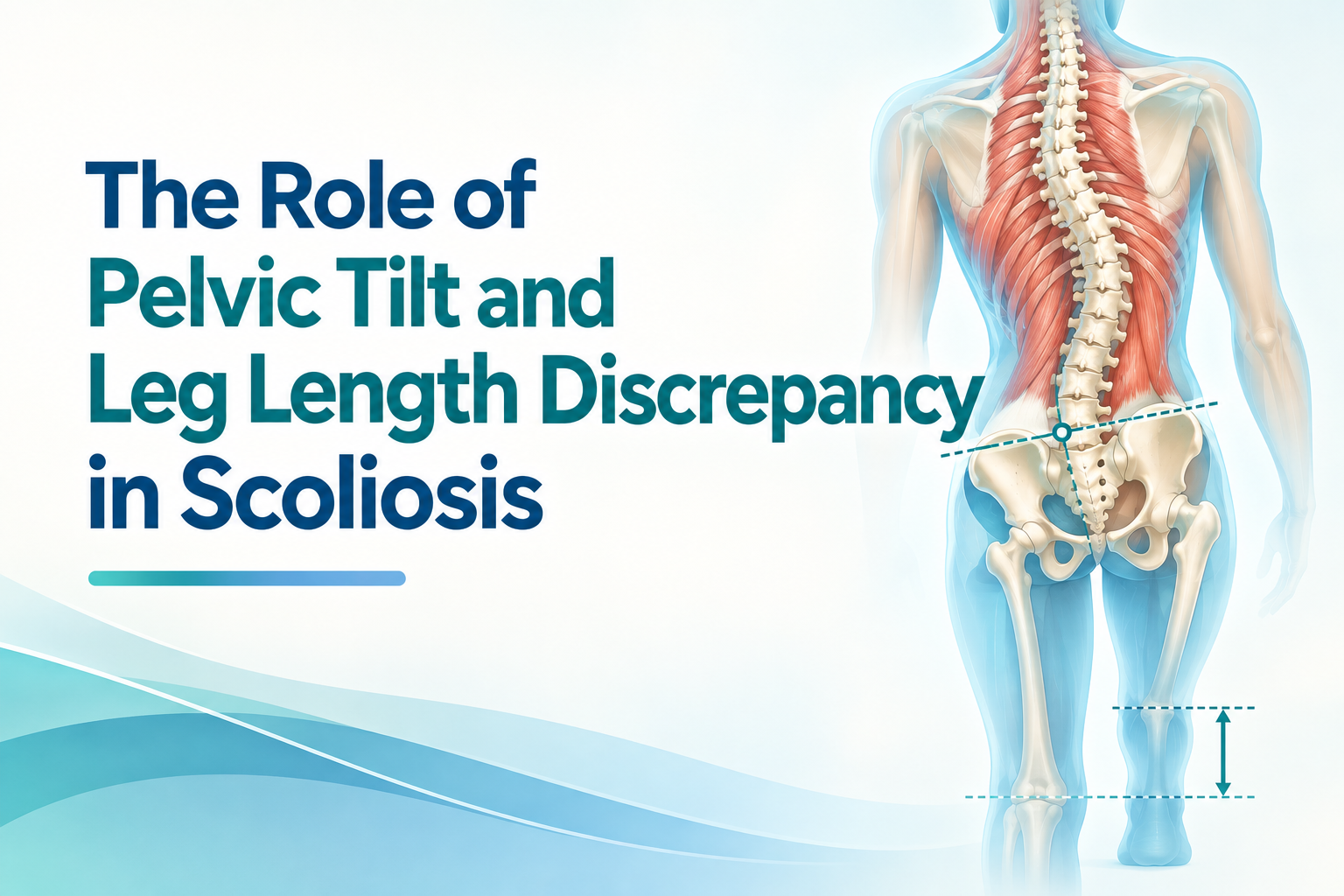
When a person with scoliosis has one hip higher than the other, one leg appears longer, or the pelvis seems tilted, it is natural to wonder whether the pelvic position or leg length difference is causing the spinal curve.
The relationship is real, but it is more complicated than simply saying that “a short leg causes scoliosis.” Pelvic alignment, leg length discrepancy (LLD), hip position, spinal curvature, and compensatory posture can influence one another. In some people, a significant difference in leg length can produce a functional scoliosis that improves when the discrepancy is corrected. In others, a pelvic imbalance occurs because an existing structural scoliosis is altering the alignment of the pelvis. Some patients have both conditions at the same time. [1][2]
This distinction is clinically important because treating a leg-length difference when the primary problem is structural scoliosis may not correct the spinal deformity. Conversely, overlooking a clinically meaningful LLD can leave a functional component of the spinal curve unaddressed.
Recent research emphasizes the difficulty of distinguishing spinal-origin pelvic obliquity from limb-origin pelvic obliquity and recommends a structured assessment using clinical examination, standing radiographs, and functional correction tests when appropriate. [1]
Pelvic Tilt vs. Pelvic Obliquity: They Are Not the Same
The term pelvic tilt can be confusing because the pelvis can move in different planes.
Pelvic obliquity
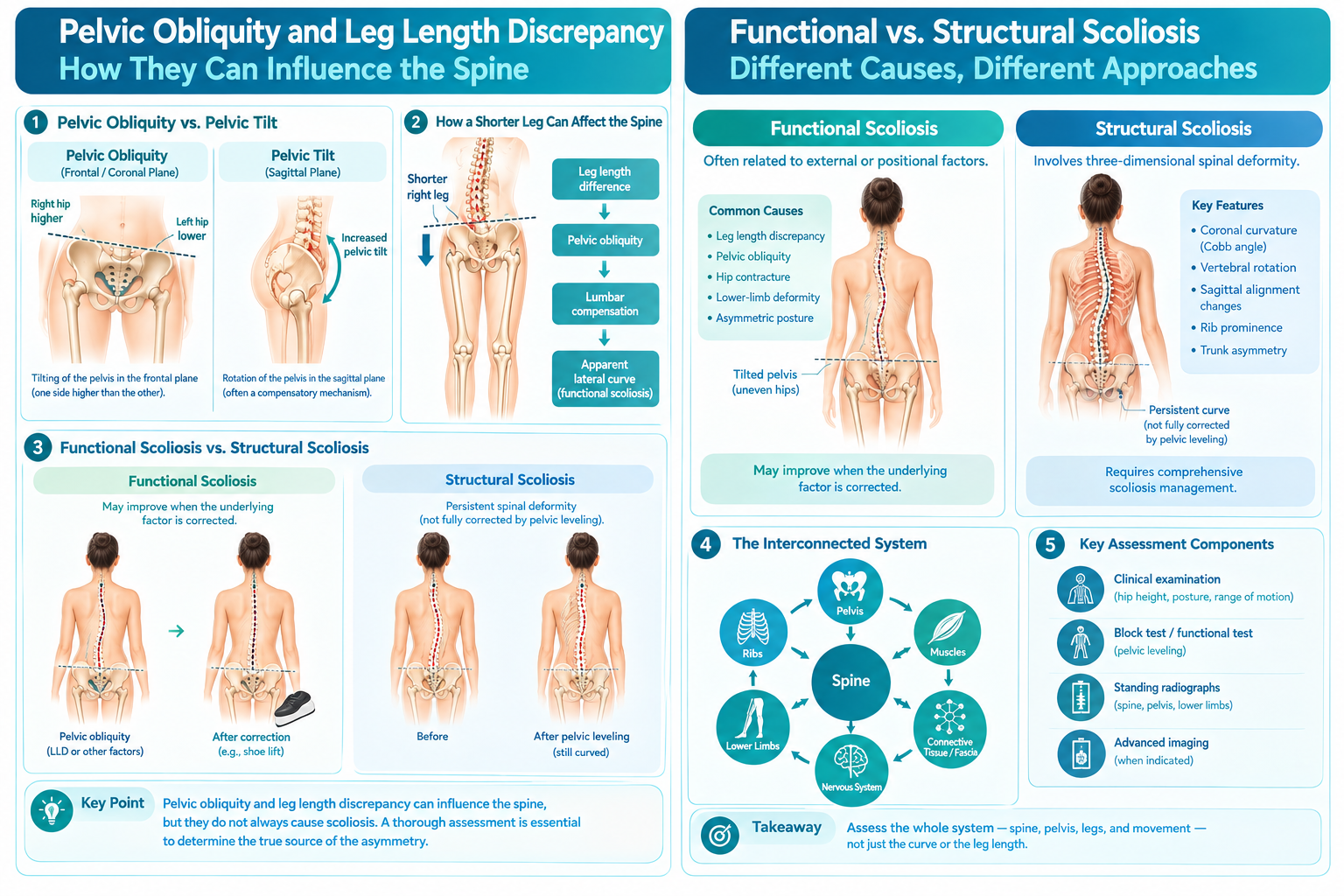
Pelvic obliquity refers to tilting of the pelvis in the coronal or frontal plane, so that one side of the pelvis is higher than the other.
For example, if the right iliac crest is higher than the left, the pelvis is oblique rather than level.
This is particularly relevant when discussing leg length discrepancy and functional scoliosis. The Scoliosis Research Society defines pelvic obliquity as angulation of the pelvis from the horizontal in the frontal plane and notes that it may result from leg-length inequality, hip contracture, or other conditions below or within the pelvis. [3]
Pelvic tilt in the sagittal plane
Pelvic tilt (PT) can also refer specifically to a sagittal-plane radiographic parameter used in spinal deformity assessment.
It describes the orientation of the pelvis relative to the spine and lower body. Increased pelvic tilt can represent a compensatory mechanism in which the pelvis rotates backward to help maintain an upright posture when spinal alignment is compromised. [4][5]
Therefore, the phrase “pelvic tilt” should always be interpreted according to the context.
For scoliosis and leg-length discrepancy, pelvic obliquity in the frontal plane is usually the more relevant concept.
What Is Leg Length Discrepancy?
Leg length discrepancy (LLD) means that the two lower limbs have different effective or anatomical lengths.
LLD can be divided broadly into:
- Anatomical LLD: the bones of one limb are genuinely shorter or longer.
- Functional LLD: the legs have similar anatomical lengths, but differences in pelvic position, hip mechanics, joint contracture, foot position, or other factors make one limb functionally shorter or longer.
This distinction matters because a person may appear to have one shorter leg without actually having a significant difference in bone length.
For example, pelvic rotation or obliquity can change the apparent position of the femoral heads and make one leg appear shorter.
A clinical examination therefore should not rely solely on visual observation.
How Can a Shorter Leg Affect the Spine?
When one leg is genuinely shorter, the pelvis may tilt downward toward the shorter side during standing.
The spine then has to adapt to maintain the body's overall balance.
A simplified sequence can look like this:
Leg-length difference → pelvic obliquity → lumbar compensation → apparent lateral spinal curve
This type of curve is generally referred to as functional scoliosis.
The spine itself may not have the same structural three-dimensional deformity seen in idiopathic scoliosis. Instead, the curvature is partly a response to the altered position of the pelvis.
Research has demonstrated that LLD can produce pelvic obliquity and lumbar curvature, with the convexity of the functional lumbar curve typically directed toward the shorter limb. [6]
However, the magnitude of the spinal response varies substantially between individuals.
Functional Scoliosis vs. Structural Scoliosis
This distinction is one of the most important concepts in understanding LLD and scoliosis.
Functional scoliosis
A functional curve is generally associated with an external or positional factor.
Possible contributors include:
- leg length discrepancy
- pelvic obliquity
- lower-limb deformity
- hip contracture
- asymmetric standing posture
When the underlying factor is corrected, the spinal curve may partially or completely decrease.
The Scoliosis Research Society describes a functional curve as a curve that can disappear when the positional abnormality is corrected. For example, standing with one knee bent and the pelvis tilted can produce an apparent curve that disappears when the legs are straightened and the pelvis is leveled. [2]
Structural scoliosis
A structural scoliosis involves persistent spinal deformity.
In adolescent idiopathic scoliosis, for example, the curve includes three-dimensional changes involving the vertebrae and surrounding structures. It does not simply disappear because the pelvis is leveled.
This distinction is essential because a structural scoliosis should not be attributed to a minor leg-length difference without appropriate evaluation.
Can Leg Length Discrepancy Actually Cause Scoliosis?
Yes—but the terminology needs to be precise.
A clinically significant LLD can produce functional scoliosis, particularly when the discrepancy creates persistent pelvic obliquity.
A 2025 review concluded that significant LLD can produce pelvic tilt and functional scoliosis, while also noting that smaller discrepancies may influence spinal curvature in growing children. [7]
An earlier clinical study of children with LLD-related functional scoliosis found that correcting the discrepancy with a shoe lift resulted in rapid improvement of the spinal curve in many patients. [6]
However, these findings should not be interpreted to mean that every small difference in leg length causes idiopathic scoliosis.
The Scoliosis Research Society specifically notes that minor leg-length differences do not cause scoliosis. [8]
The practical question is therefore not simply:
“Are the legs different lengths?”
It is:
“Is the leg-length difference large and mechanically significant enough to alter pelvic and spinal alignment?”
How Much Leg Length Difference Matters?
There is no single universal threshold at which every person's spine will respond in exactly the same way.
A recent review reported that discrepancies greater than approximately 2 cm are more likely to produce clinically meaningful biomechanical effects, including functional scoliosis, while smaller discrepancies can sometimes influence alignment—particularly during growth. [7]
Another recent review of pediatric scoliosis and LLD similarly reported that discrepancies greater than 2 cm can produce pelvic tilt and functional scoliosis, while smaller discrepancies may also contribute to spinal curvature in some growing children. [9]
This variability is important.
Two individuals with the same measured LLD may respond differently because of differences in:
- age
- skeletal maturity
- pelvic mobility
- hip range of motion
- foot mechanics
- spinal flexibility
- neuromuscular control
- pre-existing scoliosis
- duration of the discrepancy
Therefore, treatment decisions should not be based solely on a numerical measurement.
How the Pelvis Can Influence Lumbar Alignment
The pelvis forms the mechanical connection between the spine and lower limbs.
If the pelvis becomes asymmetrical in the frontal plane, the lumbar spine may compensate above it.
For example:
Short right leg → right pelvic depression → lumbar adaptation → trunk compensation
The exact direction and magnitude of the curve depend on the individual biomechanics.
This is one reason the pelvis should be examined when a lumbar curve is observed.
The SRS radiographic measurement manual notes that coronal tilting of the sacral endplate may result from pelvic obliquity, leg length discrepancy, intrinsic sacral deformity, or a combination of these factors. [10]
Thus, what appears to be a simple “pelvic tilt” on an X-ray may actually have several possible causes.
The Sacrum Matters Too
The pelvis does not simply sit beneath the spine as a passive platform.
The sacrum forms the connection between the lumbar spine and pelvis, and its orientation influences the starting point of the lumbar spine.
When the sacral endplate is oblique in the coronal plane, the lumbar spine may have to adapt to that orientation.
However, an oblique sacral endplate does not automatically prove that the leg lengths are different.
The SRS specifically distinguishes among:
- pelvic obliquity
- leg length discrepancy
- intrinsic sacral obliquity
These can occur individually or together. [10]
This is another reason why visual inspection alone is insufficient.
Why One Hip May Look Higher
A visibly higher hip can have several explanations.
True leg length discrepancy
One lower limb is anatomically shorter or longer.
Pelvic obliquity
The pelvis is tilted because of its own position or shape.
Hip contracture
Limited hip motion can hold one side of the pelvis in a different position.
Knee or foot mechanics
A knee flexion deformity, foot deformity, or other lower-extremity condition can alter effective leg length.
Structural scoliosis
A spinal curve can alter trunk and pelvic positioning, making one hip appear higher.
The SRS notes that pelvic obliquity may be related to a short leg, foot abnormalities, pelvic deformity, hip contractures, iliotibial-band problems, or knee flexion deformity. [11]
Therefore, “one hip is higher” is a clinical observation, not a diagnosis.
How Doctors Determine Whether the Leg Is Actually Shorter
Several methods can be used to investigate LLD.
Physical examination
A clinician can examine:
- iliac crest height
- anterior and posterior superior iliac spines
- hip range of motion
- knee position
- foot posture
- standing alignment
- gait
Block test
A block or lift can be placed under the apparently shorter leg.
The clinician observes whether leveling the pelvis changes the apparent spinal curvature.
This can provide useful functional information.
Standing radiographs
Standing full-spine or lower-extremity radiographs can help evaluate:
- spinal curvature
- pelvic obliquity
- femoral head position
- sacral orientation
- lower-limb length
The SRS recommends standing imaging as part of scoliosis evaluation when clinically indicated, while its radiographic manual provides specific methods for assessing pelvic and sacral relationships. [2][10]
Advanced imaging
When the diagnosis remains unclear, specialized imaging may provide a more accurate measurement of true anatomical LLD.
A 2026 systematic review found that standing AP radiographs can reliably quantify pelvic obliquity and LLD, while advanced imaging can improve reproducibility in subtle or ambiguous cases. Functional block or shoe-lift testing can also help distinguish limb-driven from spine-driven pelvic obliquity. [1]
Why a Shoe Lift Can Sometimes Improve a Spinal Curve
If a functional scoliosis is genuinely caused by a significant LLD, correcting the difference can reduce the mechanical reason for the compensatory curve.
A lift under the shorter limb can:
- raise the lower side of the pelvis;
- reduce pelvic obliquity;
- change the orientation of the sacrum;
- reduce the compensatory lumbar curve.
In a clinical series of children with LLD-related functional scoliosis, correction with shoe lifts produced substantial improvement in spinal alignment in most evaluated patients. [6]
This provides a useful diagnostic principle:
If leveling the pelvis substantially reduces the curve, a functional component is likely present.
However, this does not mean that every scoliosis curve that changes with a lift is entirely caused by LLD.
Mixed cases are possible.
What Happens When a Patient Has Both LLD and Structural Scoliosis?
This is one of the most difficult clinical situations.
A patient may have:
- a genuine structural scoliosis;
- a separate leg-length discrepancy;
- pelvic obliquity;
- a compensatory lumbar curve.
In this situation, correcting the leg length may reduce part of the curvature without eliminating the structural scoliosis.
For example:
Structural thoracic scoliosis + LLD → additional pelvic imbalance → compensatory lumbar curve
If the LLD is corrected, the compensatory component may decrease while the primary structural curve remains.
A 2026 systematic review specifically highlighted the difficulty of patients with mixed spinal and limb-related causes of pelvic obliquity. [1]
This is why the goal should not simply be to “make the Cobb angle smaller.” The clinician must determine what is structurally present and what is compensatory.
Pelvic Tilt in Adult Scoliosis
The relationship becomes even more complex in adults.
Adult spinal deformity can involve changes in:
- lumbar lordosis
- pelvic incidence
- pelvic tilt
- sacral slope
- sagittal vertical axis
- coronal balance
The pelvis can rotate to compensate for spinal imbalance and help maintain an upright posture.
In sagittal imbalance, posterior pelvic rotation can be used as a compensatory mechanism to move the body's center of mass backward and maintain standing balance. [4][5]
This is different from the frontal-plane pelvic obliquity associated with LLD.
Therefore, adult scoliosis assessment should consider both:
Coronal pelvic alignment
and
Sagittal spinopelvic alignment.
Pelvic Incidence Is Not the Same as Pelvic Tilt
These terms are sometimes confused.
Pelvic incidence (PI) is a relatively fixed anatomical parameter determined by pelvic morphology.
Pelvic tilt (PT) is a positional parameter that can change with posture and compensation.
Sacral slope (SS) describes the orientation of the sacral endplate.
These parameters are related geometrically and are important in adult spinal deformity assessment. [5]
Pelvic incidence itself is not something that changes because one leg is temporarily shorter or because a person stands asymmetrically.
This distinction is important when reading scoliosis research or radiographic reports.
Can a Leg-Length Difference Make an Existing Scoliosis Worse?
Potentially, yes.
A pre-existing structural curve can coexist with an LLD that adds another source of asymmetrical loading.
The result may be additional pelvic obliquity and compensatory curvature.
Recent research comparing functional and structural scoliosis has specifically examined how lower-extremity length discrepancy can influence both coronal and sagittal spinal balance. [12]
However, it would be inaccurate to state that a small LLD necessarily causes progression of idiopathic scoliosis.
The relationship depends on the size and duration of the discrepancy, skeletal maturity, curve characteristics, and the individual's compensatory capacity.
Should Everyone With Scoliosis Get a Shoe Lift?
No.
A shoe lift is most appropriate when there is evidence that a clinically meaningful leg-length discrepancy is contributing to pelvic and spinal imbalance.
Giving a lift simply because one hip appears higher can be counterproductive if the apparent difference is actually caused by structural scoliosis, pelvic anatomy, or another factor.
The first question should therefore be:
Is the leg truly shorter, or does it only appear shorter because of the way the pelvis and spine are positioned?
The second question is:
Does correcting the apparent discrepancy change the spinal alignment?
Only after these questions are considered can a clinician determine whether a lift is appropriate.
Pelvic Alignment and Scoliosis-Specific Exercise
Pelvic alignment is also relevant during scoliosis-specific rehabilitation.
Exercise may address:
- pelvic control
- trunk stabilization
- active self-correction
- weight distribution
- hip mobility
- lower-limb alignment
- breathing mechanics
- three-dimensional spinal control
The objective is not necessarily to force the pelvis into a perfectly symmetrical position at every moment.
Human posture is dynamic.
A useful rehabilitation strategy instead seeks to improve the person's ability to control alignment during standing, walking, sitting, and movement.
This becomes particularly important when pelvic asymmetry is a compensation for a structural spinal curve.
A Three-Dimensional View of Pelvic and Spinal Balance
It can be tempting to think about scoliosis as a simple chain:
short leg → tilted pelvis → curved spine.
That model is useful for understanding functional scoliosis, but it is incomplete for many patients.
A more comprehensive model is:
Lower limbs ↔ pelvis ↔ sacrum ↔ lumbar spine ↔ thoracic spine ↔ head and trunk
Each region can influence the others.
For example, a structural thoracic curve may alter trunk balance, which may influence pelvic positioning. A leg-length discrepancy may then add another asymmetrical force from below.
The final posture can therefore represent the combined result of structural deformity and compensation.
How This Fits With Biomechanical Assessment
From a biomechanical perspective, the pelvis is a major transfer point for forces between the lower limbs and spine.
Standing requires continuous management of:
- compression
- shear
- bending moments
- rotational forces
- ground-reaction forces
A leg-length difference changes the position from which these forces enter the pelvis.
The body then adapts through joint positioning and muscle activation.
This makes pelvic and lower-limb assessment particularly relevant to a broader understanding of spinal biomechanics.
It also explains why a patient's posture can change when standing on a lift even though the underlying vertebral anatomy has not immediately changed.
A Pattern-Based Approach to Pelvic Asymmetry
Pelvic asymmetry should ideally be interpreted as part of the individual's complete spinal pattern.
Assessment may include:
- Cobb angle
- curve location
- curve apex
- vertebral rotation
- coronal balance
- sagittal balance
- pelvic obliquity
- pelvic tilt
- leg length
- hip mobility
- knee alignment
- foot mechanics
- muscle asymmetry
- skeletal maturity
This approach avoids reducing a complex three-dimensional problem to one measurement.
For example, two patients may both have a 1.5-cm apparent leg-length difference but have completely different causes and spinal responses.
One may have a true anatomical LLD producing a functional lumbar curve.
Another may have equal anatomical leg lengths but pelvic rotation caused by structural scoliosis.
The treatment logic would be very different.
What Patients and Parents Should Remember
If one hip is higher, one leg appears shorter, or the pelvis seems tilted, this does not automatically mean that leg length discrepancy caused the scoliosis.
A small difference in leg length is common, and minor differences do not explain most cases of idiopathic scoliosis. [8]
At the same time, a clinically significant LLD can produce a functional spinal curve and should not be ignored.
The key is to determine whether the spinal curve:
- persists when the pelvis is leveled;
- changes with a block or lift;
- shows structural characteristics on radiographs;
- includes vertebral rotation;
- fits the pattern of idiopathic or other structural scoliosis.
Recent evidence supports a structured approach because pelvic obliquity can originate from the lower limbs, pelvis, spine, or several factors simultaneously. [1]
Key Takeaways
- Pelvic obliquity and sagittal pelvic tilt are different concepts and should not be used interchangeably.
- A significant leg length discrepancy (LLD) can produce pelvic obliquity and functional scoliosis. [6][7]
- Functional scoliosis caused by LLD may improve when the leg-length difference is corrected.
- Minor leg-length differences do not automatically cause idiopathic scoliosis. [8]
- A higher hip does not necessarily mean that one leg is anatomically shorter.
- Hip contracture, foot position, knee alignment, pelvic anatomy, and structural scoliosis can all create apparent leg-length differences.
- Structural scoliosis can itself contribute to pelvic imbalance.
- Some patients have both structural scoliosis and LLD, producing a mixed pattern. [1]
- Block or shoe-lift testing can help determine whether pelvic and spinal alignment changes when the apparent LLD is corrected.
- Standing radiographs and, when necessary, advanced imaging can help distinguish limb-driven from spine-driven pelvic obliquity. [1][10]
- In adult scoliosis, sagittal pelvic parameters such as pelvic incidence, pelvic tilt, and sacral slope are also important for understanding global spinal balance.
- Treatment should address the actual source of the asymmetry rather than assuming that every pelvic imbalance comes from a short leg.
References
[1] Truumees, E., Akkihal, K., Griffin, J., Singh, D., Geck, M., Stokes, J., & Mayer, R. “Differentiating Spinal Deformity Versus Leg Length Discrepancy in Patients With Pelvic Obliquity: Systematic Review of Diagnostic Methods, Imaging, and Clinical Management.” Spine. 2026. PubMed.
[2] Scoliosis Research Society. “Diagnosing Scoliosis.” Scoliosis Research Society.
[3] Scoliosis Research Society. “Glossary.” Scoliosis Research Society.
[4] Schwab, F., Patel, A., Ungar, B., Farcy, J.-P., & Lafage, V. “Adult spinal deformity—postoperative standing imbalance: how much can you tolerate?” Spine. Related discussion of pelvic compensation and sagittal alignment. PubMed.
[5] Celestre, P. C., Dimar, J. R., & Glassman, S. D. “Spinopelvic Parameters: Lumbar Lordosis, Pelvic Incidence, Pelvic Tilt, and Sacral Slope: What Does a Spine Surgeon Need to Know to Plan a Lumbar Deformity Correction?” Neurosurgery Clinics of North America. 2018. PubMed.
[6] Raczkowski, J. W., Daniszewska, B., & Zolynski, K. “Functional scoliosis caused by leg length discrepancy.” Archives of Medical Science. 2010. PubMed.
[7] Menez, C., et al. “Overview and Spinal Implications of Leg Length Discrepancy: Narrative Review.” Journal of Korean Neurosurgical Society. 2021. PubMed.
[8] Scoliosis Research Society. “Scoliosis.” Scoliosis Research Society.
[9] “Scoliosis, leg length discrepancy, or both?” Current Opinion in Pediatrics. 2025. PubMed.
[10] Scoliosis Research Society. “Adolescent Idiopathic Scoliosis: Radiographic Measurement Manual.” Scoliosis Research Society PDF.
[11] Scoliosis Research Society. “Bracing Manual.” Scoliosis Research Society PDF.
[12] Huang, Y., Zhang, Y., Chang, J., & Sun, X. “Differential Effects of Lower Extremity Length Discrepancy on Functional and Structural Scoliosis: Coronal and Sagittal Plane Analysis.” Journal of Pediatric Orthopaedics. 2026. PubMed.