Spine Care
[Biomechanics, Tensegrity & Meridian Concepts 04] Meridian Pathways and Structural Balance in Scoliosis Management
Meridian Pathways and Structural Balance in Scoliosis Management
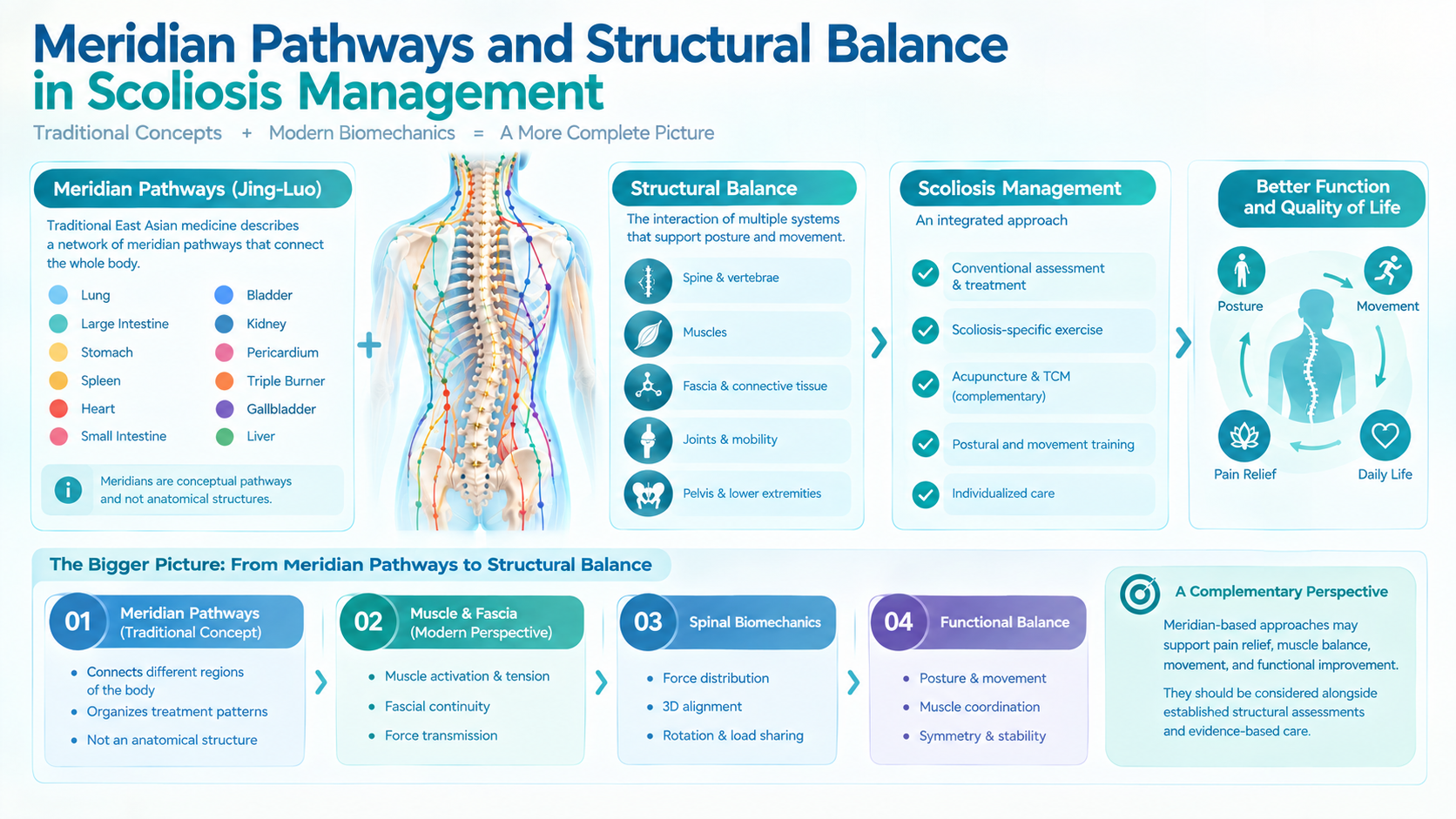
Meta Description: Explore how meridian pathways, posture, muscle coordination, and structural balance may be considered together in scoliosis management, with an evidence-based perspective on acupuncture and scoliosis-specific exercise.
---
Introduction
Scoliosis is a three-dimensional spinal deformity involving more than a lateral curvature of the spine. Changes may occur in the coronal plane, sagittal alignment, and axial rotation, while the surrounding muscles and soft tissues adapt to the altered geometry. [1]
Conventional scoliosis assessment focuses on measurable structural characteristics such as the Cobb angle, vertebral rotation, sagittal alignment, skeletal maturity, and curve progression. These measurements remain essential for diagnosis, monitoring, and treatment decisions.
At the same time, complementary approaches to musculoskeletal care have traditionally considered the body as an interconnected functional system rather than a collection of isolated anatomical structures.
Traditional East Asian medicine describes this interconnected system through meridian pathways (jing-luo). In traditional theory, meridians are pathways through which qi and related functional relationships are described. They are not anatomical structures that can be directly equated with nerves, blood vessels, fascia, or muscles.
This distinction is important.
A modern clinical discussion can explore whether treatments organized around meridian-based concepts may influence pain, muscle activity, posture, movement, and functional balance, while avoiding the unsupported claim that meridians themselves have been demonstrated to cause or mechanically correct structural scoliosis.
Recent clinical research has begun examining acupuncture and other Traditional Chinese Medicine (TCM) interventions in adolescent idiopathic scoliosis, although the evidence base remains considerably smaller than that for established approaches such as observation, bracing, and scoliosis-specific exercise. [2][3]
---
What Is Structural Balance?
Structural balance refers broadly to the relationship between different components of the musculoskeletal system that contribute to upright posture and efficient movement.
In the spine, this may include:
- Coronal alignment
- Sagittal alignment
- Pelvic position
- Vertebral rotation
- Trunk balance
- Muscle activation
- Joint mobility
- Soft-tissue tension
- Weight distribution
A person can have a radiographically measurable scoliosis curve while maintaining relatively good overall trunk balance.
Conversely, a relatively modest curve may be accompanied by substantial postural asymmetry or functional compensation.
This is why the Cobb angle should not be interpreted as a complete description of the patient's biomechanical condition.
Structural balance is therefore best considered a multidimensional clinical concept, rather than a single numerical measurement.
---
The Three-Dimensional Nature of Scoliosis
The traditional description of scoliosis as a "sideways curve" is useful but incomplete.
A scoliotic spine can demonstrate:
Coronal Deformity
The spine curves from side to side. This component is commonly quantified using the Cobb angle.
Sagittal Changes
Normal thoracic kyphosis and lumbar lordosis may be altered depending on the scoliosis pattern.
Axial Rotation
The vertebrae may rotate around the longitudinal axis, contributing to rib prominence and trunk asymmetry.
These components interact.
A change in vertebral rotation can affect the appearance of the rib cage. A change in sagittal alignment can alter the location of the body's center of mass. Pelvic compensation can influence trunk balance.
Consequently, scoliosis management increasingly considers the spine as a three-dimensional mechanical system rather than a simple two-dimensional curve. [1]
---
What Are Meridian Pathways?
In Traditional Chinese Medicine, meridians are conceptual pathways used to describe relationships among different regions of the body and to organize acupuncture treatment.
The major meridian systems traditionally include pathways such as:
- Lung Meridian
- Large Intestine Meridian
- Stomach Meridian
- Spleen Meridian
- Heart Meridian
- Small Intestine Meridian
- Bladder Meridian
- Kidney Meridian
- Pericardium Meridian
- Triple Burner/San Jiao Meridian
- Gallbladder Meridian
- Liver Meridian
Additional extraordinary pathways, including the Governing Vessel and Conception Vessel, are also used within traditional clinical frameworks.
These pathways have a long history within East Asian medical theory.
However, from a modern biomedical perspective, a meridian should not automatically be interpreted as a physical anatomical structure equivalent to a nerve, artery, muscle, or fascial chain.
This distinction allows traditional concepts to be discussed without presenting them as established anatomical facts.
---
Meridian Theory and Musculoskeletal Function
Traditional acupuncture practice often uses meridian relationships to organize treatment for musculoskeletal problems.
For example, a practitioner may consider:
- The location of pain
- Movement limitations
- Muscle tenderness
- Postural asymmetry
- Range of motion
- Palpation findings
- Functional movement
- Traditional diagnostic patterns
From a modern clinical perspective, some of these observations overlap with conventional musculoskeletal assessment.
For example, examining asymmetrical muscle tension and movement limitations is relevant to spinal rehabilitation regardless of whether the findings are described using traditional meridian terminology or contemporary biomechanical terminology.
The two frameworks, however, should not be treated as interchangeable.
A clinician can use a traditional framework to organize treatment while still using radiographic and biomedical measurements to assess structural scoliosis.
---
Can Meridian Pathways Be Equated With Fascia?
This is an increasingly common question.
Some modern discussions propose that meridian pathways correspond to fascial planes or connective-tissue networks.
There are anatomical reasons why such comparisons are interesting. Fascia forms continuous connective-tissue structures throughout the body, and mechanical force can be transmitted between certain interconnected tissues.
However, anatomical overlap does not establish equivalence.
A fascial plane identified through modern anatomy is not automatically a "meridian," and a traditional meridian pathway cannot be scientifically validated simply because connective tissue exists in a similar region.
Therefore, it is more accurate to say:
Meridian theory and modern fascial anatomy may provide different frameworks for describing relationships within the body, but they should not be assumed to represent the same anatomical system.
This distinction is particularly important when discussing scoliosis with patients.
---
Muscle Balance and Spinal Alignment
The muscles surrounding the spine play an important role in maintaining posture and controlling movement.
Important muscle groups include:
- Multifidus
- Erector spinae
- Rotatores
- Quadratus lumborum
- Abdominal muscles
- Psoas
- Gluteal muscles
- Hip rotators
In scoliosis, muscle characteristics and activation patterns may differ between sides of the curve.
These differences may reflect the underlying deformity, compensation for the deformity, or a combination of structural and functional factors.
Therefore, muscle asymmetry should not automatically be interpreted as the original cause of idiopathic scoliosis.
Nevertheless, improving neuromuscular control and movement symmetry can be a reasonable component of conservative rehabilitation.
Scoliosis-specific exercise research supports this general principle. Recent systematic reviews and meta-analyses have reported improvements in outcomes such as Cobb angle, trunk rotation, and quality of life with certain scoliosis-specific exercise programs, although the magnitude and certainty of benefit vary across studies. [4][5]
---
Structural Balance and Force Distribution
The concept of structural balance is closely related to biomechanics.
When the body's geometry changes, forces are distributed differently.
For example, a scoliotic curve can modify:
- Compression
- Tension
- Shear
- Bending moments
- Rotational forces
- Muscle activation
The body then responds to these mechanical changes.
A simplified model might look like:
Spinal asymmetry → altered loading → altered muscle recruitment → postural adaptation
The process can also operate in the opposite direction:
Altered movement strategy → asymmetric loading → functional adaptation
The actual relationship is likely to be much more complex.
This is why scoliosis should not be reduced to a single cause such as "weak muscles," "tight fascia," or "blocked meridians."
---
Acupuncture and Scoliosis
Acupuncture has been investigated as a potential component of conservative scoliosis care.
However, the evidence base is still developing.
An earlier controlled pilot study examined acupuncture in adolescents with idiopathic scoliosis and highlighted the limited number of trials specifically designed to evaluate acupuncture for scoliosis at that time. [6]
A subsequent research protocol proposed a systematic review of acupuncture for scoliosis, focusing on outcomes such as Cobb angle, pain, functional status, quality of life, and adverse events. The protocol itself emphasized the need for better-quality randomized evidence. [2]
More recent research has expanded this area.
A 2025 clinical study involving 116 adolescents with idiopathic scoliosis compared conventional brace correction and posture training with a treatment involving acupuncture and bone-setting massage. The study reported improvements in Cobb angle, pain, quality of life, and spinal function in both groups, with greater improvements in the intervention group. However, the study design and treatment combination mean that the individual contribution of acupuncture cannot be separated from the effects of the broader intervention. [7]
This distinction is important.
The evidence does not establish that acupuncture alone can structurally correct scoliosis.
Instead, acupuncture may have potential as a complementary intervention, particularly for symptoms and functional aspects, while further high-quality research is needed to establish its effects on structural progression.
---
Traditional Chinese Medicine as a Multimodal Approach
Traditional Chinese Medicine interventions for scoliosis are not limited to acupuncture.
They may include combinations of:
- Acupuncture
- Tuina
- Daoyin exercises
- Manual techniques
- Breathing exercises
- Postural exercises
- Other traditional therapeutic approaches
A randomized controlled trial published in 2015 compared a TCM combination including Daoyin, Tuina, and acupotomy with brace treatment in adolescents with mild-to-moderate idiopathic scoliosis. The study reported changes in Cobb angle, pulmonary function, and surface EMG measures. [8]
More recently, a systematic review and meta-analysis examined TCM interventions including spinal manipulation, Daoyin exercises, acupuncture, and massage in adolescent idiopathic scoliosis and reported reductions in Cobb angle across the included studies. However, the interventions were heterogeneous, meaning that the pooled result should not be interpreted as evidence that acupuncture or any single TCM technique independently produces the observed effect. [9]
This is a key methodological issue.
When several therapies are delivered together, it becomes difficult to determine which component is responsible for the outcome.
---
Meridian-Based Exercise and Postural Control
One potentially useful area of overlap between traditional and modern approaches is movement-based therapy.
Traditional systems such as Daoyin have historically emphasized:
- Controlled movement
- Breathing
- Posture
- Coordination
- Whole-body integration
Modern scoliosis-specific exercise systems similarly emphasize individualized postural correction and three-dimensional control.
For example, Schroth-based exercise programs use three-dimensional corrective strategies, rotational breathing, postural awareness, and active self-correction.
Recent systematic reviews have reported beneficial effects of Schroth and other scoliosis-specific exercise approaches on measures including Cobb angle, trunk rotation, and quality of life, although methodological limitations and heterogeneity remain important considerations. [4][5]
This does not mean that Schroth exercises and meridian-based exercises are scientifically identical.
Rather, they demonstrate a common clinical interest in active postural control and individualized movement.
---
The Importance of Active Self-Correction
Modern scoliosis rehabilitation increasingly emphasizes the patient's ability to actively control their posture.
Instead of relying entirely on passive correction, the patient may learn to:
- Recognize their asymmetry
- Find a more balanced position
- Activate specific muscle groups
- Coordinate breathing and trunk movement
- Maintain correction during functional activities
This approach may be particularly relevant to the concept of structural balance.
The objective is not necessarily to force the spine into a single "perfect" position.
Instead, the goal may be to improve the patient's ability to control their three-dimensional posture under different loading conditions.
---
A Meridian-Based View of Regional Relationships
Within traditional East Asian medicine, the body is often considered as a network of connected functional regions.
From a modern musculoskeletal perspective, regional interdependence is also recognized.
For example:
Foot → ankle → knee → pelvis → lumbar spine → thoracic spine
or:
Pelvis → lumbar spine → thoracic cage → shoulder girdle
Movement or restriction in one region can influence movement elsewhere through mechanical and neuromuscular relationships.
These relationships do not prove the traditional meridian theory.
However, they provide a clinically interesting area for research: whether traditional pattern-based treatment can produce measurable changes in posture, movement, muscle activation, pain, or functional performance.
Future studies could investigate these questions using:
- Surface EMG
- Three-dimensional motion analysis
- Pressure mapping
- Force plates
- Ultrasound
- Three-dimensional spinal imaging
- Digital postural analysis
This would allow traditional clinical concepts to be examined alongside measurable biomechanical outcomes.
---
Meridian Pathways and Structural Balance: A Clinical Framework
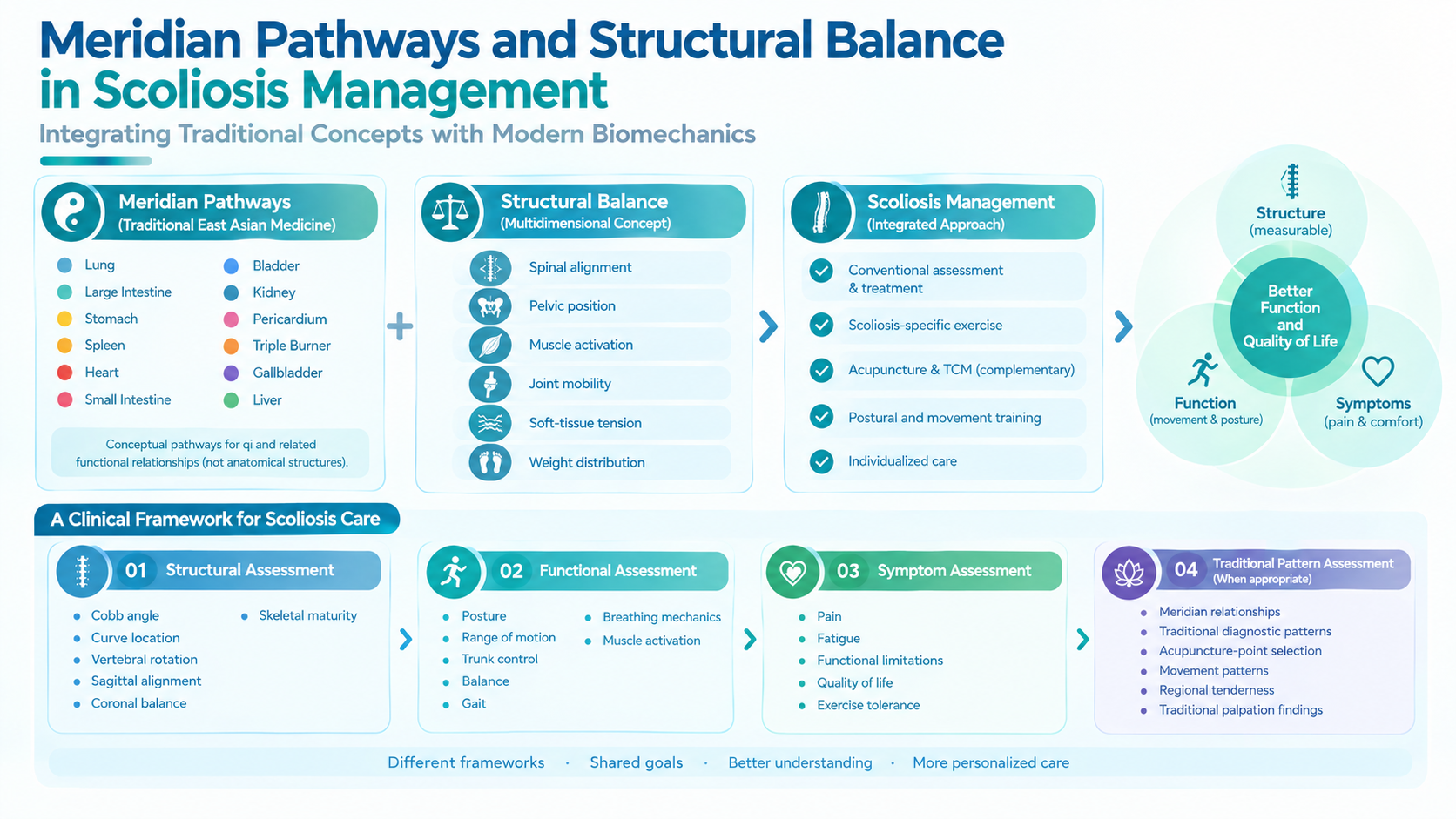
A cautious clinical framework could consider several layers simultaneously.
Layer 1: Structural Assessment
Evaluate:
- Cobb angle
- Curve location
- Vertebral rotation
- Sagittal alignment
- Coronal balance
- Skeletal maturity
Layer 2: Functional Assessment
Evaluate:
- Posture
- Range of motion
- Trunk control
- Balance
- Gait
- Breathing mechanics
- Muscle activation
Layer 3: Symptom Assessment
Evaluate:
- Pain
- Fatigue
- Functional limitations
- Quality of life
- Exercise tolerance
Layer 4: Traditional Pattern Assessment
Where appropriate, a trained practitioner may additionally consider:
- Meridian relationships
- Traditional diagnostic patterns
- Acupuncture-point selection
- Movement patterns
- Regional tenderness
- Traditional palpation findings
This layered model avoids treating traditional assessment as a replacement for radiographic diagnosis.
Instead, it positions traditional concepts as a complementary clinical framework that can be investigated alongside established structural and functional measurements.
---
JESU5C and Pattern-Based Clinical Thinking
A pattern-oriented approach to scoliosis can be useful when patients with similar Cobb angles demonstrate very different postural and functional characteristics.
For example, two patients might have:
- Similar Cobb angles
- Similar skeletal maturity
- Similar curve locations
but very different:
- Trunk asymmetry
- Vertebral rotation
- Pelvic compensation
- Muscle activation
- Movement strategies
A pattern-based system attempts to capture some of these differences.
A clinician-developed approach described in Scoliosis, Meridian-Based Isometric Exercises and JESU5C Pattern Suit presents the JESU5C classification, Hyun-Ga Manual Technique (HGMT), and meridian-based isometric exercises as an approach to organizing patterns of idiopathic scoliosis. [10]
This framework should be regarded as a clinical model requiring independent validation, rather than as an established replacement for radiographic classification or conventional scoliosis management.
---
Can Meridian-Based Treatment Correct Structural Scoliosis?
This question requires a clear distinction between symptom improvement, functional improvement, and structural correction.
A treatment may potentially improve:
- Pain
- Muscle tension
- Movement
- Postural awareness
- Balance
- Functional capacity
without necessarily producing a major anatomical change in the vertebral curve.
The Scoliosis Research Society emphasizes that established scoliosis curves generally cannot simply be reversed without surgery, while exercise has a role in management and bracing is used primarily to limit progression in appropriate growing patients. [11]
Therefore, meridian-based treatment should not be presented as a proven method for reversing structural scoliosis.
A more scientifically responsible position is:
Meridian-based interventions may be explored as complementary approaches for symptoms, movement, neuromuscular control, and functional balance, while their ability to modify structural scoliosis remains an area requiring further evidence.
---
How Meridian-Based Care Could Be Studied Scientifically
One of the most important opportunities for future research is to translate traditional clinical concepts into measurable outcomes.
For example, researchers could investigate whether a defined meridian-based intervention changes:
Muscle Activity
Surface EMG could compare muscle activation before and after treatment.
Postural Symmetry
Three-dimensional motion capture or digital postural analysis could quantify changes in trunk and pelvic alignment.
Spinal Rotation
Surface topography or three-dimensional imaging could investigate changes in trunk rotation.
Pain and Function
Validated questionnaires could assess pain, disability, and quality of life.
Radiographic Structure
Standing X-rays could determine whether Cobb angle or vertebral rotation changes over time.
Mechanical Loading
Force plates and pressure sensors could investigate changes in weight distribution.
This approach would allow traditional treatment concepts to be examined using contemporary scientific methodology.
---
Meridian Pathways and the Future of Scoliosis Research
The most promising direction may not be a competition between traditional and modern medicine.
Instead, researchers can ask whether different therapeutic frameworks identify clinically meaningful patterns that can be measured objectively.
For example:
Traditional pattern → specific intervention → measurable neuromuscular change → functional improvement
If a consistent relationship is demonstrated across well-designed studies, the clinical value of that approach becomes easier to evaluate.
Similarly, if a traditional concept does not correspond to measurable anatomical or functional changes, clinicians should be willing to refine or reconsider the model.
This is the normal process of scientific development.
---
What Patients Should Know
Patients with scoliosis should understand that complementary treatment does not replace appropriate medical assessment.
A comprehensive scoliosis evaluation may include:
- Standing spinal radiographs
- Cobb angle measurement
- Curve classification
- Assessment of vertebral rotation
- Sagittal alignment
- Skeletal maturity
- Neurological examination when indicated
- Pain and functional assessment
- Monitoring for progression
Depending on age, curve magnitude, skeletal maturity, and progression risk, conventional management may include observation, scoliosis-specific exercise, bracing, or surgery. [11][12]
Acupuncture or other traditional interventions may be considered as complementary care where appropriate, particularly when the treatment goal is clearly defined.
Patients should be cautious of claims that a single acupuncture point, meridian, manual technique, or exercise can permanently "straighten" every type of scoliosis.
---
Conclusion
Meridian pathways provide a traditional framework for understanding relationships within the body, while modern scoliosis science describes spinal structure and function using radiography, biomechanics, neuromuscular assessment, and quantitative measurement.
These frameworks should not be treated as scientifically identical.
Nevertheless, there may be a useful area of intersection in the study of posture, muscle coordination, movement, pain, functional balance, and whole-body mechanical relationships.
Current evidence suggests that scoliosis-specific exercise can improve several clinical outcomes in selected patients, while emerging research on acupuncture and broader TCM interventions suggests potential benefits but remains less established and methodologically heterogeneous. [4][7][9]
The most scientifically responsible approach is therefore not to claim that meridians have been proven to cause or correct scoliosis, but to investigate whether meridian-based interventions can produce measurable changes in neuromuscular function, movement, symptoms, and—ultimately—structural outcomes.
For scoliosis management, the central principle remains comprehensive assessment.
Structure should be measured. Function should be assessed. Symptoms should be addressed. Treatment should be individualized.
Meridian-based approaches may offer an additional clinical perspective, but their role in structural scoliosis management should continue to be evaluated through rigorous research.
---
References
[1] Scoliosis Research Society. Scoliosis. Scoliosis Research Society.
[2] Choi, S.-K., Jo, H.-R., Park, S.-H., Sung, W.-S., Keum, D.-H., & Kim, E.-J. The effectiveness and safety of acupuncture for scoliosis: A protocol for systematic review and/or meta-analysis. Medicine. 2020.
[3] Scoliosis Research Society. Diagnosis and Treatment. Scoliosis Research Society.
[4] Deng, H., et al. Physiotherapeutic Scoliosis-Specific Exercise for the Treatment of Adolescent Idiopathic Scoliosis: A Systematic Review and Network Meta-analysis. American Journal of Physical Medicine & Rehabilitation. 2024.
[6] Acupuncture in the treatment of scoliosis: a single blind controlled pilot study. Scoliosis. 2008.
[7] Jia, K., & Yang, Y. Effect of acupuncture and massage on adolescent idiopathic scoliosis and pain severity. Frontiers in Medicine. 2025.
[8] Wei, H., Xu, J., Jiang, Z., et al. Effect of a Traditional Chinese Medicine combined therapy on adolescent idiopathic scoliosis: a randomized controlled trial. Journal of Traditional Chinese Medicine. 2015.
[10] LEE, Yongsub, & Lee, Minsu (translator). Scoliosis, Meridian-Based Isometric Exercises and JESU5C Pattern Suit: “JESU5C” a New Classification of Idiopathic Scoliosis and HGMT (Hyun-Ga Manual Technique). Amazon Kindle Edition.
[11] Scoliosis Research Society. Living with Scoliosis. Scoliosis Research Society.
[12] Scoliosis Research Society. Bracing. Scoliosis Research Society.