Spine Care
[Biomechanics, Tensegrity & Meridian Concepts 03] Biomechanics of Scoliosis: How Force Distribution Changes the Spine
Learn how compression, tension, shear, bending, muscle forces, and spinal alignment interact in scoliosis and how altered force distribution may influence spinal deformity and progression.
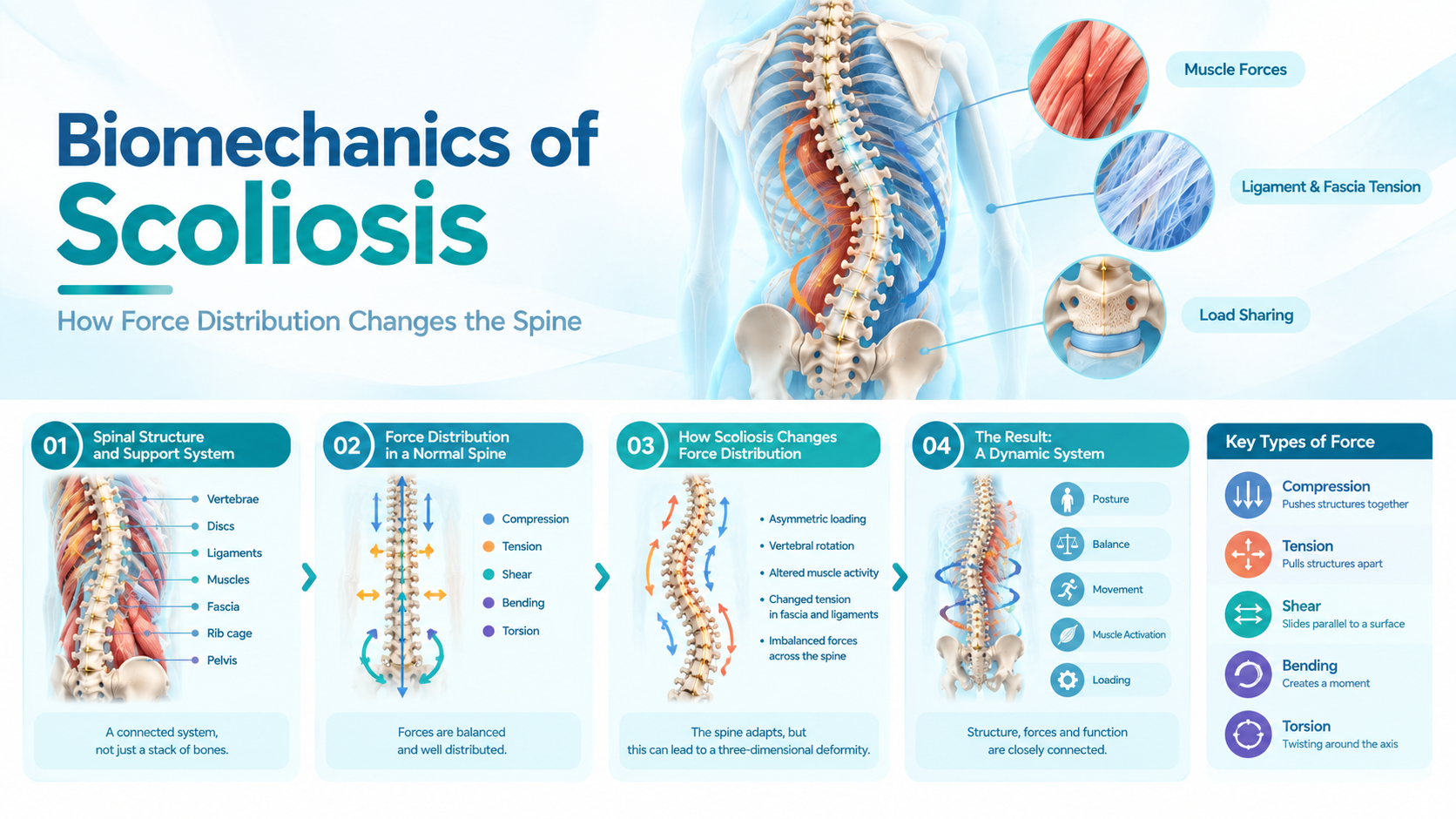
Introduction
Scoliosis is often described as a sideways curvature of the spine, but this definition does not fully explain what happens mechanically inside the spine.
The spine is a dynamic load-bearing structure. Every time a person stands, walks, bends, lifts, or changes position, forces are distributed through the vertebrae, intervertebral discs, ligaments, muscles, and surrounding connective tissues.
When spinal geometry changes, the way these forces are distributed can change as well.
This is one of the central concepts of spinal biomechanics.
In scoliosis, an abnormal three-dimensional geometry may alter compression, tension, shear, bending moments, and rotational forces across different parts of the spinal column. At the same time, altered loading may contribute to changes in spinal motion, muscle activation, and tissue adaptation. [1][2]
This does not mean that abnormal force distribution alone causes idiopathic scoliosis. The cause of adolescent idiopathic scoliosis remains incompletely understood, and current research considers biological, genetic, neurological, musculoskeletal, and biomechanical factors. [3]
However, understanding how forces move through a scoliotic spine can help explain why the deformity is three-dimensional and why spinal alignment, muscle activity, growth, and treatment forces are closely interconnected.
---
What Is Spinal Biomechanics?
Biomechanics is the study of how mechanical forces interact with biological structures.
For the spine, this includes questions such as:
- How much force is placed on a vertebral body?
- How is load shared between the vertebrae and discs?
- How do muscles stabilize the spine?
- How does posture change spinal loading?
- What happens when the spine bends or rotates?
- How do ligaments resist excessive movement?
- How does an external force from a brace affect spinal alignment?
- How does spinal geometry influence the distribution of mechanical stress?
The spine must perform several apparently conflicting functions at the same time.
It must be:
- Strong enough to support the body
- Flexible enough to allow movement
- Stable enough to protect the spinal cord and nerve roots
- Adaptable enough to respond to changing loads
These characteristics depend on the interaction of multiple structures rather than a single component. Modern spinal biomechanics therefore considers the vertebrae, discs, ligaments, facet joints, muscles, and their mechanical interactions as an integrated system. [4]
---
The Spine as a Load-Bearing Structure
When a person stands upright, body weight and external forces are transmitted through the spinal column toward the pelvis and lower extremities.
The force does not travel through a single straight line.
Instead, it is distributed across multiple structures according to:
- Spinal geometry
- Posture
- Segmental orientation
- Muscle activation
- Ligament tension
- Disc properties
- External loading
- Movement
The exact distribution changes continuously.
For example, bending forward changes the relative contribution of the discs, vertebral bodies, posterior elements, ligaments, and muscles. Muscle activation can also substantially alter the mechanical environment of the spine.
Research on lumbar load-sharing demonstrates that factors such as posture, loading magnitude and direction, preload, disc condition, bone quality, and structural changes can significantly influence how loads are distributed among spinal components. [5]
This principle becomes particularly important when the geometry of the spine is abnormal.
---
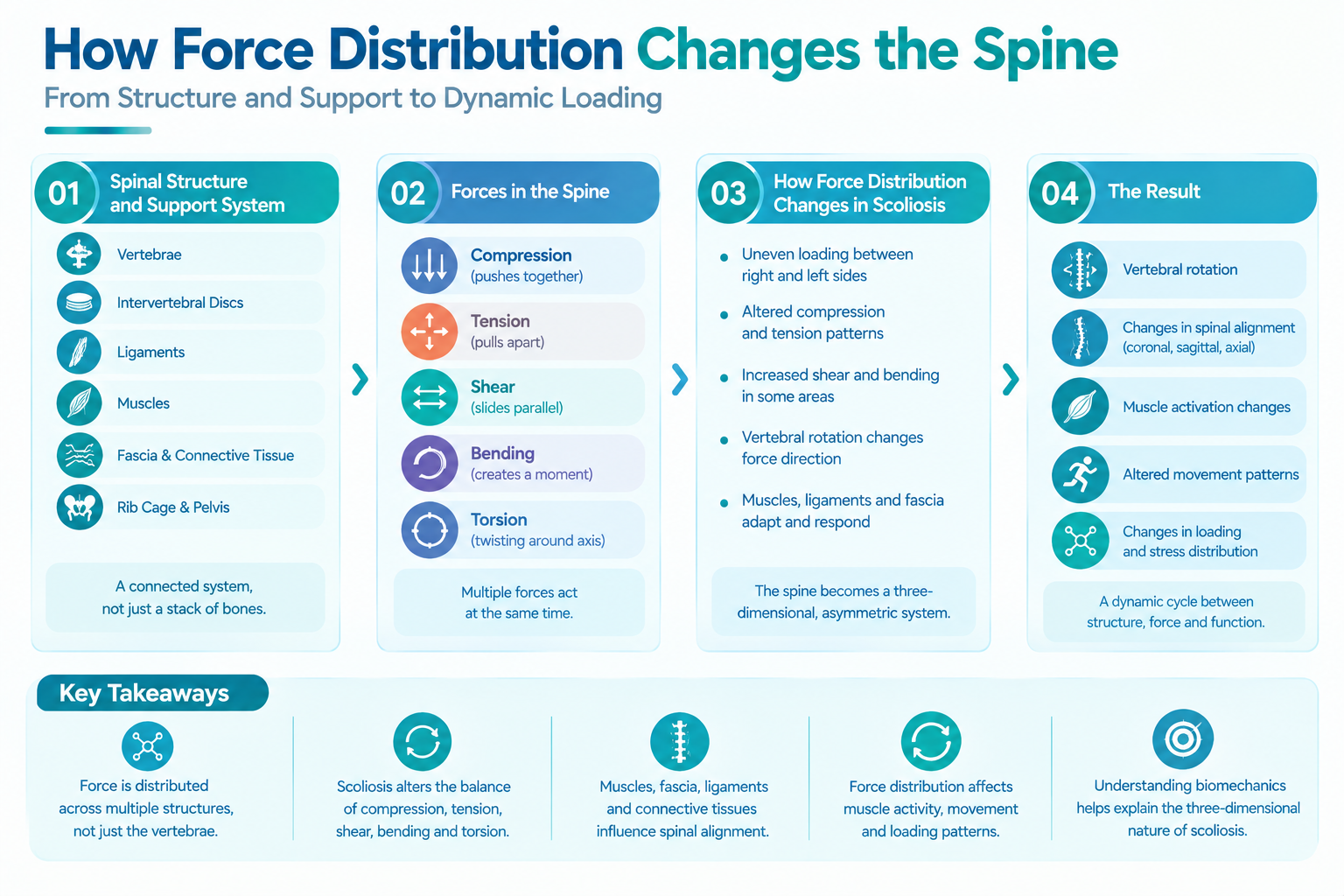
Compression, Tension, and Shear
Several basic types of mechanical force are particularly important when discussing scoliosis.
Compression
Compression occurs when structures are pushed toward one another.
The vertebral bodies and intervertebral discs normally experience substantial compressive loading during upright posture.
In a curved spine, however, compression may not be distributed evenly across a motion segment.
Tension
Tension occurs when tissues are pulled apart.
Ligaments, muscles, fascia, and other connective tissues can develop tensile forces as they resist deformation or stabilize the spine.
Shear
Shear occurs when forces act parallel to a surface or cause adjacent structures to slide relative to one another.
Shear forces can become particularly important when spinal alignment changes.
Bending
Bending occurs when a force produces a moment around an axis.
A spinal curve changes the geometry through which forces act. Consequently, the same external load can create different mechanical effects depending on the position and orientation of the spine.
Torsion
Torsion refers to twisting forces around the longitudinal axis.
This is particularly relevant to scoliosis because vertebral axial rotation is one component of the three-dimensional deformity.
These forces do not act independently. Compression, tension, shear, bending, and torsion can occur simultaneously.
---
Why Spinal Alignment Matters
The geometry of the spine determines how forces are transmitted.
A straight column and a curved column do not distribute loads in exactly the same way.
In scoliosis, changes may occur in:
- Coronal alignment
- Sagittal alignment
- Axial rotation
- Vertebral orientation
- Rib-cage geometry
- Pelvic alignment
Scoliosis is therefore best understood as a three-dimensional deformity, rather than simply a lateral deviation. Three-dimensional classification systems have incorporated parameters such as vertebral rotation, axial rotation of the apical vertebra, and geometric torsion. [6]
This has important biomechanical consequences.
When the geometry changes, the direction and magnitude of forces acting on individual spinal structures may also change.
---
The Importance of the Cobb Angle—and Its Limitations
The Cobb angle remains the standard radiographic measurement used to quantify the magnitude of a scoliosis curve.
It is clinically important for:
- Diagnosing scoliosis
- Monitoring progression
- Evaluating treatment
- Communicating curve magnitude
However, the Cobb angle describes primarily the angular deformity seen in the coronal plane.
It does not completely describe:
- Vertebral axial rotation
- Rib prominence
- Sagittal alignment
- Three-dimensional torsion
- Muscle forces
- Dynamic loading
- Internal tissue stresses
Two patients can have similar Cobb angles while having different three-dimensional geometry and different biomechanical behavior.
This is one reason modern scoliosis research increasingly combines radiographic measurements with three-dimensional imaging and computational biomechanical modelling.
---
How a Spinal Curve Can Change Force Distribution
Imagine a simplified vertical spinal column.
If the column is well aligned, the gravitational load is distributed through a relatively balanced geometry.
Now introduce a lateral curve.
The orientation of individual vertebrae changes.
As a result, the direction of forces relative to each vertebral segment also changes.
This can create differences in:
- Compressive loading
- Bending moments
- Shear forces
- Rotational moments
- Muscle activation
- Ligament tension
The relationship becomes even more complex when sagittal curvature and axial rotation are included.
The mechanical system is therefore not simply:
Curve → more pressure
Instead, it is more accurately represented as:
Altered geometry → altered force vectors → altered load distribution → tissue and neuromuscular adaptation
These changes may then interact with the existing deformity.
---
The Concave and Convex Sides
A scoliotic curve has a concave side and a convex side.
The mechanical environment can differ between these two sides.
Depending on the location and geometry of the curve, the concave side may experience greater compressive loading while the convex side may experience relatively greater tensile or unloading effects. However, actual loading patterns are influenced by the three-dimensional shape of the spine and cannot be determined from the Cobb angle alone.
This distinction is important because simplified diagrams often portray scoliosis as a two-dimensional curve.
Real spinal mechanics are more complicated.
Vertebral rotation, sagittal alignment, rib-cage geometry, pelvic position, and muscle activity can all influence the actual distribution of forces.
---
Muscle Forces Are Part of the Mechanical System
The spine is not a passive structure.
Muscles actively influence spinal loading.
Important muscles include:
- Multifidus
- Erector spinae
- Transversospinal muscles
- Quadratus lumborum
- Abdominal muscles
- Psoas
- Other trunk and hip stabilizers
When these muscles contract, they produce forces that can stabilize the spine but can also alter compression and moments acting on spinal segments.
This means that the mechanical environment of the spine depends on both:
External forces
and
Internal forces generated by muscles and connective tissues.
Research on movement-related biomechanics in adolescent idiopathic scoliosis has identified differences in gait, pelvic and trunk motion, balance, postural control, muscle activation, loading patterns, and spinal mobility compared with individuals without scoliosis. [7]
These findings support the idea that scoliosis is expressed not only as a static radiographic curve but also through altered movement and mechanical behavior.
---
Does Abnormal Loading Cause Scoliosis?
This is one of the most important questions in spinal biomechanics.
The answer is not simply yes.
Researchers have proposed several biomechanical theories of scoliosis development and progression. Some models suggest that altered loading may interact with spinal growth and produce a self-reinforcing mechanical process. [3][8]
For example:
Small asymmetry → asymmetric loading → tissue adaptation → greater asymmetry → further asymmetric loading
This type of model is sometimes described as a vicious cycle.
However, a proposed biomechanical mechanism is not necessarily a proven cause of idiopathic scoliosis.
Genetic susceptibility, skeletal growth, neuromuscular control, connective-tissue properties, and other biological factors may influence whether a mechanical asymmetry develops into a progressive deformity.
Therefore, biomechanics should be viewed as one part of a complex biological system.
---
Growth Makes Biomechanics Particularly Important
The adolescent spine is changing rapidly.
During growth, vertebrae and other spinal structures are continuously adapting to mechanical and biological influences.
This creates an important interaction between:
- Growth
- Spinal geometry
- Mechanical loading
- Tissue properties
- Muscle forces
Some biomechanical theories propose that asymmetric mechanical stress during growth can contribute to asymmetric vertebral development. Earlier biomechanical research proposed that abnormal geometry could produce persistent stress concentrations, which could then influence further deformation of growing spinal segments. [8]
More recent biomechanical theories similarly consider the interaction between spinal geometry, gravity, muscle forces, sagittal alignment, and growth-related changes. [3]
Nevertheless, these mechanisms remain areas of active research rather than definitive explanations for every case of scoliosis.
---
The Spine Does Not Experience Force in Isolation
One of the most important principles in biomechanics is that a force must be interpreted in relation to its direction, magnitude, location, and the geometry of the structure receiving it.
For example, a force applied to the trunk may produce different effects depending on whether it acts:
- Laterally
- Anteriorly
- Posteriorly
- Obliquely
- Close to the spinal axis
- Farther from the spinal axis
The distance between a force and the axis of rotation affects the resulting moment or torque.
This principle is especially relevant to scoliosis bracing.
A brace does not simply "push the spine straight." Its mechanical effect depends on the location, direction, magnitude, and distribution of corrective forces.
---
Biomechanics of Scoliosis Bracing
Bracing is one of the clearest clinical examples of applied spinal biomechanics.
A brace can apply external forces to the trunk to influence spinal alignment during growth.
Computational modelling has been used to investigate:
- Brace configuration
- Force magnitude
- Force direction
- Contact locations
- Spinal deformation
- Cobb angle changes
- Vertebral rotation
- Internal stresses
Finite-element studies have demonstrated that different loading configurations can produce different effects on Cobb angle and vertebral rotation. One study, for example, found that lateral-medial loading had a greater influence on Cobb angle in its model, while anterior-posterior loading had a greater influence on axial vertebral rotation. [9]
This illustrates a fundamental biomechanical principle:
The direction of a corrective force matters.
A force that changes coronal curvature does not necessarily produce the same effect on axial rotation or sagittal alignment.
---
Finite Element Modeling and Scoliosis
One of the most powerful tools in modern spinal biomechanics is finite element analysis (FEA).
Finite element models divide a complex anatomical structure into many smaller elements.
Researchers can then mathematically simulate how the structure responds to different forces.
In scoliosis research, models may include:
- Vertebral bodies
- Intervertebral discs
- Facet joints
- Ligaments
- Muscles
- Rib cage
- Brace components
- Surgical instrumentation
Computational models have been used to investigate scoliosis mechanisms, brace treatment, surgical correction, and patient positioning. [10]
However, finite-element models are not perfect replicas of the human body.
Important limitations include:
- Simplified material properties
- Incomplete representation of active muscle behavior
- Limited patient-specific data
- Assumptions about boundary conditions
- Difficulty validating internal stresses directly in living patients
For this reason, computational results should complement clinical and experimental evidence rather than replace it. [10][11]
---
Multibody Models and Whole-Spine Movement
Another approach is multibody musculoskeletal modelling.
While finite-element models are particularly useful for examining local stress and deformation, multibody models can help investigate larger-scale spinal movement and loading.
For example, researchers can examine:
- Whole-spine motion
- Joint forces
- Muscle forces
- Segmental movement
- Postural changes
- Dynamic loading
Combining multibody modelling with finite-element modelling can potentially provide a more comprehensive picture.
Multibody models can describe overall motion and kinetics, while finite-element models can provide information about internal stress and deformation in specific structures. [12]
This type of integrated modelling is particularly relevant to a three-dimensional condition such as scoliosis.
---
From Static Alignment to Dynamic Biomechanics
Traditional scoliosis assessment relies heavily on standing radiographs.
These images are extremely valuable, but they represent a particular moment in time.
Human movement is dynamic.
A person may demonstrate different spinal mechanics while:
- Standing
- Walking
- Sitting
- Bending
- Reaching
- Running
- Lifting
Recent review-level evidence indicates that adolescent idiopathic scoliosis is associated with differences in movement patterns, postural control, muscle activation, loading, and spinal mobility. [7]
This suggests that future scoliosis assessment may increasingly combine static structural measurements with dynamic functional measurements.
The goal would not be to replace the Cobb angle but to understand what the spine is doing beyond a single radiographic position.
---
Force Distribution and the Three-Dimensional Spine
A useful way to conceptualize scoliosis biomechanics is to consider three interacting planes.
Coronal Plane
This describes the side-to-side curvature commonly measured with the Cobb angle.
Sagittal Plane
This describes forward and backward spinal alignment, including lordosis and kyphosis.
Axial Plane
This describes rotation around the longitudinal axis.
These planes are mechanically coupled.
A change in one plane can influence forces and movements in another.
This is why a correction strategy focused exclusively on the coronal curve may not completely address vertebral rotation or sagittal alignment.
Three-dimensional spinal modelling attempts to capture these interactions more accurately. [6][11]
---
Could Manual Therapy or Exercise Change Force Distribution?
Exercise and manual therapy can influence movement, muscle activation, posture, and the way forces are distributed through the body.
However, the distinction between changing function and structurally correcting a vertebral deformity is essential.
An exercise may:
- Improve trunk control
- Change muscle recruitment
- Improve balance
- Reduce discomfort
- Improve postural awareness
- Modify movement strategies
These changes can be clinically meaningful even if the underlying vertebral geometry does not substantially change.
Similarly, manual therapy may influence soft-tissue mobility or symptoms without necessarily correcting a structural spinal curve.
Therefore, claims that a particular exercise or manual technique permanently redistributes spinal forces and straightens structural scoliosis require appropriate clinical and radiographic evidence.
---
A Pattern-Based Biomechanical Perspective
Because scoliosis involves complex three-dimensional geometry, some clinical approaches attempt to classify patients according to different structural and functional patterns rather than relying exclusively on Cobb angle.
These approaches may consider:
- Curve direction
- Curve location
- Vertebral rotation
- Trunk asymmetry
- Pelvic alignment
- Muscle activity
- Postural compensation
- Movement patterns
One clinician-developed framework is presented in Scoliosis, Meridian-Based Isometric Exercises and JESU5C Pattern Suit, which describes the JESU5C pattern classification together with the Hyun-Ga Manual Technique (HGMT) and meridian-based isometric exercises as a pattern-oriented approach to idiopathic scoliosis. [13]
This type of framework can be considered a clinical model for organizing individual patterns, but it should not be interpreted as replacing established radiographic assessment or evidence-based scoliosis classification.
---
Why Force Distribution Matters for Treatment
Understanding force distribution can help explain why scoliosis treatment cannot be reduced to simply "pushing the curve back."
Different interventions act through different mechanical pathways.
Bracing
Braces apply external forces to influence spinal alignment, particularly during growth.
Exercise
Exercise can modify muscle activation, postural control, balance, and movement strategies.
Surgery
Instrumentation can apply corrective forces to vertebrae and alter spinal alignment through rods, screws, and other implants.
Rehabilitation
Rehabilitation may address strength, endurance, balance, movement coordination, and functional limitations.
The mechanical goals of each intervention are different.
Computational biomechanical models have been increasingly used to investigate these mechanisms and predict potential treatment effects. [10][11]
---
What This Means for Patients
For patients and parents, biomechanics provides a useful way to understand why scoliosis is more complex than a number on an X-ray.
A comprehensive evaluation may consider:
- Cobb angle
- Curve location
- Vertebral rotation
- Coronal balance
- Sagittal alignment
- Pelvic alignment
- Skeletal maturity
- Muscle and neuromuscular function
- Pain and functional limitations
- Evidence of progression
The same Cobb angle does not necessarily mean the same biomechanical condition.
Likewise, improving posture or muscle balance does not automatically mean that the structural curve has been corrected.
The most meaningful assessment combines structural imaging with appropriate clinical examination and functional information.
---
The Future of Scoliosis Biomechanics
The future of scoliosis research is likely to involve increasingly patient-specific biomechanical models.
Instead of using a generalized model of the spine, researchers may increasingly combine:
- Three-dimensional imaging
- Motion analysis
- Surface or intramuscular EMG
- Muscle morphology
- Patient-specific finite-element models
- Multibody musculoskeletal models
- Growth prediction
- Clinical outcome data
The goal would be to predict how a particular patient's spine responds to specific mechanical conditions.
Computational modelling research has already demonstrated the potential of finite-element and multibody approaches, while also highlighting the limitations of current models and the need for improved validation and personalization. [10][11]
Such developments could eventually help clinicians answer more individualized questions:
Where are the major mechanical asymmetries?
Which structures are carrying the greatest load?
How does a particular brace configuration affect this patient's spine?
How might muscle activation change the mechanical environment?
Which treatment is most appropriate for this specific three-dimensional pattern?
These questions represent an important direction for future scoliosis research.
---
Conclusion
The biomechanics of scoliosis can be understood as the interaction between spinal geometry and mechanical forces.
When spinal alignment changes, the distribution of compression, tension, shear, bending moments, and rotational forces can also change. Muscles and connective tissues actively participate in this mechanical system, while growth can further modify the relationship between spinal shape and loading.
However, abnormal force distribution should not be presented as a single proven cause of idiopathic scoliosis.
Instead, current evidence supports a more complex model in which spinal geometry, mechanical loading, muscle activity, tissue properties, growth, and neuromuscular control interact over time. [3][7][8]
This biomechanical perspective is particularly valuable because scoliosis is fundamentally three-dimensional.
The Cobb angle remains an essential clinical measurement, but understanding the spine also requires consideration of coronal curvature, sagittal alignment, axial rotation, load distribution, muscle forces, and dynamic movement.
As computational modelling, three-dimensional imaging, and patient-specific biomechanics continue to develop, clinicians and researchers may be able to understand these relationships with increasing precision.
The ultimate goal is not simply to describe where the spine is curved, but to understand why the spine behaves the way it does under load—and how that knowledge can improve scoliosis assessment and treatment.
---
References
[1] Schlenk, R. P., Kowalski, R. J., & Benzel, E. C. Biomechanics of spinal deformity. Neurosurgical Focus. 2003.
[2] Oxland, T. R. Fundamental biomechanics of the spine—What we have learned in the past 25 years and future directions. Journal of Biomechanics. 2016.
[3] Current biomechanical theories on the etiopathogenesis of idiopathic scoliosis. European Spine Journal. 2023.
[4] Biomechanics of the thoracolumbar spine. Neurosurgical Focus. 1997.
[5] Ghezelbash, F., Schmidt, H., Shirazi-Adl, A., & El-Rich, M. Internal load-sharing in the human passive lumbar spine: Review of in vitro and finite element model studies. Journal of Biomechanics. 2019.
[6] State of the art of current 3-D scoliosis classifications: a systematic review from a clinical perspective. European Spine Journal. 2015.
[7] Movement Related Biomechanics in Adolescent Idiopathic Scoliosis: A Review of Reviews. Studies in Health Technology and Informatics. 2026.
[8] Biomechanical factors affecting progression of structural scoliotic curves of the spine. European Spine Journal. 2004.
[9] Finite element analysis of the scoliotic spine under different loading conditions. Biomedical Engineering. 2010.
[10] Computational Biomechanical Modeling of Scoliotic Spine: Challenges and Opportunities. Journal of Spinal Disorders & Techniques. 2016.
[11] Computational modelling of the scoliotic spine: A literature review. International Journal for Numerical Methods in Biomedical Engineering. 2021.
[12] Recent Advances in Coupled MBS and FEM Models of the Spine—A Review. Bioengineering. 2023.
[13] LEE, Yongsub, & Lee, Minsu (translator). Scoliosis, Meridian-Based Isometric Exercises and JESU5C Pattern Suit: “JESU5C” a New Classification of Idiopathic Scoliosis and HGMT (Hyun-Ga Manual Technique). Amazon Kindle Edition.