Spine Care
[Biomechanics, Tensegrity & Meridian Concepts 01] The Tensegrity Model: Understanding Spinal Alignment as a Dynamic Network
Learn how the tensegrity model explains spinal alignment as a dynamic network of bones, muscles, ligaments, fascia, and connective tissues—and what it may mean for scoliosis and spinal biomechanics.
Introduction
The human spine is often described as a column of stacked vertebrae. This description is useful for understanding basic anatomy, but it does not fully explain how the spine actually functions during standing, walking, bending, lifting, and other everyday movements.
The spine is not simply a rigid tower that supports the body from above. It is a dynamic mechanical system in which vertebrae, intervertebral discs, ligaments, muscles, fascia, the rib cage, and the pelvis continuously interact to maintain stability and allow movement. [1, 2]
One biomechanical concept that attempts to explain this type of organization is tensegrity.
The term tensegrity comes from the combination of "tensional integrity." In a tensegrity structure, stability is created through an interaction between elements primarily carrying tension and elements primarily carrying compression. The concept has been proposed as a model for understanding how biological structures can maintain stability while remaining flexible and adaptable. [3]
In spinal biomechanics, the biotensegrity model proposes that the spine can be understood as a dynamic network in which muscles, ligaments, connective tissues, and other structures influence the position and loading of the vertebral column.
This perspective is particularly interesting when thinking about spinal alignment, posture, movement, and scoliosis.
However, it is important to distinguish between a useful biomechanical model and a clinically proven explanation of scoliosis. Tensegrity provides a conceptual framework for understanding distributed forces and dynamic stability, but it does not replace established clinical measurements such as the Cobb angle, radiographic assessment, neurological examination, or evidence-based scoliosis classification and treatment. [1, 4]
---
What Is Tensegrity?
Tensegrity is a structural concept in which stability results from the interaction of continuous tension and discontinuous compression.
Traditional structures often rely on rigid components stacked or connected together. A tensegrity structure works differently.
Instead of depending primarily on one rigid element supporting another, forces are distributed through an interconnected network.
This creates several characteristic properties:
- distributed mechanical loading
- structural stability
- adaptability to changes in position
- interaction between tension and compression
- nonlinear mechanical behavior
- the ability to maintain overall integrity while individual components move
Stephen Levin proposed the tensegrity-truss model as a way of conceptualizing spinal mechanics. His model challenged the simple "tower of blocks" representation of the spine and proposed that the vertebral column should instead be understood as part of a larger tension-compression system. [3]
This idea became associated with the broader concept of biotensegrity, which applies tensegrity principles to living biological systems.
---
The Spine Is More Than a Stack of Bones
The vertebrae are obviously essential to spinal structure, but vertebrae do not function independently.
The spine also contains:
- intervertebral discs
- facet joints
- spinal ligaments
- paraspinal muscles
- abdominal muscles
- pelvic muscles
- connective tissues
- neural structures
- thoracic cage structures
- the pelvis
These components interact continuously.
Modern spinal biomechanics recognizes the importance of both passive and active structures in controlling spinal motion and loading. Biomechanical research examines the whole spine, functional spinal units, individual vertebrae, intervertebral discs, ligaments, muscles, and their interactions. [1]
This means that spinal alignment should not be viewed exclusively as a property of the vertebral bones.
Instead, alignment is influenced by the interaction between structure, load, movement, muscle activity, and passive tissue constraints.
---
The "Tower of Blocks" Model vs. the Tensegrity Model
A traditional simplified model represents the spine as a series of vertebral blocks stacked vertically.
This model is useful for teaching basic anatomy.
However, it becomes less satisfactory when trying to explain dynamic movement.
The spine constantly experiences:
- gravity
- ground-reaction forces
- muscle forces
- ligament tension
- disc loading
- joint forces
- acceleration and deceleration
- changes in body position
The tensegrity model attempts to conceptualize how these forces can be distributed across a network rather than being transmitted only vertically through a stack of bones. [3]
This does not mean that the conventional mechanical model is "wrong."
Rather, the tensegrity concept offers a different level of abstraction for understanding how a living spine can remain stable while moving.
---
How Does a Tensegrity Spine Work?
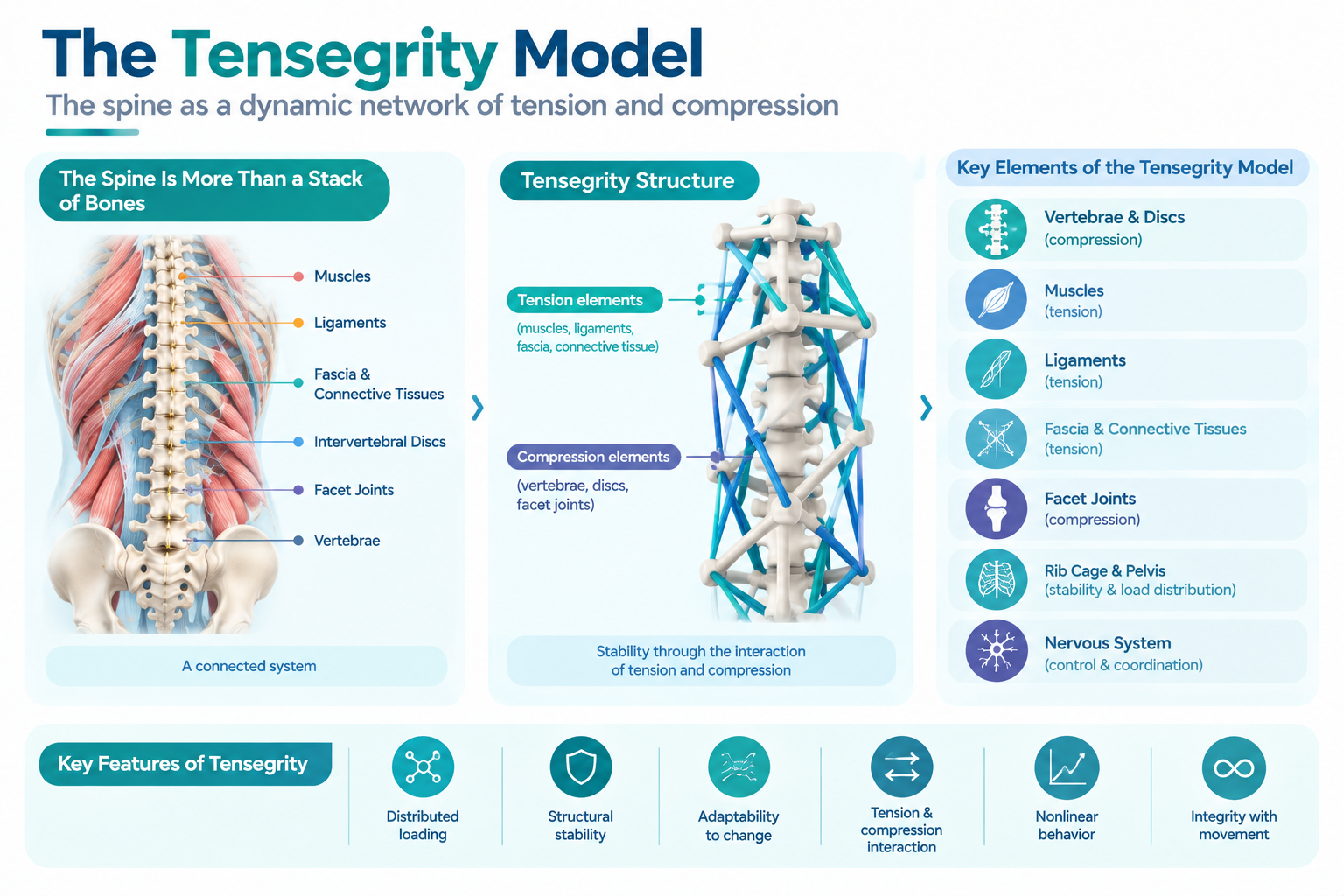
The simplest way to understand the model is to imagine a network containing elements that resist compression and elements that provide tension.
In a biological interpretation:
Compression-bearing structures may include:
- vertebral bodies
- intervertebral discs
- facet joints
- portions of the skeletal framework
Tension-bearing structures may include:
- muscles
- tendons
- ligaments
- fascial and connective-tissue structures
These categories are simplified because biological tissues can have complex mechanical behaviors and may contribute to both stiffness and load transmission depending on the situation.
The important concept is not that one tissue performs only one mechanical role.
The important concept is that multiple structures contribute simultaneously to mechanical equilibrium.
---
Why This Matters for Spinal Alignment
Spinal alignment is often presented as though the bones simply "line up."
In reality, maintaining upright posture requires continuous regulation.
When you stand:
- gravity pulls the body downward
- the feet interact with the ground
- the pelvis provides a mechanical base
- spinal muscles generate forces
- ligaments provide passive constraints
- discs and joints transmit loads
- the nervous system adjusts muscle activity
The body continuously makes small corrections to prevent loss of balance.
Therefore, upright posture is not a completely static state.
It is better understood as a dynamic equilibrium.
This concept fits naturally with a network-based view of spinal stability.
---
Dynamic Stability Rather Than Static Alignment
A key implication of the tensegrity perspective is that stability does not necessarily mean immobility.
A healthy spine must be both:
stable enough to support the body
and
mobile enough to allow normal movement.
These goals may appear contradictory, but the musculoskeletal system achieves them through coordinated control of multiple tissues and muscles.
Modern musculoskeletal modeling similarly recognizes that spinal function depends on the interaction of rigid structures, joints, flexible tissues, and muscle forces. Multibody models, for example, are used to study how different components contribute to spinal loading and movement. [2]
The tensegrity concept provides a conceptual way of thinking about this distributed stability.
---
The Role of Muscles in the Tensegrity Concept
Muscles are particularly important because they can actively change the mechanical state of the system.
Unlike bones and many passive tissues, skeletal muscles can change their force output rapidly.
For example, when a person:
- reaches forward
- lifts an object
- walks
- turns the trunk
- stands on one leg
- changes sitting posture
muscle activation changes.
The spine therefore experiences a different mechanical environment from one moment to the next.
A tensegrity-based interpretation emphasizes that these changes can influence the entire network rather than acting only at a single spinal segment.
---
Local Changes Can Influence the Larger System
One of the most interesting implications of a network model is that a change in one region may influence other regions.
The spine is mechanically connected from the skull to the pelvis.
For example, changes in:
- pelvic position
- lumbar lordosis
- thoracic kyphosis
- cervical alignment
- muscle activation
- trunk position
can alter the overall mechanical configuration of the body.
This does not mean that every postural change automatically causes a structural spinal deformity.
Rather, it means that spinal alignment should be considered in the context of the entire musculoskeletal system.
This principle is consistent with modern whole-spine biomechanical approaches, which examine spinal alignment and loading as integrated mechanical problems rather than isolated vertebral measurements. [1, 2]
---
Tensegrity and the Three-Dimensional Spine
Scoliosis provides an especially interesting context for thinking about spinal mechanics.
Scoliosis is not simply a two-dimensional lateral curve. Structural scoliosis involves three-dimensional changes that may include:
- coronal curvature
- vertebral rotation
- changes in sagittal alignment
- rib-cage asymmetry
- altered trunk balance
Computational models of scoliosis increasingly attempt to represent these complex three-dimensional relationships. A systematic review of computational scoliosis models identified finite-element, multibody, and other modeling approaches used to investigate spinal deformity and its mechanical behavior. [4]
A network-based biomechanical perspective can therefore complement, but not replace, conventional radiographic assessment.
---
Can Tensegrity Explain Scoliosis?
This question requires caution.
Tensegrity may provide a useful theoretical framework for thinking about scoliosis, but it is not established that scoliosis is caused by a failure of tensegrity.
Scoliosis is a heterogeneous condition with multiple etiologies.
These include:
- adolescent idiopathic scoliosis
- congenital scoliosis
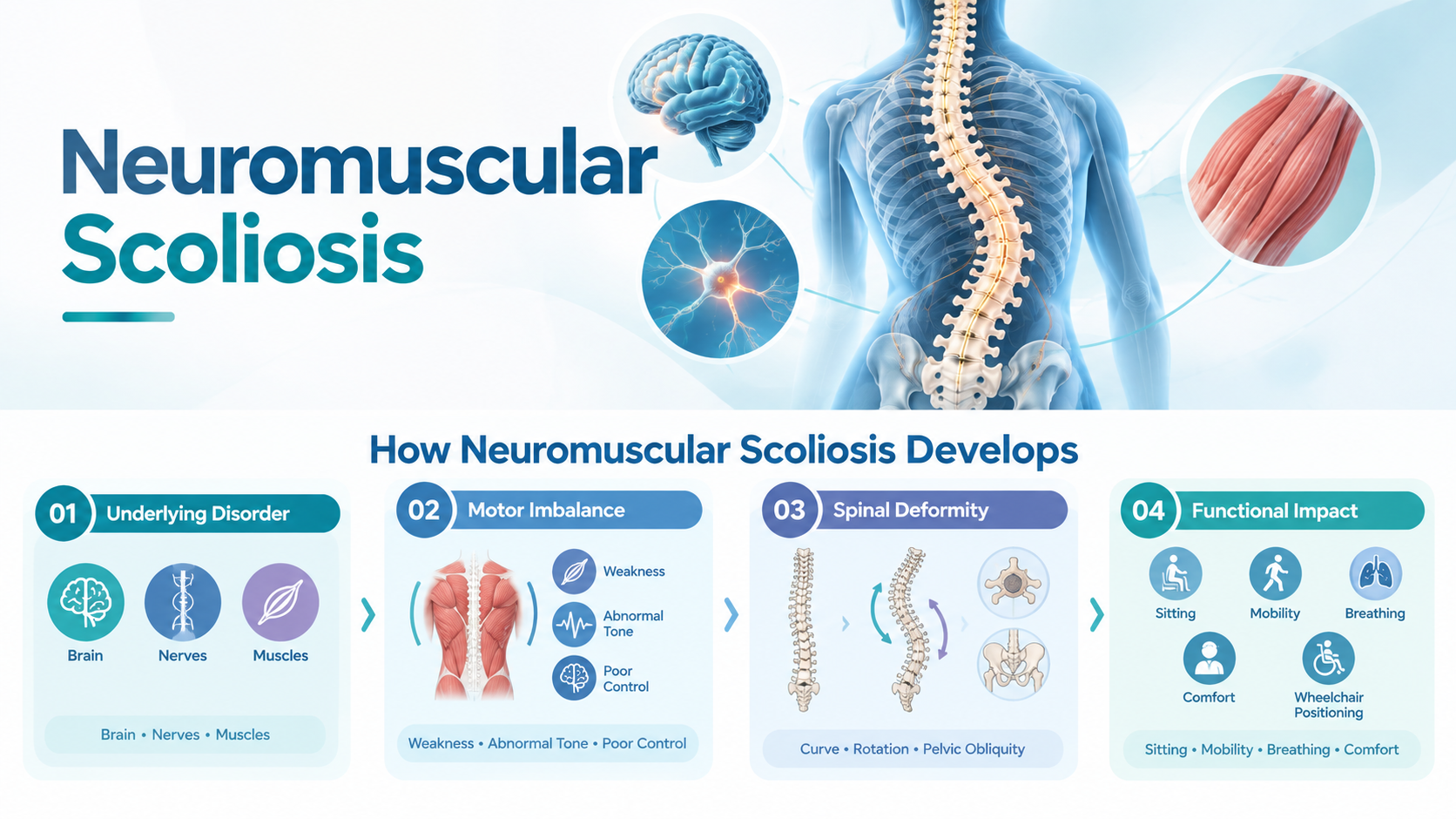
- neuromuscular scoliosis
- degenerative scoliosis
- syndromic scoliosis
- other structural causes
In adolescent idiopathic scoliosis in particular, the underlying mechanisms remain incompletely understood.
Therefore, it would be scientifically inappropriate to state that "imbalanced muscles cause scoliosis because of tensegrity."
That would go beyond the current evidence.
A more defensible interpretation is that a tensegrity or network model may help researchers conceptualize how spinal deformity, muscle forces, connective tissues, gravity, and movement interact mechanically.
---
Tensegrity Is a Model, Not a Diagnosis
This distinction is particularly important for patients.
A patient does not receive a diagnosis of "tensegrity dysfunction."
Clinicians diagnose and characterize scoliosis using established clinical and radiographic methods.
These may include:
- physical examination
- standing spinal radiographs
- Cobb angle measurement
- assessment of vertebral rotation
- evaluation of coronal balance
- assessment of sagittal alignment
- neurological examination
- evaluation of skeletal maturity
- additional imaging when indicated
Tensegrity is better understood as a conceptual biomechanical model rather than a clinical diagnostic category.
---
How the Tensegrity Model Relates to the Cobb Angle
The Cobb angle remains the standard radiographic measurement for quantifying scoliosis curvature.
It is extremely useful.
However, the Cobb angle provides only one measurement of spinal deformity.
It does not directly measure:
- muscle activation
- ligament tension
- fascial loading
- dynamic movement
- three-dimensional force distribution
- spinal stiffness
- whole-body postural control
This creates an interesting distinction.
Cobb angle answers:
How large is the radiographic spinal curve?
A biomechanical network model asks:
How does the entire musculoskeletal system contribute to maintaining or changing spinal position and loading?
These are different questions.
They should not be treated as competing measurements.
---
Static X-Rays and Dynamic Human Movement
A standing spinal X-ray provides a valuable snapshot of spinal alignment.
However, human movement is dynamic.
A person may have one spinal configuration while:
- standing
- sitting
- walking
- bending
- lifting
- rotating
- sleeping
Therefore, a single radiograph cannot capture every aspect of spinal biomechanics.
This is one reason researchers use computational and musculoskeletal models to investigate spinal mechanics under different loading and movement conditions. Modern modeling research increasingly considers muscle forces, joint mechanics, spinal loading, and dynamic tasks. [2, 5]
The tensegrity concept is particularly attractive because it emphasizes the relationship between structure and changing force states.
---
The Nervous System Is Part of the Dynamic System
A purely mechanical explanation of spinal alignment is incomplete.
The human body does not passively respond to mechanical forces.
The nervous system continuously regulates muscle activity.
Sensory information from:
- muscles
- joints
- the vestibular system
- the eyes
- the feet
helps the nervous system maintain posture and balance.
When body position changes, muscle activity changes accordingly.
Therefore, spinal alignment is not simply the result of bones and connective tissues.
It is influenced by an interaction between:
skeletal structure + passive tissues + muscles + nervous-system control + gravity + external forces.
This broader perspective is consistent with contemporary approaches to musculoskeletal biomechanics, although the exact biological implementation of tensegrity remains a matter of scientific discussion rather than an established clinical doctrine. [1, 5]
---
Tensegrity and Postural Adaptation
The human body constantly adapts to changes in its environment.
Consider standing on an unstable surface.
The body responds by changing muscle activation and joint positions to maintain balance.
Similarly, carrying a heavy object on one side changes the distribution of forces through the trunk.
The spine and surrounding muscles adapt to the new mechanical conditions.
This illustrates an important concept:
alignment is not necessarily a single fixed position.
The body can maintain function across a range of positions through coordinated adjustments.
A tensegrity-inspired model emphasizes this adaptability.
---
What About Muscle Imbalance?
The concept of muscle imbalance is often discussed in relation to posture and scoliosis.
However, the terminology can become misleading.
A difference in muscle activity does not automatically mean that one muscle is "weak" and another is "tight."
Muscle function depends on:
- task
- joint position
- contraction type
- fatigue
- neural control
- mechanical advantage
- pain
- adaptation
In scoliosis, asymmetrical muscle activity may occur, but the relationship between muscular asymmetry and structural spinal deformity is complex.
Therefore, tensegrity should not be reduced to the simplistic idea that "tight muscles pull the spine crooked."
The actual biomechanics are considerably more complicated.
---
Tensegrity and Fascia
Biotensegrity discussions frequently emphasize the fascia and connective-tissue network.
Fascia forms interconnected connective-tissue structures throughout the body.
Because connective tissues transmit mechanical forces, it is reasonable to investigate their contribution to movement and mechanical coupling.
However, claims that fascial tension alone determines spinal alignment or causes scoliosis should be treated cautiously.
The scientific literature supports the importance of connective tissues in musculoskeletal mechanics, but the precise extent to which a generalized fascial network determines spinal alignment remains an area of ongoing investigation.
For a medical website, it is therefore better to describe fascia as one component of a larger mechanical system, rather than presenting it as the primary explanation for spinal deformity.
---
Tensegrity and Spinal Rehabilitation
A network-based view may also influence how clinicians think about rehabilitation.
Instead of focusing exclusively on one vertebral segment, rehabilitation may consider:
- trunk control
- breathing
- pelvic positioning
- lower-extremity mechanics
- balance
- muscle coordination
- spinal mobility
- functional movement
This does not mean that every rehabilitation program is a "tensegrity treatment."
Rather, the broader concept encourages clinicians to consider how different regions interact during movement.
For patients with scoliosis, exercise-based interventions may be individualized according to curve pattern, age, symptoms, functional limitations, and treatment goals.
---
Tensegrity and Scoliosis-Specific Exercise
Some scoliosis-specific exercise approaches emphasize active postural correction and three-dimensional control.
These approaches may include:
- axial elongation
- trunk stabilization
- breathing techniques
- rotational correction
- posture awareness
- individualized movement strategies
A tensegrity framework may provide a useful conceptual language for understanding why an exercise can influence more than one body region at a time.
However, it should not be used to claim that tensegrity-based exercise has been proven to reverse structural scoliosis.
Clinical evidence for specific exercise approaches must be evaluated independently of the tensegrity concept.
---
Could Tensegrity Help Explain Why Spinal Alignment Changes?
Potentially, but only as part of a broader model.
Spinal alignment can change because of:
- growth
- degeneration
- trauma
- muscle forces
- ligament properties
- disc degeneration
- neurological conditions
- congenital abnormalities
- changes in pelvic alignment
- changes in body weight or loading
- compensatory postural strategies
A network model allows these factors to be considered as interacting influences rather than completely independent variables.
This is consistent with modern computational spinal biomechanics, where researchers increasingly use multibody and finite-element models to investigate complex relationships between spinal structures, muscles, loads, and movement. [2, 4]
---
What Tensegrity Can—and Cannot—Tell Us
What the Model Can Help Explain
The tensegrity concept can help illustrate:
- why spinal stability is distributed across multiple structures
- why muscles can influence spinal loading
- why movement changes mechanical forces
- why local changes can affect global alignment
- why the spine must be both stable and mobile
- why static bone alignment alone does not fully describe spinal function
What It Cannot Currently Prove
The tensegrity model does not by itself prove:
- that tensegrity failure causes scoliosis
- that muscle imbalance is the primary cause of idiopathic scoliosis
- that fascia determines spinal alignment
- that a particular exercise can correct scoliosis
- that manipulating one body region will automatically straighten the spine
- that tensegrity-based treatment is superior to established scoliosis care
These distinctions are essential for maintaining scientific accuracy.
---
Tensegrity vs. Modern Computational Spine Modeling
It is useful to distinguish the conceptual tensegrity model from computational biomechanical models.
Modern spine research uses several modeling approaches.
Finite Element Models
Finite element models can represent tissues as deformable structures and are useful for investigating stresses, strains, and deformation.
Multibody Models
Multibody models simplify components as bodies connected through joints and flexible elements. They can be used to investigate movement, muscle forces, and spinal loading. [2]
Coupled Models
More advanced approaches can combine different modeling methods to capture multiple levels of spinal mechanics.
Recent reviews emphasize increasing interest in personalized musculoskeletal models, more complex functional tasks, and improved model validation. However, important limitations remain, including variability in model assumptions and limited experimental data for validation. [5]
The tensegrity model is therefore best considered a conceptual framework that complements biomechanical modeling, rather than a replacement for finite-element or multibody analysis.
---
Why This Model May Be Relevant to the Future of Scoliosis Research
Scoliosis is inherently three-dimensional and dynamic.
Traditional measurements such as the Cobb angle remain essential, but future research may increasingly combine:
- three-dimensional imaging
- motion analysis
- muscle activity
- computational modeling
- spinal loading
- posture analysis
- patient-specific anatomy
- longitudinal progression data
Computational scoliosis research is already moving toward increasingly patient-specific models and simulations. [4]
A network-based biomechanical perspective may help researchers investigate how structural deformity interacts with muscle forces and whole-body mechanics.
This could eventually contribute to better understanding of:
- curve progression
- mechanical loading
- treatment response
- brace mechanics
- surgical planning
- individualized rehabilitation
However, these applications require rigorous validation before they can be translated into clinical recommendations.
---
A Practical Way to Think About the Tensegrity Model
For patients and parents, the concept can be simplified:
Imagine the spine not as a pile of blocks but as a dynamic suspension system.
The bones provide structural support.
The discs and joints allow controlled movement and transmit loads.
The ligaments provide passive restraint.
The muscles continuously adjust tension.
The pelvis provides a critical foundation.
The nervous system coordinates the entire system.
When one part changes, other parts may adapt.
This does not mean that every change is harmful or that every asymmetry produces disease.
It means that the spine functions as part of an interconnected system.
---
Tensegrity and the Concept of Spinal Alignment
Spinal alignment is therefore better understood as a relationship among several dimensions:
Coronal Alignment
Describes left-right alignment and is particularly relevant when assessing scoliosis curves.
Sagittal Alignment
Describes front-to-back spinal curvature, including cervical lordosis, thoracic kyphosis, and lumbar lordosis.
Axial Rotation
Describes rotational changes around the spinal axis and is an important component of three-dimensional scoliosis.
Global Balance
Describes how the head, trunk, spine, pelvis, and lower extremities work together to maintain an efficient upright position.
A network-based model helps place these measurements into a broader biomechanical context.
---
Key Takeaways
The tensegrity model provides a useful way to think about the spine as a dynamic mechanical network rather than a simple stack of vertebrae.
The most important concepts are:
- The spine is a dynamic biomechanical system, not merely a rigid column of bones. [1]
- Tensegrity describes stability arising from interacting tension and compression. [3]
- Muscles, ligaments, discs, joints, bones, and connective tissues all contribute to spinal mechanics. [1, 2]
- Spinal alignment is dynamic and changes with posture, movement, loading, and muscle activity.
- The tensegrity concept may help explain distributed mechanical interactions across the body.
- Scoliosis is a three-dimensional deformity, making network-based biomechanical thinking potentially relevant to research. [4]
- Tensegrity is a conceptual model, not an established clinical diagnosis or standalone treatment system.
- The Cobb angle remains an essential clinical measurement of scoliosis and should not be replaced by theoretical models.
- Modern computational biomechanics uses finite-element, multibody, and other approaches to investigate spinal loading and movement. [2, 4, 5]
- Future scoliosis research may benefit from combining structural imaging with dynamic, patient-specific biomechanical information.
---
Important Precautions & Medical Disclaimer
This article is intended for educational purposes and does not replace professional medical evaluation, diagnosis, or treatment.
The tensegrity or biotensegrity model is a biomechanical framework used to conceptualize relationships among structural and force-generating components of the body. It should not be interpreted as a universally accepted explanation for the causes of scoliosis or other spinal disorders.
In particular, this article does not claim that muscle imbalance, fascial tension, or a failure of tensegrity causes idiopathic scoliosis.
Patients with scoliosis should be evaluated using established clinical methods, including appropriate physical examination and radiographic assessment. Depending on the clinical situation, evaluation may also include neurological examination, pulmonary assessment, advanced imaging, or other investigations.
Treatment should be based on the individual's diagnosis, age, skeletal maturity, curve characteristics, symptoms, progression risk, and overall health.
---
Conclusion
The human spine is often imagined as a vertical column of stacked vertebrae. While this model is useful for understanding basic anatomy, it does not fully capture the complexity of human movement and postural control.
The tensegrity model offers another way to conceptualize spinal mechanics—as a dynamic network in which compression-bearing structures and tension-bearing structures interact continuously.
From this perspective, vertebrae do not work alone. Intervertebral discs, ligaments, muscles, connective tissues, the pelvis, and the nervous system all participate in maintaining spinal stability and controlling movement.
This perspective is particularly interesting in scoliosis because scoliosis is a three-dimensional deformity involving curvature, rotation, and changes in spinal and trunk alignment. Modern computational research is increasingly investigating these complex relationships through finite-element, multibody, and other biomechanical models. [4, 5]
Nevertheless, tensegrity should be viewed as a biomechanical model rather than a proven clinical theory of scoliosis. It does not replace the Cobb angle, radiographic analysis, neurological assessment, or evidence-based treatment.
Its greatest value may be conceptual: it reminds us that spinal alignment is not simply the position of individual bones—it is the dynamic result of interactions throughout the musculoskeletal system.
As spinal biomechanics becomes increasingly patient-specific and three-dimensional, models that integrate structure, muscle forces, movement, and whole-body alignment may contribute to a deeper understanding of spinal health and deformity.
---
References
[1] Oxland TR. Fundamental biomechanics of the spine—What we have learned in the past 25 years and future directions. Journal of Biomechanics. 2016;49(6):817–832. doi:10.1016/j.jbiomech.2015.10.035.
[2] Wochner R, et al. Multibody Models of the Thoracolumbar Spine: A Review on Applications, Limitations, and Challenges. Bioengineering. 2023.
[3] Levin SM. The Tensegrity-Truss as a Model for Spine Mechanics: Biotensegrity. Journal of Mechanics in Medicine and Biology. 2002;2(3–4):375–388. doi:10.1142/S0219519402000472.
[4] Gould M, et al. Computational modelling of the scoliotic spine: A literature review. International Journal for Numerical Methods in Biomedical Engineering. 2021;37(10):e3503. doi:10.1002/cnm.3503.
[5] Carpenedo L, Ignasiak D, Remus R, et al. Advances in Musculoskeletal Modeling of the Thoraco-Lumbar Spine: A Comprehensive Systematic Review. Annals of Biomedical Engineering. 2025;53:2883–2910.