Functional Scoliosis
[Scoliosis Basics & Fundamentals 06] Adult Degenerative Scoliosis: Causes and Symptoms
Adult Degenerative Scoliosis: Causes, Symptoms, Spinal Alignment, and Diagnosis. Learn about adult degenerative scoliosis, including its causes, symptoms, Cobb angle, spinal alignment changes, nerve c
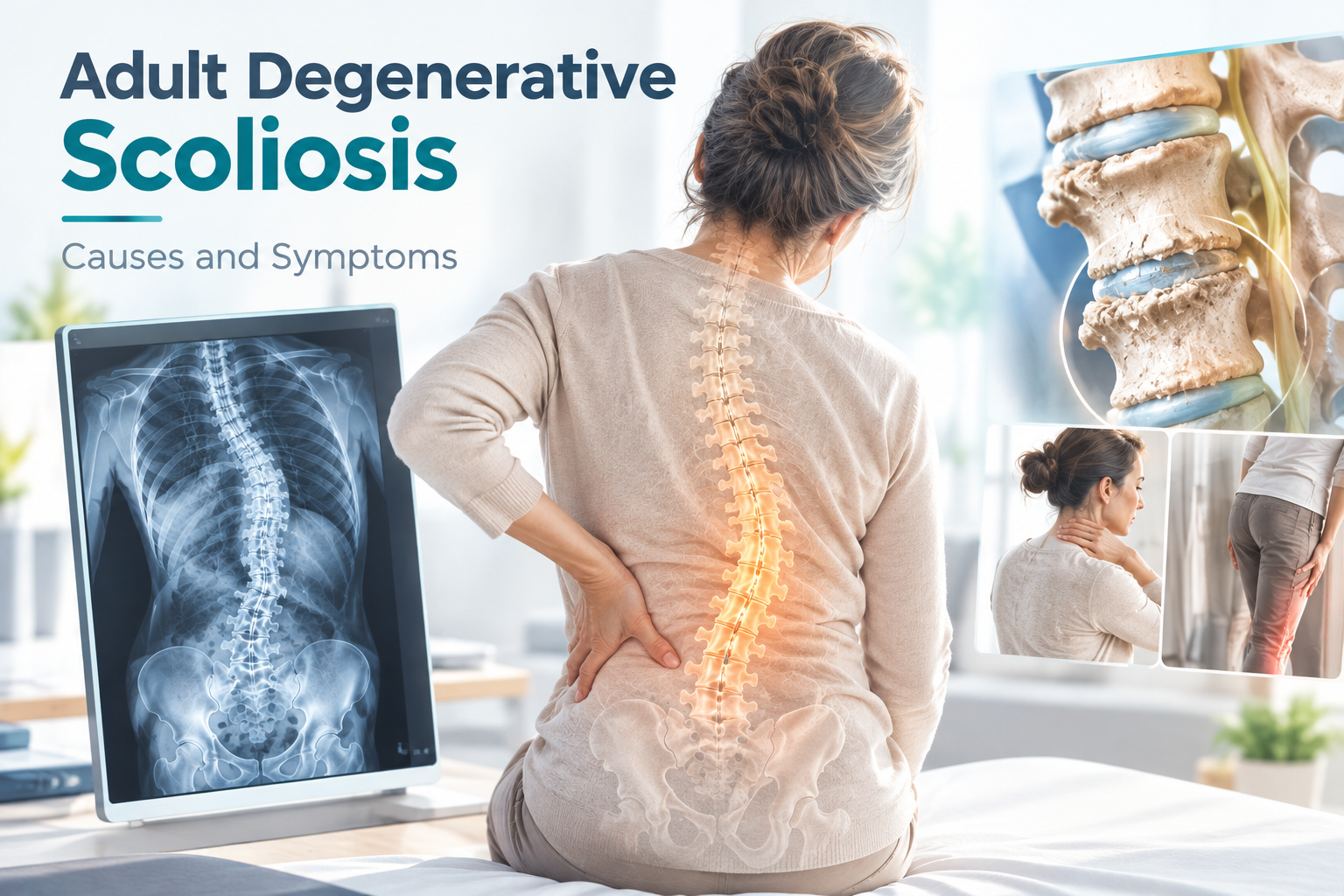
Adult Degenerative Scoliosis: Causes and Symptoms
Introduction
Adult degenerative scoliosis is a form of spinal deformity that develops or progresses during adulthood as age-related changes affect the intervertebral discs, facet joints, vertebral structures, and supporting tissues of the spine. It is also commonly called degenerative lumbar scoliosis or de novo scoliosis when the curvature develops in a previously relatively straight spine during adulthood. Unlike adolescent idiopathic scoliosis, which usually begins during childhood or adolescence, adult degenerative scoliosis is closely associated with progressive degeneration of the structures that normally maintain spinal alignment. [1][2]
For many patients, the condition develops gradually. At first, an individual may notice occasional lower-back stiffness or fatigue after standing for a long time. Over time, however, asymmetric disc degeneration and joint arthritis can alter the alignment of the lumbar spine. This may produce a measurable coronal curvature, changes in lumbar lordosis, trunk imbalance, and narrowing of the spaces through which spinal nerves travel. [1][3]
Adult degenerative scoliosis is therefore more than simply an age-related "curve" in the spine. It is a three-dimensional spinal alignment disorder that can involve coronal curvature, vertebral rotation, sagittal imbalance, pelvic compensation, and degenerative narrowing around the spinal nerves. [2][4]
For patients and families, this distinction is important because the symptoms of adult degenerative scoliosis may come from several interacting sources. Pain may arise from degenerating discs or facet joints, while leg pain, numbness, or weakness may result from spinal stenosis or nerve-root compression. A person's symptoms therefore cannot be predicted from the Cobb angle alone. [1][3]
---
What Is Adult Degenerative Scoliosis?
Adult degenerative scoliosis generally refers to a structural spinal curvature that develops in adulthood as a consequence of degenerative changes in the spine. The condition most often affects the lumbar spine, although degeneration and deformity can influence alignment across multiple spinal regions. [1][2]
The Scoliosis Research Society describes adult degenerative scoliosis as a type of adult scoliosis that develops because of degeneration of the intervertebral discs, arthritis of the facet joints, and collapse or wedging of disc spaces. It is commonly associated with loss of normal lumbar lordosis when viewed from the side. [1]
Unlike adolescent idiopathic scoliosis, adult degenerative scoliosis is often associated with symptoms caused by degenerative spinal disease. These may include lower-back pain, stiffness, leg pain, numbness, and symptoms associated with spinal stenosis. [1][3]
The term de novo scoliosis is sometimes used because the curvature develops during adulthood rather than representing a continuation of a clearly established adolescent curve. However, not every adult with scoliosis has a newly developed curve. Some adults have adolescent idiopathic scoliosis that has persisted and progressed during later life. Distinguishing these conditions can be clinically important. [1]
---
Adult Degenerative Scoliosis vs. Adult Idiopathic Scoliosis
There are two broad pathways by which an adult may have scoliosis.
Adult idiopathic scoliosis
This is generally a continuation of scoliosis that began earlier in life, often during adolescence. A person may have had a known spinal curve for decades, or an old curve may only become recognized when symptoms develop later in adulthood. Degenerative changes can subsequently increase the magnitude of the curve and contribute to symptoms. [1]
Adult degenerative or de novo scoliosis
This develops later in life as asymmetric degeneration alters spinal alignment. The process commonly involves intervertebral disc degeneration, facet-joint arthritis, asymmetric disc-space collapse, and changes in lumbar lordosis. [1][2]
The distinction is not merely academic. The underlying anatomy, pattern of degeneration, neurological symptoms, and treatment considerations may differ between long-standing idiopathic scoliosis and a newly developed degenerative curve. [1][3]
---
What Causes Adult Degenerative Scoliosis?
1. Intervertebral Disc Degeneration
One of the central mechanisms in adult degenerative scoliosis is intervertebral disc degeneration.
Between most vertebral bodies are intervertebral discs that provide cushioning and contribute to spinal movement and load distribution. With aging, discs can lose hydration and structural integrity. Disc height may decrease, and the degeneration may not occur symmetrically from one side to the other. [2][5]
When one side of a disc space collapses more than the other, the vertebral segment can gradually tilt. When this process occurs at multiple levels, the combined effect can produce a progressive coronal curvature. This is one reason adult degenerative scoliosis is frequently associated with asymmetric disc-space narrowing and wedging. [1][2]
Disc degeneration can also alter the normal sagittal profile of the lumbar spine. Loss of lumbar lordosis may cause the trunk to shift forward, increasing the demands placed on the spinal and pelvic muscles needed to maintain an upright position. [2][4]
---
2. Facet Joint Osteoarthritis
The facet joints are small paired joints located at the back of the vertebral column. They help guide spinal movement and contribute to stability.
As people age, the facet joints may develop osteoarthritic changes. Cartilage can deteriorate, joint surfaces may become irregular, and osteophytes or bone spurs may develop. [5]
Facet-joint degeneration can contribute to both mechanical back pain and narrowing of spaces around spinal nerves. When degeneration is asymmetric, it can also contribute to progressive changes in spinal alignment. [1][5]
This means that adult degenerative scoliosis is rarely caused by one isolated structure. Instead, the condition usually reflects interaction among discs, facet joints, vertebral alignment, muscles, ligaments, and the pelvis. [2][3]
---
3. Asymmetric Disc Collapse
A particularly important feature of degenerative scoliosis is asymmetric disc collapse.
Imagine a lumbar disc that gradually loses height. If the loss of height occurs relatively evenly, the primary result may be generalized loss of disc height. If the collapse is greater on one side, however, the vertebral bodies can tilt toward that side. [1][2]
When several adjacent levels develop this type of asymmetric degeneration, the individual changes can combine into a larger structural curve.
This process may also produce:
- Lateral vertebral translation
- Foraminal narrowing
- Segmental instability
- Vertebral rotation
- Progressive coronal imbalance
- Changes in lumbar lordosis
These structural changes help explain why adult degenerative scoliosis can produce both visible posture changes and neurological symptoms. [2][3]
---
4. Loss of Lumbar Lordosis and Sagittal Imbalance
The spine needs to maintain a balanced relationship between the head, thorax, pelvis, and lower extremities.
Lumbar lordosis is the normal inward curvature of the lower back when viewed from the side. Degenerative disc disease and other age-related changes can reduce this curvature. [1][4]
When lumbar lordosis decreases substantially, the trunk may shift forward. The body can initially compensate by rotating the pelvis backward, extending the hips, or flexing the knees to maintain an upright posture. [4]
These compensatory mechanisms can eventually become physically demanding.
Patients may describe:
- Difficulty standing completely upright
- A tendency to lean forward
- Back-muscle fatigue
- Difficulty walking for extended periods
- Relief when sitting or leaning forward
This illustrates why adult spinal deformity should be evaluated in both the coronal plane and sagittal plane, rather than by measuring only the lateral curvature. [2][4]
---
5. Osteoporosis and Vertebral Compression Fractures
Bone health can also influence spinal alignment in older adults.
Osteoporosis reduces bone mass and weakens the structural strength of vertebrae. Vertebral compression fractures can change vertebral shape and alter the alignment of the spinal column. [4][6]
A compression fracture may produce a localized kyphotic deformity rather than classic degenerative scoliosis, but multiple fractures or asymmetric vertebral collapse can contribute to a broader spinal deformity. [4]
For this reason, evaluation of an older adult with a newly developing spinal deformity may include consideration of bone health, especially when there is a history of osteoporosis, low-trauma fracture, or significant height loss. [4][6]
---
6. Age-Related Changes in the Spine
Aging does not automatically cause symptomatic scoliosis.
Many adults have disc degeneration or facet arthritis visible on imaging without experiencing significant pain. However, in some individuals, progressive degeneration can contribute to spinal deformity and neurological compression. [5]
This distinction is important because an X-ray or MRI may show substantial degenerative changes in a person who has relatively few symptoms, while another patient with less dramatic imaging findings may experience substantial pain or disability.
Therefore, imaging findings should always be interpreted alongside the patient's symptoms, physical examination, functional limitations, and neurological findings. [1][3]
---
What Does Adult Degenerative Scoliosis Look Like?
The physical appearance of adult degenerative scoliosis can vary considerably.
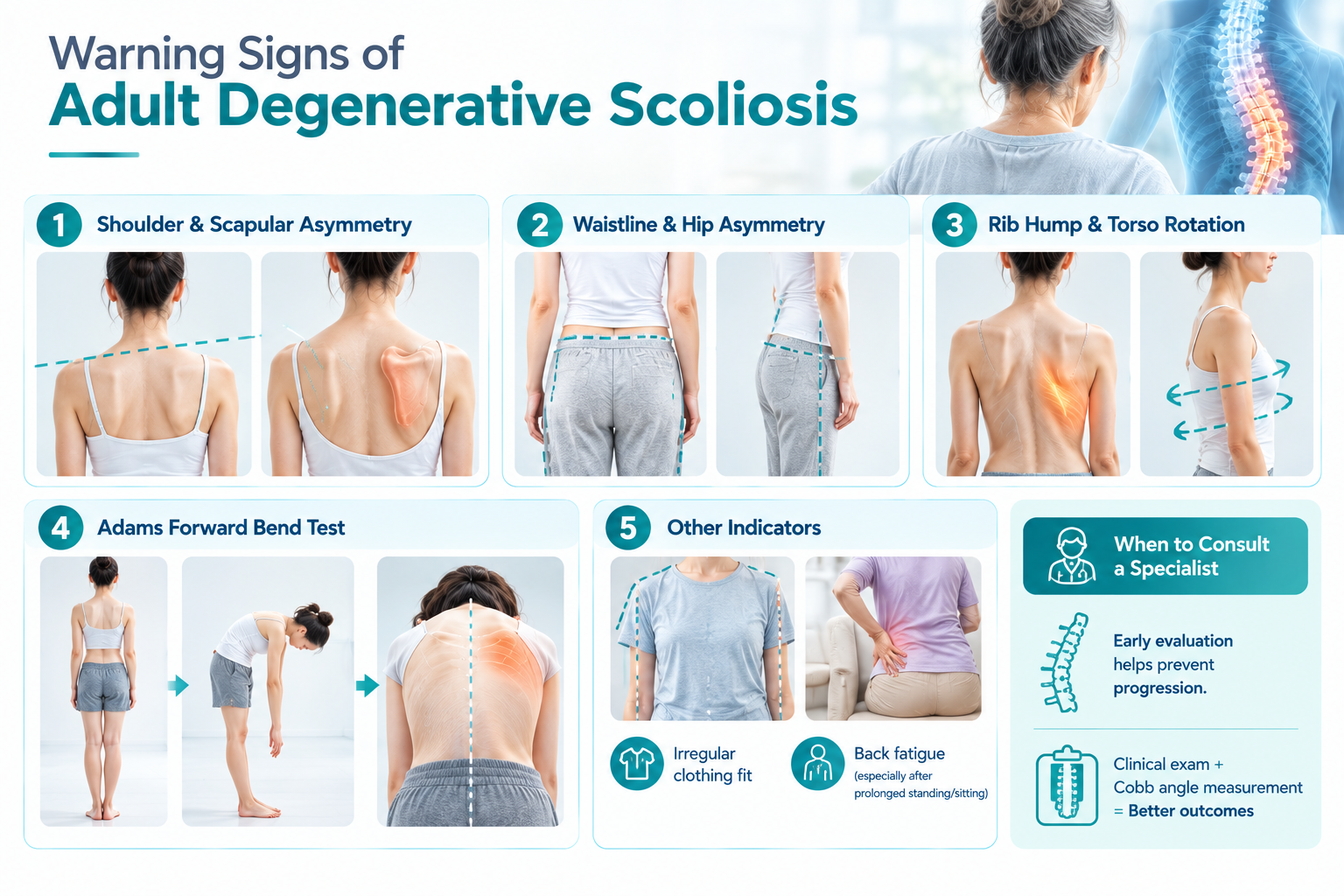
Some patients have a relatively subtle curve that is difficult to see externally. Others may develop noticeable asymmetry of the shoulders, waist, pelvis, or trunk. [1]
Possible visible findings include:
- Uneven shoulders
- Uneven waist contours
- Pelvic asymmetry
- Trunk shift
- A visible lumbar curve
- Prominence of one side of the lower back
- Forward-leaning posture
- Difficulty maintaining an upright position
- Reduced posture symmetry
However, visible asymmetry does not establish the diagnosis by itself. A structural spinal deformity requires appropriate clinical assessment and, when indicated, radiographic evaluation. [1][7]
---
Common Symptoms of Adult Degenerative Scoliosis
1. Lower-Back Pain
Low-back pain is one of the most common symptoms associated with adult scoliosis. Degenerative discs, facet joints, muscular fatigue, mechanical instability, and altered spinal alignment can all contribute to pain. [1][2]
Pain may be localized to the lower back or may occur around the apex or concavity of the spinal curve. Some patients experience increased discomfort after prolonged standing or walking, while others notice symptoms during particular movements or activities. [2]
Importantly, not every adult with degenerative scoliosis experiences pain. The presence of a radiographic curve does not necessarily mean that the curve itself is the source of pain. [1][5]
---
2. Back Stiffness
Stiffness is another common complaint.
Degeneration of the intervertebral discs and facet joints can reduce normal segmental motion. Muscles surrounding the spine may also remain active for longer periods to compensate for altered alignment and maintain an upright posture. [1][5]
Patients may therefore describe their back as:
- Stiff after waking
- Tight after prolonged sitting
- Fatigued after standing
- Difficult to straighten after activity
Persistent or progressively worsening stiffness should be assessed in the broader context of spinal degeneration and deformity. [1]
---
3. Leg Pain and Sciatica-Like Symptoms
Adult degenerative scoliosis can be associated with spinal stenosis, which occurs when the spaces available for the spinal cord or nerve roots become narrowed.
Degenerative changes such as disc-space collapse, facet hypertrophy, osteophyte formation, and changes in spinal alignment can reduce the available space for nerve roots. [1][5]
When a nerve root becomes compressed or irritated, patients may experience:
- Shooting pain
- Burning pain
- Tingling
- Numbness
- Pain extending from the back into the buttock or leg
These symptoms may resemble what patients commonly call "sciatica," although the precise neurological cause should be established clinically. [1][5]
---
4. Neurogenic Claudication
Some adults with degenerative scoliosis develop neurogenic claudication.
This condition typically produces symptoms such as leg pain, numbness, heaviness, or weakness that become worse with standing or walking and improve with sitting or bending forward. [2][5]
Patients sometimes describe being able to walk farther when leaning over a shopping cart or using a walker with the trunk flexed forward.
This posture may temporarily increase the available space for certain neural structures in patients with lumbar spinal stenosis. However, the characteristic symptoms should be medically evaluated rather than assumed to be caused by scoliosis alone. [2][5]
---
5. Numbness or Weakness
Nerve compression can also cause sensory or motor changes.
A patient may notice:
- Numbness in the thigh or lower leg
- Tingling in the foot
- Weakness when climbing stairs
- Difficulty lifting the foot
- A feeling that one leg is less stable
- Changes in walking ability
Neurological symptoms are particularly important because they may indicate spinal stenosis or nerve-root compression rather than simply mechanical back pain. [1][2]
Progressive weakness requires prompt medical evaluation.
---
6. Fatigue and Reduced Walking Tolerance
Maintaining an upright posture requires coordinated interaction among the spine, pelvis, hips, and lower-extremity muscles.
When sagittal alignment becomes compromised, the body may recruit compensatory mechanisms to keep the head positioned over the pelvis and feet. These compensations can increase muscular demand and contribute to fatigue. [4]
As a result, some patients report that they can no longer stand or walk for as long as they once could.
The limitation may be caused by a combination of pain, muscle fatigue, spinal stenosis, neurological symptoms, and loss of efficient spinal alignment. [2][4]
---
Cobb Angle and Adult Degenerative Scoliosis
The Cobb angle is the standard radiographic method used to quantify the magnitude of a scoliosis curve.
A coronal spinal curvature greater than approximately 10 degrees is generally considered scoliosis according to conventional radiographic criteria. [7]
However, in adults with degenerative scoliosis, the Cobb angle is only one part of the assessment.
Two patients can have similar Cobb angles but very different symptoms and functional limitations.
Clinicians may also evaluate:
- Coronal balance
- Sagittal vertical axis
- Lumbar lordosis
- Pelvic incidence
- Pelvic tilt
- Disc-space collapse
- Lateral vertebral listhesis
- Foraminal stenosis
- Central canal stenosis
- Neurological findings
Contemporary adult spinal deformity assessment increasingly emphasizes the relationship between the spine and pelvis rather than viewing the Cobb angle in isolation. [2][4]
---
Why Sagittal Alignment Matters
One of the most important concepts in adult spinal deformity is sagittal alignment.
A person may have a moderate coronal curve but remain relatively well balanced from the side. Another person may have a similar Cobb angle but develop substantial forward trunk shift because of loss of lumbar lordosis. [4]
This difference can have major functional consequences.
When the trunk moves forward, the pelvis and lower limbs may compensate. Over time, maintaining this posture can become increasingly demanding. Patients may develop pain, fatigue, reduced walking tolerance, and difficulty standing upright. [4]
For this reason, modern assessment of adult degenerative scoliosis often considers global spinal alignment, not simply the size of the curve. [2][4]
---
How Is Adult Degenerative Scoliosis Diagnosed?
Diagnosis generally begins with a detailed medical history and physical examination.
A clinician may assess:
- Spinal posture
- Shoulder and pelvic symmetry
- Trunk shift
- Range of motion
- Gait
- Muscle strength
- Sensation
- Reflexes
- Signs of nerve compression
- Functional limitations
Standing spinal radiographs are commonly used to evaluate the overall alignment of the spine. The Scoliosis Research Society recommends appropriate standing imaging that can assess the spinal curves, balance, pelvis, and hips in adults with spinal deformity. [1]
MRI or CT may be appropriate when neurological symptoms, spinal stenosis, or other structural abnormalities need further evaluation. [1]
---
When Should an Adult See a Doctor?
Not every spinal curve requires urgent medical attention. However, professional evaluation is appropriate when an adult develops a persistent or progressive change in spinal alignment, particularly when symptoms interfere with daily activities. [1][5]
Seek medical evaluation if you experience:
- Persistent or worsening back pain
- Progressive spinal asymmetry
- Difficulty standing upright
- Increasing forward stooping
- Persistent leg pain
- Numbness or tingling
- Progressive weakness
- Reduced walking distance
- Loss of balance
- Significant functional limitations
Seek urgent medical attention for serious neurological symptoms
New bowel or bladder dysfunction, severe or rapidly progressive weakness, saddle-area numbness, or other signs of significant neurological compromise require urgent medical assessment because they may indicate serious nerve compression or another spinal emergency.
---
Important Precautions and Medical Disclaimer
The information provided by 4scoliosis.com is intended for general educational purposes and should not be considered a substitute for professional medical diagnosis, examination, or individualized treatment. [1]
Adult degenerative scoliosis is a complex condition, and symptoms such as back pain, leg pain, numbness, or walking difficulty can have many causes. A spinal curve visible on an X-ray does not automatically mean that the curve is responsible for every symptom. [1][5]
Likewise, the Cobb angle should not be interpreted as a stand-alone measure of disease severity. Clinical decisions may also depend on neurological status, spinal stenosis, sagittal alignment, coronal balance, pain severity, functional limitations, bone health, and the patient's overall medical condition. [2][4]
Patients should not begin a new exercise program, brace treatment, medication regimen, injection therapy, or other intervention solely on the basis of information in this article. Treatment should be individualized by an appropriately qualified healthcare professional. [1]
---
Conclusion: Understanding Adult Degenerative Scoliosis
Adult degenerative scoliosis is a complex condition that develops when age-related degeneration interacts with spinal alignment and stability. The process commonly involves intervertebral disc degeneration, asymmetric disc-space collapse, facet-joint arthritis, vertebral translation, and changes in lumbar lordosis. [1][2]
Unlike adolescent idiopathic scoliosis, adult degenerative scoliosis is frequently associated with degenerative spinal stenosis and neurological symptoms. Patients may experience lower-back pain, stiffness, leg pain, numbness, weakness, neurogenic claudication, or reduced walking tolerance. [1][2]
The Cobb angle remains an important measurement of coronal curvature, but it should not be considered the complete description of an adult spinal deformity. Evaluation of coronal balance, sagittal alignment, lumbar lordosis, pelvic compensation, neural compression, and overall function can provide a much more meaningful picture of the patient's condition. [2][4]
Most importantly, developing scoliosis in adulthood does not mean that a person must simply "live with" progressive pain or loss of function. Appropriate evaluation can identify the structural and neurological factors contributing to symptoms and help determine an individualized management strategy. [1][3]
If you notice increasing spinal asymmetry, persistent back pain, difficulty standing upright, leg symptoms, or declining walking tolerance, consider seeking an evaluation from a qualified spine or musculoskeletal healthcare professional. Early assessment can help distinguish degenerative scoliosis from other causes of back and leg symptoms and provide a clearer understanding of the condition. [1][5]
At 4scoliosis.com, our goal is to help patients and families understand scoliosis through clear, evidence-informed information about spinal structure, alignment, symptoms, diagnosis, and care.
---
References
[1] Scoliosis Research Society (SRS). Adult Scoliosis. The SRS provides patient-oriented information on adult idiopathic and adult degenerative scoliosis, including causes, symptoms, imaging, and treatment considerations. Scoliosis Research Society – Adult Scoliosis
[2] Coşkun E, Bucak ÖF. A comprehensive review of adult scoliosis: Advances in pathogenesis, diagnosis, and management strategies. Turkish Journal of Physical Medicine and Rehabilitation. 2025. This recent review discusses adult scoliosis as a three-dimensional deformity and emphasizes parameters such as the Cobb angle, sagittal vertical axis, and pelvic incidence in assessment. PubMed – A comprehensive review of adult scoliosis
[3] Adult degenerative scoliosis: a review. This review describes adult degenerative scoliosis as a complex spinal deformity involving coronal, rotational, and sagittal components and discusses its relationship with degenerative spinal disease. PubMed – Adult degenerative scoliosis: a review
[4] Scoliosis Research Society. Sagittal Spinal Alignment: A Handbook for Patients and Health Care Providers. This patient-oriented resource explains sagittal malalignment, loss of lumbar lordosis, compensatory mechanisms, and degenerative changes affecting adult spinal alignment. SRS – Sagittal Spinal Alignment Handbook
[5] Scoliosis Research Society. Osteoarthritis & Related Conditions. This resource explains age-related degeneration of discs and facet joints and the relationship between degeneration, spinal stenosis, and back or leg symptoms. SRS – Osteoarthritis & Related Conditions
[6] Scoliosis Research Society. Conditions of the Aging Spine. This resource discusses osteoporosis, compression fractures, osteoarthritis, degenerative discs, facet-joint disease, and spinal stenosis in the aging spine. SRS – Conditions of the Aging Spine
[7] Scoliosis Research Society. Scoliosis. The SRS provides the conventional definition of scoliosis as a spinal curve greater than 10 degrees measured radiographically and describes common clinical features. Scoliosis Research Society – Scoliosis
[8] Scoliosis Research Society. Diagnosing Scoliosis. This resource describes clinical examination findings, including shoulder asymmetry, shoulder-blade prominence, trunk shift, and other physical signs that can prompt evaluation for scoliosis. SRS – Diagnosing Scoliosis
[9] Adult Spinal Deformity: A Comprehensive Review of Current Advances and Future Directions. This review discusses adult spinal deformity, sagittal imbalance, age-related degeneration, neurological symptoms, and quality-of-life effects. PubMed – Adult Spinal Deformity Review